
Last Updated on May 2, 2026
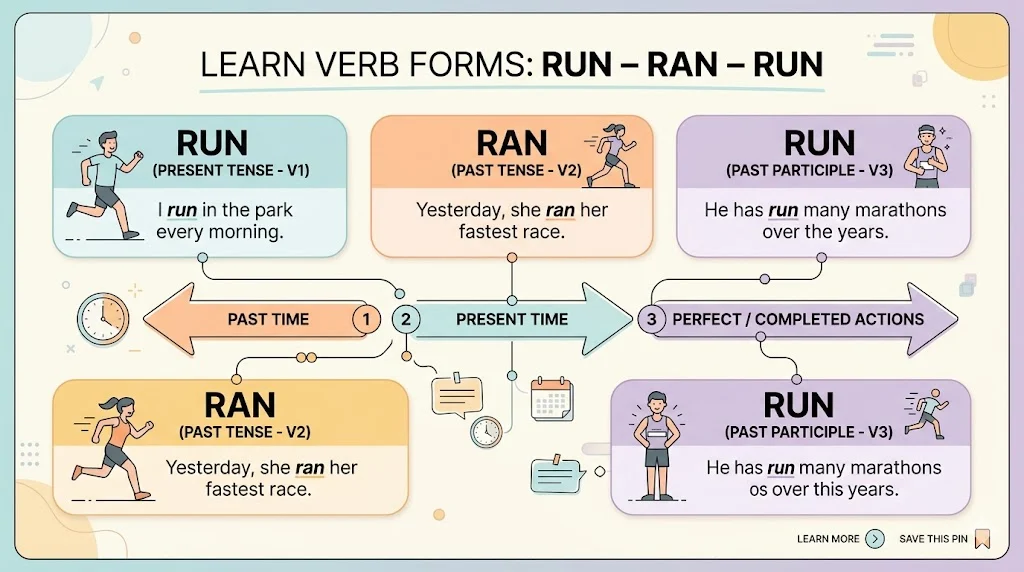
The past tense of “run” is “ran.” The past participle form is “run.”
- Example (past tense): I ran yesterday.
- Example (present perfect): I have run five miles.
If you’ve ever hesitated mid-sentence wondering whether it’s “I run yesterday” or “I ran yesterday,” you’re not alone. English verbs can be tricky especially irregular verbs like run, which don’t follow the usual “-ed” rule.
Understanding the past tense of “run” is essential for clear, correct communication whether you’re writing essays, sending emails, or just chatting casually. Let’s break it down in a simple, friendly, and practical way so you’ll never second-guess it again.
What Is the Past Tense of “Run”?
The verb “run” is an irregular verb, which means it doesn’t follow the standard pattern of adding “-ed” to form the past tense.
✅ Correct Forms:
- Base form (present): run
- Past tense: ran
- Past participle: run
Quick Overview Table
| Verb Form | Example Sentence | Usage Type |
| Present | I run every morning | Habit / routine |
| Past | I ran yesterday | Completed action |
| Past Participle | I have run many races | Perfect tenses |
| Present Participle | I am running right now | Continuous action |
Why “Run” Is Irregular
English has many irregular verbs inherited from Old English and Germanic roots, and “run” is one of them.
Instead of:
- ❌ runned (incorrect)
It becomes:
- ✅ ran (correct past tense)
👉 These irregular forms developed naturally over time and are still widely used today.
How to Use “Ran” Correctly (Past Tense)
Use “ran” when talking about something that happened in the past and is now completed.
💬 Examples:
- I ran five kilometers this morning.
- She ran to catch the bus.
- They ran a successful campaign last year.
👉 Tone: Neutral and factual
How to Use “Run” as a Past Participle
The past participle “run” is used with helping verbs like:
- has
- have
- had
💬 Examples:
- I have run this route before.
- She has run out of time.
- They had run the business for years.
👉 Notice: You never say “I have ran” ❌
Common Mistakes to Avoid
❌ Incorrect:
- I have ran five miles
- She run yesterday
- He runned fast
✅ Correct:
- I have run five miles
- She ran yesterday
- He ran fast
📊 Example Table: Correct vs Incorrect Usage
| Incorrect Sentence | Correct Sentence | Explanation |
| I have ran today | I have run today | Use past participle after “have” |
| She run yesterday | She ran yesterday | Use “ran” for past tense |
| He runned quickly | He ran quickly | “Runned” is not a real word |
Different Meanings of “Run” in Past Tense
The verb “run” has many meanings, and “ran” can apply to all of them.
🏃 1. Physical Movement
- I ran in the park.
💼 2. Managing Something
- She ran a company for 10 years.
⚙️ 3. Operating
- The machine ran smoothly.
🎬 4. Continuing or Extending
- The show ran for three seasons.
⚠️ 5. Escaping or Leaving Quickly
- He ran away from danger.
Tone and Context in Usage
While “ran” itself is neutral, the sentence tone changes meaning.
😊 Friendly:
- I ran into an old friend today!
😐 Neutral:
- He ran the program successfully.
😠 Negative:
- He ran away from responsibility.
Past Tense vs Past Participle: Key Difference
This is where many learners get confused.
🧠 Simple Rule:
- Ran → Simple past (no helping verb)
- Run → Used with has/have/had
Example Comparison:
| Sentence Type | Example |
| Past tense | I ran yesterday |
| Present perfect | I have run before |
| Past perfect | I had run earlier |
Run vs Similar Verbs (Comparison)
Let’s compare “run” with other verbs to make things clearer.
🔹 Run vs Walk
- Run → Ran
- Walk → Walked
👉 Walk is regular; run is irregular.
🔹 Run vs Go
- Run → Ran → Run
- Go → Went → Gone
👉 Both are irregular, but forms differ.
🔹 Run vs Jog
- Run → Ran
- Jog → Jogged
👉 Jog follows the standard “-ed” rule.
Alternate Uses of “Run” (Beyond Physical Action)
“Run” is one of the most versatile verbs in English.
📌 Other meanings:
- Run a business → manage
- Run a program → execute
- Run late → delayed
- Run out → finish something
💬 Examples:
- We ran out of milk.
- She ran the meeting professionally.
- The app ran perfectly.
Tips to Remember the Past Tense of Run
🧠 Easy memory tricks:
- Think: “Yesterday I ran.”
- Pair with time words: yesterday, last night, earlier
- Remember: No “-ed” ending
✅ Quick Rule:
If there’s no “have/has/had,” use ran
Real-Life Usage Scenarios
🧑🎓 Academic:
- The experiment ran successfully.
💼 Professional:
- She ran the project efficiently.
🧑🤝🧑 Casual:
- I ran into him at the mall.
Polite or Professional Alternatives
Depending on context, “ran” can sometimes be replaced with more formal verbs:
Instead of “ran a business”:
- Managed
- Operated
- Led
Instead of “ran quickly”:
- Moved swiftly
- Hurried
SEO Keywords & Variations Covered
- past tense of run
- what is the past tense of run
- run past tense and past participle
- ran vs run difference
- examples of ran in sentences
- irregular verb run
FAQs
1. What is the past tense of run?
The past tense of “run” is “ran.”
2. What is the past participle of run?
The past participle is “run.”
3. Is “runned” correct?
No, “runned” is incorrect.
4. Can I say “I have ran”?
No. The correct form is “I have run.”
5. Why is “run” irregular?
Because it comes from Old English and doesn’t follow standard verb rules.
6. What’s the difference between “ran” and “run”?
“Ran” is past tense; “run” is past participle.
7. Is “ran” used in formal writing?
Yes, it’s correct and appropriate in all contexts.
8. What are examples of “ran” in sentences?
- I ran home
- She ran a company
- They ran out of time
Conclusion
The verb “run” may seem simple, but its irregular forms can trip people up.
- Past tense = ran
- Past participle = run
- Never use “runned”
- Use “ran” for completed actions
When in doubt, remember this sentence:
👉 “Yesterday I ran. Today I have run.”
Once you lock that in, you’ll never get confused again.

Sophia Bennett is a professional writer focused on explaining word meanings, expressions and everyday language in a simple and engaging way.