
Last Updated on July 15, 2026
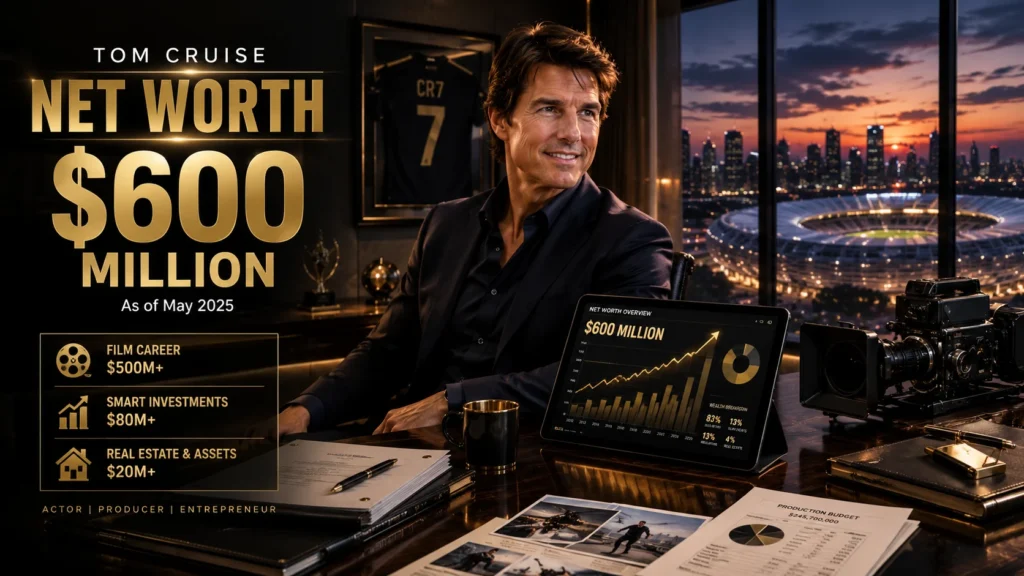
Tom Cruise’s net worth is estimated at $600 million in 2026, based on the latest widely cited public estimates and publicly reported career earnings. His wealth primarily comes from blockbuster acting fees, producer compensation, and powerful backend deals tied to films such as Top Gun: Maverick and Mission: Impossible. Estimates vary because Cruise’s private assets, liabilities, investment portfolio, and exact contract terms are not fully public.
Disclaimer: Net worth figures are estimates based on publicly available information and may vary.
Key Takeaways
| Category | Details |
|---|---|
| Estimated Net Worth | $600 million |
| Profession | Actor and film producer |
| Nationality | American |
| Primary Income Source | Film acting and producer compensation |
| Biggest Publicly Reported Wealth Driver | High-value movie compensation and backend participation |
| Industry | Film and entertainment |
| Years Active | 1981–present |
| Current Status | Alive and active in film |
The most commonly cited public estimate for Tom Cruise’s wealth is $600 million. That figure is an estimate, not a verified financial statement. Public reporting makes one point clear, however: Cruise built his fortune through an unusually powerful combination of global movie-star economics, producer leverage, and long-term ownership of his career decisions.
Why Readers Search This Topic
People search for Tom Cruise net worth because his financial story is different from that of a typical actor. Cruise isn’t simply a performer who collects a salary for appearing in a movie. Over four decades, he has repeatedly negotiated from a position of extraordinary box-office power.
That distinction matters.
A $20 million acting fee can make someone rich. But a star who can negotiate a lower upfront fee in exchange for first-dollar gross participation can potentially create a much larger financial outcome when a movie becomes a global hit. Variety reported that Cruise’s Mission: Impossible compensation structure included a relatively modest upfront fee alongside a significant percentage of first-dollar gross, while his Top Gun: Maverick earnings were estimated at more than $100 million from salary, ticket sales, and later entertainment revenue.
What Makes This Person Financially Significant
Tom Cruise is financially significant because he has effectively turned personal brand power into negotiating leverage.
His films have generated more than $10 billion worldwide according to his official biography, while the Mission: Impossible franchise alone has produced more than $3.5 billion in worldwide box-office revenue across the franchise’s history as presented by his official site.
The important financial lesson is not simply that Cruise made a lot of money. It is that he shifted from being paid like an actor to being compensated like a strategic participant in the economics of a film.
Biography
| Field | Details |
|---|---|
| Full Name | Thomas Cruise Mapother IV |
| Known As | Tom Cruise |
| Date of Birth | July 3, 1962 |
| Age in 2026 | 64 |
| Birthplace | Syracuse, New York, United States |
| Nationality | American |
| Occupation | Actor, film producer |
| Industry | Film and entertainment |
| Education | Publicly documented biography records schooling; no completed college degree is listed as a defining career credential |
| Years Active | 1981–present |
| Children | Three, according to widely documented public biographies |
| Known For | Top Gun, Mission: Impossible, Jerry Maguire, Rain Man |
| Official Website | Tom Cruise official website |
| Current Estimated Net Worth | $600 million |
| Current Status | Alive and active in film |
The Academy recognized Cruise with an Honorary Oscar at the 2025 Governors Awards, formally honoring his long-term contribution to cinema.
Early Life
Tom Cruise was born in Syracuse, New York, on July 3, 1962. His early life was not built around the Hollywood machinery that would later define his career. Public biographies describe a childhood marked by frequent family moves and financial difficulty.
He also faced dyslexia, a challenge that he has publicly discussed in the context of his education and early life. Rather than following a traditional academic path, Cruise became increasingly focused on performance and the possibility of becoming an actor.
That background matters financially because Cruise’s early career was built on skill development before wealth accumulation. There was no established family entertainment empire waiting for him. His first meaningful asset was his ability to create value on screen.
Career Beginning
Cruise made his screen debut in Endless Love in 1981, and the Golden Globes identifies the film as his first screen appearance at age 19.
His early career accelerated quickly. Risky Business gave him a major breakthrough, while Top Gun transformed him into a global movie star. From a financial perspective, the transition from promising young actor to bankable leading man was the first major inflection point in his wealth story.
Cruise was no longer selling only acting ability.
He was selling audience certainty.
That is one of the most valuable products in the film industry.
Tom Cruise Net Worth in 2026
Current Estimated Net Worth
Tom Cruise’s estimated net worth is $600 million in 2026.
The figure comes from the latest widely cited public estimate rather than an audited disclosure. Unlike a publicly traded company, Cruise does not publish a personal balance sheet showing his cash, property, investments, private companies, liabilities, and tax obligations. The estimate should therefore be viewed as a best-available public approximation.
Net worth figures are estimates based on publicly available information and may vary.
Why do Tom Cruise net worth estimates differ?
- Private financial information is not fully disclosed.
- Exact movie contracts are often confidential.
- Backend compensation can depend on complex studio accounting and contract milestones.
- Real estate values change over time.
- Taxes, liabilities, and private investments are not fully visible.
- Different websites use different estimation methods.
For that reason, a $600 million estimate is more defensible than presenting a precise number such as $601.4 million.
Major Wealth Sources
Cruise’s wealth is best understood as a stack of high-value income streams built over decades.
The major sources include:
- Film acting compensation
- Producer compensation
- Backend and gross participation
- Career leverage from major franchises
- Real estate transactions and asset ownership
- Long-term entertainment industry income
The most important distinction is that Cruise’s wealth appears to have been driven primarily by active entertainment income and contract economics, not by a publicly documented technology company, beverage brand, or massive stock portfolio.
That makes his financial model fundamentally different from the wealth model of a celebrity entrepreneur such as George Clooney, whose widely cited estimate is heavily associated with the Casamigos sale.
Net Worth Growth Timeline
Timeline Table
| Year | Major Career Event | Estimated Financial Impact |
|---|---|---|
| 1981 | Makes screen debut in Endless Love | Establishes professional acting income |
| 1983 | Risky Business breakthrough | Major increase in market value |
| 1986 | Top Gun becomes a global cultural hit | Creates long-term blockbuster-star premium |
| 1992 | Launches Cruise/Wagner Productions with Paula Wagner | Expands producer and ownership leverage |
| 1996 | Mission: Impossible begins | Creates a major franchise wealth engine |
| 2000s | Continues leading major studio films | Builds high-value salary and producer income |
| 2010s | Mission: Impossible becomes a global franchise | Strengthens negotiating power and backend potential |
| 2022 | Top Gun: Maverick becomes a massive global hit | Major reported financial windfall |
| 2025 | Receives Honorary Oscar | Reinforces long-term industry status and brand value |
| 2026 | Continues active film career and prepares for Digger | Maintains future earning potential |
What the Timeline Reveals
The biggest mistake in celebrity wealth analysis is to assume that wealth grows in a straight line.
Cruise’s financial trajectory appears more like a series of step changes.
The first step was becoming a recognizable actor. The second was becoming a bankable leading man. The third was gaining producer influence. The fourth was turning a successful franchise into a long-term financial platform.
The Mission: Impossible decision was especially important. Cruise did not merely accept the role of Ethan Hunt. He helped conceive the film adaptation and produced the first film, according to his official biography.
That move changed the economics of his career.
Income Sources
| Income Source | Estimated Contribution | Confidence Level |
|---|---|---|
| Film acting compensation | Major lifetime wealth driver | High |
| Backend/gross participation | Potentially very significant | High |
| Producer compensation | Significant but exact totals undisclosed | High |
| Franchise compensation | Major | High |
| Real estate gains | Material but secondary | Medium |
| Private investment portfolio | Not publicly disclosed | Low |
| Brand partnerships | Not a major publicly documented wealth source | Low |
| Speaking engagements | No major public evidence of a significant income stream | Low |
Primary Career Income
Acting has been the foundation of Cruise’s wealth.
His career spans more than 40 years, and his official site lists an extensive filmography ranging from Taps and The Outsiders to Top Gun: Maverick and the Mission: Impossible series.
The financial significance of longevity is often underestimated.
An actor can earn $20 million once. Cruise has spent decades repeatedly operating at the top end of the movie-star market.
Business Ownership
Cruise’s most important business strategy has been his involvement in film production.
Cruise/Wagner Productions was created in 1992 with Paula Wagner. The company was designed to give Cruise greater creative freedom and production influence.
Although the partnership later ended, the strategic lesson is clear: Cruise moved closer to the ownership side of the filmmaking process.
That is usually where the most valuable economic leverage exists.
Equity Holdings
There is no comprehensive public disclosure of a personal stock portfolio or major publicly traded equity holdings that can responsibly be assigned a specific value.
Therefore, claims that Cruise owns a particular amount of stock should be treated cautiously unless supported by a verifiable public filing.
Investments
Publicly documented information does not provide a complete picture of Tom Cruise’s investment portfolio.
That is an important limitation.
A net worth article should not automatically turn every celebrity into an alleged venture capitalist. Available information strongly supports Cruise’s entertainment career as the central engine of his wealth. His private investment activity is much less transparent.
Royalties & Licensing
Cruise’s long-term film catalog and entertainment contracts can create continuing revenue through home entertainment and other distribution channels.
However, exact royalty and licensing income has not been publicly disclosed in a comprehensive way.
Brand Partnerships
Cruise has historically been less dependent on conventional celebrity endorsement economics than many other stars.
His brand has primarily been monetized through film projects, production influence, and box-office leverage.
Speaking Engagements
There is no reliable public evidence that speaking engagements represent a material part of Cruise’s wealth.
For this reason, it would be misleading to assign a major contribution to this category.
Passive Income
Cruise may receive continuing income from past entertainment work and asset ownership, but the exact level of passive income is not publicly available.
The safest conclusion is that passive income exists as a possibility within his long career, but it is not separately quantifiable from public information.
Business Strategy Behind the Wealth
Business Model
Tom Cruise’s wealth model is best described as star-powered entertainment ownership and revenue participation.
The traditional actor model is simple:
Work on a film → receive a fee → move to the next film.
Cruise’s model became more sophisticated:
Build audience trust → create franchise value → negotiate from leverage → participate in the economics of the production.
This is why his financial story is more interesting than a list of movie salaries.
Variety’s reporting on Cruise’s Mission: Impossible and Top Gun: Maverick deals shows the importance of backend economics. In a conventional salary arrangement, the actor’s upside is limited. In a gross-participation arrangement, a blockbuster can materially change the financial outcome.
Competitive Advantage
Cruise’s biggest competitive advantage is brand reliability.
He has spent decades building a reputation for:
- Global recognition
- Physical commitment to action roles
- Consistent promotional effort
- Strong franchise association
- Long-term audience familiarity
The business value of that reputation is enormous.
A studio may spend hundreds of millions of dollars on production and marketing. In that environment, the perceived ability of a star to help attract audiences can become a significant negotiating asset.
Cruise’s decision to champion theatrical moviegoing also reinforced his positioning as a cinema-first star. The Academy specifically recognized his contribution to filmmaking and his long career when it honored him at the 2025 Governors Awards.
The strategic weakness is equally clear: this model depends heavily on continued audience demand for expensive theatrical films.
Assets & Investments
Real Estate
Tom Cruise has owned some of the most expensive real estate associated with a Hollywood star.
His former Telluride ranch sold for $39.5 million in 2021. The 320-acre Colorado property included a roughly 10,000-square-foot home and had previously been quietly marketed at a much higher price.
Cruise also sold his Beverly Hills compound for a reported $40 million in 2016. The property had been purchased for $30.5 million in 2007.
These transactions illustrate two important points.
First, Cruise has historically held significant luxury real estate.
Second, real estate sale prices should not automatically be added to net worth. The sale price is gross transaction value, not profit. Taxes, transaction costs, original purchase prices, and other financial factors matter.
Vehicles
Cruise is widely associated with aviation and high-performance action filmmaking, but a complete, verified list of his personal vehicle assets and their current values is not publicly disclosed.
Accordingly, this article does not assign a speculative dollar figure to a private vehicle collection.
Investment Portfolio
No comprehensive public investment portfolio is available.
Claims about specific stocks, private equity positions, or venture investments should be treated as unverified unless supported by reliable public documentation.
Private Businesses
Cruise’s production involvement is publicly documented. His production career includes Cruise/Wagner Productions, and the United Kingdom’s Companies House records an active T C Productions Ltd company classified under performing arts.
The existence of a company, however, does not reveal Tom Cruise’s personal net worth or the value of every associated asset.
Luxury Assets
Cruise’s publicly reported luxury real estate is the clearest asset category that can be analyzed with confidence.
Beyond that, the value of privately held luxury goods has not been comprehensively disclosed.
Financial Analysis
Revenue Quality
Cruise’s income has historically had high earning power but uneven timing.
Film compensation is not like a salary paid every two weeks. It can arrive in large, irregular amounts tied to production schedules, releases, and contract structures.
That creates a different financial profile.
The upside is enormous.
The risk is concentration.
Cruise’s financial engine remains closely connected to the film industry and his ability to command premium compensation.
Cash Flow Stability
His long career provides a degree of financial stability that younger actors cannot match.
Cruise has accumulated decades of earning history and asset ownership. Yet the exact cash-flow profile of his personal finances is not publicly disclosed.
The more accurate analysis is that Cruise possesses career stability, not necessarily publicly measurable annual cash-flow stability.
Business Sustainability
The sustainability of his wealth model is strong because Cruise has diversified within entertainment.
He is not dependent on one movie.
He has acted, produced, built franchises, and maintained a global brand.
The major question is whether the economics of theatrical filmmaking continue to support the type of enormous backend participation that helped define his peak earning years.
Competitive Positioning
Cruise occupies an unusual position in Hollywood.
He is not simply a famous actor. He is a legacy brand with current commercial relevance.
The success of Top Gun: Maverick demonstrated that Cruise’s market value could still expand dramatically decades after Top Gun. Meanwhile, Mission: Impossible – The Final Reckoning finished with approximately $591.4 million worldwide, according to The Numbers.
That performance was below the franchise’s earlier highs, but it still shows the scale of the property attached to Cruise’s name.
Long-Term Wealth Potential
Cruise’s future wealth potential depends less on whether he earns another $100 million movie payday and more on how he manages the next stage of his career.
If he continues producing high-value films and secures strong backend economics, his net worth could rise.
If he shifts toward fewer films, more production control, or selective prestige projects, his annual income could become less predictable while his career brand remains valuable.
Market Risks
The largest risk is industry economics.
The Mission: Impossible franchise illustrates the problem. The Final Reckoning had a reported $400 million production budget and generated approximately $591 million worldwide, according to The Numbers.
Box office gross is not the same as profit.
The studio must account for production costs, marketing, distribution, and theater economics.
For a star with major backend participation, the financial outcome of a film can become closely linked to the economics of the production itself.
Net Worth Comparison
The following comparison uses publicly cited estimates from the same celebrity-net-worth data source for consistency. These are not audited financial statements.
| Person | Profession | Estimated Net Worth | Difference vs. Tom Cruise |
|---|---|---|---|
| Tom Cruise | Actor/Producer | $600M | – |
| George Clooney | Actor/Producer/Entrepreneur | $500M | Cruise estimated $100M higher |
| Brad Pitt | Actor/Producer | $400M | Cruise estimated $200M higher |
| Will Smith | Actor/Producer/Musician | $350M | Cruise estimated $250M higher |
Why the Differences Exist
The comparison highlights a key financial principle: Hollywood fame does not produce identical wealth outcomes.
George Clooney’s estimate is heavily influenced by his business success with Casamigos, while Brad Pitt’s wealth model includes acting and production. Will Smith’s career spans music, television, film, and production.
Cruise’s model is more concentrated in high-value film economics and long-term superstar leverage.
Challenges & Financial Risks
High-Cost Film Economics
The most visible risk is the cost of modern blockbuster filmmaking.
The Mission: Impossible franchise has produced enormous box-office revenue, but recent films also demonstrate how large production budgets can create financial pressure. The Final Reckoning was listed with a $400 million production budget by The Numbers.
Franchise Dependence
Cruise’s wealth is not dependent on a single franchise, but Mission: Impossible remains a major part of his professional identity.
Franchise fatigue, rising production costs, and changing audience behavior are all legitimate industry risks.
Private Financial Opacity
Another challenge for financial analysts is the lack of a public personal balance sheet.
That means outside observers cannot reliably calculate:
- Cruise’s cash reserves
- Total liabilities
- Private investments
- Tax exposure
- Exact annual income
This is precisely why net worth estimates should be presented as estimates.
Career Concentration
Cruise’s wealth is highly connected to his personal brand.
That is a strength, but it is also a concentration risk.
The financial value of the brand depends on continued audience interest and the ability to deliver commercially relevant films.
Philanthropy
Tom Cruise’s official biography highlights his work with Mentor LA and his recognition with the Simon Wiesenthal Humanitarian Award in 2011. It also describes his advocacy and philanthropic involvement in areas including health, education, and human rights.
Publicly available information does not provide a complete, audited total of Cruise’s lifetime charitable giving.
That distinction is important.
Celebrity philanthropy is often discussed in broad terms, but donation totals should not be invented simply because a star has received humanitarian recognition.
From a brand perspective, philanthropy can strengthen public perception by reinforcing an image of social contribution beyond commercial entertainment. For a celebrity whose wealth is closely connected to personal brand value, that reputation can have long-term importance.
Future Net Worth Projection
Growth Drivers
Tom Cruise’s net worth could continue rising if:
- He maintains premium acting compensation.
- He secures backend participation in successful films.
- He expands his producer role.
- His upcoming projects perform strongly.
- He continues to monetize his long-established global brand.
His next major public project is Digger, an Alejandro González Iñárritu film scheduled for theatrical release on October 2, 2026. Associated reporting describes the film as a major departure from Cruise’s recent franchise-heavy work.
Potential Risks
The key risks are:
- Very high production costs
- Theatrical market volatility
- Changing streaming economics
- Fewer major films per year
- Reduced leverage if a franchise underperforms
Long-Term Outlook
My base-case view is moderate long-term growth rather than an explosive increase.
Cruise has already built a substantial fortune. The question is no longer whether he can become wealthy. It is whether he can continue converting his brand into ownership and premium participation as the film business changes.
A reasonable financial analysis does not support an aggressive prediction that he will suddenly become a billionaire.
However, a stable or gradually rising net worth remains plausible if he continues to make carefully selected films and maintains strong producer-level leverage.
Interesting Financial Facts
- Cruise’s most important financial asset may be his negotiating leverage, not a publicly known stock portfolio.
- Variety reported that his Mission: Impossible deals used a lower upfront fee alongside significant first-dollar gross participation.
- His Telluride ranch sold for $39.5 million in 2021 after being privately marketed at a much higher price years earlier.
- Cruise’s official biography says the Mission: Impossible franchise was his idea for a film adaptation of the classic television series.
- He received his first Honorary Oscar in 2025 after four competitive Academy Award nominations.
- Cruise’s wealth is unusually concentrated in entertainment economics rather than a publicly documented consumer brand empire.
- The $600 million estimate should not be confused with liquid cash. Net worth includes the estimated value of assets minus liabilities.
- His career shows why a movie star can sometimes earn more from contract structure than from the headline salary.
Frequently Asked Questions
What is Tom Cruise’s net worth in 2026?
Tom Cruise’s net worth is estimated at $600 million in 2026. The figure is based on publicly available information and widely cited public estimates. It is not an audited personal financial statement.
How did Tom Cruise become so rich?
Tom Cruise built his wealth primarily through film acting, producer compensation, and powerful backend deals. His long career and major franchises helped him negotiate from an unusually strong position.
How much did Tom Cruise make from Top Gun: Maverick?
Variety reported that Cruise was estimated to earn $100 million or more from Top Gun: Maverick through salary, ticket-sale participation, and later home entertainment and streaming-related revenue.
Is Tom Cruise a billionaire?
No. Publicly available estimates place Tom Cruise’s net worth at approximately $600 million, not $1 billion.
What is Tom Cruise’s biggest source of income?
His biggest publicly supported wealth source is film compensation, including acting and producer-related earnings. Backend participation has also been a major part of his reported deal structure.
Does Tom Cruise own a production company?
Tom Cruise has had significant involvement in film production. He co-founded Cruise/Wagner Productions with Paula Wagner in 1992, and his production career has been an important part of his business strategy.
What happened to Tom Cruise’s Telluride ranch?
Cruise sold his 320-acre Telluride ranch for $39.5 million in 2021.
Is Tom Cruise still acting in 2026?
Yes. Cruise remains active in film. He is attached to Digger, a new project directed by Alejandro González Iñárritu and scheduled for theatrical release in October 2026.
Conclusion
Tom Cruise net worth is estimated at $600 million in 2026, but the number itself only tells part of the story.
The deeper financial lesson is how Cruise built his fortune. He combined decades of acting income with producer influence, franchise ownership instincts, and contract structures that gave him access to the upside of successful films.
His real financial advantage has been leverage.
From Top Gun to Mission: Impossible, Cruise repeatedly converted audience trust into negotiating power. His future wealth will likely depend on whether he can continue doing the same as Hollywood moves through an increasingly expensive and uncertain era.
For now, the evidence supports a balanced conclusion: Tom Cruise is one of the most financially successful actors in entertainment history, and his estimated $600 million fortune remains closely tied to the same asset that created it his extraordinary global value as a movie star and filmmaker.

George Hall is an enthusiastic blogger at ReplyTix.com, recognized for creating clear, engaging and informative content. He shares practical insights and valuable knowledge to keep readers informed and motivated.