
Last Updated on June 16, 2026
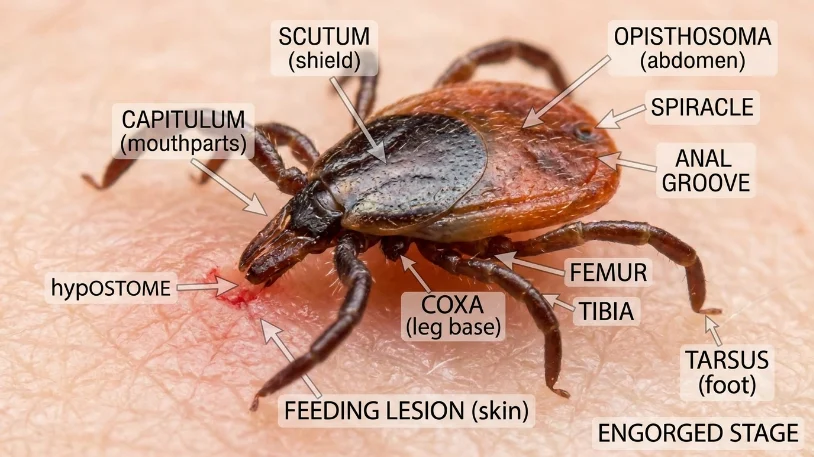
A tick is a small, oval-shaped parasitic arachnid with eight legs, no wings, and a flat body that swells after feeding. Its color ranges from brown and black to reddish, and its size varies from a tiny poppy seed (larva) to a large, gray, engorged parasite. Ticks attach firmly to skin and often appear as raised, dark spots.
Ticks are small, quiet hitchhikers. You won’t hear them buzz. You won’t feel them crawl. Yet once you spot one, the question hits fast: what does a tick look like?
This guide answers that clearly. You’ll learn how to recognize a tick in seconds, how its appearance changes over time, and how to avoid confusing it with other bugs. By the end, you won’t second-guess what you’re seeing.
What Does a Tick Look Like at First Glance
A tick doesn’t look like what most people expect. Many assume it resembles a typical insect. It doesn’t.
Instead, you’ll notice a compact, oval body paired with tiny legs clustered near the front. Its body sits low and close to the surface. No wings. No antennae. Just a slow-moving parasite designed to latch on.
At a glance, here’s what stands out:
- Shape: Oval and flattened
- Body: Smooth, slightly leathery
- Legs: Eight (adult stage)
- Movement: Slow crawl, no jumping or flying
- Size: Often extremely small
Think of a tick as a living drop of dark gel with legs. That mental image sticks because it’s surprisingly accurate.
Tick Appearance Breakdown: Size, Shape, and Structure
Body Shape: Flat Before Feeding, Swollen After
A tick’s body transforms dramatically. Before feeding, it looks flat and compact. After feeding, it balloons.
- Unfed tick: Flat, thin, almost paper-like
- Feeding tick: Slightly rounded
- Engorged tick: Bulging, stretched, almost spherical
This change happens because the tick fills itself with blood.
Visual analogy: Imagine a raisin turning into a grape. That’s how drastic the transformation can be.
Tick Size and Shape: From Invisible to Obvious
Ticks don’t stay one size. Their growth stages make identification tricky.
| Life Stage | Size Comparison | Visibility |
|---|---|---|
| Larva | Poppy seed | Hard to see |
| Nymph | Sesame seed | Very small |
| Adult | Apple seed | Noticeable |
| Engorged | Pea-sized or larger | Very visible |
Many people miss ticks because they expect something bigger.
Tick Color: Brown, Black, Red, and Gray
Tick color shifts depending on species and feeding status.
Common colors include:
- Dark brown or black – most common
- Reddish-brown – especially in females
- Light brown or tan – younger ticks
- Gray or bluish – engorged ticks
Color alone won’t confirm a tick, but it helps narrow things down.
Tick Characteristics That Make Identification Easy
You don’t need a microscope. You just need to know what to look for.
Key Tick Identification Traits
- Eight legs (not six like insects)
- No wings or antennae
- Flattened oval body
- Slow movement
- Firm attachment to skin
These traits separate ticks from nearly every other bug.
Tick Legs: How Many and Why It Matters
Ticks belong to the arachnid family. That includes spiders.
So they have:
- Eight legs (adults and nymphs)
- Six legs (larval stage only)
This detail matters more than you think. Many people misidentify ticks because they assume all small bugs have six legs.
Tick Life Stages and Appearance Differences
Ticks go through four life stages. Each stage looks slightly different.
Tick Larvae (Seed Ticks)
These are the smallest and most overlooked.
- Size of a poppy seed
- Only six legs
- Pale or light brown
- Often cluster together
They’re easy to miss until it’s too late.
Tick Nymphs: The Most Dangerous Stage
Nymphs are small but fully capable of biting.
- Eight legs
- Slightly larger than larvae
- Hard to detect on skin
- Responsible for many disease transmissions
Because they’re tiny, people rarely notice them.
Adult Ticks: Easier to Identify
Adults are larger and more visible.
- Clear body structure
- Distinct coloration
- More noticeable movement
You’re more likely to spot these before they attach.
Common Tick Species and Their Appearance
Different species have unique markings. Knowing them helps.
Deer Tick Appearance (Blacklegged Tick)
- Dark legs
- Reddish-orange body (female)
- Small size
Often linked with disease transmission.
Dog Tick vs Deer Tick
| Feature | Dog Tick | Deer Tick |
|---|---|---|
| Color | Brown with markings | Dark with red tones |
| Size | Larger | Smaller |
| Markings | White or silver patterns | Minimal |
Lone Star Tick
- Female has a white dot on its back
- Brown body
- Easy to recognize
Brown Dog Tick
- Uniform reddish-brown color
- No distinctive markings
What Does a Tick Look Like on Human Skin
Ticks don’t just sit on your skin. They embed themselves.
When attached, you’ll see:
- A small dark or gray bump
- Legs visible near the surface
- Slight swelling around the bite
Sometimes it looks like a tiny mole. Other times, like a scab that doesn’t belong.
Where Ticks Are Found on the Body
Ticks prefer hidden, warm areas.
Common spots include:
- Behind ears
- Hairline
- Armpits
- Behind knees
- Groin area
Check these areas carefully after outdoor exposure.
Engorged Tick: What It Looks Like After Feeding
An engorged tick looks completely different.
- Enlarged body
- Pale gray or bluish color
- Smooth, swollen surface
It may look like a small balloon attached to the skin.
Key fact: An engorged tick can grow up to 10 times its original size.
Tick vs Bed Bug: Key Differences
Ticks get confused with bed bugs all the time.
| Feature | Tick | Bed Bug |
|---|---|---|
| Legs | 8 | 6 |
| Shape | Rounded | Flat |
| Movement | Slow crawl | Faster |
| Attachment | Stays attached | Doesn’t stay attached |
Tick vs Flea Appearance
Fleas behave very differently.
- Fleas jump
- Ticks crawl
| Feature | Tick | Flea |
|---|---|---|
| Movement | Crawling | Jumping |
| Body | Oval | Narrow |
| Legs | 8 | 6 |
Tick vs Spider: Why People Get Confused
Both have eight legs. That’s where the similarity ends.
- Spiders have distinct body segments
- Ticks have a fused, compact body
Tick Bite Marks vs Tick Bug Appearance
A bite mark doesn’t always show immediately.
Possible signs:
- Small red bump
- Mild irritation
- Sometimes no visible mark
But if the tick remains attached, you’ll see the insect itself.
How Small Are Ticks Really
Ticks can be shockingly small.
- Larvae: barely visible
- Nymphs: look like dust specks
- Adults: still easy to miss
That’s why regular skin checks matter.
What Do Ticks Look Like Up Close
Under magnification, ticks look almost alien.
- Mouthparts extend forward
- Legs cluster tightly
- Body appears rubbery
You’ll see how specialized they are for feeding.
Ticks in Grass Identification
Ticks don’t fly or jump. They wait.
They climb:
- Grass blades
- Low shrubs
- Leaf litter
Then they latch onto passing hosts.
Hard Tick vs Soft Tick Appearance
Not all ticks look the same.
Hard Ticks
- Have a rigid outer shell
- Visible plate near the head
- Stay attached longer
Soft Ticks
- Lack hard shell
- More wrinkled appearance
- Feed quickly
Why Tick Identification Matters
Correct identification isn’t just about curiosity.
It helps you:
- React quickly
- Reduce risk
- Avoid panic
Misidentifying a tick can delay action.
What to Do If You Find a Tick
Stay calm and act carefully.
Basic Removal Steps
- Use fine-tipped tweezers
- Grip close to skin
- Pull upward steadily
Avoid These Mistakes
- Don’t twist
- Don’t burn it
- Don’t crush it
Frequently Asked Questions
Can ticks be too small to see?
Yes. Larvae and nymphs are extremely tiny.
Do ticks look different after feeding?
Yes. They swell and change color.
Are all ticks visible?
Not always. Early stages can go unnoticed.
Do ticks always stay attached?
No. They detach after feeding.
Final Thoughts
Ticks don’t announce themselves. They rely on stealth.
But once you know what a tick looks like, everything changes. You’ll notice the shape. The legs. The slow movement. The unnatural bump on skin.
That awareness gives you an edge. And in this case, that edge matters.

Michael Anderson is a content writer specializing in word meanings, definitions and clear explanations of modern terms and phrases.