
Last Updated on May 18, 2026
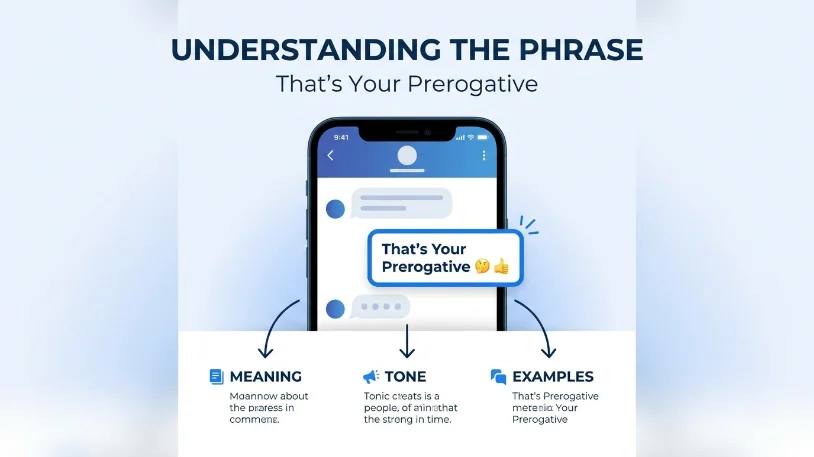
“Prerogative” in text means a person’s right, privilege, freedom, or authority to make a decision or act in a certain way. It is often used to acknowledge that someone has the power to choose, even if the speaker disagrees with the choice.
Simple Example:
- “If you want to leave early, that’s your prerogative.”
This means:
- You have the right to decide for yourself.
The tone can be:
- Respectful
- Neutral
- Slightly dismissive
- Professional
- Sarcastic (depending on wording and punctuation)
Have you ever received a message that said, “It’s your prerogative” and wondered whether it sounded respectful, passive-aggressive, or dismissive? You’re not alone. The word prerogative appears in texts, emails, social media posts, and workplace conversations more often than many people realize. Depending on the tone and context, it can sound empowering, neutral, formal, or even slightly cold.
In modern communication, understanding what “prerogative” means in text can help you avoid misunderstandings and communicate more effectively especially in professional or emotionally sensitive conversations.
What Does “Prerogative” Really Mean?
The word prerogative refers to a special right, privilege, or authority held by someone. In texting and casual communication, it usually points to a person’s freedom to make their own choice.
Basic Breakdown:
| Word | Meaning |
|---|---|
| Prerogative | A right or privilege to decide or act |
| Common Use | Acknowledging someone’s choice |
| Tone Depends On | Context, punctuation, relationship |
Everyday Interpretation:
When someone says:
- “That’s your prerogative.”
They often mean:
- “You can do what you want.”
- “It’s your decision.”
- “I can’t stop you.”
- “That’s up to you.”
Origin of the Word “Prerogative”
The term comes from the Latin word praerogativa, which originally referred to a privileged vote in ancient Roman assemblies.
Over time, the meaning evolved into:
- a special right,
- an exclusive privilege,
- or authority granted to a person or group.
Historically, the term was commonly associated with:
- kings and queens,
- governments,
- legal authority,
- executive powers.
Today, however, it is widely used in everyday speech and texting.
Historical Example:
- “The king exercised his royal prerogative.”
Modern Example:
- “You don’t have to come if you don’t want to that’s your prerogative.”
Why Is “Prerogative” Popular in Text Conversations?
The word has become increasingly common because it:
- sounds intelligent and formal,
- avoids direct confrontation,
- acknowledges personal choice,
- creates emotional distance when needed.
People often use it in:
- workplace chats,
- relationship discussions,
- debates,
- social media comments,
- parenting conversations,
- customer service interactions.
It’s especially common when someone wants to avoid arguing while still making their opinion clear.
How “Prerogative” Is Used in Text Messages
The exact meaning changes depending on tone, punctuation, and context.
1. Neutral Tone
This is the most straightforward use.
Example:
- “If you prefer another option, that’s your prerogative.”
Meaning:
- The speaker respects the other person’s choice.
Tone:
✅ Calm
✅ Respectful
✅ Professional
2. Friendly or Supportive Tone
Sometimes the word is used warmly to encourage independence.
Example:
- “Hey, if taking a break helps you, that’s totally your prerogative 😊”
Meaning:
- The speaker supports the decision.
Tone:
✅ Encouraging
✅ Friendly
✅ Open-minded
3. Dismissive or Passive-Aggressive Tone
This is where confusion often happens.
Example:
- “Well, that’s your prerogative.”
Meaning:
- “I disagree, but do whatever you want.”
Tone:
⚠️ Cold
⚠️ Slightly annoyed
⚠️ Passive-aggressive
Punctuation and wording heavily influence interpretation.
Compare these:
- “That’s your prerogative 😊” → friendly
- “That’s your prerogative.” → neutral
- “That’s YOUR prerogative.” → confrontational
Example Table: “Prerogative” in Different Contexts
Labeled Usage Examples
| Text ExampleToneIntended Meaning | ||
|---|---|---|
| “It’s your prerogative.” | Neutral | Your choice |
| “That’s totally your prerogative 😊” | Friendly | I support your decision |
| “Well, that’s your prerogative.” | Dismissive | I disagree but won’t argue |
| “Employees have the prerogative to work remotely.” | Professional | Employees have the right |
| “As manager, it’s her prerogative.” | Formal | She has authority |
| “Ignore my advice if you want that’s your prerogative.” | Slightly negative | Your choice, but not recommended |
Is “Prerogative” Formal or Informal?
The word itself is somewhat formal, but people still use it casually in texting and conversation.
Formal Usage
Common in:
- business communication,
- legal discussions,
- workplace emails,
- official statements.
Example:
- “It is within your prerogative to decline the offer.”
Informal Usage
Common in:
- texts,
- social media,
- casual arguments,
- relationship discussions.
Example:
- “You wanna skip the party? Your prerogative lol.”
Tone Analysis: How Context Changes Meaning
One fascinating thing about this word is how much emotional tone it can carry.
Positive Tone Indicators
These make “prerogative” sound supportive:
- emojis 😊
- soft wording
- phrases like “totally” or “absolutely”
Example:
- “That’s absolutely your prerogative!”
Negative Tone Indicators
These make it sound cold or sarcastic:
- periods after short sentences,
- capital letters,
- “well” at the beginning,
- eye-roll emojis 🙄
Example:
- “Well, that’s your prerogative.”
This often signals disagreement.
Real-World Usage of “Prerogative”
In Relationships
People use it when discussing personal decisions.
Example:
- “If you need space, that’s your prerogative.”
This can sound:
- understanding,
- hurt,
- or emotionally distant.
In the Workplace
Managers and coworkers use it professionally.
Example:
- “It’s your prerogative whether you accept the promotion.”
Meaning:
- The final decision belongs to you.
On Social Media
The word often appears in debates or controversial discussions.
Example:
- “Believe what you want that’s your prerogative.”
This can sound:
- respectful,
- dismissive,
- or argumentative.
Comparison: Prerogative vs Similar Words
Many people confuse “prerogative” with related terms.
Comparison Table
| Word | Meaning | Difference |
|---|---|---|
| Prerogative | A right or privilege | Often emphasizes authority or personal choice |
| Choice | Selection between options | More casual and broad |
| Right | Legal or moral entitlement | Stronger legal implication |
| Privilege | Special advantage | May imply exclusivity |
| Authority | Power to command | Focuses on control |
| Discretion | Freedom to decide responsibly | Often used professionally |
“Prerogative” vs “Choice”
These terms overlap but are not identical.
Choice
- Simple decision-making.
Prerogative
- Implies rightful authority or entitlement.
Example:
- “You have a choice.” → neutral
- “It’s your prerogative.” → more formal and authoritative
Professional Alternatives to “That’s Your Prerogative”
Sometimes “prerogative” sounds too stiff or passive-aggressive. Here are softer alternatives.
Polite Alternatives
| Alternative Phrase | Tone |
|---|---|
| “It’s your decision.” | Neutral |
| “That’s up to you.” | Casual |
| “You’re free to decide.” | Professional |
| “I respect your choice.” | Warm |
| “You have every right to choose.” | Supportive |
| “The decision is yours.” | Formal |
| “I understand your perspective.” | Diplomatic |
When NOT to Use “Prerogative”
Avoid using it when:
- emotions are already tense,
- clarity matters more than formality,
- the other person may perceive coldness,
- casual audiences may not understand the word.
Risky Example
- “If that’s what you want, it’s your prerogative.”
This may sound:
- irritated,
- detached,
- passive-aggressive.
Alternate Meanings of “Prerogative”
While everyday texting usually focuses on personal choice, the word also has specialized meanings.
1. Legal Meaning
Refers to official powers held by governments or rulers.
Example:
- “Executive prerogative.”
2. Historical Meaning
Associated with monarchies and royal authority.
Example:
- “Royal prerogative powers.”
3. Workplace Authority
Used to describe managerial rights.
Example:
- “Hiring decisions are management’s prerogative.”
Common Misunderstandings About “Prerogative”
Misunderstanding #1: It Always Sounds Rude
Not true. Tone and context matter.
Misunderstanding #2: It Means “Permission”
Not exactly. It means someone already has the right.
Misunderstanding #3: It’s Only Formal
Modern texting has made it more conversational.
Keyword Variations Naturally Related to “Define Prerogative in Text”
These related phrases often appear in searches:
- what does prerogative mean in text
- prerogative meaning in chat
- your prerogative meaning
- prerogative definition slang
- what does that’s your prerogative mean
- prerogative tone meaning
- define prerogative in texting
- prerogative examples
Using these variations helps readers better understand the concept from multiple angles.
How to Respond When Someone Says “That’s Your Prerogative”
Your response depends on tone and context.
Friendly Response
- “Thanks for understanding!”
Clarifying Response
- “Do you disagree with my decision?”
Professional Response
- “I appreciate your perspective.”
Calm Response to Passive Aggression
- “I understand we see things differently.”
Frequently Asked Questions
1. What does “prerogative” mean in text?
In text, “prerogative” means someone has the right or authority to make their own choice or decision.
2. Is “that’s your prerogative” rude?
Not always. It can be neutral, respectful, or passive-aggressive depending on tone, punctuation, and context.
3. What is a simple definition of prerogative?
A prerogative is a special right, privilege, or freedom to decide something.
4. Is “prerogative” a formal word?
Yes, it is somewhat formal, but many people use it casually in texting and everyday conversation.
5. What’s another word for prerogative?
Common alternatives include:
- right,
- choice,
- privilege,
- authority,
- discretion.
6. Why do people say “that’s your prerogative”?
People use the phrase to acknowledge another person’s decision-making power, often while expressing emotional distance or disagreement.
7. Can “prerogative” sound passive-aggressive?
Yes. Short replies like:
- “That’s your prerogative.”
can sound dismissive if delivered coldly or during conflict.
8. How do you use “prerogative” in a sentence?
Examples:
- “It’s your prerogative whether you attend the meeting.”
- “Parents have the prerogative to set household rules.”
- “You can disagree that’s your prerogative.”
Practical Tips for Using “Prerogative” Correctly
Use It When:
✅ discussing personal choice
✅ speaking professionally
✅ acknowledging authority
✅ avoiding direct confrontation politely
Avoid It When:
❌ emotions are high
❌ you want a warm tone
❌ simplicity is better
❌ the audience may not know the word
Conclusion
Understanding how to define “prerogative” in text can dramatically improve communication. While the word simply refers to someone’s right or authority to make a choice, its emotional tone changes depending on context, punctuation, and delivery.
In friendly conversations, it can sound respectful and supportive. In tense discussions, however, it may feel passive-aggressive or emotionally distant. That’s why paying attention to tone is just as important as understanding the dictionary definition.
Whether you’re texting friends, responding professionally at work, or navigating social media debates, knowing how “prerogative” works in modern communication helps you interpret messages more accurately and choose your own words more carefully.
The next time someone says:
- “That’s your prerogative,”
you’ll know exactly what they might mean and how to respond appropriately.

Michael Anderson is a content writer specializing in word meanings, definitions and clear explanations of modern terms and phrases.