Last Updated on May 15, 2026
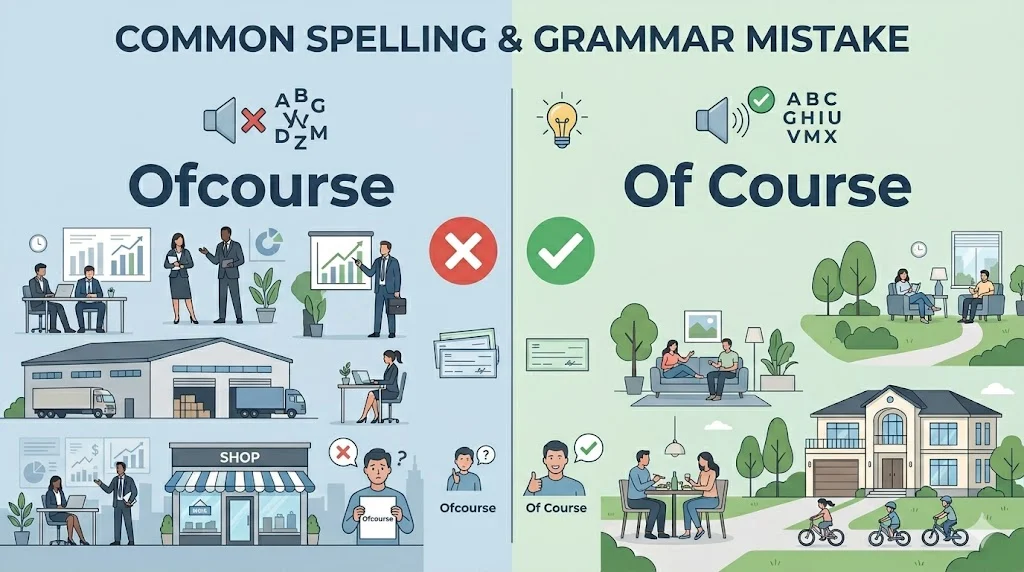
“Of course” is the correct and standard English phrase used to express agreement, confirmation, or something that is expected. “Ofcourse” (one word) is an informal, non-standard spelling commonly used in casual texting but not accepted in formal writing.
Ever found yourself typing “ofcourse” in a message and wondering is this actually correct, or should it be “of course”? You’re not alone. This is one of the most common writing and grammar confusions in everyday English, especially in texting and social media.
The good news? The answer is simple but the usage is where things get interesting.
In this complete guide, we’ll break down “ofcourse or of course”, explain which one is correct, how tone changes meaning, and when each form is appropriate (or not).
Quick Answer: Ofcourse or Of Course?
✔ Correct: Of course
❌ Incorrect (formal English): Ofcourse
👉 However:
- “Ofcourse” is widely used in informal texting
- It’s accepted casually but not grammatically correct
What Does “Of Course” Mean?
The phrase “of course” is used to express:
- Agreement (“yes”)
- Certainty (“definitely”)
- Something obvious or expected
💬 Simple Examples:
- “Can you help me?” → “Of course!”
- “Are you coming?” → “Of course I am.”
- “That’s obvious.” → “Of course it is.”
Origin of “Of Course”
The phrase comes from traditional English usage, where:
- “Of” = relating to
- “Course” = natural order or flow
👉 Combined meaning:
Something that follows naturally or is expected
📜 Historical Use:
- Used in formal English for centuries
- Common in literature, speeches, and conversation
- Represents logical agreement or certainty
Why Do People Write “Ofcourse”?
In modern texting, speed matters.
📱 Reasons:
- Faster typing
- Informal tone
- Social media habits
- No strict grammar rules in chats
👉 Similar examples:
- “alright” instead of “all right”
- “thankyou” instead of “thank you”
Ofcourse vs Of Course: Key Differences
| Aspect | Of Course | Ofcourse |
| Grammar | ✅ Correct | ❌ Incorrect |
| Usage | Formal + informal | Informal only |
| Context | Emails, writing, speech | Texting, chats |
| Tone | Polished | Casual |
| Acceptability | Standard English | Non-standard |
How Tone Changes Meaning
The phrase “of course” may seem simple, but tone can completely change its impact.
🟢 Friendly Tone 😊
“Of course! I’d love to help.”
✔ Warm and positive
✔ Shows enthusiasm
🔵 Neutral Tone
“Of course.”
✔ Straightforward
✔ No strong emotion
🟡 Reassuring Tone
“Of course, don’t worry about it.”
✔ Comforting
✔ Builds trust
🔴 Sarcastic or Dismissive Tone 😐
“Of course you forgot”
✔ Can sound critical
✔ Depends on context
Example Table: Usage in Context
| Situation | Example | Meaning | Tone |
| Helping someone | Of course, I’ll help you | Willingness | Friendly |
| Confirming something | Of course I remember | Certainty | Neutral |
| Reassuring | Of course it’s okay | Comfort | Positive |
| Sarcasm | Of course that happened | Irony | Negative |
| Casual texting | Ofcourse bro 😂 | Informal agreement | Casual |
When to Use “Of Course”
Use “of course” when:
✔ Writing emails
✔ Speaking professionally
✔ Academic writing
✔ Formal communication
✔ Any situation requiring correct grammar
When “Ofcourse” Might Be Acceptable
Use “ofcourse” only when:
✔ Texting friends
✔ Casual chats
✔ Social media comments
✔ Informal tone is okay
👉 Even then, “of course” is always safer.
Better Alternatives to “Of Course”
If you want variety, try:
✅ Casual Alternatives
- Sure
- Yeah
- Definitely
- No problem
- Absolutely
💼 Professional Alternatives
- Certainly
- Absolutely
- I’d be happy to
- Yes, that works
- Without a doubt
Common Mistakes to Avoid
❌ Using “ofcourse” in formal writing
✔ Fix: Always use “of course”
❌ Overusing the phrase
✔ Fix: Mix with alternatives
❌ Misinterpreting tone
✔ Fix: Look at context and punctuation
Comparison with Similar Phrases
| Phrase | Meaning | Difference |
| Of course | Expected agreement | Neutral and versatile |
| Sure | Casual agreement | Less formal |
| Absolutely | Strong agreement | More enthusiastic |
| Definitely | Certainty | Slightly more confident |
Alternate Meanings (Context-Based)
“Of course” always relates to:
- Agreement
- Certainty
- Expectation
👉 It does NOT have multiple meanings like slang terms.
How to Respond to “Of Course”
😊 Positive Response
“Thanks, I appreciate it!”
👍 Casual Response
“Awesome, thank you!”
💬 Continue Conversation
“Great, let’s do it then.”
FAQs
1. Which is correct: ofcourse or of course?
✔ “Of course” is correct.
2. Is “ofcourse” a real word?
No, it’s an informal spelling.
3. Can I use “ofcourse” in texting?
Yes, but only casually.
4. Is “of course” formal?
Yes, it works in both formal and informal settings.
5. What does “of course” mean?
It means yes, definitely, or naturally.
6. Why do people use “ofcourse”?
For speed and convenience in typing.
7. Is it wrong to write “ofcourse”?
In formal English, yes.
8. What are better alternatives?
“Sure,” “absolutely,” “definitely.”
Conclusion
So, ofcourse or of course which should you use?
- Always use “of course” in proper English
- “Ofcourse” is informal and not grammatically correct
- Tone and context matter just as much as spelling
- “Of course” = correct and professional
- “Ofcourse” = casual and non-standard
- Use the right version based on context
- Always aim for clarity and tone awareness
If you’re unsure, just remember:
When in doubt, go with “of course” ✔

Michael Anderson is a content writer specializing in word meanings, definitions and clear explanations of modern terms and phrases.