

Last Updated on July 6, 2026
Annual income means the total amount of money a person earns in one year from all sources, including salary, wages, bonuses, business profits, and investments. It can be measured as gross income (before taxes) or net income (after taxes and deductions), and it is commonly used for loans, taxes, job applications, and financial planning.
Annual income means the total money you earn over a full year.
It includes everything you receive from work, business, or other income sources within 12 months. Think of it like your financial “scoreboard” for the year. It tells you how much money came in before or after taxes depending on the context.
Here’s the simplest way to understand it:
- Annual = one year (12 months)
- Income = money you earn or receive
- Annual income = total earnings in one year
So if you earn money every month, week, or day, annual income just adds it all up into one yearly number.
Why Annual Income Matters in Real Life
Annual income is not just a financial term. It controls real decisions in your life.
You’ll see it everywhere:
- Job applications
- Loan approvals
- Credit card applications
- Renting apartments
- Tax filing
- Government assistance programs
For example, when you apply for a mortgage, the lender doesn’t just ask how much you made last week. They want your annual income because it shows stability and long-term earning ability.
Simple Real-Life Example
Let’s say:
- You earn $3,000 per month
Your annual income is:
- $3,000 × 12 = $36,000 per year
That’s it. No complexity.
Now imagine if you also earn freelance income:
- $500 per month extra
New annual income becomes:
- ($3,000 + $500) × 12 = $42,000 per year
This is why understanding all income sources matters.
What Is Annual Income? Meaning in Finance and Everyday Use
Annual income is a financial measure that represents total earnings in a 12-month period.
But here’s where people get confused: it can mean different things depending on context.
Sometimes it means:
- Income before taxes (gross income)
- Income after taxes (net income)
- Or total income from all sources
That’s why you always need to check how it’s being used.
Annual Income in Simple Financial Terms
In finance, annual income includes:
- Salary or wages
- Bonuses and commissions
- Business profits
- Rental income
- Investment returns
Basically, anything that increases your money over a year counts.
Why It’s Used So Often
Annual income is used because it standardizes earnings.
Instead of comparing:
- weekly pay
- monthly pay
- hourly wages
Everything is converted into one yearly number.
This makes it easier for banks, employers, and governments to evaluate financial strength.
Types of Annual Income (Gross vs Net Explained Clearly)
Not all annual income is the same. The two most important types are:
Gross Annual Income (Before Taxes)
Gross annual income is your total earnings before any deductions.
It includes:
- Salary
- Overtime pay
- Bonuses
- Commissions
- Business revenue (before expenses in some cases)
Example
If you earn:
- $4,000/month salary
Your gross annual income is:
- $4,000 × 12 = $48,000
But this is NOT what you take home.
Net Annual Income (After Taxes)
Net annual income is your actual take-home money after deductions.
These deductions include:
- Income tax
- Social security contributions
- Health insurance
- Retirement contributions
Example
From $48,000 gross income:
- Taxes and deductions: $10,000
Net income becomes:
- $38,000 per year
This is the money you actually live on.
Quick Comparison Table
| Type | Meaning | Used For |
| Gross Annual Income | Before taxes | Loans, job offers |
| Net Annual Income | After taxes | Budgeting, spending |
What Counts as Annual Income? Full Breakdown
Annual income is not limited to salary.
Let’s break it down clearly.
Employment Income
This is the most common type:
- Salary jobs
- Hourly wages
- Overtime pay
- Tips
- Bonuses
- Commissions
Example: A salesperson may earn a base salary plus commission, both count.
Self-Employment Income
If you work for yourself:
- Freelance projects
- Online gigs
- Small business profits
- Consulting income
Formula:
Annual income = Revenue − Expenses
Investment Income
Money earned from assets:
- Stock dividends
- Interest from savings
- Capital gains
- Crypto profits (when realized)
Rental Income
If you own property:
- Monthly rent payments
- Short-term rental earnings (Airbnb-style income)
Government and Retirement Income
- Social security payments
- Pension income
- Disability benefits
- Unemployment benefits
Other Income Sources
- Royalties (books, music, content)
- Trust funds
- Alimony (depending on context)
- Passive income streams
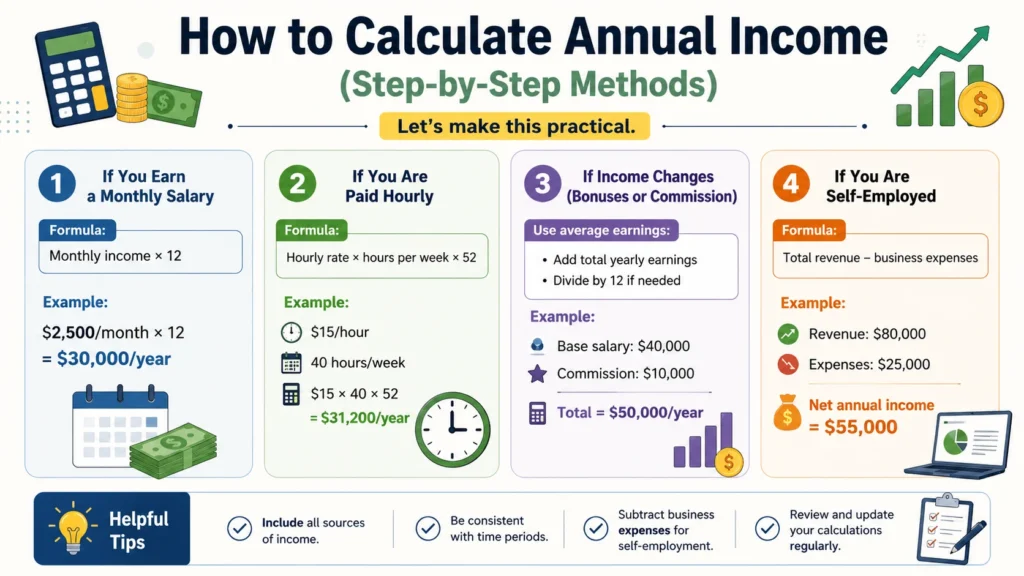
How to Calculate Annual Income (Step-by-Step Methods)
Let’s make this practical.
If You Earn a Monthly Salary
Formula:
Monthly income × 12
Example:
- $2,500/month × 12 = $30,000/year
If You Are Paid Hourly
Formula:
Hourly rate × hours per week × 52
Example:
- $15/hour
- 40 hours/week
$15 × 40 × 52 = $31,200/year
If Income Changes (Bonuses or Commission)
Use average earnings:
- Add total yearly earnings
- Divide by 12 if needed
Example:
- Base salary: $40,000
- Commission: $10,000
Total = $50,000/year
If You Are Self-Employed
Formula:
Total revenue − business expenses
Example:
- Revenue: $80,000
- Expenses: $25,000
Net annual income = $55,000
Income Calculation Table
| Scenario | Formula | Example Result |
| Monthly salary | Monthly × 12 | $36,000 |
| Hourly job | Hourly × hours × 52 | $41,600 |
| Freelance work | Revenue − expenses | $55,000 |
| Mixed income | Add all sources | $60,000+ |
Annual Income vs Other Financial Terms
Annual Income vs Gross Income
Gross income can refer to monthly or yearly earnings.
Annual income always refers to 12 months.
Annual Income vs Net Income
Net income is what you actually keep.
Annual income may be either gross or net depending on context.
Annual Income vs Household Income
Household income combines all earners in a home.
Example:
- Person A: $40,000
- Person B: $30,000
Household income = $70,000/year
Annual Income vs Adjusted Gross Income (AGI)
AGI is used in taxes.
It is:
- Gross income minus adjustments (like retirement contributions)
It affects tax brackets and deductions.
Where You Need to Show Annual Income
You’ll see it in many real-world situations:
- Renting apartments
- Getting loans
- Credit card applications
- Buying a home
- Insurance applications
- Financial aid forms
For example, landlords often want to see:
Annual income = 3x rent
So if rent is $1,000/month:
- Required annual income = $36,000+
Common Mistakes People Make
Many people misunderstand annual income.
Here are common errors:
- Confusing gross and net income
- Forgetting side jobs
- Ignoring bonuses
- Not including freelance income
- Overestimating based on hourly work
- Using monthly income incorrectly
How to Increase Your Annual Income
You don’t just calculate it. You can grow it.
Increase Primary Income
- Ask for a raise
- Improve skills
- Switch jobs strategically
- Move into higher-paying industries
Add Extra Income Streams
- Freelancing
- Investing
- Rental property
- Online business
- Consulting work
Skill-Based Income Growth
High-demand skills increase annual income fast:
- Software development
- Digital marketing
- Sales expertise
- Data analysis
Frequently Asked Questions
What does annual income mean on a job application?
It means your total yearly earnings, usually before taxes.
Is annual income before or after tax?
It depends, but most employers mean gross income unless stated otherwise.
How do I calculate annual income from weekly pay?
Multiply weekly pay by 52.
Does annual income include bonuses?
Yes, if bonuses are part of your earnings.
What is a good annual income?
It depends on location, lifestyle, and expenses.
In the U.S., average personal income is around $60,000–$65,000/year, but comfort varies widely.
Does annual income include benefits?
Usually no, unless converted into monetary value.
Can annual income change?
Yes. It changes with salary, hours, business performance, or investments.
Final Thoughts
Annual income is more than a number.
It shapes your financial identity.
It affects:
- What you can borrow
- What you can afford
- How you plan your future
Once you understand it clearly, you stop guessing and start planning with real numbers.
That’s where financial control begins.

Sophia Bennett is a professional writer focused on explaining word meanings, expressions and everyday language in a simple and engaging way.