Last Updated on July 8, 2026
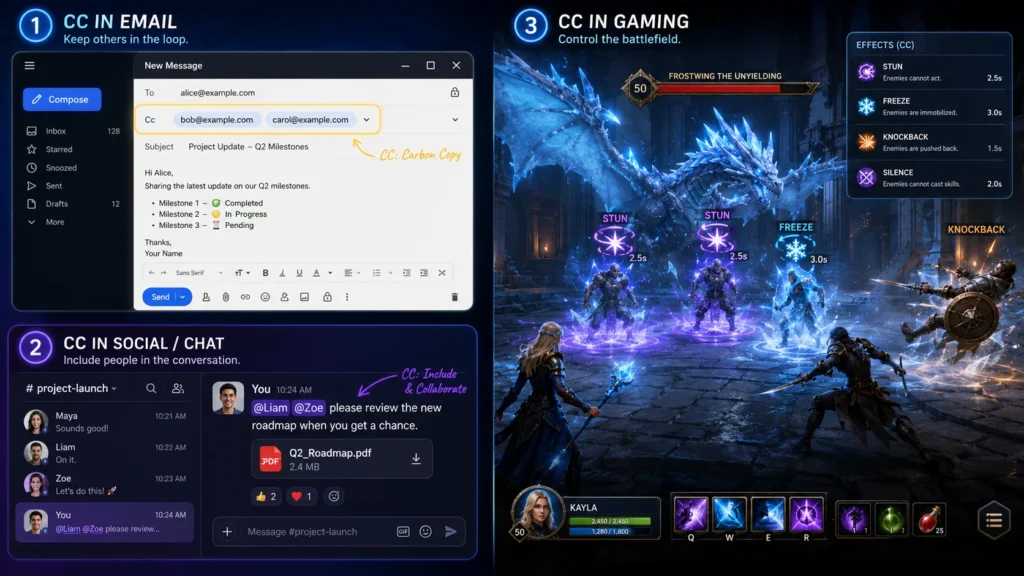
What does CC mean? CC stands for “Carbon Copy.” It originally comes from email systems where you send a copy of a message to someone besides the main recipient. In modern slang, CC meaning has expanded and now includes tagging someone, indirectly involving them in a conversation, or even referencing them in social media posts. In gaming, CC can also mean “crowd control,” referring to abilities that stun or slow opponents.
So, CC meaning depends on context:
- Email → Carbon Copy (keeping someone informed)
- Social media → Tagging or indirect mention
- Gaming → Crowd Control abilities
You’ve probably seen “cc” everywhere.
Maybe in an email where someone says “I cc’d my manager.”
Or in a TikTok caption like “cc my bestie for this drama.”
Or even in a game chat where someone says “we need more CC in fights.”
Same letters. Totally different meanings.
That’s where the confusion starts.
The truth is simple: “CC” is not a single meaning word. It changes based on context. And once you understand those contexts, it becomes one of the easiest internet terms to decode.
Let’s break it down in a clear, real-world way.
What Does CC Mean? Full Form and Core Definition
At its core, CC stands for “Carbon Copy.”
This comes from old typewriters. People used carbon paper to make duplicates of documents. So when you typed one letter, another copy appeared underneath.
That idea carried over into email systems.
So when someone asks:
What does CC mean in email?
The answer is:
CC = sending a copy of an email to additional people so they stay informed.
Simple. Clean. Functional.
CC Meaning in Email: The Original and Most Formal Use
Email is where CC actually started its digital life.
When you send an email, you usually have three fields:
- To
- CC
- BCC
Let’s break CC down properly.
What CC Does in Email
When you CC someone:
- They receive the email
- Everyone else can see they received it
- They are not the main recipient
Think of it like this:
You are talking to your teacher, but you also want your principal to listen in quietly.
That’s CC.
Real Example of CC in Email
Let’s say you email your boss:
“Project report is attached.”
You CC your team lead.
Now both people see the message, but your boss remains the main focus.
Why People Use CC in Emails
People don’t CC randomly. It has a purpose.
Here’s why CC is used:
- To keep someone informed
- To maintain transparency
- To avoid repeating messages
- To document communication flow
- To involve supervisors or team members
CC vs BCC Difference (Important Confusion Point)
A lot of people mix CC and BCC.
Here’s the real difference:
| Feature | CC | BCC |
| Visibility | Everyone sees recipients | Hidden recipients |
| Use case | Transparency | Privacy |
| Tone | Formal/inclusive | Quiet/informational |
So if CC is a group discussion, BCC is a silent observer mode.
CC Meaning in Slang: How It Changed on Social Media
Now things get interesting.
On social media, CC stopped being formal.
It became playful.
Instead of “carbon copy,” people now use CC to mean:
“I’m tagging you or calling you out indirectly.”
This is where internet culture shaped the meaning.
What CC Means in Texting and Apps
In messaging apps like WhatsApp, Instagram, or Snapchat:
- CC = “I’m including you in this conversation”
- CC = “This is about you”
- CC = “Pay attention, this is for you”
Real Slang Examples
- “cc my sister so she sees this meme”
- “cc the person who ghosted me 😂”
- “cc him, this is exactly what he said”
Notice something?
It’s not formal anymore. It’s emotional, funny, or sarcastic.
Why CC Became Slang in the First Place
This shift didn’t happen randomly.
Three big reasons:
- Social media loves short expressions
- People already knew CC from email
- Tagging culture (mentions and @symbols) reinforced it
So CC naturally evolved into “indirect tagging.”
CC Meaning in Gaming: Crowd Control Explained
Now we step into a completely different world.
In gaming, CC does NOT mean carbon copy at all.
Here, CC stands for:
Crowd Control
What Is Crowd Control (CC)?
Crowd control refers to abilities that:
- Stop enemies from moving
- Slow them down
- Stun or freeze them
- Disable their attacks
Examples of CC in Games
If you play games like MOBAs or shooters, you’ve seen CC already:
- Stun → Enemy can’t move for 2 seconds
- Freeze → Enemy is locked in place
- Knock-up → Enemy gets thrown in air
- Slow → Enemy movement is reduced
Simple Gaming Example
A player says:
“We need more CC in team fights.”
That means:
“We need more abilities that can control enemies.”
Why CC Matters in Competitive Games
CC can completely change a fight.
Here’s why:
- It stops powerful enemies
- It gives your team control
- It creates openings for attacks
- It can turn losing fights into wins
In esports, CC is often the difference between victory and defeat.
CC Meaning in Memes and Internet Culture
Internet users love twisting meanings.
CC became a tool for humor and sarcasm.
How People Use CC in Memes
- “cc everyone who said I’d fail”
- “cc my past self for bad decisions”
- “cc the group chat that ignored me”
It creates a sense of inclusion without directly naming people.
That makes it funny and slightly dramatic.
How to Know the Correct Meaning of CC
This is where most confusion ends.
You don’t guess CC meaning randomly.
You check context.
Quick Context Guide
| Situation | CC Meaning |
| Carbon Copy | |
| Work communication | Keeping someone informed |
| Social media | Tagging or indirect mention |
| Gaming | Crowd Control |
| Memes | Sarcastic reference |
Simple Rule to Remember
If it looks professional → email meaning
If it looks emotional or funny → slang meaning
If it looks technical or gaming-related → crowd control
Common Misunderstandings About CC Meaning
People often misinterpret CC.
Here are the most common mistakes:
- Thinking CC always means email copy
- Confusing CC with “see see”
- Mixing it with closed captions
- Assuming it has only one definition
The truth is simple:
CC is a multi-context abbreviation, not a fixed word.
CC Full Form in Different Contexts
Let’s make it crystal clear.
| Context | CC Full Form |
| Carbon Copy | |
| Gaming | Crowd Control |
| Medical (rare use) | Cubic Centimeter |
| Finance (rare slang) | Credit Card |
Yes, the same letters can represent completely different ideas.
That’s why context is everything.
Why CC Became So Popular in Digital Communication
CC stayed relevant because it is:
- Short
- Easy to type
- Already known globally
- Flexible in meaning
Modern communication loves abbreviations like this.
Think about it:
- LOL
- BRB
- DM
- CC
All of them survive because they save time and carry meaning quickly.
Real-Life Scenarios Where You’ll See CC
Let’s connect it to real life so it sticks better.
Workplace Email
You CC your manager on a report so they stay updated.
Group Chat Drama
Someone says “cc him” after a funny argument.
Gaming Session
Teammate asks for more CC before a boss fight.
Quick Comparison Table of CC Meanings
| Area | Meaning | Purpose |
| Carbon Copy | Share information | |
| Slang | Indirect mention | Tag or reference someone |
| Gaming | Crowd Control | Disable enemies |
| Science | Cubic centimeter | Measurement |
Final Thoughts
If you strip everything down, here’s the truth:
CC is a flexible abbreviation that changes meaning based on context.
- In emails, it keeps people informed.
- In slang, it includes or calls out someone indirectly.
- In games, it controls enemies.
So instead of memorizing one meaning, learn to read the situation.
That’s the real skill.
Because once you understand context, CC stops being confusing and starts being obvious.

Sophia Bennett is a professional writer focused on explaining word meanings, expressions and everyday language in a simple and engaging way.