Last Updated on July 7, 2026
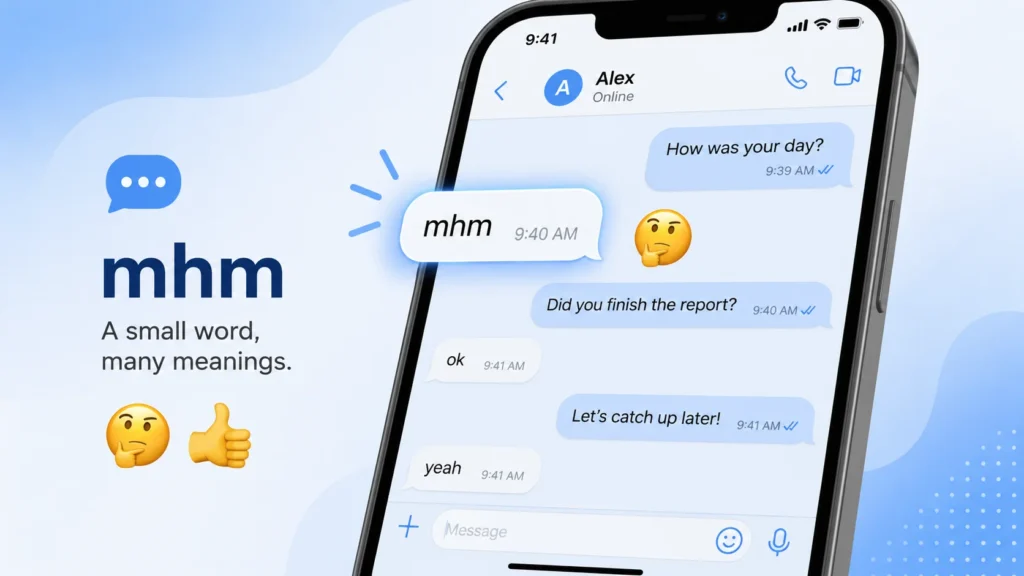
“mhm” is an informal slang expression used in texting and conversation to show agreement, acknowledgment, or active listening. It often means “yes” in a casual or neutral way, but the tone can change based on context. In chat, “mhm” can signal simple confirmation, mild disinterest, or even sarcasm depending on how it is used. It is a non-lexical utterance and a common backchannel response in digital communication.
If you’ve ever texted someone and got a quick “mhm” in reply, you probably paused for a second. It feels simple, but also a little unclear. Are they agreeing with you? Are they annoyed? Or are they just not that interested?
Here’s the truth. The slang “mhm” is one of the most flexible and context-dependent expressions in digital communication.
At its core, “mhm” means yes or I agree, but that’s only the surface. In real conversations, it can carry different tones, emotions, and intentions depending on how it’s used.
Core Meaning of MHM
The basic meaning of mhm is:
- Yes
- I agree
- I understand
- I’m listening
It is not a formal word. Instead, it is a sound-based expression people use in speech and texting.
Think of it like a soft nod in text form. You’re not fully committing to a long reply, but you are acknowledging the message.
Simple Definition of MHM
In simple terms:
Mhm = a casual way of saying yes or showing acknowledgment in conversation
It works like a verbal shortcut. People use it when they want to respond without typing a full sentence.
MHM Meaning in Different Contexts
The tricky part about “mhm” is that its meaning changes depending on context. Tone matters more than the word itself.
Let’s break it down.
MHM as Agreement
Most of the time, mhm means agreement.
Example:
- A: “We should go out tonight.”
- B: “mhm”
Here, it means “yes, I agree.”
It’s short, relaxed, and informal.
MHM as Acknowledgment
Sometimes, people don’t fully agree or disagree. They just acknowledge.
Example:
- A: “I’ll be late today.”
- B: “mhm”
In this case, it means:
- “I heard you”
- “Okay noted”
No emotion. Just acknowledgment.
MHM as Reluctant Agreement
Now things get interesting. “mhm” can also show half-hearted agreement.
Example:
- A: “That movie was amazing.”
- B: “mhm”
That pause or tone shift suggests:
- Not fully convinced
- Mild disinterest
- Polite agreement without excitement
It’s like saying “yeah, sure” without enthusiasm.
MHM as Sarcasm
Yes, “mhm” can even turn sarcastic.
Example:
- A: “I totally didn’t forget your birthday.”
- B: “mhm.”
Here it signals:
- Doubt
- Disbelief
- Silent judgment
Sarcasm depends heavily on context and relationship between speakers.
MHM in Texting Culture
Modern texting has changed how people communicate. Short responses dominate chats today, and “mhm” fits perfectly into this trend.
MHM on WhatsApp, Instagram, and SMS
Across platforms like WhatsApp, Instagram DMs, and regular SMS, “mhm” is used the same way:
- Quick reply
- Low effort response
- Conversation filler
People don’t always want to type long sentences. So “mhm” becomes a shortcut.
Why People Use MHM in Chats
There are a few real reasons people prefer it:
- It saves time
- It keeps conversation going
- It avoids awkward silence
- It feels casual and natural
- It signals they are still engaged
Think of it like nodding during a conversation instead of speaking.
The Rise of Short Responses
Digital communication has pushed people toward minimal typing. Alongside words like:
- ok
- yeah
- k
- sure
“mhm” fits into this ecosystem of micro-responses.
It’s part of modern “fast communication culture.”
Linguistic Breakdown of MHM
Let’s go deeper into language structure. “mhm” is more than slang. Linguists classify it in interesting ways.
MHM as an Interjection
An interjection is a short sound or word that expresses emotion or reaction.
Examples:
- wow
- oh
- hmm
- mhm
So “mhm” falls into this category.
It doesn’t carry grammar rules. It carries reaction.
MHM as a Discourse Marker
A discourse marker helps manage conversation flow.
“Mhm” tells the speaker:
- “I’m following you”
- “Keep going”
- “I understand so far”
It keeps dialogue smooth without interrupting.
MHM as Backchanneling
This is a key concept in linguistics.
Backchanneling means short responses that show attention while someone else is speaking.
Examples:
- mhm
- uh-huh
- yeah
- right
So when someone says “mhm” during a story, they are saying:
“I’m listening. Continue.”
Even in texting, this function still applies.
Pragmatic Meaning of MHM
Pragmatics is about meaning in context.
“Mhm” has no fixed meaning on its own. Instead, it depends on:
- tone
- timing
- relationship
- situation
That’s why it can feel friendly in one chat and cold in another.
MHM vs HMM Difference
People often confuse “mhm” with “hmm,” but they are not the same.
Here’s a clear comparison:
| Expression | Meaning | Tone | Usage |
| mhm | yes / agreement | neutral to positive | confirmation, acknowledgment |
| hmm | thinking / doubt | uncertain | hesitation, analysis |
Key Difference Explained Simply
- mhm = I agree or I hear you
- hmm = I’m thinking or unsure
Example:
- “Do you like this idea?”
- “mhm” → yes
- “hmm” → not sure
MHM Meaning From Girl or Boy
One of the most searched questions online is whether “mhm” means something different depending on gender.
The answer is simple.
It doesn’t change based on gender.
However, tone interpretation can vary based on relationship dynamics.
Possible Meanings in Personal Chats
From anyone, “mhm” can mean:
- Interest in conversation
- Polite response
- Lack of enthusiasm
- Slight annoyance
- Casual agreement
Why People Overthink It
People often read too much into it because:
- It is short
- It feels emotionally neutral
- It lacks clarity
But realistically, you need more context to interpret it correctly.
How to Respond to MHM
Replying to “mhm” depends on what you want from the conversation.
If You Want to Continue Talking
You can:
- Ask a follow-up question
- Add more detail
- Change topic slightly
Example:
- “mhm”
- “So what do you think about it?”
If It Feels Like Disinterest
You can:
- Pause the conversation
- Switch tone
- Give them space
Sometimes “mhm” is just a soft exit signal.
If It’s Neutral Agreement
You can:
- Move forward
- Continue the plan
- Treat it as “yes”
Examples of MHM in Real Conversations
Here’s a practical breakdown.
| Situation | Conversation | Meaning of “mhm” |
| Making plans | “Let’s meet at 5.” → “mhm” | Agreement |
| Sharing news | “I got promoted.” → “mhm” | Acknowledgment |
| Emotional talk | “I feel tired.” → “mhm” | Listening |
| Argument | “You forgot again.” → “mhm” | Sarcasm or annoyance |
| Casual chat | “Are you free?” → “mhm” | Neutral yes |
Common Mistakes When Interpreting MHM
People often misread “mhm” because they assume emotion where there may be none.
Here are common mistakes:
- Thinking it always means excitement
- Assuming anger without context
- Overanalyzing short replies
- Ignoring conversation history
- Reading tone incorrectly in text
Text strips away voice tone. That’s why confusion happens.
Psychology Behind MHM in Digital Communication
There’s a real psychological layer here.
People use “mhm” because:
- It reduces cognitive load
- It keeps interaction low pressure
- It avoids emotional commitment
- It maintains social connection without effort
It acts like a “soft presence signal.”
In psychology terms, it supports minimal engagement communication, where people stay socially active without deep involvement.
MHM in AI and NLP Interpretation
From a Natural Language Processing (NLP) perspective, “mhm” is classified as:
- Slang / informal expression
- Non-lexical utterance
- Backchannel response
- Pragmatic marker
AI systems interpret it using context windows. Alone, it has low semantic weight. But inside conversation history, it gains meaning.
NLP Challenges with MHM
Machines struggle because:
- It has no fixed definition
- Tone is not visible
- Context changes meaning
- Cultural differences affect usage
So AI must rely heavily on surrounding text.
Final Thoughts
The phrase “mhm” looks small, but it carries a lot of hidden meaning in digital communication.
Sometimes it’s a simple yes. Other times it’s a quiet pause. And occasionally, it hides emotion behind a single sound.
The real key is this:
You don’t read “mhm” in isolation. You read the conversation around it.
Once you understand that, texting becomes a lot clearer and a lot less confusing.

Sophia Bennett is a professional writer focused on explaining word meanings, expressions and everyday language in a simple and engaging way.