
Last Updated on July 3, 2026
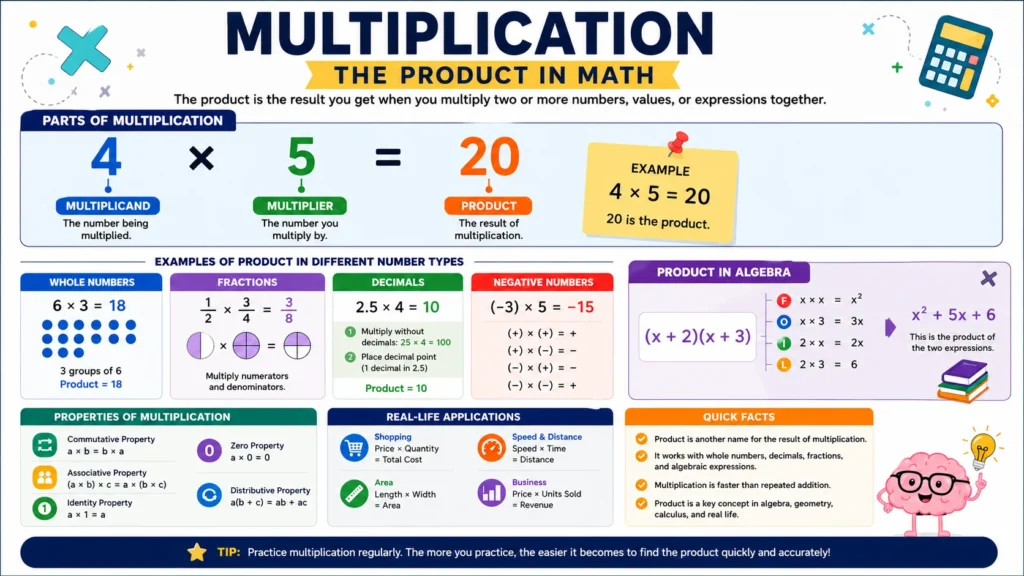
The product in math is the result you get when two or more numbers, values, or expressions are multiplied together. For example, in 6 × 4 = 24, the number 24 is called the product. In simple terms, the product meaning in math refers to the outcome of multiplication across integers, decimals, fractions, and algebraic expressions.
Math builds layer by layer. You learn addition first. Then subtraction. Soon after, multiplication enters the picture. That’s where the product in math becomes essential.
The idea may seem simple at first glance. Multiply two numbers and you get an answer. But that answer has a name. That name is product.
Here’s a quick thought.
You walk into a store and buy 8 notebooks. Each notebook costs 3 dollars. Instead of adding 3 eight times, you multiply:
8 × 3 = 24
That 24 is the multiplication product.
Now stretch that idea further. You’ll use products when calculating area, solving algebra equations, analyzing data, and even coding algorithms. It shows up everywhere.
So understanding the definition of product in math is not optional. It’s foundational.
Definition of Product in Math
What Is Product in Mathematics?
The product in mathematics is defined as:
The result obtained when two or more numbers, quantities, or expressions are multiplied together.
This is the core product meaning math uses across all levels.
Breaking Down Multiplication Terms
Understanding the structure helps.
| Term | Meaning | Example |
|---|---|---|
| Multiplicand | The number being multiplied | 7 in 7 × 5 |
| Multiplier | The number multiplying | 5 in 7 × 5 |
| Product | Final result | 35 |
Key Insight
Multiplication is not just repeated addition. It is also:
- Scaling values
- Combining quantities
- Transforming numbers
That final result always becomes the product of numbers.
Product Formula
The general formula looks like this:
Product = Multiplicand × Multiplier
Or for multiple numbers:
Product = a × b × c × d …
Important Fact
- The product can involve two numbers or dozens
- It applies to all real numbers
- It extends into algebra and higher mathematics
Simple Examples of Product in Math
Whole Number Multiplication
Let’s start clean and simple.
- 3 × 4 = 12
- 9 × 2 = 18
- 10 × 5 = 50
Each answer is the product.
Repeated Addition Perspective
Multiplication can be visualized as repeated addition.
Example:
5 × 3 means:
3 + 3 + 3 + 3 + 3 = 15
So 15 becomes the result of multiplication.
Negative Number Multiplication
Signs change everything.
| Expression | Product |
|---|---|
| (-2) × 4 | -8 |
| 3 × (-5) | -15 |
| (-6) × (-2) | 12 |
Rule:
- Same signs → positive product
- Different signs → negative product
Decimal Multiplication Product
Decimals follow a consistent pattern.
- 2.5 × 2 = 5
- 1.25 × 4 = 5
Steps:
- Multiply normally
- Place decimal correctly
Fraction Product
Fractions multiply directly.
Example:
2/3 × 3/5 = 6/15 = 2/5
Mixed Example Table
| Type | Example | Product |
|---|---|---|
| Whole number | 6 × 7 | 42 |
| Decimal | 1.5 × 2 | 3 |
| Fraction | 1/2 × 4 | 2 |
| Negative | -3 × 3 | -9 |
Product in Different Number Systems
Product of Integers
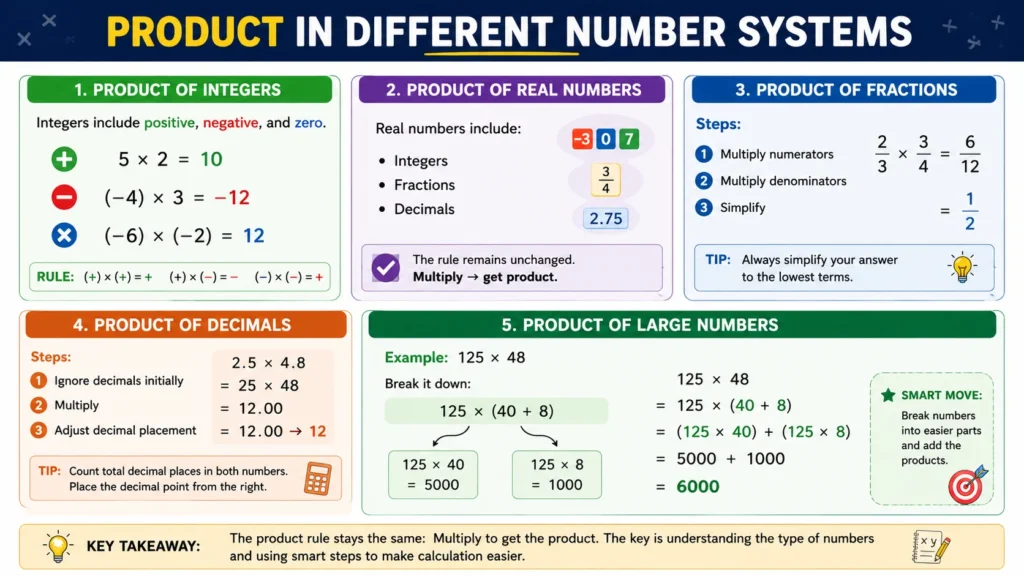
Integers include positive, negative, and zero.
- 5 × 2 = 10
- (-4) × 3 = -12
- (-6) × (-2) = 12
Product of Real Numbers
Real numbers include:
- Integers
- Fractions
- Decimals
The rule remains unchanged.
Multiply → get product.
Product of Fractions
Steps:
- Multiply numerators
- Multiply denominators
- Simplify
Product of Decimals
Steps:
- Ignore decimals initially
- Multiply
- Adjust decimal placement
Product of Large Numbers
Example:
125 × 48
Break it down:
125 × (40 + 8)
= 5000 + 1000
= 6000
Product in Algebra
Product in Algebra Expressions
Algebra introduces variables.
Example:
3x × 2y = 6xy
Multiplying Variables
- x × x = x²
- a × b = ab
Polynomial Product
Example:
(x + 2)(x + 3)
| Step | Result |
|---|---|
| x × x | x² |
| x × 3 | 3x |
| 2 × x | 2x |
| 2 × 3 | 6 |
Final result:
x² + 5x + 6
Special Algebraic Products
| Formula | Result |
|---|---|
| (a + b)² | a² + 2ab + b² |
| (a – b)² | a² – 2ab + b² |
| (a + b)(a – b) | a² – b² |
Why Algebraic Product Matters
It helps you:
- Expand expressions
- Solve equations
- Understand polynomials
Properties of Multiplication Product
Commutative Property
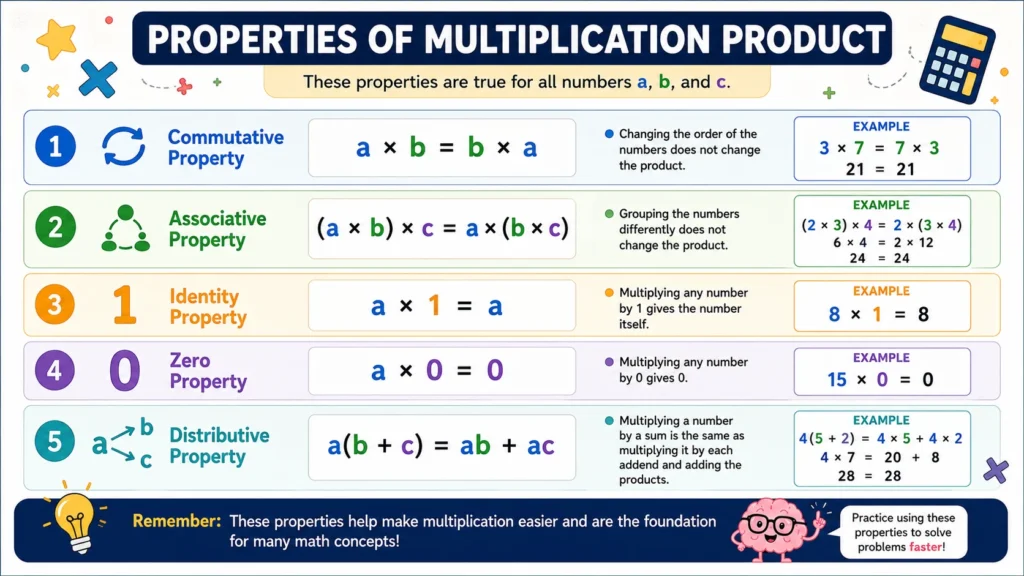
a × b = b × a
Associative Property
(a × b) × c = a × (b × c)
Identity Property
a × 1 = a
Zero Property
a × 0 = 0
Distributive Property
a(b + c) = ab + ac
Summary Table
| Property | Formula | Example |
|---|---|---|
| Commutative | a × b = b × a | 3×4 = 4×3 |
| Associative | (a×b)×c = a×(b×c) | (2×3)×4 |
| Identity | a×1 = a | 5×1 = 5 |
| Zero | a×0 = 0 | 7×0 = 0 |
| Distributive | a(b+c) = ab+ac | 3(2+4) |
Real-Life Applications of Product
Shopping and Budgeting
- Cost = price × quantity
Area Calculation
Area = length × width
Speed Problems
Distance = speed × time
Business Calculations
Revenue = units × price
Everyday Examples
You use product when:
- Cooking
- Measuring
- Planning
Product vs Other Math Terms
| Term | Meaning | Operation |
|---|---|---|
| Product | Result of multiplication | × |
| Sum | Result of addition | + |
| Difference | Result of subtraction | – |
| Quotient | Result of division | ÷ |
Quick Memory Trick
- Product = multiply
- Sum = add
Common Mistakes in Product Calculation
Sign Mistakes
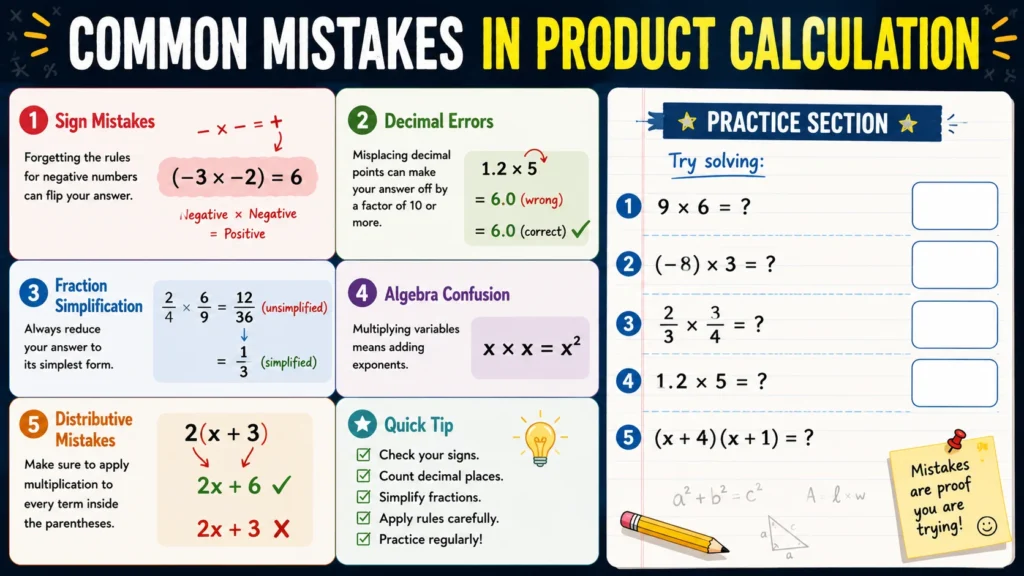
(-3 × -2) = 6
Decimal Errors
Misplacing decimal points
Fraction Simplification
Always reduce answers
Algebra Confusion
x × x = x²
Distributive Mistakes
Apply multiplication to all terms
Practice Section
Try solving:
- 9 × 6 = ?
- (-8) × 3 = ?
- 2/3 × 3/4 = ?
- 1.2 × 5 = ?
- (x + 4)(x + 1) = ?
Advanced Concepts of Product in Mathematics
Product Notation
Symbol: ∏
Example:
∏ (i = 1 to 5) i = 120
Dot Product
Used in vectors.
- Produces a scalar
- Used in physics
Cross Product
- Produces a vector
- Used in 3D geometry
Scalar Multiplication
Multiply vector by number
Key Facts About Product in Math
- Product always comes from multiplication
- Applies to all number types
- Core to algebra
- Used in real life
Final Thoughts
Let’s simplify everything.
The product in math is:
- The result of multiplication
- Used across arithmetic and algebra
- Essential for problem-solving
Master multiplication, and you master product.

Michael Anderson is a content writer specializing in word meanings, definitions and clear explanations of modern terms and phrases.