Last Updated on June 15, 2026
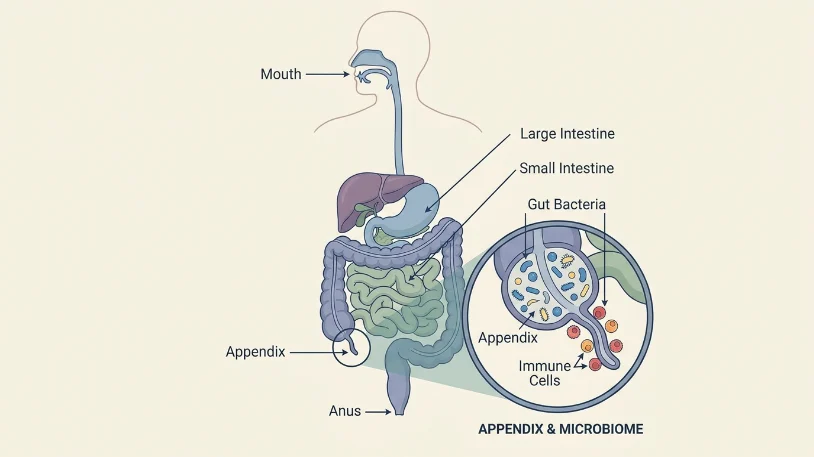
The appendix is a small organ attached to the large intestine that supports the immune system and stores beneficial gut bacteria. While not essential for survival, its main function is to help restore healthy gut flora after illness and contribute to immune defense, especially early in life.
For years, people called the appendix useless. Doctors removed it without hesitation. Textbooks labeled it a “vestigial organ,” which sounded like nature forgot to clean up after evolution.
That idea didn’t age well.
Modern research flipped the script. The appendix does have a purpose. In fact, it plays a quiet but meaningful role inside the human body. You won’t notice it day to day. Still, when things go wrong in your gut, this tiny structure can step in like a backup system.
So what does the appendix do exactly?
Let’s break it down in plain language, without the fluff.
What Does the Appendix Do in the Human Body?
The appendix function centers around two key roles:
- Supports the immune system
- Stores beneficial gut bacteria
Think of it like a hidden shelter. When your digestive system takes a hit say from infection or antibiotics the appendix helps restore balance by releasing healthy bacteria back into your gut.
It doesn’t digest food. It doesn’t control metabolism. Instead, it protects something far more valuable: your internal ecosystem.
Where Is the Appendix Located?
The appendix sits in a very specific spot inside your body.
- Found in the lower right abdomen
- Attached to the cecum, the first part of the large intestine
- Positioned just below where the small intestine meets the colon
Physical Characteristics
| Feature | Description |
|---|---|
| Length | 2 to 4 inches |
| Shape | Narrow, tube-like |
| Texture | Soft tissue with lymphatic cells |
| Opening | Connects to the large intestine |
It’s small. Easy to overlook. Yet its position gives it a strategic advantage right at the junction of major digestive pathways.
The Appendix Function in the Immune System
Here’s where things get interesting.
The appendix isn’t just sitting there. It actively participates in your immune system, especially during early life.
Lymphatic Tissue: The Key Player
The appendix contains lymphatic tissue, which acts like a training ground for immune cells.
These tissues help your body:
- Recognize harmful pathogens
- Build immune memory
- Produce white blood cells
Early-Life Immune Development
During childhood, your immune system learns fast. The appendix contributes by exposing immune cells to microbes in a controlled way.
It’s like a classroom.
Your body learns what’s dangerous. It learns what’s harmless. Over time, it builds smarter responses.
Ongoing Immune Role
Even in adulthood, the appendix continues to:
- Support gut immunity
- Assist in antibody production
- Monitor microbial activity
The Appendix and Gut Bacteria: The “Safe House” Theory
If there’s one idea that defines modern understanding of the appendix, it’s this:
The appendix acts as a reservoir for beneficial gut bacteria.
Why Gut Bacteria Matter
Your gut holds trillions of microorganisms. These bacteria:
- Help digest food
- Produce vitamins like B12 and K
- Support immune defense
- Influence mood and brain function
Lose them, and your system struggles.
How the Appendix Protects These Bacteria
During illness especially severe diarrhea your intestines flush out harmful bacteria. Unfortunately, they often wipe out good bacteria too.
That’s where the appendix steps in.
It:
- Stores healthy bacteria in a protected environment
- Shields them from digestive disruption
- Releases them when your gut needs rebuilding
Analogy That Makes It Click
Imagine your gut as a forest.
A storm hits. Trees fall. Wildlife disappears.
The appendix? It’s the seed bank.
When conditions improve, it helps regrow everything.
Does the Appendix Help Digestion?
Short answer: Not directly.
The appendix doesn’t break down food like the stomach or small intestine.
However, it indirectly supports digestion through gut bacteria.
Indirect Digestive Role
Healthy bacteria:
- Ferment fiber
- Break down complex carbs
- Produce short-chain fatty acids
Without them, digestion becomes inefficient.
So while the appendix doesn’t digest food itself, it supports the system that does.
Is the Appendix Useless or Important?
This question comes up all the time.
The truth sits somewhere in the middle.
You Can Live Without It
People who undergo appendix removal (appendectomy):
- Live normal lives
- Maintain proper digestion
- Experience no major long-term issues
But It Still Has Value
Calling it useless oversimplifies things.
Here’s a better comparison:
| Without Appendix | With Appendix |
|---|---|
| Gut recovery may take longer | Faster microbiome recovery |
| Less bacterial backup | Built-in bacterial reserve |
| Slightly reduced immune support | Extra immune tissue |
It’s not essential. Still, it’s helpful.
Why Do Humans Have an Appendix?
Evolution doesn’t keep things around without reason.
Historical Theory
Scientists once believed the appendix helped digest plant-heavy diets in early humans.
That theory faded.
Modern View
Now, researchers believe the appendix:
- Evolved to support immune function
- Helps maintain gut bacteria stability
- Acts as a survival advantage during infections
Evidence Across Species
Many mammals have appendix-like structures. That suggests a consistent biological purpose.
What Happens If the Appendix Is Removed?
Millions of people have their appendix removed each year.
Let’s look at what changes and what doesn’t.
What Stays the Same
- Digestion continues normally
- Nutrient absorption remains intact
- Daily function stays stable
What Might Change
Some studies suggest:
- Slightly slower recovery after gut infections
- Minor shifts in microbiome diversity
Still, most people never notice a difference.
What Causes Appendicitis?
Appendicitis happens when the appendix becomes inflamed.
It’s one of the most common medical emergencies worldwide.
Main Causes
- Blockage by stool (fecalith)
- Infection
- Swelling of lymphatic tissue
What Happens Inside
- Bacteria multiply rapidly
- Pressure builds
- Blood flow decreases
- Tissue becomes inflamed
If untreated, it can rupture.
Symptoms of Appendicitis You Should Never Ignore
Recognizing symptoms early can save your life.
Common Signs
- Sharp pain in lower right abdomen
- Pain that worsens with movement
- Nausea and vomiting
- Fever
- Loss of appetite
Warning Signs of Rupture
- Sudden relief followed by severe pain
- High fever
- Rapid heartbeat
Don’t wait it out. Seek medical help immediately.
What Happens When the Appendix Bursts?
A ruptured appendix spreads bacteria into the abdominal cavity.
This leads to peritonitis, a serious infection.
Effects Include
- Severe inflammation
- Risk of sepsis
- Life-threatening complications
Treatment requires:
- Emergency surgery
- Antibiotics
Appendix Function and Gut Health
Your gut health shapes everything from digestion to immunity.
The appendix plays a subtle role in maintaining balance.
Key Contributions
- Preserves microbial diversity
- Supports recovery after illness
- Maintains intestinal stability
Gut Health Benefits
- Improved digestion
- Stronger immunity
- Better nutrient absorption
Is the Appendix a Vestigial Organ?
The term “vestigial” means an organ with no current function.
That label no longer fits.
Why It Was Misunderstood
- No obvious role in digestion
- Removal didn’t cause immediate harm
- Limited early research
Why It’s Not Truly Vestigial
- Contains active immune tissue
- Supports microbiome recovery
- Plays a role in health resilience
Surprising Facts About the Appendix
Let’s make this practical and memorable.
- The appendix contains biofilms, which protect bacteria
- It may help prevent certain infections
- It’s more active in younger individuals
- Not everyone has the exact same appendix size or shape
FAQs
What is the main function of the appendix?
It supports immunity and stores beneficial gut bacteria.
Does the appendix help digestion?
Not directly. It supports bacteria that aid digestion.
Can you live without an appendix?
Yes, most people live normal lives after removal.
Why do humans still have an appendix?
It helps maintain gut health and immune function.
What does the appendix store?
It stores beneficial bacteria for gut recovery.
Final Thoughts
The appendix won’t win any awards for size. It doesn’t demand attention. It doesn’t perform flashy tasks.
Yet it quietly protects one of the most important systems in your body your gut.
Sometimes, the smallest parts do the heaviest lifting.
And the appendix proves that point perfectly.

Sophia Bennett is a professional writer focused on explaining word meanings, expressions and everyday language in a simple and engaging way.