Last Updated on June 12, 2026
If you’ve ever typed “what does BBC mean” into a search bar, you’re not alone. It’s one of those acronyms that gets thrown around constantly in news headlines, casual conversation, and across social media yet not everyone knows exactly what it stands for or why it matters. So let’s clear that up immediately and then dig much deeper.
BBC stands for the British Broadcasting Corporation. It’s the United Kingdom’s national public broadcaster, the oldest broadcasting organization in the world, and one of the most trusted news institutions on the planet. But the three letters carry far more weight than a simple definition suggests.
BBC Meaning: The Full Form and What It Actually Represents
The BBC acronym breaks down like this:
| Letter | Stands For |
|---|---|
| B | British |
| B | Broadcasting |
| C | Corporation |
So the BBC full form is British Broadcasting Corporation. Simple enough. But what does that actually mean in practice?
The word British signals its origin it was created by the British government and is deeply tied to the United Kingdom’s cultural and political identity. Broadcasting covers its core function: distributing audio and visual content to a mass audience via television, radio, and the internet. Corporation reflects its legal and organizational structure it operates as a chartered public corporation, not a private company chasing profit.
Think of it as the UK’s version of a public utility, except instead of electricity or water, it delivers news, education, and entertainment. And it does this on a genuinely massive scale.
A Quick Snapshot: BBC by the Numbers
Before diving into the history and services, here’s a fast-facts table that shows just how large this organization really is:
| Metric | Figure (2024–2025) |
|---|---|
| Founded | 18 October 1922 |
| Became a Corporation | 1 January 1927 |
| Annual Revenue | £5.389 billion |
| Total Employees | 21,918 |
| Weekly UK Adult Reach | 83% |
| Weekly Global Audience | ~450 million |
| BBC iPlayer Weekly Active Accounts | 15.2 million |
| iPlayer Viewing Hours (2024/25) | 4.5 billion |
| BBC World Service Languages | 42 |
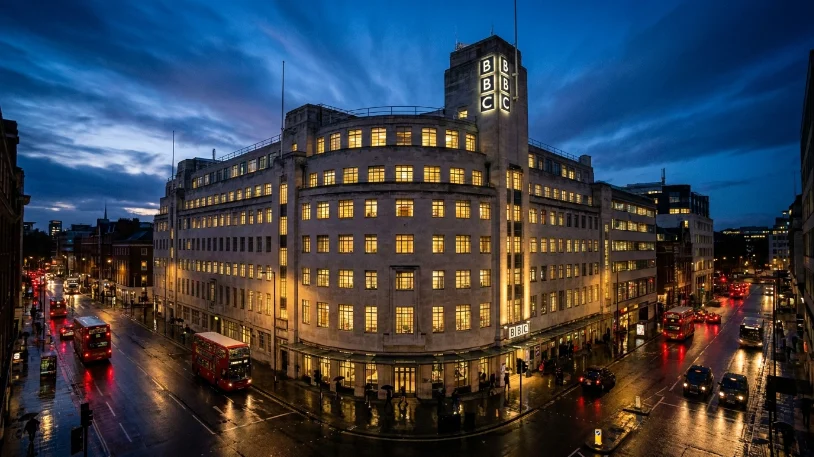
| Headquarters | Broadcasting House, London |
These aren’t vanity metrics. They illustrate why the BBC acronym means something substantively different from most media brands you’ll encounter.
The History Behind the BBC Full Form
How It All Started
The story begins in 1922 a time when radio was brand new technology and governments had to figure out fast who should control the airwaves.
On 18 October 1922, a group of British and American electrical companies formed the British Broadcasting Company Ltd — note “Company,” not “Corporation.” It was a commercial enterprise, licensed by the UK’s General Post Office. The first radio broadcast went out on 14 November 1922 from the 2LO studio in London, using technology pioneered by Guglielmo Marconi.
The man who shaped everything was John Reith, hired in December 1922 as managing director. Reith wasn’t just an administrator he had a clear philosophy. Broadcasting, he believed, should “inform, educate, and entertain.” That three-word mission still drives the BBC today, over a century later.
From Company to Corporation
By 1926, it was clear that a private company controlling the airwaves created too many conflicts. The British government commissioned the Crawford Committee to examine the situation. Its recommendation: broadcasting should become a public service, free from commercial interference.
On 1 January 1927, the British Broadcasting Corporation was born under Royal Charter. John Reith became its first Director-General. The original charter gave the BBC a monopoly over all broadcasting in Britain and set it apart from both government control and private profit.
That dual independence is still the BBC’s defining characteristic. The government doesn’t run it. Advertisers don’t fund it. And that’s intentional.
Key Milestones in BBC History
| Year | Milestone |
|---|---|
| 1922 | British Broadcasting Company founded |
| 1927 | Became the British Broadcasting Corporation |
| 1932 | Broadcasting House, London opens |
| 1936 | World’s first regular television service launched |
| 1939 | TV service suspended during World War II |
| 1946 | Television service resumes |
| 1967 | BBC Radio reorganized into Radio 1, 2, 3, 4 |
| 1997 | BBC News 24 (now BBC News) launches |
| 2007 | BBC iPlayer launches |
| 2022 | BBC celebrates its centenary |
| 2027 | UK television licence fee set to be phased out |
The 1936 television service launch deserves special mention. Under Reith’s leadership, the BBC launched the world’s first regular high-definition television service from Alexandra Palace in London. That alone secures its place in broadcasting history.
What Does the BBC Do? Its Services Explained
Television Channels
The BBC doesn’t run just one channel. It operates an entire network of television services, each targeting a different audience:
- BBC One — The flagship channel, covering news, drama, sport, and entertainment. It’s the UK’s most-watched channel by weekly reach.
- BBC Two — A mix of documentaries, arts, and specialist programming.
- BBC Three — Originally a traditional channel, now primarily a streaming-first service targeting younger audiences (16–34).
- BBC Four — Arts, music, and international programming.
- BBC News — 24/7 rolling news coverage.
- BBC Parliament — Live and recorded coverage of UK political proceedings.
- CBBC — Children’s programming for 6–12 year olds.
- CBeebies — Programming for children under 6.
- BBC Alba — Scottish Gaelic language channel (in partnership with MG Alba).
BBC One remains the crown jewel. In 2024/25, it still commanded the greatest weekly reach among all BBC television services, though all channels have seen linear audiences decline over the past decade as viewers migrate to streaming.
Radio
Radio is where the BBC began, and it still takes it seriously. The BBC operates ten national radio stations:
| Station | Focus |
|---|---|
| BBC Radio 1 | Contemporary music, primarily for young listeners |
| BBC Radio 2 | Adult contemporary and popular music |
| BBC Radio 3 | Classical music, jazz, and cultural programming |
| BBC Radio 4 | Speech, news, drama, documentaries |
| BBC Radio 5 Live | News and sport |
| BBC Radio 6 Music | Alternative music |
| BBC Radio 4 Extra | Comedy and drama archive |
| BBC Asian Network | British Asian music and culture |
| BBC World Service | International broadcast (detailed below) |
| BBC Local Radio | Regional stations across England |
Radio 4 deserves a special mention. It’s often called the most intelligent radio station in the world home to flagship programmes like Today, Desert Island Discs, The Archers, and In Our Time. Critics and fans alike consider it a national institution within a national institution.
BBC iPlayer — The Streaming Platform
BBC iPlayer is the corporation’s free on-demand streaming service, launched in 2007. It’s evolved dramatically since then. In 2024/25:
- 4.5 billion hours of content were viewed on iPlayer a 25% increase from the previous year
- There were 8.9 billion total iPlayer requests
- 15.2 million weekly active accounts use the platform regularly
- 22% of all BBC television viewing now happens on iPlayer
- Among viewers aged 16–24, that number jumps to 50% half of all BBC viewing by young people is via iPlayer
That last statistic tells you everything about where the BBC’s future lies. The platform allows users to watch live broadcasts, catch up on recent programmes, and access archive content. It’s free, ad-free, and available on virtually every device.
BBC News Online
BBC News online is consistently one of the world’s most-visited news websites. It publishes content across politics, business, science, health, technology, arts, sports, and global affairs in multiple languages. It’s separate from the television news channel but feeds off the same journalistic infrastructure.
The BBC World Service: Broadcasting to the World
Here’s where the BBC acronym takes on a genuinely global dimension.
The BBC World Service is the international broadcasting arm of the BBC. It delivers news and information to audiences outside the United Kingdom across television, radio, and digital platforms. The scale is remarkable:
- Broadcasts in 42 languages including English
- Reaches approximately 450 million people weekly globally
- Employs journalists based in 73 cities across 59 countries
- Maintains shortwave radio broadcasts to regions where internet access is unreliable
Former UN Secretary-General Kofi Annan once described it as “perhaps Britain’s greatest gift to the world this century.” That’s not hyperbole for audiences in countries with restricted press freedoms, the BBC World Service has historically been a lifeline to independent, verified information.
During the 2022 Russian invasion of Ukraine, for example, the BBC reactivated shortwave radio broadcasts specifically because digital infrastructure in the region was at risk. That’s the kind of operational flexibility that makes the World Service extraordinary.
What Languages Does the BBC World Service Broadcast In?
A selection of the 42 languages includes:
Arabic, Bengali, Burmese, Chinese (Mandarin), French, Hausa, Hindi, Indonesian, Nepali, Pashto, Persian, Portuguese, Russian, Sinhala, Somali, Spanish, Swahili, Tamil, Ukrainian, Urdu, Vietnamese, and Yoruba among many others.
Each language service isn’t just a translation. It employs native-speaking journalists who understand the local context and produce region-specific content. That’s an editorial commitment most broadcasters don’t come close to matching.
How Is the BBC Funded?
This is a question that comes up constantly and it’s genuinely complicated in 2026.
The Television Licence Fee
Historically, the BBC’s primary funding source has been the UK television licence fee. If you own a television or use a device to watch live television or use BBC iPlayer in the UK, you pay this fee. As of 2024, the annual cost stands at £169.50 per household.
In 2023/24, licence fee income came in at around £3.6 billion roughly 68% of the BBC’s total revenue that year. However, that figure dropped by 2% from the previous year, highlighting the structural vulnerability of this funding model.
BBC Studios and Commercial Revenue
The rest of the BBC’s income comes from BBC Studios, its commercial production and distribution arm. BBC Studios sells programming globally, licenses formats, distributes content, and generates commercial revenues that flow back into the corporation. This includes international sales of shows like Planet Earth, Doctor Who, Sherlock, and Strictly Come Dancing.
The Looming Funding Crisis
Here’s the uncomfortable reality: the UK government has announced plans to end the television licence fee by 2027. That’s an existential challenge for the BBC. It’s currently exploring alternatives, including:
- A subscription model (similar to Netflix)
- Partial privatisation
- Direct government funding
- A broadband or device-based levy
None of these is straightforward. A subscription model risks excluding lower-income households. Direct government funding threatens editorial independence. Privatisation contradicts the BBC’s founding charter. The debate is ongoing and unresolved.
In 2023/24, the BBC reported an operating deficit of £263 million its finances are already under pressure before any licence fee changes take effect.
The BBC’s Editorial Principles
The BBC operates under a set of core editorial values that distinguish it from commercial competitors. These aren’t just PR language they’re embedded in the Royal Charter:
- Impartiality — The BBC is legally required to present news without political bias, representing a range of perspectives
- Accuracy — Reporting must be based on verified facts, not assumptions
- Independence — Editorial decisions are made by journalists, not politicians or advertisers
- Serving the public interest — The BBC exists to serve its audience, not shareholders
In May 2025, Ofcom research found that 70% of regular BBC TV news viewers rate it highly for accuracy and 68% for trust. That’s a strong score by any measure especially in an era of widespread media scepticism.
However, trust isn’t unconditional. Ofcom’s 2025 annual report on the BBC flagged a “significant crisis” in editorial decision-making in news and current affairs, pointing to high-profile controversies in 2024 including the departure of prominent presenters and the conviction of a veteran anchor. The BBC’s credibility remains intact overall but it’s clearly navigating turbulent internal waters.
The BBC’s Cultural Impact
Iconic Programmes That Shaped Culture
You can’t fully understand what BBC means without appreciating what it’s produced. Here’s a small selection of culturally significant BBC output:
Drama:
- Doctor Who (1963–present) — The longest-running science fiction television programme in history
- Sherlock — Redefined the detective genre globally
- Fleabag — Won multiple Emmy and BAFTA awards; defined a generation of television writing
- The Crown — A global phenomenon via co-production
- Normal People — Became one of the most-watched BBC Three programmes ever
Natural History:
- Planet Earth and Planet Earth II Set the global benchmark for wildlife documentary filmmaking
- Blue Planet II Credited with triggering significant public awareness of ocean plastic pollution
- Sir David Attenborough’s entire body of work originates largely from BBC Natural History Unit productions
Comedy:
- Blackadder, Only Fools and Horses, Fawlty Towers, The Office (original UK version) all BBC productions that became internationally beloved
News:
- The BBC’s coverage of World War II via radio was a defining moment in broadcast journalism
- Its international reporting has set standards that competitors still try to emulate
The BBC’s Nicknames
The BBC doesn’t just have one nickname it has two that have stuck for decades:
- “The Beeb” A playful abbreviation that’s been in common usage since the mid-20th century
- “Auntie” This one’s more loaded. It implies the BBC is slightly old-fashioned, safe, and paternalistic a gentle critique wrapped in affection
Both nicknames reflect something real: the BBC occupies a unique emotional space in British culture. People complain about it, debate it, reform it and simultaneously can’t imagine life without it.
BBC vs. Other Major Broadcasters: A Comparison
| Feature | BBC | CNN | Al Jazeera | Reuters |
|---|---|---|---|---|
| Founded | 1922 | 1980 | 1996 | 1851 (news agency) |
| Funding Model | Licence fee + commercial | Advertising + subscription | Qatari government | Subscription B2B |
| Languages | 42 | Primarily English | Multiple | Multiple |
| Weekly Reach | ~450 million | N/A | ~430 million | N/A |
| Editorial Independence | Charter-protected | Corporate-owned | State-funded | Independent |
| Free to Access | Yes (UK/World Service) | Partially | Partially | No (trade) |
The BBC’s position is genuinely unique. It’s not state media in the Chinese or Russian sense its editorial independence is legally protected. But it’s not commercially funded either. That middle ground is what makes it so unusual in a global media landscape increasingly dominated by either government-controlled outlets or attention-driven commercial platforms.
Other Meanings of “BBC” — Context Matters
While the British Broadcasting Corporation is overwhelmingly the primary and most widely accepted meaning of “BBC,” it’s worth acknowledging that acronyms can carry multiple meanings depending on context.
In informal, slang, and internet contexts, “BBC” has been used to mean other things entirely. These usages are colloquial, informal, and context-dependent they don’t represent the standard, professional, or widely accepted definition. When you see “BBC” in a news article, a professional conversation, or any formal context, it refers unambiguously to the British Broadcasting Corporation.
The BBC’s Digital Future
The BBC isn’t standing still. It’s actively reinventing itself for the streaming era and its approach reveals a lot about where public broadcasting is headed globally.
Streaming-First Strategy
iPlayer’s growth numbers tell a compelling story. With 4.5 billion hours of viewing in 2024/25 up 25% year-on-year the platform is compensating for declining linear television audiences. The BBC has already started experimenting with streaming-first releases for certain programmes, dropping entire series on iPlayer before (or without) traditional broadcast transmission.
Youth Audiences
Half of all BBC viewing by 16–24 year olds now happens on iPlayer. That’s not just a statistic it’s the BBC telling itself that its next generation of audience is digital-native, and if iPlayer fails, those viewers may never come back.
Podcasting and Audio
BBC Radio 4 and BBC Sounds (the BBC’s audio app) have leaned heavily into podcasting. Programmes like Desert Island Discs, More or Less, and In Our Time now reach global audiences via podcast audiences who would never tune into traditional radio.
The World Service’s Digital Expansion
In September 2022, the BBC announced plans to accelerate its digital offering for the World Service, shifting several language services to digital-only distribution. That decision came with job losses around 382 and was controversial. But it reflects a pragmatic reality: the audiences the World Service wants to reach increasingly access content via mobile apps, not shortwave radio.
Why the BBC Still Matters in 2026
It’s easy to take the BBC for granted if you grew up with it. It’s harder to appreciate what the world would look like without it.
Consider: 83% of UK adults use at least one BBC service every single week. The BBC World Service reaches 450 million people globally many of them in countries where it represents the only accessible source of independent journalism. BBC Studios generates programming that travels to nearly every country on Earth.
No single media organization covers all these bases simultaneously: local, national, international; television, radio, digital; news, education, entertainment. That breadth is the BBC’s real competitive advantage and it’s the result of 103 years of deliberate public investment.
The funding model is changing. The technology landscape is unrecognizable from 1927. The audiences are fragmenting. But the mission inform, educate, entertain is as relevant now as it was when John Reith coined it at a desk in central London more than a century ago.
Frequently Asked Questions
What does BBC stand for? BBC stands for British Broadcasting Corporation the UK’s national public broadcaster, founded in 1922.
Is BBC a government channel? No. The BBC is independent of government control. It’s funded primarily by the UK television licence fee and operates under a Royal Charter that protects its editorial independence.
What’s the difference between BBC and BBC World Service? The BBC is the umbrella organization. The BBC World Service is its international broadcasting arm, delivering news in 42 languages to a global audience of roughly 450 million people per week.
Is the BBC free to watch? In the UK, watching the BBC requires a television licence (£169.50 per year). BBC iPlayer requires a free account. The BBC World Service is free to access internationally.
What is BBC iPlayer? BBC iPlayer is the BBC’s free on-demand streaming platform, launched in 2007. In 2024/25, it recorded 8.9 billion requests and had 15.2 million weekly active accounts.
What is the BBC’s annual revenue? The BBC’s total revenue in 2024 was £5.389 billion, with the majority coming from the UK television licence fee.
What are the BBC’s nicknames? The BBC is commonly called “The Beeb” or “Auntie” both affectionate but slightly ironic terms that reflect its cultural status in Britain.
Conclusion
Here’s the short answer, the long answer, and everything in between distilled into one closing thought.
BBC means British Broadcasting Corporation. It’s not just an acronym. It’s a 103-year-old institution that invented modern public broadcasting, launched the world’s first regular television service, and now reaches nearly half a billion people every week across 42 languages. It employs almost 22,000 people, generates £5.4 billion in annual revenue, and faces an uncertain funding future yet remains the most trusted news source in the UK and one of the most recognized media brands on Earth.
Whether you know it as the BBC, the Beeb, or Auntie the three letters carry a weight that very few acronyms in history ever have.
Sophia Bennett is a professional writer focused on explaining word meanings, expressions and everyday language in a simple and engaging way.