
Last Updated on June 12, 2026
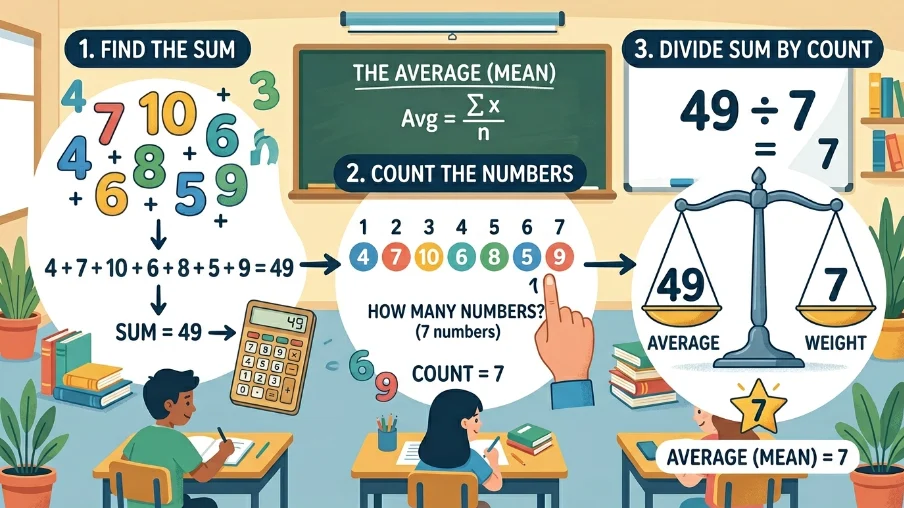
The mean in math is the average of a set of numbers. You calculate it by adding all values together and dividing the total by how many values exist. It represents the central value of a dataset and helps describe typical or expected outcomes in mathematics, statistics, and real-life situations like grades, income, or performance tracking.
What Does Mean in Math Mean? Understanding the Core Idea
Let’s clear up something that confuses a lot of students right away.
When people ask what does mean in math, they are not talking about attitude or behavior. In mathematics, the word mean has a very specific and useful meaning.
It refers to the average value of a set of numbers.
That’s it. Simple idea, powerful use.
If you’ve ever shared snacks with friends and tried to split them equally, you’ve already worked with the idea of the mean without realizing it. You add everything together, then divide so everyone gets an equal share.
That’s the heart of it.
The meaning of mean in mathematics is about fairness and balance. It shows what each value would be if everything were shared equally.
Mean in Math Definition Explained in Simple Words
Let’s define it clearly:
Mean in math definition: The mean is the sum of all numbers in a dataset divided by the total number of values.
Or even simpler:
Mean = total of values ÷ number of values
This is also called the average mean in math or arithmetic mean definition in statistics.
You’ll see it everywhere:
- School grades
- Weather reports
- Sports statistics
- Business reports
- Science experiments
It’s one of the most common tools used to understand data.
Why the Mean Matters in Mathematics and Real Life
Numbers alone don’t tell a story. The mean helps turn raw numbers into meaning.
For example:
Imagine three students scored:
- 40
- 60
- 100
Without the mean, these are just random scores.
But when we calculate the mean:
- Total = 200
- Number of values = 3
- Mean = 66.67
Now we understand the average performance level of the group.
That’s the power of the mean in math.
It gives you a central value that represents the whole dataset.
Mean Formula in Mathematics
Let’s break down the mean formula in mathematics clearly.
Basic formula:
Mean = (Sum of all values) ÷ (Total number of values)
Expanded form:
If you have values:
x₁, x₂, x₃ … xₙ
Then:
Mean = (x₁ + x₂ + x₃ + … + xₙ) ÷ n
Where:
- x = values
- n = number of values
This is the foundation of how to calculate average in math.
Step-by-Step: How to Find the Mean in Math
Let’s walk through a simple process.
Step 1: Write the numbers clearly
Example: 5, 10, 15, 20
Step 2: Add them together
5 + 10 + 15 + 20 = 50
Step 3: Count how many numbers there are
There are 4 values
Step 4: Divide the total by the count
50 ÷ 4 = 12.5
Final answer:
Mean = 12.5
That’s the average calculation steps in action.
Real Meaning of Mean of Numbers Explained
The mean of numbers explained in simple terms is this:
It is the number that represents all values equally.
Think of it like sharing pizza slices equally among friends. Even if someone eats more or less, the mean shows what each person would get if everything were divided evenly.
That’s why the mean is often called a central tendency in statistics.
It finds the center point of your data.
Simple Average Formula vs Mean in Math
People often confuse the term “average” with mean.
Let’s clear it up.
| Term | Meaning | Usage |
|---|---|---|
| Mean | Sum ÷ count | Statistics, mathematics |
| Average | General term for central value | Everyday language |
| Median | Middle value | Skewed data |
| Mode | Most frequent value | Repeated data |
So yes, average mean in math usually refers to the arithmetic mean.
But “average” in everyday language can mean different things depending on context.
Meaning of Mean Symbol in Math
The what does mean symbol mean in math question usually refers to notation.
The mean is often represented as:
x̄ (x-bar)
This symbol represents the sample mean in statistics.
For population mean, we use:
μ (mu)
Example:
- x̄ = 75 → sample average
- μ = 75 → population average
These symbols are very important in advanced math and statistics.
Mean vs Median vs Mode: Key Differences
Understanding statistical mean explained fully requires comparing it with other measures.
Mean
- Add values and divide
- Sensitive to extreme values
Median
- Middle number in sorted data
- Not affected by outliers
Mode
- Most repeated value
- Useful for frequency analysis
Example dataset:
2, 3, 3, 4, 100
- Mean = 22.4 (skewed by 100)
- Median = 3
- Mode = 3
This shows why choosing the right measure matters.
Why the Mean Can Sometimes Be Misleading
Here’s something important most students miss.
The mean is not always perfect.
If one value is extremely high or low, it can distort the result.
Example:
Salaries in a company:
- 5 employees earn $30,000
- 1 CEO earns $500,000
Mean salary becomes very high, even though most people earn much less.
This is why analysts often prefer median in such cases.
Weighted Mean Explanation (Advanced but Practical)
Not all numbers carry equal importance.
That’s where weighted mean explanation becomes useful.
Formula idea:
Weighted Mean = (Value × Weight) ÷ Sum of weights
Example:
- Test = 80 (weight 70%)
- Homework = 90 (weight 30%)
Weighted mean:
(80×0.7 + 90×0.3) = 56 + 27 = 83
So final grade = 83
This is used heavily in schools and data analysis.
How to Calculate Average of Numbers in Real Life
You already use mean without noticing.
Here are real-life examples:
1. Grades
Your final score is an average of all tests.
2. Sports
Players are judged by average performance.
3. Finance
Banks calculate average income for loans.
4. Weather
Meteorologists use average temperatures.
5. Daily life
You calculate average spending each week.
Mean in Statistics Examples
Let’s go deeper into mean in statistics examples.
Example 1: Exam scores
60, 70, 80, 90
Mean = 75
Example 2: Daily temperatures
30°C, 32°C, 35°C, 33°C
Mean = 32.5°C
Example 3: Sales data
100, 150, 200, 250
Mean = 175
These examples show how the mean smooths out variations.
Data Set Average Calculation: Why It Works
The mean works because it balances total value across entries.
Think of it like a seesaw.
If one side goes up, another must adjust to balance it.
That’s why the mean always “centers” the data.
It doesn’t care about order. It only cares about total sum and count.
Common Mistakes When Finding the Mean
Students often make simple but costly mistakes.
Mistake 1: Forgetting to divide
They add numbers but skip division.
Mistake 2: Counting wrong values
Missing or double-counting numbers changes results.
Mistake 3: Mixing data types
Combining unrelated values (like hours and money).
Mistake 4: Ignoring decimals
Rounding too early causes errors.
Avoiding these makes your calculations accurate.
Quick Practice Problems (With Answers)
Let’s test your understanding.
Problem 1
Find mean of: 10, 20, 30
Answer: 20
Problem 2
Find mean of: 5, 15, 25, 35
Answer: 20
Problem 3
Find mean of: 100, 200, 300
Answer: 200
Problem 4
Find mean of: 2, 4, 6, 8, 10
Answer: 6
Central Tendency in Statistics: Where Mean Fits
The mean is part of a bigger concept called central tendency in statistics.
It includes:
- Mean
- Median
- Mode
Together, they describe the center of a dataset.
The mean is the most mathematically precise but also the most sensitive.
Why the Mean Is Used in Data Science and AI
Modern systems rely heavily on averages.
In data science:
- Mean helps clean datasets
- It smooths noise in signals
- It helps train AI models
- It summarizes large data quickly
Without mean, interpreting massive datasets would be chaotic.
Real-World Insight: Mean Beyond the Classroom
The mean isn’t just school math.
It shapes decisions in:
- Economics
- Healthcare
- Engineering
- Technology
- Sports analytics
For example, hospitals use average recovery times to improve treatment methods.
Businesses use average sales to predict future demand.
The world runs on averages more than you think.
Final Thoughts
At its core, the answer stays simple.
The meaning of mean in mathematics is the fair center of numbers.
You add everything. You divide. You find balance.
That’s it.
But behind that simple idea sits a powerful tool used in science, business, and everyday life.
Once you understand it, numbers stop feeling random. They start telling stories.

Sophia Bennett is a professional writer focused on explaining word meanings, expressions and everyday language in a simple and engaging way.