
Last Updated on June 12, 2026
Collagen is the most abundant protein in the human body, making up roughly 30% of total protein mass. It acts as the primary structural scaffold holding skin firm, cushioning joints, strengthening bones, supporting tendons, and maintaining connective tissue throughout the body. Collagen gives skin its elasticity and hydration, keeps cartilage resilient, helps bones resist fracture, and promotes wound healing. After age 25, the body naturally produces less collagen each year leading to wrinkles, joint stiffness, and reduced bone density. You can support collagen production through vitamin C-rich foods, collagen peptide supplements, bone broth, and protein-dense nutrition.
What Is Collagen, Exactly?
Think of collagen as the body’s internal scaffolding. Without it, everything sags, cracks, and breaks down.
Collagen is a structural protein the single most abundant protein in the human body, accounting for roughly 30% of the body’s total protein content. The word itself comes from the Greek kólla, meaning glue, which perfectly captures what it does. It literally holds you together.
Structurally, collagen consists of long chains of amino acids primarily glycine, proline, and hydroxyproline wound tightly into a triple helix. That triple-helix shape is what gives collagen its extraordinary tensile strength. Pound for pound, collagen fibers are stronger than steel wire of the same diameter. That’s not a marketing claim. That’s biomechanics.
Your body uses collagen to build and reinforce:
- Skin (dermis layer)
- Tendons and ligaments
- Cartilage and joints
- Bones and teeth
- Corneas and blood vessels
- The gut lining
- Muscles and fascia
So when someone asks what is collagen used for the honest answer is: almost everything structural in your body.
The Different Types of Collagen in Your Body
Not all collagen is the same. Scientists have identified 28 distinct types of collagen in the human body but the vast majority of collagen falls into five main categories. Each one has a specific job.
| Type | Location | Primary Function |
|---|---|---|
| Type I | Skin, tendons, bones, ligaments, teeth | Tensile strength; most abundant type (90% of total body collagen) |
| Type II | Cartilage, eyes | Cushioning and shock absorption in joints |
| Type III | Blood vessels, organs, muscles | Structural support in soft tissue |
| Type IV | Skin layers, kidneys, ear | Forms basement membranes and filters |
| Type V | Corneas, hair, placenta | Works alongside Type I; regulates fiber formation |
Type I collagen alone makes up approximately 90% of the collagen in your body. It’s the workhorse. When you hear about collagen for skin or bone health, Type I is usually the star of the show. Type II, on the other hand, is the go-to for joint and cartilage support which is why many joint-health supplements specifically source Type II collagen from chicken sternum or bovine cartilage.
“Collagen is the main component of connective tissue and is the most abundant protein in mammals, comprising approximately 25%–35% of the whole-body protein content.” Journal of Cosmetic Dermatology
Understanding these types matters because it shapes which supplement or dietary approach makes sense for your specific goals.
What Does Collagen Do for Your Skin?
This is where most people start and for good reason. Collagen and skin health are deeply intertwined.
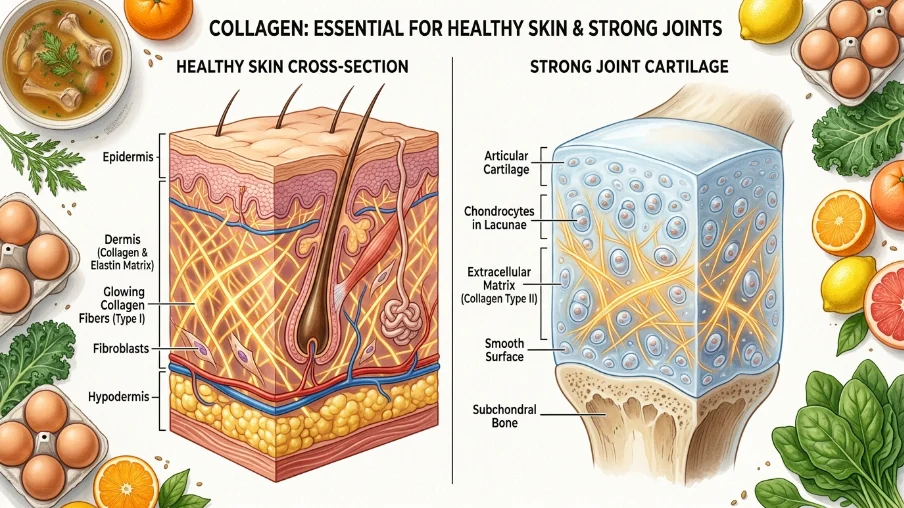
The dermis the middle layer of your skin is made up of roughly 75–80% collagen. This dense network of collagen fibers gives skin its:
- Firmness — resistance to gravity and pressure
- Elasticity — the ability to bounce back after being stretched
- Hydration — collagen binds water molecules, keeping skin plump
- Wound-healing capacity — collagen scaffolds repair sites where tissue has been damaged
When collagen levels are high, skin appears smooth, plump, and youthful. As levels decline which starts in your mid-20s skin begins to thin, lose elasticity, and form wrinkles. The nasolabial folds (those lines from nose to mouth) and crow’s feet are classic signs of collagen depletion in the dermis.
How Collagen Affects Wrinkles
Wrinkles don’t form just because skin gets dry. They form because the collagen and elastin scaffolding beneath the skin weakens. Without that internal support, the skin can’t spring back the way it used to. UV radiation accelerates this process UV rays break down collagen fibers and generate free radicals that interfere with new collagen synthesis.
A 2014 study published in Skin Pharmacology and Physiology found that women who took 2.5g of collagen peptides daily for 8 weeks showed a 20% reduction in eye wrinkle depth compared to placebo. Skin elasticity improved by 7% after 4 weeks and by 15% after 8 weeks.
Collagen and Skin Hydration
Collagen contains a high concentration of hydroxyproline, an amino acid that strongly attracts water. Think of it like a sponge embedded in your skin. Well-hydrated skin looks fuller, reflects light better, and resists the formation of fine lines more effectively than dehydrated skin.
Key skin benefits of collagen:
- Reduces the appearance of fine lines and wrinkles
- Improves skin elasticity and firmness
- Enhances skin moisture retention
- Accelerates wound healing and scar repair
- Supports the skin barrier against environmental damage
What Does Collagen Do for Your Joints and Cartilage?
Joint health is one of the most evidence-backed areas of collagen function and one of the most practically important, especially as you age.
Cartilage is the rubbery tissue that cushions the ends of bones in joints like your knees, hips, and shoulders. It has no blood supply it relies on the fluid in your joints for nutrients. And approximately 60–70% of cartilage’s dry weight is Type II collagen.
That collagen creates a mesh-like matrix that:
- Absorbs shock during movement
- Prevents bone-on-bone friction
- Distributes mechanical loads evenly across the joint
- Maintains the structural integrity of the joint over decades of use
When collagen in cartilage degrades faster than it’s replaced which happens with age, overuse, injury, or poor nutrition the result is osteoarthritis. This is one of the most common joint conditions worldwide, affecting over 500 million people globally according to the World Health Organization.
Clinical Evidence for Collagen and Joint Health
A randomized controlled trial published in Current Medical Research and Opinion followed 147 athletes who took 10g of collagen hydrolysate daily for 24 weeks. The results showed statistically significant reductions in joint pain during activity compared to placebo particularly in the knee.
Another study published in Osteoarthritis and Cartilage demonstrated that undenatured Type II collagen (UC-II) significantly reduced knee joint discomfort and improved mobility in subjects with knee osteoarthritis often outperforming glucosamine and chondroitin in head-to-head comparisons.
What collagen does for your joints:
- Maintains cartilage thickness and resilience
- Reduces joint inflammation and discomfort
- Supports tendon and ligament repair
- Improves mobility and flexibility
- May slow the progression of osteoarthritis
What Does Collagen Do for Your Bones?
Here’s something most people overlook: bones aren’t just calcium. Bone tissue is actually about 35% organic material and collagen makes up roughly 90% of that organic matrix.
Think of bone like reinforced concrete. Calcium and phosphate minerals give bones their hardness. Collagen gives them their flexibility the quality that prevents bones from shattering under impact the way pure mineral would. Together they create a material that’s simultaneously hard and resilient.
This means collagen isn’t just a “skin thing.” It’s fundamental to bone density and fracture resistance.
Collagen, Bone Density, and Osteoporosis
As collagen production declines with age, the collagen matrix in bone becomes thinner and less organized. This doesn’t just reduce overall bone mass it changes the microarchitecture of bone, making it more porous and brittle. This is a core driver of osteoporosis, which affects an estimated 200 million women worldwide.
Postmenopausal women are particularly vulnerable because estrogen plays a role in stimulating collagen synthesis. When estrogen levels drop at menopause, collagen production decreases rapidly accelerating both skin aging and bone loss simultaneously.
A 2018 study in Nutrients found that postmenopausal women who took 5g of specific collagen peptides daily for 12 months showed significantly greater increases in bone mineral density compared to placebo particularly in the spine and femoral neck (the top of the thighbone, a common fracture site).
What collagen does for bones:
- Forms the structural scaffold that holds calcium and minerals in place
- Gives bone flexibility to resist fracture under impact
- Supports ongoing bone remodeling and repair
- May help slow bone density loss associated with aging and osteoporosis
What Does Collagen Do for Your Gut?
The gut lining is a single-cell-thick barrier separating the contents of your digestive tract from your bloodstream. It’s remarkably thin and collagen is critical to keeping it intact.
Collagen is found throughout the layers of the gastrointestinal tract, particularly in the connective tissue that makes up the gut wall. It supports the structural integrity of the intestinal lining and plays a role in the tight junctions between intestinal cells the seals that prevent undigested food particles, toxins, and bacteria from leaking into the bloodstream.
When those tight junctions weaken a condition sometimes called increased intestinal permeability or “leaky gut” inflammatory responses can follow throughout the body.
Glycine, one of the primary amino acids in collagen, has demonstrated anti-inflammatory properties in gut tissue. It helps regulate the immune response in the gut mucosa and may support the repair of damaged intestinal cells.
Collagen’s role in gut health:
- Supports the structural integrity of the gut wall
- Helps maintain tight junctions in the intestinal lining
- Provides glycine, which has anti-inflammatory effects in gut tissue
- May support recovery from conditions like irritable bowel syndrome (IBS) and leaky gut
What Does Collagen Do for Hair and Nails?
Hair and nails aren’t made of collagen themselves they’re made of keratin, a different structural protein. But collagen still plays an essential supporting role.
Collagen and Hair Growth
The scalp contains a dense network of collagen in the dermis that surrounds each hair follicle. This collagen matrix:
- Anchors hair follicles securely in the scalp
- Provides structural support during the hair growth cycle
- Supplies the amino acids (particularly proline) that cells use to build keratin
Collagen also contains antioxidant properties specifically, the amino acid proline can fight free radicals that damage hair follicles and contribute to hair thinning. As scalp collagen weakens with age, the follicle anchoring weakens too which is one reason hair becomes thinner and more prone to shedding as we get older.
Collagen and Nail Strength
A 2017 study in the Journal of Cosmetic Dermatology found that daily supplementation with 2.5g of bioactive collagen peptides for 24 weeks increased nail growth rate by 12% and reduced broken nails by 42%. About 80% of participants reported visible improvement in nail quality, with benefits persisting for 4 weeks after supplementation stopped.
Collagen helps hair and nails by:
- Strengthening the dermal layer surrounding hair follicles
- Providing amino acids needed for keratin production
- Fighting oxidative damage to follicle cells
- Improving nail growth rate and reducing brittleness
What Does Collagen Do for Muscles?
Muscle tissue contains collagen primarily in the fascia (the connective tissue sheath surrounding and separating muscles) and the endomysium (the tissue surrounding individual muscle fibers). About 1–10% of muscle tissue is made up of collagen depending on the muscle type.
This collagen network transmits the mechanical force generated by muscle fibers to tendons and bones, enabling movement. Without it, even strong muscles can’t move the body efficiently.
After exercise, the body ramps up collagen synthesis in muscle connective tissue this is part of the recovery and adaptation process. Several studies have shown that consuming collagen peptides in the hours around exercise enhances the body’s collagen synthesis response compared to exercise alone or other protein sources.
A 2015 study published in the American Journal of Clinical Nutrition found that subjects who consumed 15g of collagen peptides 1 hour before exercise showed significantly increased collagen synthesis markers compared to placebo suggesting collagen supplementation can enhance the connective tissue repair triggered by physical activity.
Collagen’s role in muscle health:
- Supports fascial tissue that surrounds and protects muscles
- Transmits muscle force to tendons and bones
- Supports tendon repair and injury recovery
- May enhance connective tissue adaptation to resistance training
What Happens When Collagen Levels Drop?
This is where things get real. Collagen production begins declining around age 25 and drops by approximately 1–1.5% per year after that. By age 50, many people have lost 30–40% of their peak collagen levels. By age 60, the decline can exceed 50%.
The effects aren’t subtle.
| Age Range | Typical Collagen-Related Changes |
|---|---|
| Mid-20s | Collagen synthesis begins slowing; very early fine lines may appear |
| 30s | Skin elasticity noticeably reduced; joint recovery takes longer |
| 40s | Deeper wrinkles; more frequent joint stiffness; reduced bone density measurable |
| 50s+ | Significant skin sagging; increased osteoporosis risk; cartilage thinning accelerates |
Beyond cosmetic concerns, declining collagen has real clinical implications:
- Increased fracture risk due to weakened bone matrix
- Faster cartilage degradation leading to joint pain and mobility issues
- Reduced wound healing — older skin heals more slowly partly because collagen synthesis is impaired
- Weakened blood vessel walls — arterial walls contain significant collagen; their loss contributes to increased cardiovascular risk with age
- Gut lining compromise — increased intestinal permeability risk
Understanding this timeline answers the question many people ask: why is collagen important? It’s important because losing it isn’t just a cosmetic problem. It’s a systemic aging process with consequences across nearly every organ system.
How Does Collagen Production Work?
Your body doesn’t get collagen from food directly. Instead, it manufactures collagen from raw materials primarily amino acids from dietary protein in a process called collagen synthesis.
Here’s how it works step by step:
Step 1 — Amino Acid Assembly: Cells called fibroblasts (in skin, tendons, and bone) and chondrocytes (in cartilage) take amino acids primarily glycine, proline, and hydroxyproline and assemble them into long polypeptide chains.
Step 2 — Hydroxylation: An enzyme called prolyl hydroxylase modifies proline residues. This step is entirely dependent on vitamin C (ascorbic acid) as a cofactor. No vitamin C = no hydroxylation = defective collagen. This is why sailors historically developed scurvy a catastrophic breakdown of collagen throughout the body.
Step 3 — Triple Helix Formation: Three polypeptide chains wind together into a stable triple helix the characteristic structure of collagen.
Step 4 — Secretion and Crosslinking: The triple helices are secreted out of cells and then cross-linked into collagen fibers by the enzyme lysyl oxidase (which requires copper to function).
Step 5 — Fiber Organization: Individual fibers organize into larger collagen fiber bundles adapted to the mechanical demands of the tissue.
This means collagen production requires:
- Adequate protein intake (for amino acids)
- Vitamin C (critical cofactor for hydroxylation)
- Copper (for crosslinking via lysyl oxidase)
- Zinc (supports fibroblast activity)
- Silica and manganese (minor but supportive roles)
Deficiency in any of these nutrients impairs the entire chain.
What Foods Help Your Body Produce Collagen Naturally?
You can support natural collagen production through two dietary strategies: eating collagen-containing foods (which provide pre-formed collagen peptides) and eating foods that supply the nutrients needed for collagen synthesis.
Collagen-Rich Foods
| Food | Type of Collagen | Best For |
|---|---|---|
| Bone broth | Type I, II, III | Skin, joints, gut |
| Chicken skin/tendons | Type II | Joints and cartilage |
| Fish and fish skin | Type I | Skin and bone |
| Egg whites | Procollagen precursors | Connective tissue |
| Pork skin | Type I, III | Skin and vascular tissue |
Foods That Boost Collagen Synthesis
These don’t contain collagen but provide the building blocks your body needs to make it:
| Nutrient | Role in Collagen Production | Best Food Sources |
|---|---|---|
| Vitamin C | Essential cofactor for hydroxylation | Bell peppers, kiwi, citrus, strawberries, guava |
| Proline | Core structural amino acid | Egg whites, dairy, beef, cabbage, asparagus |
| Glycine | Most abundant amino acid in collagen | Bone broth, gelatin, pork skin, chicken skin |
| Copper | Required for lysyl oxidase crosslinking | Shellfish (especially oysters), nuts, seeds, liver |
| Zinc | Supports fibroblast activity | Red meat, shellfish, legumes, nuts, seeds |
| Vitamin A | Regulates collagen gene expression | Sweet potato, carrots, liver, leafy greens |
| Anthocyanins | Antioxidants that protect collagen from breakdown | Blueberries, blackberries, cherries |
| Sulfur | Required for collagen crosslinking | Onions, garlic, leeks, eggs |
Combining a vitamin C-rich food with a collagen or protein source at the same meal is a simple way to maximize your body’s synthesis capacity. Think salmon with a lemon-dressed salad or scrambled eggs with bell peppers.
Do Collagen Supplements Actually Work?
For a long time, scientists were skeptical. The argument went: collagen is a protein, and when you eat protein, your digestive system breaks it into individual amino acids losing the collagen structure entirely. Why would taking collagen be better than taking any other protein?
The answer turned out to be more interesting than expected.
Research now shows that when you consume hydrolyzed collagen (collagen peptides), the digestion process doesn’t fully break it down to single amino acids. Specific dipeptides and tripeptides particularly hydroxyproline-containing fragments like Pro-Hyp and Hyp-Gly are absorbed intact through the gut wall and enter the bloodstream. These peptides have been detected in human blood within 1–2 hours of consumption.
Once in circulation, these bioactive peptides signal fibroblasts to produce more collagen. They act as biological messengers, telling the body that collagen is being broken down and triggering a repair response a process sometimes called the “feedback stimulation” mechanism.
This is the key insight: collagen peptides don’t just provide amino acids. They send a collagen-synthesis signal.
What the Research Shows
| Study | Dose | Duration | Outcome |
|---|---|---|---|
| Proksch et al. (2014) — Skin Pharmacology and Physiology | 2.5g collagen peptides/day | 8 weeks | 20% reduction in eye wrinkle depth; 15% increase in skin elasticity |
| Shaw et al. (2017) — American Journal of Clinical Nutrition | 15g collagen peptides before exercise | 6 months | Significant increase in collagen synthesis markers in connective tissue |
| König et al. (2018) — Nutrients | 5g specific collagen peptides/day | 12 months | Significant increases in bone mineral density in postmenopausal women |
| Clark et al. (2008) — Current Medical Research and Opinion | 10g collagen hydrolysate/day | 24 weeks | Significant reduction in joint pain in athletes |
| Hexsel et al. (2017) — Journal of Cosmetic Dermatology | 2.5g collagen peptides/day | 24 weeks | 12% faster nail growth; 42% reduction in broken nails |
The evidence isn’t perfect more large-scale trials are needed but the accumulating body of research is more robust than critics initially expected.
The bottom line: Collagen supplements, particularly hydrolyzed collagen peptides, appear to provide meaningful benefits for skin elasticity, joint comfort, bone density, and connective tissue repair when taken consistently at adequate doses (typically 2.5g–15g per day depending on the goal).
Hydrolyzed Collagen vs. Collagen Peptides — What’s the Difference?
Short answer: they’re essentially the same thing, just described differently.
Hydrolyzed collagen refers to collagen that has been broken down through hydrolysis (the addition of water molecules, typically via enzymatic or acid treatment) into smaller fragments called peptides.
Collagen peptides is simply another name for the same product short chains of amino acids derived from collagen through hydrolysis.
Both terms describe a form of collagen that’s:
- More easily dissolved in liquids (including cold water)
- More rapidly digested and absorbed than intact collagen
- More bioavailable than gelatin or unprocessed collagen
- Rich in the bioactive dipeptides and tripeptides (Pro-Hyp, Hyp-Gly) that stimulate fibroblast collagen production
Gelatin is a related but distinct product it’s partially hydrolyzed collagen that dissolves in hot water but gels when cooled. It contains similar amino acids but its absorption profile differs, and it doesn’t dissolve in cold liquid.
Collagen Sources in Supplements
| Source | Primary Collagen Type | Notes |
|---|---|---|
| Bovine (cow) | Type I, III | Most common; good for skin, bone, muscle |
| Marine (fish) | Type I | Smaller peptides; potentially higher bioavailability; good for skin |
| Chicken | Type II | Preferred for joint and cartilage support |
| Egg | Type I, V | Good amino acid profile; suitable for those avoiding animal tissue |
| Porcine (pig) | Type I, III | Similar profile to bovine |
Marine collagen has attracted particular interest because its peptide size is smaller than bovine collagen potentially allowing faster absorption. It also has a higher hydroxyproline content, which may make it especially effective for skin health.
How to Increase Collagen Naturally
You don’t need to rely solely on supplements. Several lifestyle practices meaningfully support natural collagen production.
Dietary Strategies
- Eat adequate protein daily — aim for at least 0.8g per kg of body weight; higher if you’re active
- Prioritize vitamin C — 75–90mg daily minimum (though higher intakes may better support collagen synthesis)
- Include bone broth regularly — it’s one of the richest natural sources of collagen peptides
- Eat zinc and copper-rich foods — oysters, pumpkin seeds, cashews, liver
- Limit ultra-processed foods — refined sugars accelerate collagen glycation and breakdown
Lifestyle Practices
- Apply SPF daily — UV radiation is the single biggest external driver of collagen degradation in skin
- Don’t smoke — smoking dramatically reduces collagen synthesis and accelerates structural breakdown in skin and blood vessels
- Get adequate sleep — growth hormone (released during deep sleep) stimulates collagen synthesis
- Exercise regularly — mechanical loading through weight-bearing exercise stimulates collagen production in bones, tendons, and cartilage
- Manage chronic stress — cortisol directly inhibits collagen synthesis; elevated chronic stress accelerates collagen loss
Topical Approaches for Skin
- Retinoids (vitamin A derivatives) — the most evidence-backed topical ingredient for stimulating dermal collagen production
- Vitamin C serums — topical ascorbic acid supports collagen synthesis in the dermis and neutralizes UV-generated free radicals
- Peptide creams — certain topical peptides (like palmitoyl tripeptide-1) signal fibroblasts to produce more collagen
- Niacinamide — supports the extracellular matrix and complements collagen-building processes
What Destroys Collagen?
Supporting collagen production is only half the equation. Understanding what breaks collagen down lets you stop undermining your own efforts.
| Collagen Destroyer | Mechanism | Impact |
|---|---|---|
| UV radiation | Generates free radicals; activates collagenase enzymes that degrade collagen fibers | Skin aging, wrinkles, loss of elasticity |
| Cigarette smoking | Reduces blood flow; generates oxidative stress; activates collagen-degrading enzymes | Accelerated skin aging; impaired wound healing |
| High sugar intake | Glycation — sugar molecules attach to collagen fibers, making them rigid and dysfunctional | Stiff, cross-linked collagen; accelerated skin aging |
| Chronic inflammation | Inflammatory cytokines activate MMPs (matrix metalloproteinases) that degrade collagen | Breakdown in joints, skin, gut, and vascular tissue |
| Chronic stress | Cortisol directly suppresses collagen synthesis and activates collagen degradation | Thinning skin; slower healing |
| Alcohol | Impairs liver function; reduces collagen synthesis; dehydrates skin | Weakened collagen structure throughout body |
| Nutrient deficiencies | Inadequate vitamin C, zinc, copper, or protein impairs synthesis at multiple stages | Defective collagen formation; reduced production |
| Age | Fibroblast activity declines; antioxidant defenses weaken; hormonal support diminishes | Progressive, inevitable decline (but manageable) |
The biggest takeaway here: UV protection and quitting smoking are the two most impactful actions you can take to preserve existing collagen in skin. No supplement can fully compensate for daily unprotected sun exposure or the oxidative damage of smoking.
Collagen by the Numbers — Key Facts at a Glance
Here’s a quick-reference summary of the most important collagen statistics and facts:
| Fact | Figure |
|---|---|
| Collagen as % of body’s total protein | ~30% |
| Collagen as % of skin’s dry weight | ~75–80% |
| Collagen as % of bone’s organic matrix | ~90% |
| Collagen as % of cartilage’s dry weight | ~60–70% |
| Number of collagen types identified | 28 |
| Age collagen production begins declining | ~25 years |
| Annual rate of collagen loss after 25 | ~1–1.5% per year |
| Collagen loss by age 50 (approximate) | 30–40% |
| Effective supplement dose for skin | 2.5g–10g/day |
| Effective supplement dose for joints | 10g–15g/day |
| Effective supplement dose for bones | 5g/day |
| Time to see skin results from supplementation | 4–12 weeks |
| Global osteoarthritis patients (WHO) | 500 million+ |
| Global osteoporosis cases (predominantly women) | 200 million+ |
Frequently Asked Questions
What does collagen do for your skin specifically?
Collagen forms the structural framework of the skin’s dermis layer. It maintains firmness, elasticity, and hydration. As collagen levels decline with age, skin loses its ability to bounce back resulting in sagging and wrinkles. Supplementing with collagen peptides and protecting skin from UV exposure can slow this process.
What does collagen do for your joints?
Collagen specifically Type II collagen makes up the bulk of cartilage, the tissue that cushions joints. It prevents bone-on-bone friction, absorbs shock, and maintains joint mobility. Declining cartilage collagen is a primary driver of osteoarthritis and joint pain.
What happens when collagen levels drop?
When collagen levels fall, the consequences span multiple body systems: wrinkles and skin sagging, joint stiffness and pain, reduced bone density, slower wound healing, and potentially compromised gut lining integrity. These changes begin subtly in the mid-20s and become progressively more noticeable through the 40s and 50s.
How can you increase collagen naturally?
Eat adequate protein, prioritize vitamin C-rich foods, consume bone broth or collagen-containing foods regularly, protect skin from UV radiation daily, avoid smoking, manage stress, and get quality sleep. Weight-bearing exercise also stimulates collagen production in bones and connective tissue.
Is collagen only for women?
Absolutely not. Men lose collagen with age just as women do though men tend to lose it more gradually until later in life. Men benefit equally from the joint, bone, and muscle connective tissue support that collagen provides. Many elite male athletes now routinely use collagen peptide supplementation as part of injury prevention and recovery protocols.
When is the best time to take collagen supplements?
For connective tissue and sports recovery: 30–60 minutes before exercise, combined with vitamin C, appears to maximize the collagen synthesis response triggered by physical activity. For general skin and systemic benefits, timing appears less critical consistency matters more than timing.
Conclusion
Collagen isn’t a wellness trend or a marketing invention. It’s the most abundant protein in your body and the structural foundation of nearly every tissue that holds you together skin, joints, bones, tendons, gut lining, blood vessels, and more.
Understanding what collagen does means understanding that protecting and supporting your collagen levels isn’t vanity. It’s fundamental biology. The good news is you have more control than you think. Daily SPF, quitting smoking, adequate protein and vitamin C intake, quality sleep, and strategic supplementation all meaningfully support your body’s collagen system.
Start now not because it’s trendy, but because every year without that support is a year of preventable decline. The scaffolding matters. Take care of it.

Michael Anderson is a content writer specializing in word meanings, definitions and clear explanations of modern terms and phrases.