Last Updated on July 6, 2026
Tralalero Tralala does not have a direct English translation because it is made up of musical filler words rather than meaningful vocabulary. In Italian, “tralalero” and “tralala” function as vocal refrains similar to the English expressions “la-la-la,” “tra-la-la,” or “fa-la-la.” Traditionally, they appeared in songs to carry a melody without adding literal meaning. Today, the phrase has gained a new life through TikTok and internet meme culture, where it represents absurd humor, AI-generated content, and viral “brainrot” memes rather than a specific message.
If you’ve spent even a few minutes scrolling through TikTok, Instagram Reels, or YouTube Shorts lately, you’ve probably heard someone repeating “Tralalero Tralala.” The phrase appears in AI-generated videos, surreal animations, parody songs, and countless memes that seem completely random.
That naturally raises one question:
What does Tralalero Tralala mean in English?
The short answer is surprisingly simple.
Despite sounding like a meaningful Italian sentence, Tralalero Tralala isn’t actually a sentence at all. It doesn’t describe an object, express an emotion, or tell a story. Instead, it’s a collection of musical syllables traditionally used during singing. Think of it as the Italian equivalent of saying “la-la-la” while humming a tune.
The modern internet, however, gave the phrase an entirely different identity.
Today, Tralalero Tralala has become part of online meme culture, especially among younger audiences who enjoy absurdist humor. In many viral videos, the phrase intentionally accompanies bizarre AI-generated visuals or nonsensical storylines. The lack of a logical meaning is exactly what makes it funny.
This article explains everything you need to know, including:
- The English meaning
- The literal translation
- Whether it’s real Italian
- Its history in music
- Why it became a viral meme
- How people use it today
- Common misconceptions
- Frequently asked questions
By the end, you’ll understand why millions of people recognize the phrase despite the fact that it doesn’t actually translate into ordinary English.
What Does Tralalero Tralala Mean in English?
The English meaning of Tralalero Tralala is best understood as:
“Tra-la-la,” “la-la-la,” or other meaningless singing sounds used to carry a melody.
Unlike ordinary words, these syllables don’t have dictionary definitions. They serve as vocal refrains rather than vocabulary.
In English, people often sing phrases such as:
- La-la-la
- Tra-la-la
- Fa-la-la
- Dum-de-dum
- Na-na-na
Italian uses similar vocal sounds, including Tralala and Tralalero, to fill space within a melody.
The simplest English equivalent
| Italian Expression | Closest English Equivalent | Literal Meaning |
| Tralala | Tra-la-la | None |
| Tralalero | Extended musical refrain | None |
| Tralalero Tralala | Tra-la-la, la-la-la | No literal translation |
Notice something important.
The English version doesn’t translate word for word because there aren’t actual words to translate.
Instead, translators replace the phrase with an equivalent singing sound that feels natural in English.
Why there isn’t a literal translation
Many languages include expressions that exist only because they sound pleasant while singing.
These expressions usually:
- Keep the rhythm flowing
- Fill pauses between lyrics
- Make songs easier to remember
- Add emotion without using vocabulary
That’s exactly what Tralalero Tralala does.
Rather than asking, “What does each word mean?” it’s more accurate to ask:
“What role does this phrase play?”
Its role is musical, not linguistic.
Tralalero Tralala Meaning
Although people often search for Tralalero Tralala meaning, the answer depends on the context.
Traditional meaning
Historically, the phrase acted as a musical refrain in Italian singing traditions.
It functioned much like:
- humming
- whistling
- repeating “la-la-la”
- singing without lyrics
The performer focused on melody instead of words.
Modern internet meaning
On today’s internet, the phrase carries a completely different cultural meaning.
Instead of representing music, it often symbolizes:
- absurd humor
- randomness
- intentionally nonsensical comedy
- AI-generated content
- surreal memes
- chaotic internet entertainment
When viewers hear Tralalero Tralala in a meme, they usually don’t expect an explanation.
The randomness itself becomes the joke.
A comparison
| Context | Meaning |
| Traditional Italian music | Vocal refrain with no literal meaning |
| Folk singing | Musical filler sounds |
| Internet memes | Symbol of absurd humor |
| TikTok trends | Viral audio associated with brainrot content |
| AI meme videos | Funny nonsense phrase |
This shift from music to meme culture explains why younger audiences often recognize the phrase without knowing its historical roots.
What Is Tralalero Tralala?
At its core, Tralalero Tralala is a sequence of rhythmic vocal syllables.
It isn’t:
- a complete sentence
- an Italian proverb
- slang with a hidden meaning
- an insult
- a greeting
- a secret code
Instead, it’s an example of nonsense words used for musical expression.
Characteristics of the phrase
Type: Vocal refrain
Language: Italian
Purpose: Musical rhythm
Literal translation: None
Modern use: Internet meme
Because the syllables sound playful and memorable, they work well in both music and comedy.
That’s one reason creators began using them repeatedly in short-form videos.
Tralalero Tralala Translation
People searching for Tralalero Tralala translation often expect an exact English sentence.
Unfortunately, no exact translation exists.
Instead, translators usually substitute an equivalent expression.
Common English translations
| Italian | English |
| Tralala | Tra-la-la |
| Tralalero | Tra-la-la refrain |
| Tralalero Tralala | Tra-la-la, la-la-la |
These versions preserve the musical feeling instead of translating nonexistent vocabulary.
Why dictionaries don’t define it
Traditional dictionaries focus on words that carry semantic meaning.
Since Tralalero functions as a sound rather than a standard lexical item, dictionaries rarely provide lengthy definitions.
Instead, language references typically classify it as:
- a vocalization
- a singing refrain
- an interjection
- a nonsensical musical expression
Tralalero Tralala English Translation
If someone asked an English speaker to perform the same melody naturally, they might replace the phrase with:
- La-la-la
- Tra-la-la
- Fa-la-la
- Na-na-na
All four communicate the same musical purpose.
None of them carry literal meaning.
That’s why Tralalero Tralala English translation always emphasizes function rather than vocabulary.
Literal versus natural translation
| Translation Type | Result |
| Literal | Impossible |
| Functional | Tra-la-la |
| Musical | La-la-la |
| Natural English | Singing syllables |
This distinction matters because translation isn’t always about replacing one word with another.
Sometimes it’s about preserving the same experience.
What Does Tralalero Mean?
Many people also search only for Tralalero.
By itself, Tralalero doesn’t carry a standalone dictionary meaning.
Instead, it’s a musical vocalization commonly associated with traditional Italian singing.
The ending “-ero” doesn’t transform it into a meaningful word.
Rather, it extends the rhythm and creates a smoother melodic flow.
You can think of it like stretching “la-la-la” into a longer pattern.
Instead of:
La-la-la
A singer might perform:
Tra-la-le-ro
The extra syllables improve rhythm without adding semantic meaning.
What Does Tralala Mean?
Compared with Tralalero, Tralala appears much more widely across different languages.
English speakers already recognize similar expressions such as:
- Tra-la-la
- La-la-la
- Fa-la-la
Each serves the same purpose.
Common uses of “Tralala”
- Singing without lyrics
- Children’s songs
- Musical theater
- Holiday music
- Humorous storytelling
- Comic performances
The phrase often conveys a carefree, playful mood.
Because it sounds cheerful, writers and musicians have used variations of Tralala for centuries.
However, it still doesn’t translate into a meaningful English sentence.
Its value comes from rhythm rather than vocabulary.
Tralalero Tralala Origin
To really understand what does tralalero tralala mean in English, you need to look at where it actually comes from. The phrase didn’t start as slang. It didn’t begin on TikTok either. Its roots sit deep in Italian musical tradition, where sound mattered more than literal meaning.
Italian folk music background
In older Italian folk songs, singers often used filler syllables to keep rhythm flowing. These syllables helped when:
- A melody needed extra beats
- Lyrics felt too tight for the tune
- Singers wanted emotional expression without words
- Group singing required simple, repeatable sounds
So instead of forcing real words, singers leaned on rhythmic vocalizations like:
- Tralalero
- Tralala
- Tra-la-la
- La-la-la
These acted like musical glue. They held songs together without changing meaning.
Think of it like humming along to a tune you don’t fully know. You’re not speaking. You’re participating in the sound.
Linguistic classification
From a language perspective, Tralalero Tralala falls into:
- Onomatopoeic expression
- Vocal refrain
- Non-lexical vocables
That last term sounds fancy, but it simply means:
Words that don’t carry meaning but help produce music.
This is common across cultures, not just Italian music.
| Culture | Example | Purpose |
| Italian | Tralalero Tralala | Singing filler |
| English | Tra-la-la / La-la-la | Melody support |
| Spanish | Ay-ay-ay (in songs) | Emotional rhythm |
| African vocal traditions | Call-and-response syllables | Rhythm and participation |
So when people ask for a “translation,” the truth is simple: there’s nothing to translate in the traditional sense.
Tralalero Tralala Meaning in Italian Context
Even in Italy today, tralalero tralala meaning in Italian is still tied to music, not slang or hidden messages.
In traditional usage
In older performances, especially folk or theatrical singing, it meant:
“Continue the melody here without using real lyrics.”
It worked like a placeholder that kept the song alive.
Singers didn’t think of it as a word. They treated it like a sound instrument.
In modern Italian usage
Modern Italians might still recognize it in three main ways:
- Children’s songs
- Lighthearted singing
- Humor or parody music
However, it’s not part of everyday spoken Italian.
You won’t hear someone in Rome casually say:
“Pass me the tralalero tralala.”
That would make no sense in conversation.
Tralalero Tralala Meme Meaning
Now here’s where things get interesting. The phrase didn’t stay stuck in folk music. It escaped into internet culture and turned into something completely different.
Today, tralalero tralala meme meaning has almost nothing to do with Italian music.
Instead, it lives in the world of:
- TikTok edits
- AI-generated videos
- absurd humor
- “brainrot” meme culture
- surreal internet storytelling
What “brainrot memes” are
The term brainrot meme refers to content that feels:
- chaotic
- nonsensical
- repetitive
- overstimulating
- intentionally meaningless
And yet, people can’t stop watching it.
Tralalero Tralala fits perfectly into that style because:
- It sounds catchy
- It has no fixed meaning
- It repeats easily
- It feels funny without explanation
Why creators use it
Creators on TikTok and Instagram Reels use the phrase because it:
- grabs attention instantly
- feels musical and rhythmic
- works well with AI voices
- adds absurd comedy to random visuals
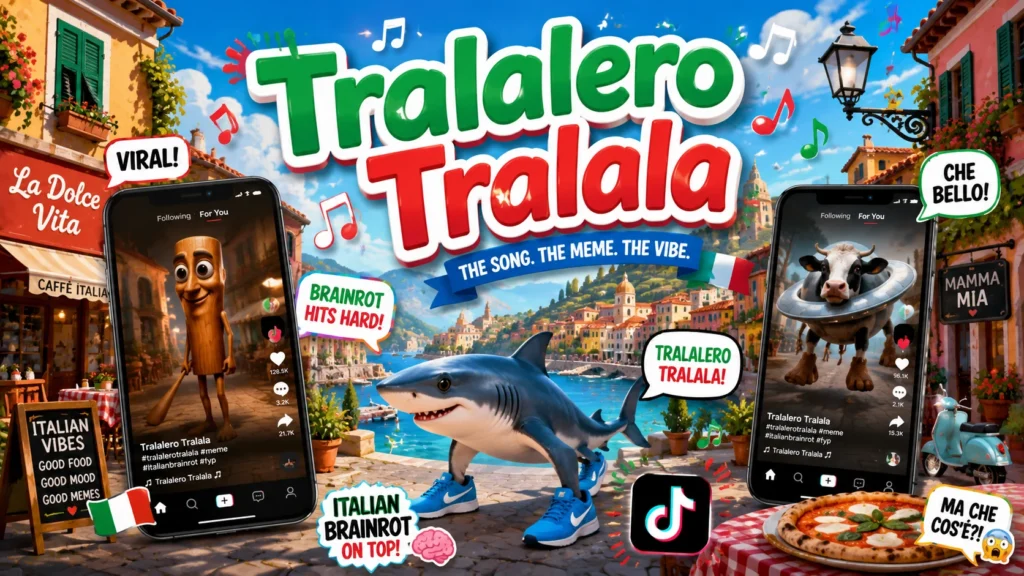
A typical meme might show:
- A shark wearing shoes
- A flying pizza talking
- A Roman statue dancing
- AI voice chanting “Tralalero Tralala” dramatically
The humor comes from the mismatch between sound and reality.
Tralalero Tralala TikTok Trend
On TikTok, the phrase exploded as part of a broader viral audio trend.
How it spreads
The trend usually follows this pattern:
- A creator uploads an AI-generated or edited video
- The audio includes “Tralalero Tralala” in a loop
- Other creators reuse the sound
- The phrase becomes a recognizable meme audio
Soon, the platform fills with variations.
Common TikTok formats
You’ll usually see:
- surreal animations with exaggerated characters
- AI voices chanting nonsense
- comedic storytelling with no plot resolution
- fast-cut edits with loud music
Why TikTok amplified it
TikTok’s algorithm favors:
- repetition
- catchy audio
- short attention spans
- remixable content
“Tralalero Tralala” checks every box.
It doesn’t need meaning. It just needs rhythm.
Tralalero Tralala Instagram Reels and YouTube Shorts
The trend didn’t stay on TikTok alone. It quickly moved across platforms.
On Instagram Reels
Creators use it for:
- meme compilations
- absurd comedy edits
- visual punchlines
Instagram audiences tend to interpret it more visually than linguistically.
On YouTube Shorts
YouTube Shorts took it further by:
- adding storytelling versions
- mixing it with animation
- pairing it with AI-generated narratives
Some Shorts even build entire “fake lore” around the phrase, turning it into fictional universes.
But at its core, it remains the same:
A meaningless vocal refrain used for comedic effect.
Tralalero Tralala Lyrics Meaning
People sometimes assume the phrase belongs to a real song.
So they search for tralalero tralala lyrics meaning expecting hidden lyrics or deep symbolism.
But here’s the reality:
There are no official lyrics
- No original song defines it
- No fixed composition exists
- No single author owns it
Instead, it appears as:
- filler in folk-style singing
- improvisational chant
- meme-generated audio
Why it feels like lyrics
Even though it’s meaningless, it feels like lyrics because:
- it repeats rhythmically
- it follows musical timing
- it sounds like part of a chorus
Our brains naturally try to assign meaning to patterns. So we assume there must be lyrics behind it.
But there aren’t.
It’s pure sound design.
Tralalero Tralala Slang Meaning
Despite its viral popularity, tralalero tralala slang meaning is actually misleading.
It is not traditional slang.
It does NOT mean:
- anything offensive
- any hidden insult
- any coded message
- any cultural phrase with a fixed definition
What it really means online
On the internet, it loosely represents:
- randomness
- absurd humor
- AI chaos
- meme culture exaggeration
So if someone uses it in chat or comments, they’re usually joking or referencing the meme trend.
Example:
“Bro went full tralalero tralala mode 💀”
This usually means:
“That was chaotic or nonsensical.”
Why Tralalero Tralala Became Viral
The rise of this phrase isn’t random. Several cultural forces pushed it forward.
1. AI-generated content explosion
AI tools started producing:
- strange voices
- surreal images
- glitchy storytelling
“Tralalero Tralala” fit perfectly as an AI chant.
2. Gen Z and Gen Alpha humor
Younger internet users enjoy:
- absurd jokes
- meaningless repetition
- chaotic humor
Meaning is optional. Vibe matters more.
3. Short-form video addiction
Short videos reward:
- instant hook
- catchy audio
- repeatable sound
The phrase delivers all three.
4. Meme remix culture
People love remixing anything viral.
So the phrase spread like wildfire across edits, remixes, and parody content.
Quick Summary Table
| Aspect | Meaning |
| Language origin | Italian musical refrain |
| Literal meaning | None |
| Traditional use | Singing filler |
| Modern use | Internet meme sound |
| TikTok role | Viral audio trend |
| Humor type | Absurd / brainrot |
| Translation | Tra-la-la equivalent |
Key Takeaway So Far
At this point, one thing should be clear:
Tralalero Tralala doesn’t translate into English because it was never a real sentence in the first place.
It started as music.
It evolved into rhythm.
Now it lives as internet humor.
And in the final part, we’ll break down its cultural impact, common misconceptions, FAQs, and why phrases like this thrive in modern meme culture.
Tralalero Tralala Cultural Context
To fully answer what does tralalero tralala mean in English, you can’t stop at translation. You also need to understand why phrases like this explode online. Culture shapes meaning just as much as language does.
From folk sound to internet symbol
Originally, Tralalero Tralala lived in a very simple space:
- It helped singers stay in rhythm
- It filled gaps in melodies
- It carried emotion without words
Fast forward to today, and it has become something much larger:
A symbol of digital absurdity and meme-driven humor.
That shift didn’t happen because the phrase changed. The internet changed instead.
Why meaningless sounds go viral
It sounds strange at first, but nonsense often performs better online than structured meaning.
Here’s why:
- Your brain recognizes patterns quickly
- Repetition creates familiarity
- Sound-based humor spreads faster than text
- Absurdity triggers curiosity
So when people hear “Tralalero Tralala,” they don’t ask for meaning first. They react to rhythm.
Internet Meme Culture and Absurdism
Modern meme culture thrives on absurdism, and this phrase fits right in.
What absurd internet humor looks like
Absurd memes usually include:
- random objects behaving like humans
- AI-generated voices speaking nonsense
- sudden narrative shifts
- exaggerated emotional tone for no reason
Now add “Tralalero Tralala” on top of that, and you get instant meme energy.
Why absurdism works online
Absurd humor removes expectations. That’s the trick.
When nothing makes sense:
- your brain stops predicting
- you focus on surprise
- humor comes from confusion itself
So instead of asking “what does it mean,” viewers think:
“Why does this exist, and why is it funny?”
That reaction fuels sharing.
Tralalero Tralala as a Viral Audio Trend
On platforms like TikTok, Instagram Reels, and YouTube Shorts, audio drives everything.
How the audio spreads
The lifecycle usually looks like this:
- A creator uploads a clip with “Tralalero Tralala” audio
- The sound gets reused in other videos
- Users remix it with different visuals
- The phrase becomes instantly recognizable
Soon, it stops being just sound.
It becomes a format.
Common viral formats
Creators often pair the phrase with:
- AI-generated talking animals
- glitchy animation loops
- surreal comedy sketches
- over-dramatic storytelling with no ending
A typical video might show:
A cat flying through space while a deep AI voice chants “Tralalero Tralala” like it’s an ancient prophecy.
It makes no logical sense. That’s exactly the point.
Tralalero Tralala Explained in Simple Terms
Let’s strip everything down and explain it plainly.
Tralalero Tralala is a meaningless musical phrase that became a viral internet meme used for absurd humor and rhythmic sound effects.
That’s it.
No hidden message. No secret translation. No coded slang.
Just sound.
Common Misconceptions
A lot of confusion surrounds this phrase, so let’s clear it up.
Misconception 1: It is a real Italian sentence
It isn’t.
Italian speakers recognize it as sound, not grammar.
Misconception 2: It has a hidden meaning
It doesn’t carry symbolic meaning. Any meaning online is added by meme context.
Misconception 3: It is modern slang
It is not Gen Z slang in origin. It predates internet culture entirely.
Misconception 4: It comes from a single song
There is no single copyrighted or original track that defines it.
Why People Keep Searching Its Meaning
Search data tells an interesting story.
People don’t just want definitions. They want clarity.
Common search intentions include:
- curiosity after seeing a meme
- confusion after hearing TikTok audio
- attempts to translate Italian-sounding phrases
- interest in viral trends
But here’s the twist:
The phrase survives precisely because it has no fixed meaning.
If it had a strict definition, it would stop being funny in meme culture.
Table: Real Meaning vs Internet Meaning
| Context | Interpretation |
| Italian music | Vocal filler for rhythm |
| Linguistics | Non-lexical vocable |
| Everyday Italian | Not used in conversation |
| TikTok culture | Viral meme audio |
| Gen Z humor | Absurd, chaotic joke |
| Translation | No literal English meaning |
Tralalero Tralala and Gen Z Digital Humor
Younger internet users reshaped how humor works.
Instead of setup and punchline, modern memes often rely on:
- randomness
- repetition
- audio exaggeration
- AI-generated chaos
“Tralalero Tralala” fits perfectly into this structure.
Why Gen Z connects with it
- It feels playful
- It is easy to remix
- It doesn’t require context
- It rewards inside jokes
In short:
You don’t need to understand it to enjoy it.
Psychological Angle: Why Your Brain Likes It
There’s also a cognitive reason this phrase sticks.
1. Pattern recognition
Your brain tries to assign meaning to repeated sounds.
2. Cognitive surprise
When meaning fails, humor kicks in.
3. Audio repetition effect
Repeated syllables create memorability.
This is why you can hear it once and still remember it hours later.
FAQs
What does Tralalero Tralala mean in English?
It has no direct English meaning. It functions as a musical filler similar to “la-la-la.”
Is Tralalero Tralala a real word?
No. It is a vocal refrain used in singing and meme content.
Where did Tralalero Tralala come from?
It originates from Italian musical traditions where singers used nonsensical syllables for rhythm.
Why is Tralalero Tralala popular on TikTok?
It became viral because it fits absurd meme culture and works well in AI-generated videos.
Is Tralalero Tralala slang?
Not originally. It became internet meme language, but it is not traditional slang.
What is the English translation of Tralalero Tralala?
The closest equivalent is “tra-la-la” or “la-la-la,” used in singing.
Conclusion
When you break it down fully, what does tralalero tralala mean in English becomes a simple answer wrapped in cultural evolution.
It started as a musical sound with no literal meaning in Italian folk singing. It helped performers keep rhythm and express melody without words. Over time, the internet transformed it into a viral meme symbol used in TikTok edits, AI-generated humor, and absurd digital storytelling.
So the real meaning is not found in translation.
It’s found in function:
- In music, it keeps rhythm
- In language, it carries no definition
- In memes, it creates chaos and humor
- In internet culture, it represents absurdity itself
And maybe that’s why it works so well.
Because sometimes the funniest things online don’t mean anything at all.
They just sound right.

Sophia Bennett is a professional writer focused on explaining word meanings, expressions and everyday language in a simple and engaging way.