
Last Updated on July 6, 2026
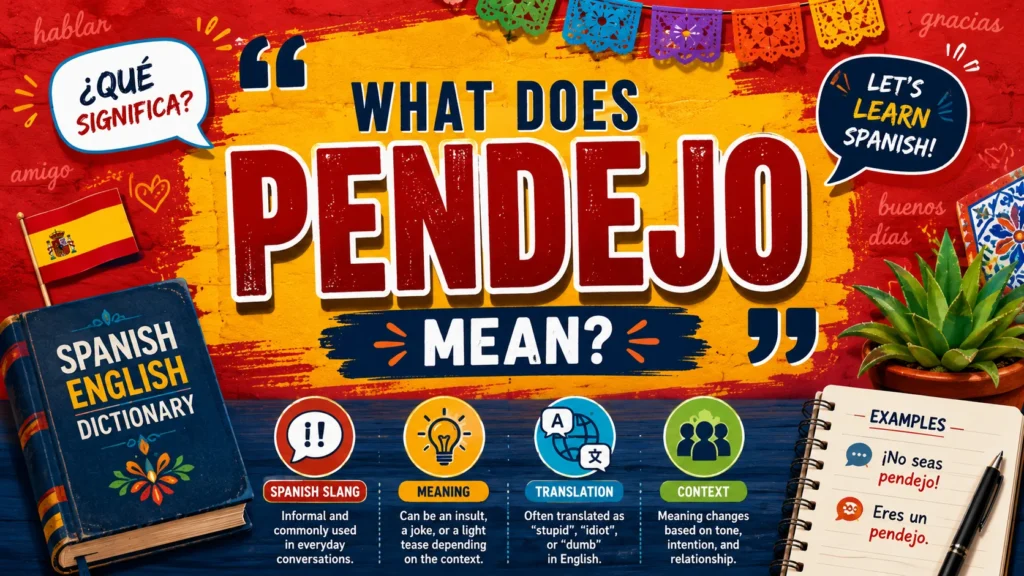
Pendejo is a Spanish slang word that usually means idiot, fool, or jerk, depending on the country, tone, and situation. Although its original literal meaning referred to pubic hair, modern Spanish speakers almost always use it as an insult or playful tease rather than with its historical definition. In Mexican Spanish, pendejo commonly describes someone acting foolish, naive, or careless. Whether it’s offensive depends on context, your relationship with the other person, and regional language differences throughout the Spanish-speaking world.
Spanish has thousands of colorful expressions, but few words spark as much curiosity as pendejo. You may have heard it in a movie, during a vacation to Mexico, in a popular television series, on social media, or while listening to Spanish-speaking friends joke with each other. Naturally, that raises the question: what does pendejo mean?
The answer isn’t as simple as opening a dictionary.
Like many slang expressions, pendejo meaning depends on where it’s spoken, who’s saying it, and how they say it. In one conversation, it might sound like a harsh insult. In another, two lifelong friends could laugh while calling each other pendejo without anyone taking offense.
That flexibility makes it one of the most misunderstood Spanish slang words.
In this guide, you’ll learn:
- What does pendejo mean in English
- The pendejo definition and literal meaning
- How native speakers actually use the word
- Why its meaning changes across Spanish-speaking countries
- When the word sounds humorous and when it becomes offensive
- Common phrases, examples, and pronunciation
- Cultural etiquette every Spanish learner should know
Whether you’re learning Spanish, translating dialogue, or simply curious after hearing the word online, this guide explains everything in clear, everyday language.
What Does Pendejo Mean?
At its core, pendejo is an informal Spanish slang term used to describe someone who is acting foolish, unintelligent, careless, naive, or annoying.
The closest English translations include:
| Spanish Word | Common English Meaning |
| Pendejo | Fool |
| Pendejo | Idiot |
| Pendejo | Foolish |
| Pendejo | Moron |
| Pendejo | Jerk (depending on context) |
Unlike many dictionary words, there isn’t one perfect English equivalent.
Instead, the meaning of pendejo changes according to several factors:
| Factor | Why It Matters |
| Country | Every Spanish-speaking region interprets the word a little differently. |
| Tone | A smile can make it playful. Anger can make it deeply offensive. |
| Relationship | Close friends often use it differently than strangers. |
| Situation | Casual conversations differ from arguments or formal settings. |
For example, imagine these two situations:
Friend: “¡Qué pendejo eres! Se te olvidaron las llaves otra vez.”
The speaker laughs because their friend forgot the keys again. Here, pendejo means something close to “you goof” or “you idiot” in a playful way.
Now compare it with this:
“Eres un pendejo.”
When spoken during a heated argument, the exact same words become a direct insult meaning “You’re an idiot.”
The vocabulary hasn’t changed.
The emotion has.
That is why understanding context matters far more than memorizing a dictionary definition.
Key Fact: Spanish slang often depends on tone just as much as vocabulary. Native speakers interpret emotion before they interpret the literal words.
Why Is Pendejo Such a Popular Word?
Few slang words appear as often in everyday Spanish conversation.
You’ll hear it in:
- Casual conversations
- Comedy shows
- Movies
- Television dramas
- Stand-up comedy
- Social media posts
- Online gaming
- Text messages
- Memes
- Podcasts
Its popularity comes from its flexibility.
Depending on delivery, one word can express:
- Frustration
- Surprise
- Disbelief
- Affection
- Sarcasm
- Mockery
- Anger
- Humor
Many languages have versatile insults that change meaning based on delivery. English speakers do the same with words like idiot, dummy, or jerk.
Spanish simply has its own version.
Is Pendejo Always Negative?
No.
Although dictionaries usually label it as an insult, real conversations tell a more nuanced story.
Among close friends, siblings, or longtime classmates, the word often loses much of its harshness.
For example:
“No seas pendejo, ven con nosotros.”
A direct translation would sound rude:
“Don’t be an idiot.”
But among close friends, the intended meaning is often much softer:
- Come on.
- Don’t be silly.
- Stop messing around.
That doesn’t make the word polite.
It simply shows how friendship changes language.
The same expression spoken to a stranger would likely sound offensive.
Quick Facts About Pendejo
| Question | Answer |
| Language | Spanish |
| Part of Speech | Noun and adjective |
| Register | Informal slang |
| Common Usage | Everyday conversation |
| Offensive? | Sometimes |
| Used in Mexico? | Very commonly |
| Used in Latin America? | Yes, with regional differences |
| Used in Spain? | Less commonly than in Latin America |
| Appropriate in professional settings? | No |
Why Dictionaries Don’t Tell the Whole Story
Many bilingual dictionaries define pendejo as:
- Fool
- Idiot
- Irrational person
Technically, these translations are correct.
However, they leave out something essential.
Native speakers don’t evaluate the word based only on its dictionary meaning.
They also pay attention to:
- Voice
- Facial expression
- Relationship
- Social setting
- Regional culture
Imagine translating the English word “wild.”
Depending on context, it could mean:
- Mentally ill
- Extremely exciting
- Funny
- Ridiculous
- Passionate
- Irritating
Spanish slang works in much the same way.
That’s why learning usage matters just as much as learning vocabulary.
What Does Pendejo Mean in English?
One of the most common questions Spanish learners ask is:
What does pendejo mean in English?
The honest answer is that no single English word captures every meaning.
Instead, translators choose an equivalent based on the conversation.
Here are the most common English translations.
| English Translation | Typical Situation |
| Idiot | General insult |
| Fool | Mild criticism |
| Irrational | Strong informal insult |
| Moron | Angry conversation |
| Jerk | Someone behaving badly |
| Dummy | Friendly teasing |
| Goof | Lighthearted joking |
Each translation reflects a slightly different emotional tone.
Pendejo Meaning in English Depends on Context
Consider these examples.
| Spanish | Natural English Translation |
| Qué pendejo eres. | You’re such an idiot. |
| No seas pendejo. | Don’t be reckless. |
| Ese pendejo perdió el tren. | That idiot missed the train. |
| Mi amigo es un pendejo. | My friend is such a goof. (playful) |
Notice that translators don’t always choose the same English word.
That’s because English also adjusts insults according to tone.
Why Machine Translation Often Gets It Wrong
Automatic translators usually replace pendejo with only one English word.
That creates problems because the emotional meaning disappears.
Imagine reading:
“You idiot.”
when the original Spanish actually meant:
“You silly fool.”
Or the opposite:
A machine translates a heated insult as:
“You fool.”
The translation suddenly sounds much weaker than the speaker intended.
Human translators almost always consider:
- Tone
- Setting
- Relationship
- Regional slang
- Intended emotion
Those clues produce a much more natural translation.
Common English Equivalents Ranked by Accuracy
| Translation | Accuracy | Notes |
| Idiot | ★★★★★ | Most common general translation. |
| Fool | ★★★★★ | Works in many situations. |
| Irrational | ★★★★☆ | Stronger and more vulgar. |
| Moron | ★★★★☆ | Appropriate during arguments. |
| Dummy | ★★★☆☆ | Softer and playful. |
| Jerk | ★★★☆☆ | Fits behavior more than intelligence. |
| Loser | ★★☆☆☆ | Sometimes accurate but not the primary meaning. |
Can Pendejo Mean “Reckless“?
Yes, but with an important distinction.
The word often criticizes someone’s actions rather than their intelligence.
For example:
Someone forgets their wallet.
A friend laughs and says:
“Qué pendejo.”
The message isn’t necessarily:
“You have low intelligence.”
Instead, it means:
“That was a really irrational thing to do.”
This subtle difference explains why native speakers often use the word casually among friends.
They’re criticizing the mistake, not making a serious judgment about the person’s intelligence.
Does Pendejo Always Mean the Same Thing?
Absolutely not.
Depending on context, pendejo can suggest that someone is:
- Foolish
- Careless
- Naive
- Gullible
- Reckless
- Annoying
- Ridiculous
- Slow to understand something
- Acting without common sense
That range of meanings explains why pendejo remains one of the most versatile and recognizable slang words in everyday Spanish conversation.
What Is the Literal Meaning of Pendejo?
If you only know the modern slang meaning, the literal meaning of pendejo may come as a surprise.
Historically, pendejo referred to pubic hair, especially a single coarse hair. This older definition appears in historical Spanish dictionaries and literary works dating back centuries. Today, however, native speakers rarely use the word with this literal meaning in everyday conversation.
Instead, almost everyone understands pendejo as a slang expression rather than a literal anatomical term.
Quick Fact: In modern Spanish, the literal definition has largely faded from everyday speech. The slang meaning dominates in conversations, media, and online communication.
How Did the Meaning Change?
Languages constantly evolve. Words that once described physical objects often develop figurative meanings over time.
With pendejo, the shift happened gradually. The literal meaning became less common while speakers increasingly used the word as an insult for someone who seemed foolish, inexperienced, or lacking good judgment.
This process isn’t unique to Spanish.
English has many words that also changed dramatically over time. For example:
| Word | Original Meaning | Modern Meaning |
| Silly | Blessed or innocent | Foolish |
| Awful | Worthy of awe | Very bad |
| Nice | Ignorant | Pleasant or kind |
Spanish followed a similar path with pendejo.
Does the Literal Meaning Matter Today?
For most people, not really.
Unless you’re reading historical literature, studying Spanish linguistics, or consulting an academic dictionary, you’ll almost never encounter the original definition.
Ask a native speaker what pendejo means, and they’ll almost certainly think of the slang usage first.
That’s why modern dictionaries usually list the slang meanings before mentioning the historical definition.
Literal Meaning vs. Figurative Meaning
The easiest way to understand the difference is through comparison.
| Type | Meaning |
| Literal meaning | Pubic hair (historical definition) |
| Figurative meaning | Fool, idiot, or someone behaving foolishly |
When people ask “What does the word pendejo mean?”, they’re almost always asking about the figurative meaning.
Why You Should Know Both Meanings
Even though you’ll rarely hear the literal definition in conversation, knowing its history helps explain why the word still carries a vulgar edge in many places.
Some insults lose their original meanings over time.
Others keep traces of their origins.
Pendejo falls somewhere in between. Most speakers no longer think about the historical definition, yet the word still feels informal and, depending on the situation, offensive.
Where Does the Word Pendejo Come From?
The pendejo origin stretches back hundreds of years into the history of the Spanish language.
Like many traditional Spanish words, its roots developed long before modern slang existed. Over time, everyday speakers reshaped its meaning until it became the familiar insult heard throughout much of Latin America today.
Understanding its history makes the modern usage much easier to understand.
The Early History of Pendejo
The earliest documented uses of pendejo referred to body hair rather than personality or intelligence.
Historical Spanish dictionaries recorded this literal definition centuries ago.
As the language evolved, speakers began using the word metaphorically.
Instead of referring to anatomy, it gradually became associated with someone viewed as:
- Immature
- Inexperienced
- Naive
- Foolish
- Easily deceived
This shift reflects a common pattern in language evolution, where literal words acquire emotional or symbolic meanings through repeated everyday use.
How the Word Spread Across the Spanish-Speaking World
When Spanish expanded throughout the Americas, local communities adapted vocabulary to fit their own cultures.
As a result, pendejo developed different shades of meaning in different countries.
In some regions, it emphasizes irratonality.
Elsewhere, it suggests naivety, carelessness, or even cowardice.
Despite these differences, one idea remains consistent:
The word usually criticizes someone’s judgment or behavior.
Why Regional Meanings Developed
Spanish is spoken by hundreds of millions of people across dozens of countries.
Just as American English differs from British or Australian English, Spanish vocabulary changes from one country to another.
Several factors influenced the evolution of pendejo:
- Local culture
- Historical migration
- Indigenous language influences
- Everyday slang
- Popular media
- Generational language changes
That explains why someone from Mexico may use the word very differently from someone in Spain or Argentina.
A Word That Continues to Evolve
Unlike formal vocabulary, slang never stands still.
New generations constantly reshape how words sound and what they imply.
Today, pendejo appears in:
- Movies
- Television series
- Stand-up comedy
- Music
- Internet memes
- Social media
- Podcasts
- Video games
- Casual conversations
Its popularity has helped preserve the word while also broadening its range of meanings.
Pendejo Etymology
The pendejo etymology offers an interesting glimpse into how language changes over time.
Linguists generally trace the word back to the Spanish noun pendejo, which originally described coarse body hair. From there, speakers gradually transformed it into a figurative expression.
Although scholars debate the exact stages of this semantic shift, the overall progression is well documented.
The Evolution of Meaning
The development of the word can be summarized like this:
Literal anatomical meaning
↓
Figurative reference to immaturity
↓
Naive person
↓
Foolish person
↓
Modern slang insult
This gradual evolution happened over centuries rather than all at once.
Why Words Change Meaning
Language changes because people naturally use words creatively.
Sometimes a metaphor becomes so common that speakers forget the original meaning entirely.
Examples from English include:
| Original Word | Modern Meaning |
| Guy | Any man |
| Nerd | Intelligent or socially awkward person |
| Cool | Excellent or fashionable |
| Wicked | Very good (informal slang in some regions) |
Spanish speakers followed a similar pattern with pendejo.
Over generations, the figurative meaning became far more common than the literal one.
Is the Origin the Same Everywhere?
Yes.
The historical origin remains the same because all regional varieties inherited the word from Spanish.
What differs is how modern speakers interpret it.
For example:
| Region | Typical Interpretation |
| Mexico | Foolish, or careless person |
| Much of Latin America | Idiot or naive person |
| Spain | Less common, with regional variation in usage and strength |
The word’s roots didn’t change.
Its everyday meaning did.
Why Etymology Doesn’t Tell You How to Use the Word
Many language learners make the mistake of relying only on etymology.
That rarely works with slang.
Knowing where a word came from is fascinating, but it won’t tell you how native speakers use it today.
For example:
- The historical meaning explains the word’s background.
- Modern conversations determine its current meaning.
- Culture influences whether it sounds playful or offensive.
- Tone decides how listeners interpret it.
That’s why understanding context matters just as much as understanding history.
Language Insight: Etymology explains where a word came from. Usage explains what the word means today. For slang terms like pendejo, modern usage is far more important than the original definition.
Why Context Matters More Than the Dictionary
One reason pendejo confuses so many learners is that dictionaries can only provide brief definitions.
Real conversations are much more dynamic.
Imagine hearing these three statements:
“Qué pendejo.”
Depending on the speaker’s voice, facial expression, and situation, it could mean:
- “That was a silly mistake.”
- “You’re such a goof.”
- “You’re an idiot.”
The words stay the same.
The meaning shifts with context.
This is one of the defining features of Spanish slang. Native speakers rely heavily on tone, relationships, and social setting to interpret expressions.
If you only memorize a dictionary definition, you’ll understand the vocabulary but miss the conversation.
That’s why anyone learning Spanish vocabulary, colloquial Spanish terms, or Mexican slang words should study both the history and the real-world usage of words like pendejo. The next section explores exactly how the word changes from one Spanish-speaking country to another and why those regional differences matter.
What Does Pendejo Mean in Different Spanish-Speaking Countries?
One of the biggest misconceptions about pendejo is that it has the exact same meaning everywhere. It doesn’t.
Spanish is spoken by more than 20 countries, and each region has developed its own vocabulary, slang, and expressions. A word that sounds mildly insulting in one country may sound much harsher—or much softer—in another.
That’s why understanding the regional meaning of pendejo is just as important as knowing its dictionary definition.
Language Tip: Never assume Spanish slang carries the same meaning across every country. Regional differences are a normal part of the language.
The sections below explain how native speakers commonly use pendejo throughout the Spanish-speaking world.
Pendejo in Mexican Spanish
If someone asks, “What does pendejo mean in Mexico?”, the answer is fairly straightforward.
In Mexican Spanish, pendejo usually refers to someone who is:
- Foolish
- Reckless
- Careless
- Slow to understand
- Acting without common sense
It’s one of the most recognizable slang words in Mexico and appears constantly in everyday conversations, films, comedy, and social media.
Depending on tone, it can range from playful teasing to a serious insult.
For example:
“No seas pendejo.”
Possible meanings include:
- Don’t be an idiot.
- Think before you act.
Among close friends, however, the same phrase often sounds much lighter.
For example, a friend who almost walks into a glass door might hear:
“¡Pendejo!”
In that situation, everyone laughs.
The word criticizes the mistake rather than attacking the person’s character.
Common Uses in Mexico
| Situation | Typical Meaning |
| Friend forgets wallet | Silly or careless |
| Someone makes an obvious mistake | Idiot |
| Heated argument | Strong insult |
| Friendly joking | Dummy or goof |
How Offensive Is It in Mexico?
The answer depends on three things:
- Your tone
- Your relationship
- The setting
Friends often use it casually.
Strangers usually don’t.
Using it toward a teacher, employer, customer, or older relative would generally be considered disrespectful.
Pendejo in Spain
Many Spanish learners assume pendejo is equally common in Spain.
In reality, it isn’t.
People in Spain certainly understand the word, but it doesn’t dominate casual conversation the way it does in Mexico or parts of Latin America.
Instead, speakers often choose other regional insults and slang expressions.
Because of that, hearing pendejo in Spain may sound more unusual or imported from Latin American media.
Does It Mean the Same Thing?
Broadly, yes.
It still suggests someone is:
- Foolish
- Idiotic
- Slow-witted
However, Spaniards may not use it as frequently in daily speech.
Regional vocabulary often takes its place.
Why This Matters
If you’re learning Spanish through Mexican television or Latin American movies, you’ll probably hear pendejo much more often than someone who learned Spanish while living in Madrid or Barcelona.
That’s one reason Spanish learners notice vocabulary differences between regions.
Pendejo in Argentina
In Argentina, pendejo carries a meaning that’s noticeably different from the one many learners expect.
Rather than primarily meaning idiot, it commonly refers to:
- A young person
- A teenager
- Someone who is immature
Depending on the conversation, it may still sound dismissive or insulting, but it doesn’t always imply irrationality.
For example:
“Ese pendejo todavía está en la escuela.”
The focus is often on youth rather than intelligence.
Context determines whether the speaker sounds affectionate, neutral, or annoyed.
Common Interpretations
| Meaning | Frequency |
| Young person | Very common |
| Immature person | Common |
| Foolish person | Less common than in Mexico |
This is one of the clearest examples of how regional Spanish can completely reshape a word’s meaning.
Pendejo in Colombia
In Colombia, pendejo generally describes someone who lacks good judgment.
Depending on the speaker, it can suggest that a person is:
- Foolish
- Easily fooled
- Naive
- Acting carelessly
Compared with Mexican usage, the word often places slightly more emphasis on poor judgment than outright reckless.
For example:
Someone believes an obvious scam.
A Colombian speaker might describe that person as pendejo because they were too trusting.
Everyday Situations
People might use the word when someone:
- Falls for a prank
- Makes a careless mistake
- Ignores obvious advice
- Shows poor decision-making
Tone still determines whether the remark feels playful or insulting.
Pendejo in Chile
In Chile, slang changes quickly and varies by region, but pendejo is generally understood.
Many speakers associate it with someone behaving foolishly or immaturely.
Depending on the context, it can also describe:
- Someone inexperienced
- Someone acting irresponsibly
- Someone making poor choices
Like most Chilean slang, pronunciation and delivery often influence how harsh the word sounds.
Pendejo in Peru
Peruvian Spanish commonly uses pendejo to describe someone who behaves foolishly or lacks common sense.
However, in some conversations, it can also imply that someone is:
- Sneaky
- Clever in a dishonest way
- Trying to take advantage of others
Because of these additional meanings, listeners usually rely on context before deciding what the speaker intends.
Example
Imagine someone cuts in line and tricks everyone into letting them go first.
One person might call them pendejo not because they’re reckless, but because they’re acting in a dishonest or shameless way.
This illustrates how one slang word can develop multiple local interpretations.
Pendejo in Venezuela
In Venezuela, the word commonly refers to someone who is:
- Foolish
- Naive
- Easily deceived
A person who trusts everyone without questioning their motives may be described as pendejo.
The insult often emphasizes gullibility rather than intelligence.
For instance:
Someone sends money to an obvious online scam.
Friends might later say the person was pendejo for believing it.
The criticism targets poor judgment instead of intellectual ability.
Pendejo in Central America
Across Central America, meanings vary from country to country.
Generally, the word may describe someone who is:
- Foolish
- Naive
- Careless
- Easily manipulated
Some communities use it frequently in casual speech.
Others reserve it for stronger disagreements.
Because regional slang differs even between neighboring countries, it’s always wise to listen first before adopting local expressions.
Pendejo in Spanish-Speaking Communities in the United States
Many bilingual communities in the United States, especially those with strong Mexican heritage, use pendejo in much the same way it’s used in Mexico.
You’ll hear it in:
- Family conversations
- Friend groups
- Neighborhood slang
- Comedy
- Music
- Social media
- Online gaming
Second-generation bilingual speakers often switch naturally between English and Spanish.
For example:
“Don’t be a pendejo.”
This kind of sentence combines English grammar with a Spanish slang word.
It’s a common example of bilingual code-switching.
Regional Meaning of Pendejo at a Glance
The following table summarizes the most common interpretations.
| Country or Region | Typical Meaning | Common Tone |
| Mexico | Fool, idiot, careless person | Playful or insulting |
| Spain | Foolish person (less common) | Informal |
| Argentina | Young or immature person | Neutral to mildly negative |
| Colombia | Naive or lacking judgment | Mild to moderate |
| Chile | Foolish or immature person | Informal |
| Peru | Foolish person or dishonest trickster (depending on context) | Varies |
| Venezuela | Gullible or easily deceived person | Informal |
| Central America | Foolish or naive person | Varies by country |
| United States (Spanish-speaking communities) | Similar to Mexican usage | Informal |
Why Does the Meaning Change So Much?
Many learners wonder why one word can have so many interpretations.
The answer lies in how languages naturally evolve.
Several factors influence regional slang:
- Local history
- Cultural traditions
- Immigration patterns
- Indigenous language influence
- Television and movies
- Music and popular culture
- Younger generations creating new expressions
English works the same way.
Consider the word “mate.”
In Australia, it’s a friendly term for a friend.
In the United States, it’s rarely used that way.
Likewise, the word “pants” refers to different clothing depending on whether you’re speaking American or British English.
Spanish develops regional vocabulary in exactly the same way.
Can You Assume Everyone Understands Pendejo the Same Way?
No.
Even within the same country, age, family background, and local culture influence how people interpret slang.
For example:
- Older adults may consider pendejo much ruder than younger speakers.
- Close friends may use it jokingly without causing offense.
- In professional settings, almost everyone avoids it.
- A word that feels harmless in one city might sound much stronger in another.
Important: If you’re learning Spanish as a second language, it’s best to understand pendejo rather than actively use it. Recognizing the word helps you follow conversations, but using regional slang without understanding local norms can easily lead to misunderstandings.
Regional differences are one of the reasons Spanish remains such a rich and expressive language. The next section explores another important question: Is pendejo a bad word, and how offensive is it really?
Is Pendejo a Bad Word?
One of the most common questions people ask after learning the pendejo meaning is whether it’s actually considered a bad word.
The short answer is yes—but not always to the same degree.
Pendejo is an informal insult. It isn’t appropriate for formal conversations, workplace communication, or speaking with people you don’t know well. However, among close friends or family members, it can lose much of its sting and become playful banter.
That doesn’t mean it’s polite.
It simply means context changes how people hear it.
Quick Answer: Pendejo is generally considered a rude slang word. Whether it sounds mildly teasing or highly offensive depends on the country, the speaker’s tone, and the relationship between the people involved.
Why the Answer Isn’t Black and White
Many English words work the same way.
Think about these expressions:
- Dummy
- Idiot
- Moron
- Jerk
A smiling friend saying, “You’re such an idiot,” after you forget your sunglasses feels very different from a stranger yelling the same words during an argument.
The vocabulary stays the same.
The emotional impact changes.
Pendejo follows this exact pattern.
Situations Where Pendejo Is Usually Considered Rude
In most Spanish-speaking communities, using pendejo in these situations is likely to offend someone:
- Speaking to a stranger
- Talking to your boss
- Addressing a teacher or professor
- Speaking during a job interview
- Customer service interactions
- Business meetings
- Formal events
- Conversations with older adults who expect respectful language
Even if the other person understands you’re joking, using slang in these settings can make you appear disrespectful or immature.
Situations Where It May Sound Less Harsh
Among people who know each other well, the word often becomes much lighter.
Common examples include:
- Close friends joking together
- Brothers and sisters teasing each other
- Cousins laughing about a mistake
- Longtime classmates
- Childhood friends
In these situations, listeners often recognize that the speaker isn’t trying to insult anyone seriously.
How Offensive Is It?
The level of offense varies considerably.
| Situation | How Offensive? |
| Friendly joke | Low |
| Casual teasing | Low to moderate |
| Heated disagreement | High |
| Angry argument | Very high |
| Professional setting | Inappropriate |
| Conversation with strangers | Usually offensive |
Notice that the same word appears in every situation.
Only the context changes.
Is Pendejo Offensive?
Yes, pendejo can absolutely be offensive.
However, calling it offensive without explaining the circumstances oversimplifies the issue.
Native speakers don’t judge the word in isolation.
Instead, they ask questions like:
- Who said it?
- Who heard it?
- What happened before it?
- Was everyone laughing?
- Was someone angry?
- Was it meant as a joke?
Those details determine whether the word sounds playful or insulting.
Tone Changes Everything
Imagine hearing these two conversations.
Example One
A friend drops an ice cream cone.
Everyone laughs.
Someone says:
“Qué pendejo.”
Most people understand that as playful teasing.
Example Two
Two strangers begin arguing in traffic.
One person shouts:
“Eres un pendejo.”
The exact same word now carries a much stronger emotional force.
The difference isn’t vocabulary.
It’s tone.
Why Non-Native Speakers Should Be Careful
Many language learners hear pendejo in movies and assume it’s acceptable everywhere.
That’s a risky assumption.
Movies often exaggerate slang for dramatic effect.
Real conversations involve social expectations that aren’t always obvious to learners.
If you don’t fully understand local customs, it’s easy to offend someone unintentionally.
A good rule is simple:
Understand the word before you try using it.
Recognition is useful.
Imitation requires cultural awareness.
Is Pendejo a Curse Word?
Many learners ask whether pendejo qualifies as a curse word, swear word, or simply an insult.
The answer depends on how those terms are defined.
Generally speaking:
- It is not one of the strongest swear words in Spanish.
- It is widely considered vulgar slang.
- Most dictionaries classify it as an insult or offensive informal language.
Because different countries define profanity differently, there isn’t universal agreement.
Still, most native speakers would avoid saying pendejo in polite company.
Where Does It Fit on the Scale?
The following table offers a general comparison.
| Type of Expression | Does Pendejo Fit? |
| Formal vocabulary | ❌ No |
| Neutral everyday word | ❌ No |
| Informal slang | ✅ Yes |
| Mild insult | ✅ Often |
| Strong insult | ✅ Sometimes |
| Extremely obscene profanity | ❌ Usually no |
This explains why the word appears frequently in films and casual conversations while remaining inappropriate in formal settings.
Is Pendejo a Swear Word?
Many people use the terms curse word, swear word, and bad word interchangeably.
In everyday conversation, pendejo often falls somewhere in the middle.
It isn’t as shocking as the strongest profanity, yet it’s far from polite.
Think of it as a word that belongs in casual speech among people who already understand each other’s sense of humor.
Using it outside that environment can quickly create tension.
Is Pendejo Vulgar?
Yes.
Most dictionaries and language experts classify pendejo as vulgar or colloquial language.
That label doesn’t mean speakers avoid it completely.
Instead, it signals that the word belongs to informal conversation rather than formal communication.
Informal vs. Formal Language
| Formal Situation | Appropriate? |
| School presentation | ❌ No |
| Business email | ❌ No |
| Job interview | ❌ No |
| Academic paper | ❌ No |
| Government document | ❌ No |
| Friendly conversation | Sometimes |
| Casual texting | Sometimes |
| Comedy or entertainment | Common |
The distinction is important because many learners confuse common with appropriate.
A word can appear every day in conversation while still being unsuitable in professional settings.
Is Pendejo Ever Used Affectionately?
Surprisingly, yes.
Among close friends and relatives, pendejo can become part of playful conversation.
This happens because relationships influence how people interpret language.
For example:
A friend forgets where they parked the car.
Another friend laughs and says:
“Eres un pendejo.”
Everyone laughs.
Nobody feels insulted.
The speaker isn’t attacking the person’s intelligence.
They’re reacting to one amusing mistake.
Common Friendly Situations
Native speakers sometimes use pendejo when someone:
- Trips over nothing
- Forgets their phone at home
- Misses an obvious answer
- Makes a harmless mistake
- Falls for a practical joke
In these moments, the word often means something closer to:
- You goof.
- You dummy.
- You silly fool.
Again, that doesn’t make it polite.
It simply shows how friendship softens language.
When Friendly Use Doesn’t Work
Even among friends, timing matters.
If someone is already upset, embarrassed, or frustrated, calling them pendejo may make the situation worse.
Likewise, newcomers shouldn’t assume they can immediately use the same language they hear among lifelong friends.
Close relationships create trust.
Without that trust, the joke may not land.
When Should You Avoid Saying Pendejo?
For language learners, this question is more important than memorizing the translation.
Understanding when not to use pendejo helps you avoid awkward or offensive situations.
Avoid It in Professional Settings
Professional environments generally expect respectful language.
Avoid using pendejo when speaking with:
- Supervisors
- Coworkers
- Clients
- Customers
- Teachers
- Professors
- Public officials
Even if the workplace seems casual, slang insults rarely make a good impression.
Avoid It With Strangers
You don’t know how strangers interpret slang.
Someone may:
- Find it insulting.
- Think you’re being aggressive.
- Assume you’re intentionally disrespectful.
It’s simply not worth the risk.
Avoid It During Travel
If you’re visiting another Spanish-speaking country, remember that local slang varies.
A phrase that sounds harmless in one region may feel much stronger somewhere else.
Listening first is almost always the smarter approach.
Avoid It While Learning Spanish
Many learners want to sound like native speakers as quickly as possible.
That’s understandable.
However, slang requires much more than vocabulary.
It also requires understanding:
- Social cues
- Cultural expectations
- Tone of voice
- Body language
- Relationships
Until you’re comfortable with those elements, it’s better to recognize pendejo than to actively use it.
Situations Where You Should Not Use Pendejo
| Situation | Recommended? |
| Job interview | ❌ Never |
| Classroom presentation | ❌ No |
| Business meeting | ❌ No |
| Talking to strangers | ❌ No |
| Speaking with elders | Usually no |
| Social media arguments | Not recommended |
| Friendly joking with close friends | Sometimes |
| Comedy between friends | Sometimes |
A Simple Rule to Remember
If you’re ever unsure whether pendejo is appropriate, ask yourself one question:
Would you comfortably call this person “idiot” in English?
If the answer is no, then pendejo probably isn’t the right choice either.
That simple comparison won’t cover every cultural nuance, but it will help you avoid many common mistakes.
Key Takeaway: Pendejo is a common part of everyday Spanish slang, yet it’s still a vulgar insult. Friends may use it jokingly, but strangers, coworkers, teachers, or people in formal settings are unlikely to appreciate it. Understanding the context is just as important as understanding the translation.
How Native Spanish Speakers Actually Use Pendejo
If you want to understand the real meaning of pendejo, don’t rely only on dictionaries. Listen to how native speakers use it in everyday conversations.
In real life, pendejo rarely has just one fixed definition. Instead, it reflects emotion, tone, and the relationship between the people involved.
The same word can sound playful one minute and deeply insulting the next.
That’s why experienced Spanish learners focus on context, not just vocabulary.
Below are the most common ways you’ll hear pendejo used in conversation.
Pendejo as an Angry Insult
This is the meaning most non-native speakers recognize first.
During an argument, pendejo becomes a direct insult aimed at someone’s intelligence, judgment, or behavior.
For example:
“¡Eres un pendejo!”
Depending on the tone, the speaker may mean:
- You’re an idiot.
- You’re a fool.
In these situations, the word carries real emotional weight.
It isn’t playful.
It’s meant to criticize or offend.
Common situations include:
- Road rage
- Heated family arguments
- Sports disputes
- Online arguments
- Personal conflicts
Pendejo as Friendly Teasing
This use surprises many learners.
Among close friends, pendejo often becomes lighthearted teasing.
Imagine someone accidentally leaves their coffee on the roof of the car and drives away.
A friend laughs and says:
“Qué pendejo.”
Nobody is questioning the person’s intelligence.
They’re reacting to a funny mistake.
In English, similar expressions might be:
- You goof.
- Nice one.
- You dummy.
- What were you thinking?
The friendship changes how the word is received.
Pendejo Used With Sarcasm
Sarcasm is another common use.
Sometimes speakers don’t genuinely believe someone is foolish.
Instead, they exaggerate for humor.
For example:
Your friend confidently gives the wrong answer to an easy question.
Someone responds:
“Sí, claro qué pendejo.”
The humor comes from exaggeration rather than hostility.
Facial expressions and voice usually make the sarcasm obvious.
Pendejo During Moments of Frustration
People also use the word when they’re frustrated with someone’s actions rather than the person themselves.
For example:
Someone repeatedly forgets important documents.
Another person sighs and says:
“Siempre tan pendejo.”
The speaker is criticizing repeated careless behavior.
They’re not necessarily making a lifelong judgment about the person’s intelligence.
Pendejo as Self-Deprecating Humor
Interestingly, many native speakers call themselves pendejo after making an embarrassing mistake.
For example:
Someone realizes they left their passport at home before heading to the airport.
They laugh and say:
“Qué pendejo soy.”
Instead of insulting themselves harshly, they’re admitting they made a foolish mistake.
English speakers often say similar things:
- I’m such an idiot.
- That was irrational.
- I can’t believe I did that.
This kind of self-deprecating humor is common in casual conversation.
Pendejo Doesn’t Always Describe Intelligence
One of the biggest misconceptions is that pendejo always means “reckless.”
In reality, it often criticizes a specific action, not a person’s overall intelligence.
Someone can be highly educated and still hear:
“Qué pendejo.”
Why?
Because they:
- Forgot their wallet
- Sent an email to the wrong person
- Locked themselves out of the house
- Missed an obvious joke
- Believed fake news without checking
The insult focuses on the moment.
Not the person’s entire character.
Examples of Pendejo in a Sentence
Learning through examples is one of the easiest ways to understand pendejo in conversation.
The following examples show how the meaning shifts depending on context.
| Spanish Sentence | Natural English Meaning | Tone |
| Qué pendejo eres. | You’re such an idiot. | Mild insult |
| No seas pendejo. | Don’t be reckless. | Advice or criticism |
| Ese pendejo olvidó su teléfono. | That idiot forgot his phone. | Casual criticism |
| Soy un pendejo. | I’m such an idiot. | Self-deprecating |
| Qué pendejo fui. | That was really foolish of me. | Regret |
| No te hagas el pendejo. | Don’t pretend you don’t know. | Frustrated |
| Pinche pendejo. | Freaking idiot. | Strong insult |
| Mi amigo es un pendejo, pero lo quiero. | My friend is a goof, but I love him. | Affectionate teasing |
Notice that the English translation changes slightly each time.
That’s because pendejo translation depends on the speaker’s intention.
Common Expressions That Include Pendejo
Many people search for phrases like “no seas pendejo meaning” or “pinche pendejo meaning.”
These expressions appear frequently in movies, television, memes, and everyday speech.
Understanding them gives you a much clearer picture of how native speakers actually communicate.
No Seas Pendejo Meaning
Literal translation:
Don’t be a pendejo.
Natural English translations:
- Don’t be foolish.
- Think about it.
- Use your head.
This phrase often warns someone before they make a bad decision.
Example:
Your friend wants to leave their backpack unattended in a crowded place.
You might hear:
“No seas pendejo.”
The speaker is encouraging better judgment.
Qué Pendejo Meaning
This is one of the most common Spanish slang expressions.
Depending on tone, it may mean:
- What an idiot.
- What a fool.
- What a dummy.
- What a silly mistake.
It can describe:
- Yourself
- A friend
- A stranger
- Someone in a story
Example:
Someone spends an hour looking for their glasses before realizing they’re wearing them.
A friend laughs:
“Qué pendejo.”
Eres un Pendejo Meaning
This expression is more direct.
It literally means:
You are a pendejo.
Natural English translations include:
- You’re an idiot.
- You’re a fool.
Because it directly labels another person, it usually sounds stronger than simply saying qué pendejo.
Pinche Pendejo Meaning
Adding pinche intensifies the insult.
Instead of simply saying someone acted foolishly, the speaker expresses stronger frustration or anger.
Possible English equivalents include:
- Freaking idiot.
- Damn fool.
- Complete idiot.
The exact strength depends on the speaker’s tone and regional usage.
Hacerse Pendejo Meaning
This phrase has a completely different meaning from the standalone word.
Hacerse pendejo doesn’t mean becoming foolish.
Instead, it usually means:
- To pretend not to notice.
- To play irrational.
- To ignore something on purpose.
- To avoid responsibility.
For example:
A student notices the teacher asking for volunteers but avoids eye contact.
A classmate laughs:
“Se hizo pendejo.”
Meaning:
He pretended not to notice.
This expression appears frequently in everyday conversation throughout Mexico and several other Spanish-speaking regions.
Pendejo Pronunciation Guide
Many English speakers wonder how to pronounce pendejo correctly.
The pronunciation is:
pen-DEH-ho
Here’s a simple breakdown.
| Part | Pronunciation |
| Pen | Like “pen” in English |
| De | Sounds like “deh” |
| Jo | Pronounced “ho” because the Spanish j has an H-like sound |
Pronunciation Tips
- Stress falls on the second syllable.
- The Spanish j is pronounced from the back of the throat.
- Don’t pronounce the j like the English word jam.
Phonetic pronunciation:
pen-DEH-ho
Listening to native speakers is the best way to master the sound.
Pendeja, Pendejos, and Pendejas Meaning
Spanish changes word endings to match gender and number.
Understanding these forms makes conversations much easier to follow.
| Word | Meaning |
| Pendejo | One male or masculine noun |
| Pendeja | One female |
| Pendejos | Multiple males or mixed group |
| Pendejas | Multiple females |
Examples:
- Ella es una pendeja.
- Ellos son unos pendejos.
- Ellas son unas pendejas.
The meaning stays the same.
Only the grammar changes.
Quick Reference Table of Common Phrases
| Phrase | Natural English Meaning | Typical Tone |
| No seas pendejo | Don’t be reckless | Friendly or critical |
| Qué pendejo | What an idiot | Playful or insulting |
| Eres un pendejo | You’re an idiot | Direct insult |
| Pinche pendejo | Freaking idiot | Strong insult |
| Hacerse pendejo | To play foolish | Informal |
| Soy un pendejo | I’m such an idiot | Self-deprecating |
| Qué pendejo fui | That was foolish of me | Humorous regret |
What These Examples Teach You
Looking at these examples reveals an important pattern.
The word pendejo isn’t defined by grammar alone.
Its meaning depends on:
- Who says it
- Who hears it
- How it’s spoken
- Where it’s spoken
- Why it’s spoken
That’s why fluent Spanish speakers don’t simply translate the word. They interpret the entire situation before deciding what it means.
Understanding these real-world uses will help you recognize pendejo in conversations, movies, music, and social media while avoiding one of the most common mistakes language learners make: assuming every use of the word carries the same level of offense.
Pendejo vs. Similar Spanish Insults
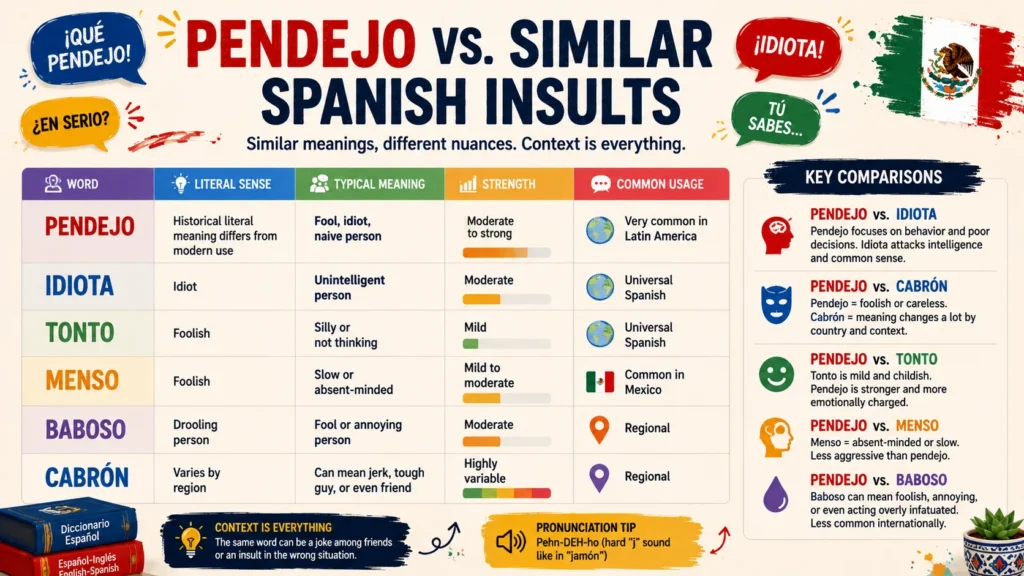
One reason pendejo confuses Spanish learners is that it overlaps with several other common insults. While many of these words can translate to idiot, fool, or jerk in English, native speakers don’t use them interchangeably.
Each word carries its own nuance.
Some criticize intelligence. Others target behavior, attitude, or personality. Choosing the wrong one can completely change what you’re trying to say.
Let’s compare the most common words you’ll encounter.
| Word | Literal Sense | Typical Meaning | Strength | Common Usage |
| Pendejo | Historical literal meaning differs from modern use | Fool, idiot, naive person | Moderate to strong | Very common in Latin America |
| Idiota | Idiot | Unintelligent person | Moderate | Universal Spanish |
| Tonto | Foolish | Silly or not thinking | Mild | Universal Spanish |
| Menso | Foolish | Slow or absent-minded | Mild to moderate | Common in Mexico |
| Baboso | Drooling person | Fool or annoying person | Moderate | Regional |
| Cabrón | Varies by region | Can mean jerk, tough guy, or even friend | Highly variable | Regional |
Although these words overlap, they aren’t perfect substitutes.
Understanding the differences helps you interpret conversations more accurately.
Pendejo vs. Idiota
This comparison causes the most confusion among beginners.
Both words can translate to idiot, but they don’t feel exactly the same.
Pendejo
Usually criticizes:
- Poor decisions
- Carelessness
- Naivety
- Acting without thinking
- Foolish behavior
Idiota
Usually criticizes:
- Intelligence
- Common sense
- Mental ability
Imagine two situations.
Someone leaves their wallet at a restaurant.
A friend laughs.
“Qué pendejo.”
The speaker comments on the careless mistake.
Now imagine someone repeatedly ignores obvious instructions despite multiple explanations.
Another person says:
“Qué idiota.”
Here the criticism sounds more direct and personal.
Quick Comparison
| Feature | Pendejo | Idiota |
| Focuses on behavior | ✅ Yes | |
| Focuses on intelligence | Sometimes | ✅ Usually |
| Used jokingly | Frequently | Less often |
| Common in casual slang | Very common | Common |
Pendejo
Usually leaves more room for interpretation.
It may describe:
- A bad decision
- A careless action
- Temporary foolishness
- Someone acting without thinking
Because of this flexibility, friends are more likely to joke using pendejo.
Pendejo vs. Cabrón
This comparison is particularly interesting because cabrón changes meaning dramatically across Spanish-speaking countries.
In some regions, cabrón is a serious insult.
Elsewhere, close friends may use it almost affectionately.
Meanwhile, pendejo generally centers on foolishness or poor judgment.
Typical Meanings
| Word | Common Meaning |
| Pendejo | Fool, idiot, careless person |
| Cabrón | Jerk, tough guy, clever person, or friend depending on region |
This is why context matters.
Two friends greeting each other with:
“¿Qué pasa, cabrón?”
doesn’t necessarily sound hostile.
Replace cabrón with pendejo, and the emotional tone changes.
Pendejo vs. Tonto
Many Spanish teachers introduce tonto long before learners encounter slang.
That’s because tonto is much milder.
Tonto
Usually means:
- Silly
- Foolish
- Goofy
Parents often say it to young children after harmless mistakes.
Pendejo
Generally sounds:
- More informal
- More vulgar
- More emotionally charged
For learners, tonto is usually the safer vocabulary choice.
Pendejo vs. Menso
Menso appears frequently in Mexican Spanish.
It usually describes someone who’s:
- Forgetful
- Slow to react
- Absent-minded
- Not paying attention
Compared with pendejo, menso often feels less aggressive.
For example:
Someone forgets where they parked.
A friend might jokingly call them menso rather than pendejo to soften the criticism.
Pendejo vs. Baboso
Baboso literally relates to drool, but figuratively it often describes someone who is:
- Foolish
- Ridiculous
- Annoying
- Immature
Depending on the country, it may also describe someone behaving in an embarrassing or overly infatuated way.
Compared with pendejo, baboso is less common internationally.
Synonyms of Pendejo
Spanish has dozens of words that overlap with pendejo.
Some are mild.
Others are much stronger.
Below are several common synonyms of pendejo.
| Spanish Word | Closest English Equivalent | Typical Strength |
| Tonto | Silly | Mild |
| Idiota | Idiot | Moderate |
| Menso | Dummy | Mild |
| Baboso | Fool | Moderate |
| Imbécil | Foolish | Strong |
| Necio | Stubborn fool | Moderate |
| Bobo | Goof | Mild |
Although dictionaries may list these as synonyms, native speakers choose different words depending on the situation.
That’s one reason direct translation rarely captures every nuance.
English Equivalents of Pendejo
Many readers searching for pendejo in English want a quick translation.
Unfortunately, no single English word works every time.
Instead, translators choose the best fit based on context.
| English Word | Best Used When |
| Idiot | General insult |
| Fool | Mild criticism |
| Foolish | Strong informal insult |
| Dummy | Friendly teasing |
| Moron | Heated disagreement |
| Jerk | Bad behavior |
| Goof | Playful joking |
| Blockhead | Lighthearted humor |
Think of these as possible translations rather than exact definitions.
Which Translation Is the Most Accurate?
The answer depends on the conversation.
Consider these examples.
Situation One
Someone leaves their keys inside the car.
Friend:
“Qué pendejo.”
Best English translation:
“What an idiot.”
Situation Two
Someone falls for an obvious prank.
Friend:
“Qué pendejo.”
Better translation:
“You’re so gullible.”
Situation Three
Someone forgets their birthday dinner reservation.
Everyone laughs.
Friend:
“Pendejo.”
Natural translation:
“You goof.”
Situation Four
Two strangers argue loudly.
One says:
“Eres un pendejo.”
Best translation:
“You’re a foolish”
Notice that every example uses the same Spanish word.
Only the English translation changes.
Choosing the Right Translation
Professional translators don’t simply replace pendejo with one English word.
Instead, they ask questions like:
- Is the speaker angry?
- Are the people friends?
- Is this a joke?
- Is the conversation formal?
- Which country does the speaker come from?
Only after answering those questions do they decide whether idiot, fool, dummy, moron, or another equivalent fits best.
Why Learners Should Avoid Direct Word-for-Word Translation
One of the fastest ways to misunderstand slang is to translate every word literally.
Languages don’t work that way.
Consider these English expressions:
- Break a leg
- Hit the books
- Piece of cake
- Spill the beans
None of these make sense if translated word for word.
Spanish slang follows the same principle.
The meaning of pendejo comes from context, culture, and conversation, not just the dictionary.
Language Insight: Think of pendejo as a category of meanings rather than one fixed definition. Depending on the speaker and the situation, it can describe someone who’s acting foolish, careless, gullible, immature, or simply having an embarrassing moment. That’s exactly why it remains one of the most versatile and recognizable words in everyday Spanish slang.
What Does Pendejo Mean on Social Media?
Social media has introduced millions of people to Spanish slang. Whether you’re scrolling through videos, reading comments, or watching livestreams, you’ve probably seen pendejo appear in jokes, memes, or heated arguments.
While the word keeps its core meaning, the tone often changes online.
On the internet, pendejo may express:
- Humor
- Frustration
- Friendly teasing
- Sarcasm
- Disbelief
- Mockery
Because written messages don’t include facial expressions or voice, context becomes even more important.
Pendejo Meaning on TikTok
TikTok has helped popularize many Spanish slang terms, including pendejo.
You’ll often see creators use it when reacting to:
- Funny fails
- Pranks
- Embarrassing moments
- Relationship jokes
- Comedy skits
Examples include captions such as:
“Cuando eres bien pendejo”
This usually means:
- When you’re being an idiot
- When you do something really foolish
In comedy videos, the word is often exaggerated for laughs rather than genuine insult.
Pendejo Meaning on Instagram
Instagram comments frequently use pendejo between friends.
For example:
- Reacting to a funny photo
- Commenting on an embarrassing story
- Laughing at someone’s mistake
Example comment:
“JAJAJA pendejo 😂”
In many cases, the laughing emoji changes the emotional tone.
Without the emoji, the same comment could sound much harsher.
Pendejo Meaning on X (Formerly Twitter)
On X, conversations move quickly and emotions often run high.
As a result, pendejo appears in:
- Political debates
- Sports discussions
- Viral arguments
- Humorous observations
- Meme replies
Because people don’t always know each other personally, the word is more likely to sound insulting than playful.
Pendejo in Online Gaming
Gaming communities often mix English and Spanish.
You might hear players say:
- “No seas pendejo.”
- “Ese pendejo perdió la partida.”
These phrases usually criticize mistakes made during gameplay.
Just like in English gaming culture, frustration often leads to stronger language.
Pendejo in Memes
Memes usually rely on exaggeration.
The word often appears with:
- Funny reaction images
- Animal memes
- Cartoon characters
- Movie screenshots
- Everyday life jokes
In meme culture, pendejo often loses much of its seriousness because the goal is entertainment.
Does Pendejo Have Different Meanings Depending on Tone?
Absolutely.
Tone is arguably the single most important factor in understanding pendejo slang meaning.
The same sentence can produce completely different reactions depending on how it’s spoken.
Consider this simple phrase:
“Qué pendejo.”
Without context, it’s impossible to know exactly what the speaker means.
Let’s examine the possibilities.
Playful Tone
Friends laugh after someone accidentally wears mismatched shoes.
Someone smiles and says:
“Qué pendejo.”
Meaning:
- You’re such a goof.
- That’s hilarious.
Nobody feels insulted.
Angry Tone
Two strangers argue after a traffic accident.
One person shouts:
“¡Qué pendejo!”
Meaning:
- You’re an idiot.
- You’re a complete fool.
Now the expression becomes confrontational.
Sarcastic Tone
Someone confidently makes an obvious mistake.
Another person responds:
“Sí qué pendejo.”
The speaker uses irony rather than direct anger.
Affectionate Tone
Close siblings sometimes tease one another using words that outsiders would avoid.
One sibling laughs after the other forgets their birthday cake.
“Eres un pendejo.”
Because they have a close relationship, everyone laughs.
The affection softens the insult.
Mocking Tone
Sometimes speakers intentionally embarrass someone.
For example:
A person repeatedly ignores simple advice.
Someone finally says:
“Siempre tan pendejo.”
The criticism now sounds more personal.
Tone Comparison Table
| Tone | Typical Meaning |
| Friendly | Goof |
| Playful | Dummy |
| Sarcastic | Nice job, genius |
| Frustrated | Fool |
| Angry | Idiot |
| Aggressive | Foolish |
This flexibility explains why direct translation is often difficult.
Can You Call Someone Pendejo?
Technically, yes.
Whether you should is a completely different question.
Language learners often hear native speakers using slang comfortably and assume they can do the same.
That’s rarely a good idea.
Why Native Speakers Have More Flexibility
Native speakers instinctively understand:
- Tone
- Timing
- Facial expressions
- Social expectations
- Regional customs
These cultural cues are difficult to learn from textbooks.
A single smile can completely change how a slang word is interpreted.
Risks for Spanish Learners
If you’re still learning Spanish, using pendejo carries several risks.
You might:
- Misjudge the tone
- Offend someone unintentionally
- Use it in the wrong country
- Sound more aggressive than intended
- Misunderstand how close your relationship really is
Understanding the word is valuable.
Using it requires experience.
Better Choices for Beginners
If you simply want to describe someone making a harmless mistake, Spanish offers many less offensive alternatives.
Examples include:
- Tonto
- Despistado (absent-minded)
- Distraído (distracted)
- Torpe (clumsy)
These words usually create fewer social risks than slang insults.
Frequently Asked Questions
Is pendejo a curse word?
Not in the strongest sense.
It’s generally considered vulgar slang and an insult rather than one of the most severe swear words in Spanish.
Is pendejo offensive?
Yes.
Whether it feels mildly rude or deeply offensive depends on:
- Country
- Context
- Tone
- Relationship
Is pendejo a bad word?
Most native speakers would classify it as a bad word for formal situations.
It’s best avoided in workplaces, schools, and conversations with strangers.
What does pendejo literally mean?
Historically, the word referred to pubic hair.
Today, that literal definition is rarely intended in everyday speech.
Most people understand it as slang.
What does pendejo mean in English?
Depending on context, common translations include:
- Idiot
- Fool
- Dummy
- Moron
- Goof
- Jerk
No single English translation works every time.
What is the female version of pendejo?
The feminine form is:
Pendeja
The meaning stays the same.
Only the grammatical gender changes.
What does pendejos mean?
Pendejos is the plural masculine form.
It refers to:
- Multiple men
- A mixed-gender group
What does pendejas mean?
Pendejas is the feminine plural form.
It refers to multiple women or girls.
What does “No seas pendejo” mean?
Common English translations include:
- Don’t be an idiot.
- Think before you act.
The exact wording depends on tone.
What does “Qué pendejo” mean?
Possible meanings include:
- What an idiot.
- What a fool.
- What a goof.
Context determines which translation fits best.
What does “Eres un pendejo” mean?
This phrase usually translates as:
- You’re an idiot.
- You’re a fool.
Among close friends, it may sound much less harsh.
What does “Pinche pendejo” mean?
Adding pinche strengthens the insult.
Natural translations include:
- Freaking idiot.
- Damn fool.
- Complete idiot.
What does “Hacerse pendejo” mean?
This common expression usually means:
- To play foolish.
- To pretend not to notice.
- To ignore something intentionally.
- To avoid responsibility.
It doesn’t literally mean “to become a pendejo.”
Is pendejo used in Spain?
Yes, but generally less often than in many Latin American countries.
People in Spain commonly use other regional slang expressions instead.
Why do people say pendejo in movies?
Movies often use recognizable slang to make dialogue sound authentic.
Because pendejo is widely understood throughout Latin America, screenwriters frequently include it in casual conversations and arguments.
Can friends call each other pendejo?
Yes.
Many close friends do.
However, this depends entirely on their relationship, local culture, and shared sense of humor.
The same word could offend someone else.
Should Spanish learners use pendejo?
Most language teachers recommend learning to recognize the word before trying to use it.
Understanding slang improves listening comprehension.
Using slang appropriately requires cultural experience that develops over time.
Language Learning Tip: One sign of fluency isn’t using every slang word you hear. It’s knowing when not to use one. Understanding the social meaning behind pendejo is often more valuable than saying it yourself.
Common Mistakes People Make With Pendejo
Many language learners make the same mistakes when they first encounter Spanish slang.
Avoiding these misunderstandings will help you communicate more naturally.
Assuming It Always Means “Idiot”
While idiot is often the closest translation, it isn’t always the best one.
Sometimes pendejo refers to someone who is:
- Careless
- Gullible
- Naive
- Distracted
- Acting without thinking
The exact meaning depends on the situation.
Believing It’s Always Extremely Offensive
Another common misconception is that pendejo is always a severe insult.
In reality, close friends may use it jokingly every day.
That doesn’t make it polite.
It simply shows how relationships influence language.
Using It After Hearing It in a Movie
Movies, television shows, and online videos often feature dramatic dialogue.
Characters argue more often than real people do.
If you copy slang directly from entertainment without understanding the cultural context, you may accidentally sound much more aggressive than intended.
Ignoring Regional Differences
Spanish isn’t identical everywhere.
A word that sounds ordinary in one country may sound unusual somewhere else.
Always remember that regional Spanish matters.
Translating Every Use the Same Way
This is perhaps the biggest mistake of all.
Imagine translating every occurrence of cool in English as cold.
The result would sound unnatural.
The same principle applies to pendejo.
Choose the English translation that matches the context rather than relying on one fixed definition.
Quick Reference Cheat Sheet
The table below summarizes the most important information from this guide.
| Question | Quick Answer |
| What does pendejo mean? | Fool, idiot, or someone acting foolishly |
| What is pendejo in English? | Idiot, fool, dummy, moron, jerk, or goof depending on context |
| Is pendejo a bad word? | Yes. It’s informal and often offensive. |
| Is pendejo a curse word? | It’s generally considered vulgar slang rather than the strongest profanity. |
| Is pendejo offensive? | Yes, especially with strangers or during arguments. |
| Can friends say pendejo? | Yes, many do in playful conversations. |
| What is pendeja? | The feminine singular form. |
| What are pendejos? | The masculine or mixed-group plural form. |
| What are pendejas? | The feminine plural form. |
| What does “No seas pendejo” mean? | Don’t be foolish. |
| What does “Qué pendejo” mean? | What an idiot or what a fool. |
| What does “Pinche pendejo” mean? | A stronger insult similar to “freaking idiot.” |
| What does “Hacerse pendejo” mean? | To play foolish or pretend not to notice. |
Final Thoughts
If someone asks, “What does pendejo mean?”, the simplest answer is:
Pendejo is a Spanish slang word that usually means fool, idiot, or someone acting carelessly or without good judgment. Its exact meaning depends on the speaker, the tone, and the country where it’s used.
That simple definition covers the basics, but the full story is much richer.
As you’ve seen throughout this guide, pendejo isn’t just a word. It’s an example of how language reflects culture, relationships, humor, and everyday life. Two people can say the same word with completely different intentions, and native speakers naturally rely on tone and context to understand the difference.
For language learners, that’s an important lesson.
Learning vocabulary is only one part of becoming fluent. Understanding how, when, and why people use certain words is what turns memorized definitions into real communication skills.
Whether you encounter pendejo in a movie, a song, a social media comment, a video game, or a conversation with native speakers, you’ll now recognize not only its translation but also the cultural nuances that shape its meaning.
Instead of asking, “What does pendejo mean?”, you’ll be able to ask the better question:
“What does pendejo mean in this particular situation?”
That’s the mindset that leads to deeper language understanding.

Michael Anderson is a content writer specializing in word meanings, definitions and clear explanations of modern terms and phrases.