
Last Updated on June 11, 2026
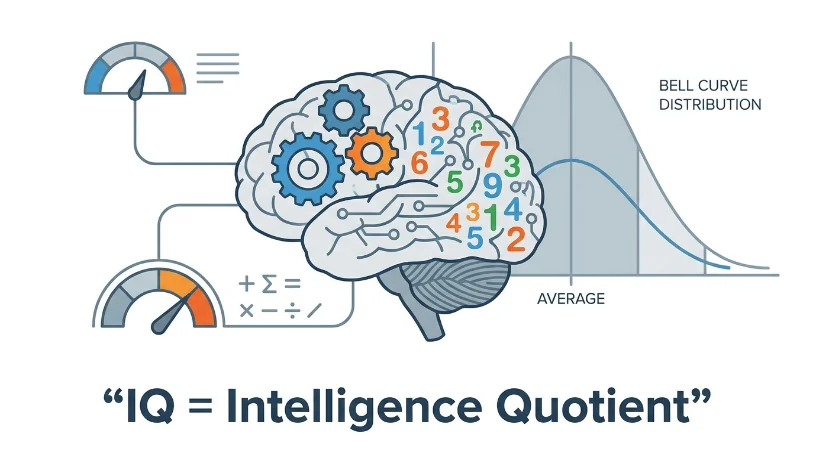
IQ stands for Intelligence Quotient. It is a standardized score used to measure human cognitive abilities such as reasoning, problem-solving, memory, and logical thinking. The average IQ score is 100, with most people scoring between 90 and 110. IQ is assessed through structured tests designed to evaluate intellectual potential rather than knowledge alone.
What Does IQ Stand For? (IQ Full Form and Meaning Explained)
You’ve probably heard the term IQ thrown around in conversations about intelligence, success, or even curiosity. But what does IQ stand for exactly?
IQ stands for Intelligence Quotient.
At its core, the IQ abbreviation represents a numerical score. That score reflects how well someone performs on tests designed to measure cognitive ability. In simple terms, it tells you how effectively a person can think, reason, and solve problems compared to others.
Now, that sounds straightforward. However, once you dig deeper, things get more interesting.
IQ Meaning: Breaking Down the Term “Intelligence Quotient”
Let’s unpack the phrase to make it clearer.
- Intelligence refers to mental abilities like learning, reasoning, and adapting
- Quotient means a calculated number or ratio
Put those together, and you get:
Intelligence Quotient = A numerical representation of cognitive ability
Originally, IQ came from a formula. It compared a person’s mental age to their actual age. Today, modern IQ scores rely on statistical models instead of simple ratios.
Still, the purpose remains the same. IQ tries to answer one question:
How does your thinking ability compare to the average person?
What Is IQ? A Clear and Simple Definition
Here’s a clean, no-nonsense definition:
IQ is a standardized score that measures human intelligence based on cognitive performance in structured tests.
That includes:
- Logical reasoning
- Pattern recognition
- Memory
- Processing speed
- Verbal understanding
Notice something important. IQ doesn’t measure everything. It doesn’t capture creativity, emotional depth, or life experience. It focuses on specific mental skills.
The History of IQ Testing: Who Invented IQ?
The story of IQ begins in early 20th-century France. Schools needed a way to identify students who required extra academic support.
That’s where Alfred Binet stepped in.
Binet developed one of the first intelligence tests. His goal wasn’t to label people. He simply wanted to help educators understand learning differences.
Later, a German psychologist named William Stern introduced the term “Intelligence Quotient.”
He created a formula:
- Mental Age ÷ Chronological Age × 100
That formula gave us the first IQ scores.
Over time, psychologists refined the system. Modern IQ testing now uses standardized scoring methods instead of simple ratios.
How IQ Is Measured Today
Modern IQ tests don’t rely on mental age anymore. Instead, they compare your performance to a large population.
The average IQ score is set at 100.
Scores follow a pattern known as the bell curve. Most people fall near the middle. Fewer people score extremely high or low.
Key Facts About IQ Measurement
- Average score: 100
- Standard range: 85–115
- Scores are relative, not absolute
- Tests are standardized and normed across populations
IQ Scale Explained (IQ Score Chart)
Understanding the IQ scale helps you interpret scores correctly.
| IQ Score Range | Classification | Meaning |
|---|---|---|
| Below 70 | Very Low | May indicate cognitive challenges |
| 70–89 | Below Average | Lower than typical range |
| 90–110 | Average | Normal cognitive ability |
| 111–130 | Above Average | Strong reasoning skills |
| 130+ | Gifted | Exceptional intellectual ability |
Here’s the key takeaway.
Most people fall in the average range. That’s normal and expected.
What IQ Tests Actually Measure
IQ tests don’t test what you know. They test how you think.
That distinction matters.
Core Cognitive Skills Measured
- Logical reasoning — Can you solve problems step by step?
- Pattern recognition — Can you spot relationships quickly?
- Memory — How well do you retain and recall information?
- Processing speed — How fast can you think and respond?
- Verbal comprehension — How well do you understand language?
For example, you might see puzzles like:
- Completing number sequences
- Identifying shapes that don’t belong
- Solving analogies
These tasks reveal how your brain processes information.
Types of Intelligence Tests (Standard IQ Tests)
Not all IQ tests are the same. Some are clinical and highly accurate. Others are casual and less reliable.
Most Recognized IQ Tests
- Stanford-Binet Intelligence Scales
- Wechsler Adult Intelligence Scale
These tests are widely used by psychologists.
They follow strict guidelines. They also undergo regular updates to stay accurate.
Online IQ Tests vs Professional Assessments
Let’s be honest. Online IQ tests are everywhere.
But here’s the reality.
Online Tests
- Quick and convenient
- Often for entertainment
- Not always reliable
Professional Tests
- Conducted by trained psychologists
- Standardized and validated
- Far more accurate
If you want a true IQ score, go with a professional assessment.
Average IQ Score and What It Means
The average IQ score is 100.
That number isn’t random. It’s designed that way.
When psychologists create IQ tests, they adjust scoring so that the average always stays at 100.
What “Average” Really Means
- You can solve everyday problems effectively
- You learn at a typical pace
- You function well in standard environments
In other words, average doesn’t mean mediocre. It means normal and functional.
High IQ Meaning and Low IQ Meaning
IQ scores often get labeled as “high” or “low.” Let’s clarify what that actually means.
High IQ (130+)
- Strong analytical thinking
- Quick problem-solving ability
- Often associated with academic success
Low IQ (Below 70)
- May indicate learning difficulties
- Often requires additional support
- Does not define a person’s worth
Here’s something important.
IQ measures ability, not value.
Factors That Influence IQ Scores
IQ isn’t fixed by a single factor. It develops through a mix of influences.
Key Influences
- Genetics — Plays a significant role
- Education — Enhances cognitive skills
- Nutrition — Supports brain development
- Environment — Shapes learning opportunities
- Practice — Familiarity with tests improves performance
Think of IQ like a muscle. It has a baseline, but environment and effort shape how it performs.
Mental Age vs Chronological Age (Classic Concept)
Earlier IQ models relied on a simple idea.
- Mental Age = Intellectual performance level
- Chronological Age = Actual age in years
Example:
- A 10-year-old with a mental age of 12
- IQ = (12 ÷ 10) × 100 = 120
That system worked for children. However, it didn’t hold up for adults.
That’s why modern IQ testing moved away from this method.
Common Myths About IQ (Debunked)
There’s a lot of confusion around IQ. Let’s clear it up.
Myth: IQ Equals Overall Intelligence
Not true. IQ measures specific cognitive skills, not total intelligence.
Myth: IQ Never Changes
Wrong. IQ can shift slightly over time, especially during development.
Myth: High IQ Guarantees Success
Plenty of successful people have average IQs.
Myth: IQ Tests Are Perfect
No test is completely free from bias.
IQ vs EQ Difference (Emotional Intelligence vs IQ)
IQ isn’t the whole story.
Enter Emotional Intelligence (EQ).
IQ vs EQ Comparison
| Factor | IQ | EQ |
|---|---|---|
| Focus | Cognitive ability | Emotional awareness |
| Skills | Logic, reasoning | Empathy, communication |
| Use | Academics, problem-solving | Relationships, leadership |
Imagine this.
Someone might solve complex equations quickly. Still, they may struggle to manage emotions or relationships.
That’s where EQ matters.
Does IQ Predict Success?
IQ helps in certain areas. However, it doesn’t guarantee success.
Where IQ Helps
- Academic achievement
- Technical careers
- Analytical problem-solving
Where IQ Falls Short
- Creativity
- Social skills
- Persistence
Success often depends on a combination of skills, not just IQ.
Can You Improve Your IQ?
This question sparks debate.
The answer isn’t simple.
What Science Suggests
- Fluid intelligence (problem-solving) is harder to change
- Crystallized intelligence (knowledge) can grow over time
Ways to Boost Cognitive Performance
- Learn new skills
- Challenge your brain with puzzles
- Read regularly
- Stay physically active
- Maintain good sleep habits
While you may not dramatically increase your IQ score, you can absolutely improve how your brain performs.
Why IQ Testing Is Controversial
IQ testing isn’t without criticism.
Key Concerns
- Cultural bias
- Misuse in history
- Oversimplification of intelligence
Some argue that IQ reduces a complex human trait into a single number.
That criticism holds weight.
IQ Importance in the Real World
So, does IQ matter?
Yes. But only to a point.
Why IQ Matters
- Helps identify learning needs
- Supports educational planning
- Useful in research and psychology
Why It’s Not Everything
- Life success depends on many factors
- Skills like resilience matter more over time
Think of IQ as a tool, not a label.
Practical Takeaways: What IQ Means for You
Let’s bring it all together.
- IQ stands for Intelligence Quotient
- It measures specific cognitive abilities
- The average score is 100
- It does not define your potential
Here’s the real insight.
Your mindset, habits, and effort shape your future far more than a number ever will.
FAQs
What does IQ stand for in simple terms?
IQ stands for Intelligence Quotient. It represents a score that measures cognitive ability.
What is a normal IQ range?
Most people score between 90 and 110.
Can IQ change over time?
It can shift slightly, especially during childhood and development.
Are online IQ tests accurate?
Not really. Professional tests provide reliable results.
Is IQ genetic or learned?
Both. Genetics and environment influence IQ.
Conclusion
At first glance, IQ seems like a simple number.
Look closer, and it becomes something more complex.
IQ stands for Intelligence Quotient, but it doesn’t define who you are. It captures a snapshot of how your mind works under specific conditions.
Life is broader than that. Skills evolve. People grow. Intelligence takes many forms.
So yes, understand your IQ. Use it wisely.
But don’t let it limit you.

Sophia Bennett is a professional writer focused on explaining word meanings, expressions and everyday language in a simple and engaging way.