
Last Updated on June 11, 2026
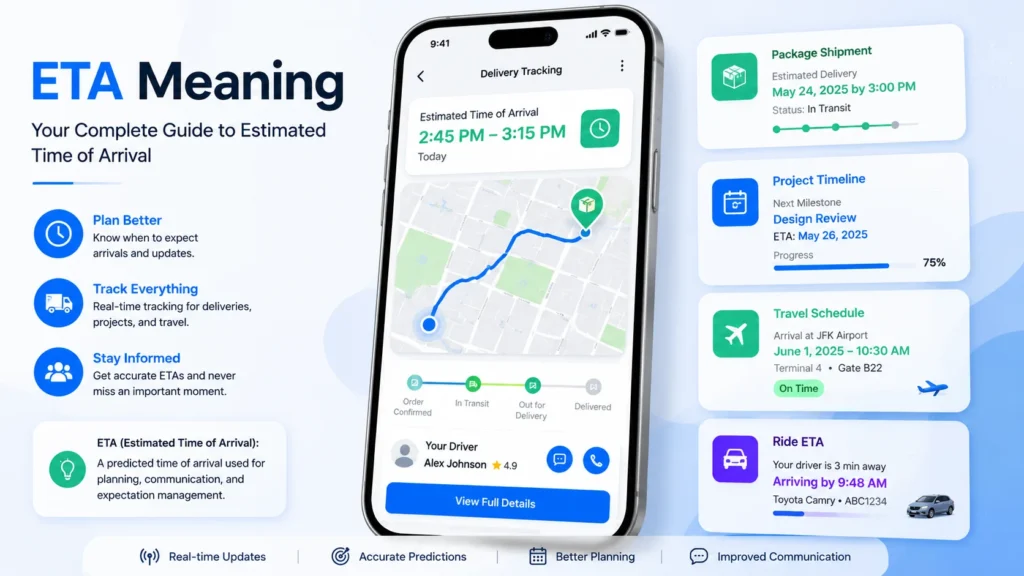
ETA stands for Estimated Time of Arrival. It refers to the expected time when a person, vehicle, shipment, flight, package, or project will reach its destination or be completed. People commonly use ETA in transportation, logistics, delivery services, project management, business communication, navigation apps, and text messages. For example, if someone says, “My ETA is 15 minutes,” they expect to arrive in about 15 minutes.
ETA is one of those abbreviations that appears almost everywhere.
You see it while tracking a package. Drivers mention it during deliveries. Project managers ask for it during meetings. Friends use it in text messages. Navigation apps display it whenever you travel.
Despite being incredibly common, many people still wonder:
What does ETA mean?
The answer seems simple at first. However, ETA has evolved far beyond its original meaning. Today it plays an important role in transportation, logistics, business operations, project planning, customer service, software development, and everyday conversations.
This guide explains everything you need to know about ETA, including its definition, history, practical applications, examples, and related terminology.
What Does ETA Mean?
ETA Meaning Explained
ETA stands for Estimated Time of Arrival.
It refers to the predicted time when a person, vehicle, shipment, aircraft, package, service technician, or project is expected to arrive at a destination or reach completion.
The keyword here is estimated.
An ETA is not an exact guarantee. Instead, it represents the best prediction available based on current information.
For example:
- A delivery truck may have an ETA of 3:00 PM.
- A flight may have an ETA of 8:45 PM.
- A friend may text an ETA of 20 minutes.
- A software project may have an ETA of two weeks.
In every case, ETA provides an expected arrival or completion time.
Simple Definition of ETA
ETA means the estimated or expected time when something or someone will arrive or be completed.
Think of ETA as a forecast rather than a promise.
Just as weather forecasts predict future conditions, ETA predicts future arrival times.
ETA Full Form
| Acronym | Full Form |
|---|---|
| ETA | Estimated Time of Arrival |
Although this is the most common meaning, ETA can have different meanings in specialized fields. Those alternative definitions will be covered later in this guide.
Why ETA Is Important
ETA Helps People Plan
Without estimated arrival times, planning becomes difficult.
Whether you’re waiting for a package or managing a construction project, knowing the expected completion time helps you organize activities efficiently.
Benefits include:
- Better scheduling
- Reduced uncertainty
- Improved communication
- Higher customer satisfaction
- Enhanced productivity
- More accurate resource allocation
ETA Reduces Waiting Anxiety
People dislike uncertainty.
Imagine ordering food and receiving no delivery estimate.
You would constantly wonder:
- Has the order been prepared?
- Is the driver nearby?
- Will it arrive soon?
An ETA provides reassurance by setting expectations.
ETA Improves Business Efficiency
Organizations rely heavily on ETA data.
Industries that frequently use ETA include:
| Industry | ETA Usage |
|---|---|
| Logistics | Shipment arrival forecasting |
| Transportation | Vehicle arrival estimation |
| Aviation | Flight arrival scheduling |
| Maritime Shipping | Port arrival predictions |
| Healthcare | Ambulance arrival estimates |
| Construction | Project milestone forecasting |
| Software Development | Release planning |
| Customer Support | Service technician scheduling |
Because of this versatility, ETA has become a universal communication tool.
The History of ETA
Military Origins
The concept of ETA gained prominence through military operations.
Military commanders needed reliable estimates regarding:
- Troop movements
- Aircraft arrivals
- Naval deployments
- Supply deliveries
Accurate timing often determined mission success.
As a result, ETA became standard operational terminology.
Expansion Into Transportation
Commercial transportation later adopted the term.
Railways, airlines, trucking companies, and shipping organizations found ETA extremely useful for coordinating schedules.
Over time, the abbreviation entered mainstream business language.
ETA in the Digital Age
Today, technology has transformed ETA calculations.
Modern systems use:
- GPS tracking
- Artificial intelligence
- Real-time traffic data
- Historical travel patterns
- Weather information
- Machine learning algorithms
As a result, ETA predictions are more accurate than ever before.
How ETA Works
Factors That Influence ETA
An ETA is calculated using available information.
Several variables affect accuracy.
Distance
Longer distances generally require more complex calculations.
A package traveling across a city is easier to predict than one traveling across continents.
Speed
Travel speed directly impacts arrival estimates.
Higher speeds often reduce ETA.
Lower speeds extend ETA.
Traffic Conditions
Road congestion can significantly affect arrival times.
Modern navigation apps continuously update ETAs based on current traffic conditions.
Weather Conditions
Weather can create delays.
Examples include:
- Snowstorms
- Heavy rain
- Flooding
- Fog
- Strong winds
These conditions often require ETA adjustments.
Route Changes
Unexpected route changes may increase or decrease estimated arrival times.
Examples include:
- Road closures
- Construction zones
- Accidents
- Detours
Operational Delays
Businesses often adjust ETAs because of:
- Staffing shortages
- Equipment failures
- Processing delays
- Inventory issues
Basic ETA Formula
A simplified ETA calculation looks like this:
Arrival Time = Current Time + Estimated Travel Time
Example:
- Current Time: 2:00 PM
- Travel Time: 45 Minutes
ETA = 2:45 PM
Real-world systems use far more sophisticated calculations.
ETA in Text Messages and Online Conversations
ETA Meaning in Text
In texting, ETA usually maintains its traditional meaning.
People often use it as shorthand for expected arrival time.
Examples:
- “What’s your ETA?”
- “ETA 10 mins.”
- “My ETA is around 6 PM.”
- “Traffic is bad. ETA moved to 7 PM.”
The abbreviation saves time and makes communication more efficient.
Why ETA Is Popular in Messaging
Text messages favor short, fast communication.
Instead of writing:
“What time do you think you’ll arrive?”
People simply write:
“ETA?”
That single word communicates the entire question.
Common ETA Text Examples
| Message | Meaning |
|---|---|
| ETA? | When will you arrive? |
| ETA 15 min | I expect to arrive in 15 minutes |
| Updated ETA 8:30 | New expected arrival time is 8:30 |
| Need ETA ASAP | Provide arrival estimate quickly |
ETA on Social Media
Social media users frequently mention ETA when discussing:
- Deliveries
- Events
- Travel plans
- Live streams
- Product launches
- Project releases
The abbreviation remains universally understood across platforms.
ETA in Navigation and Travel
ETA in GPS Systems
Navigation apps rely heavily on ETA calculations.
Every route recommendation includes an expected arrival time.
When you enter a destination, the system analyzes:
- Distance
- Road conditions
- Traffic patterns
- Speed limits
- Historical congestion data
It then generates an ETA.
How GPS Updates ETA
Modern GPS systems continuously recalculate.
For example:
- Traffic improves
- ETA becomes earlier
Or:
- Traffic worsens
- ETA becomes later
This dynamic updating improves accuracy.
ETA for Flights
Airlines regularly publish flight ETAs.
Passengers use these estimates to:
- Coordinate pickups
- Schedule transportation
- Plan connecting flights
- Inform family members
Flight ETAs may change because of:
- Weather conditions
- Air traffic control delays
- Runway congestion
- Mechanical issues
ETA for Public Transportation
Transit agencies use ETA systems for:
- Buses
- Trains
- Subway systems
- Ferries
Real-time arrival boards depend on ETA calculations.
These systems improve commuter experiences and reduce uncertainty.
ETA in Logistics and Shipping
ETA is one of the most important measurements in the logistics industry.
Every day, millions of shipments move through warehouses, distribution centers, ports, airports, and transportation networks. Businesses need accurate arrival estimates to keep operations running smoothly.
Without ETA forecasting, supply chains would become far less efficient.
Why ETA Matters in Logistics
Logistics teams use ETA information to:
- Schedule unloading crews
- Plan warehouse operations
- Coordinate transportation
- Manage inventory levels
- Inform customers
- Reduce operational delays
A small delay in one shipment can create a chain reaction that affects multiple departments.
That is why companies continuously monitor ETA updates.
Shipping ETA Explained
In shipping, ETA represents the expected date and time when cargo will reach its destination.
Examples include:
| Shipment Type | Example ETA |
|---|---|
| Container Ship | July 12 at 8:00 AM |
| Air Cargo | June 20 at 3:30 PM |
| Truck Delivery | Today by 5:00 PM |
| Parcel Shipment | Arriving in 2 days |
The estimate changes whenever conditions change.
What Can Affect Shipping ETA?
Many factors influence shipping schedules.
Weather Conditions
Storms, hurricanes, and heavy snowfall frequently disrupt transportation routes.
A shipment moving through severe weather may experience delays of several hours or even days.
Customs Clearance
International shipments often encounter customs inspections.
These inspections can alter ETAs unexpectedly.
Port Congestion
Busy ports sometimes experience bottlenecks.
When dozens of vessels arrive simultaneously, unloading operations may slow down.
Transportation Issues
Common problems include:
- Vehicle breakdowns
- Driver shortages
- Fuel disruptions
- Route closures
- Infrastructure problems
Each factor can affect arrival predictions.
ETA in Package Tracking
Most consumers encounter ETA while tracking online purchases.
When you order an item, the retailer provides an estimated delivery date.
That estimate is essentially the package’s ETA.
Modern tracking systems update ETA information throughout the shipping journey.
For example:
| Tracking Status | ETA Meaning |
|---|---|
| Package Picked Up | Initial estimate created |
| In Transit | ETA based on route progress |
| Out for Delivery | Arrival expected today |
| Delayed | ETA recalculated |
Real-time tracking has dramatically improved customer expectations.
People now expect accurate ETA updates throughout the delivery process.
ETA in Business Communication
ETA is not limited to transportation.
Businesses use ETA constantly in meetings, emails, project discussions, and customer interactions.
ETA Meaning in Business
In business communication, ETA often refers to an expected completion time rather than physical arrival.
Examples include:
- Report ETA
- Project ETA
- Product launch ETA
- Software release ETA
- Contract completion ETA
The concept remains the same.
Instead of asking when someone will arrive, people ask when work will be finished.
Examples of ETA in Professional Settings
Business teams frequently use statements such as:
“What’s the ETA for the presentation?”
“The updated ETA for completion is Friday.”
“Can you provide an ETA for the revised proposal?”
These questions help managers track progress.
Why Businesses Depend on ETA
Organizations use ETA estimates to:
- Set expectations
- Manage deadlines
- Coordinate teams
- Allocate resources
- Improve accountability
Without estimated completion times, projects can quickly lose direction.
ETA in Customer Service
Customer service teams frequently provide ETA updates.
Examples include:
| Scenario | ETA Example |
|---|---|
| Technician Visit | ETA 2:00 PM |
| Support Resolution | ETA 24 Hours |
| Replacement Shipment | ETA 3 Days |
| Installation Service | ETA Tomorrow Morning |
Clear ETA communication often increases customer satisfaction.
People generally accept delays when they receive accurate updates.
ETA in Project Management
Project managers use ETA every day.
Large projects involve numerous tasks, milestones, dependencies, and deliverables.
Knowing expected completion times helps maintain momentum.
What Does ETA Mean in Project Management?
In project management, ETA refers to the estimated completion date for a task, milestone, or entire project.
Examples:
- Design ETA
- Development ETA
- Testing ETA
- Launch ETA
Each stage receives its own estimate.
Project ETA vs Deadline
Many people confuse ETA with a deadline.
However, they are different.
| ETA | Deadline |
|---|---|
| Prediction | Commitment |
| Can Change | Usually Fixed |
| Based on Current Data | Based on Business Requirements |
| Estimate | Target Date |
A deadline may remain fixed while the ETA changes.
How Project Managers Calculate ETA
Project leaders evaluate:
- Team capacity
- Task complexity
- Historical performance
- Resource availability
- Risk factors
They then estimate realistic completion dates.
Experienced managers avoid overly optimistic ETAs.
Benefits of Accurate Project ETA Forecasting
Accurate forecasts help organizations:
- Reduce missed deadlines
- Improve planning
- Increase transparency
- Minimize bottlenecks
- Build stakeholder confidence
A realistic ETA often prevents future problems.
ETA in Software Development
Software teams frequently discuss ETA.
Developers, project managers, product owners, and stakeholders all rely on completion estimates.
Why ETA Is Important in Software Projects
Software development rarely follows a perfectly predictable path.
Unexpected issues can emerge at any stage.
Examples include:
- Coding bugs
- Security vulnerabilities
- Testing failures
- Integration problems
- Infrastructure issues
Because of this uncertainty, ETA forecasting becomes critical.
Common Software ETA Questions
Development teams often hear:
- What’s the ETA for deployment?
- What’s the ETA for the bug fix?
- What’s the ETA for the feature release?
- What’s the ETA for production launch?
Each question seeks an expected completion timeframe.
Challenges of Software ETA Estimation
Software estimates can be difficult because:
- Requirements change
- Complexity increases
- Hidden dependencies emerge
- Technical debt accumulates
- Testing uncovers new issues
As a result, software ETAs frequently evolve throughout a project.
Best Practices for Software ETA Estimates
Strong development teams:
- Break projects into smaller tasks
- Use historical data
- Include risk buffers
- Update estimates regularly
- Communicate changes quickly
This approach improves forecasting accuracy.
ETA in Transportation Industries
Transportation systems depend heavily on ETA calculations.
Whether moving passengers or freight, accurate predictions improve efficiency.
ETA in Aviation
Airlines publish ETAs for nearly every flight.
Passengers use them to:
- Arrange pickups
- Schedule connections
- Plan meetings
- Coordinate travel
Modern aviation systems continuously update flight ETAs.
ETA in Maritime Shipping
Ocean freight companies rely heavily on ETA forecasts.
Container ships travel long distances through changing conditions.
Factors affecting maritime ETA include:
- Ocean currents
- Weather systems
- Port traffic
- Fuel efficiency
- Vessel speed
Even small changes can affect arrival schedules.
ETA in Trucking
Trucking companies use GPS-powered ETA systems.
Fleet managers track:
- Vehicle locations
- Driver hours
- Traffic conditions
- Fuel stops
- Delivery schedules
This visibility improves operational performance.
ETA in Ride-Sharing Services
Ride-sharing platforms transformed consumer expectations.
Customers now expect precise arrival estimates.
Typical ride-sharing ETA calculations consider:
- Driver location
- Traffic conditions
- Road speed
- Pickup demand
- Route efficiency
These systems update every few seconds.
ETA vs ETD vs ATA
Many industries use several related abbreviations.
Understanding the differences is important.
ETA Meaning
ETA stands for:
Estimated Time of Arrival
This predicts when something should arrive.
ETD Meaning
ETD stands for:
Estimated Time of Departure
This predicts when something will leave.
ATA Meaning
ATA stands for:
Actual Time of Arrival
This records when arrival actually occurred.
Comparison Table
| Term | Full Form | Purpose |
|---|---|---|
| ETA | Estimated Time of Arrival | Predicted arrival |
| ETD | Estimated Time of Departure | Predicted departure |
| ATA | Actual Time of Arrival | Real arrival time |
| ATD | Actual Time of Departure | Real departure time |
Together, these measurements help organizations evaluate performance.
Example
Imagine a shipment:
- ETD: 9:00 AM
- ETA: 4:00 PM
- ATA: 4:45 PM
In this case, the shipment arrived 45 minutes later than expected.
That difference can be analyzed to improve future forecasts.
ETA Accuracy and Limitations
Although ETA systems have become sophisticated, they are not perfect.
Every estimate contains uncertainty.
Why ETAs Change
People sometimes assume an ETA is guaranteed.
In reality, it is only a prediction.
Changes occur because of:
- Weather events
- Traffic accidents
- Equipment failures
- Human error
- Operational disruptions
Unexpected events can alter arrival times quickly.
What Makes Some ETAs More Accurate?
Several factors improve reliability:
Real-Time Data
Systems that continuously receive live updates generally perform better.
Artificial Intelligence
Modern AI models identify patterns that humans may overlook.
Historical Analysis
Past performance helps improve future predictions.
GPS Tracking
Precise location tracking increases ETA accuracy.
Understanding ETA Confidence Levels
Some advanced systems assign confidence scores.
For example:
| Confidence Level | Meaning |
|---|---|
| 95% | Very likely to arrive as predicted |
| 80% | Reasonably reliable estimate |
| 60% | Significant uncertainty exists |
| Below 50% | High probability of change |
Confidence indicators help users interpret ETA information more realistically.
How Technology Has Improved ETA Forecasting
Today’s ETA systems are far more advanced than earlier methods.
In the past, estimates relied heavily on manual calculations.
Now technology handles most forecasting automatically.
GPS Tracking Revolution
GPS technology transformed ETA calculations.
Instead of relying on assumptions, systems can track exact locations in real time.
Benefits include:
- Greater accuracy
- Faster updates
- Improved route planning
- Better customer visibility
Artificial Intelligence and ETA
AI continuously analyzes:
- Traffic patterns
- Weather forecasts
- Historical trends
- Driver behavior
- Delivery performance
This enables smarter predictions.
Machine Learning Improvements
Machine learning systems improve over time.
As more data becomes available, prediction models become increasingly accurate.
This explains why many navigation apps now provide surprisingly precise arrival estimates.
Real-Time Data Integration
Modern ETA systems combine multiple data sources.
Examples include:
- Satellite data
- GPS locations
- Weather services
- Traffic sensors
- Fleet management systems
The result is more reliable forecasting than ever before.
Alternative Meanings of ETA
Although Estimated Time of Arrival is by far the most common definition, ETA can have different meanings depending on the industry, organization, or context.
Understanding these alternative meanings helps prevent confusion.
Common Alternative ETA Definitions
| ETA Meaning | Industry or Context |
|---|---|
| Estimated Time of Arrival | Transportation, logistics, travel |
| Estimated Time of Availability | Business operations |
| Estimated Time of Completion | Project management |
| Electronic Travel Authorization | Immigration and travel |
| Expected Time of Arrival | Informal communication |
| Engineering Test Article | Manufacturing and engineering |
In everyday conversations, however, ETA almost always refers to arrival time or completion time.
ETA as Electronic Travel Authorization
Several countries use ETA as an abbreviation for Electronic Travel Authorization.
This is a digital travel approval that allows eligible travelers to enter a country without obtaining a traditional visa.
Examples include:
- Canada ETA
- Australia ETA
- United Kingdom ETA program
In travel discussions, context determines which meaning applies.
For example:
“Have you applied for your ETA before traveling?”
Here, ETA refers to a travel authorization rather than an arrival estimate.
ETA as Estimated Time of Completion
Project teams often use ETA differently.
Instead of referring to arrival, it may indicate when work is expected to finish.
Examples:
- ETA for website launch
- ETA for bug resolution
- ETA for construction completion
- ETA for report submission
The concept remains similar because both involve forecasting future timing.
ETA Meaning in Text, Chat, and Social Media
Modern digital communication has helped ETA become even more popular.
People use it every day in text messages, chat apps, social media posts, and workplace messaging platforms.
What Does ETA Mean in Text?
In texting, ETA almost always means:
Estimated Time of Arrival
Examples include:
- ETA 10 mins
- ETA 5:30 PM
- Running late. ETA 20 minutes.
- Traffic is bad. ETA now 7 PM.
The abbreviation saves time and reduces unnecessary typing.
Why ETA Is Popular Online
Digital communication rewards brevity.
People want to communicate quickly without sacrificing clarity.
ETA achieves both goals.
Instead of writing:
“What time do you think you’ll arrive at the restaurant?”
Someone simply writes:
“ETA?”
The meaning remains perfectly clear.
ETA in Workplace Chat Platforms
Applications such as workplace messaging tools frequently use ETA.
Common workplace examples include:
- What’s the ETA for deployment?
- Can you provide an ETA for the report?
- ETA on the client feedback?
- What’s our ETA for project completion?
This usage has become standard across many industries.
ETA on Social Media
Social media users often mention ETA when discussing:
- Product releases
- Event start times
- Live streams
- Video uploads
- Software updates
- Game launches
Examples:
ETA for the new update?
Any ETA on the next episode?
ETA for restocking?
These examples demonstrate how ETA has expanded beyond transportation.
Real-World ETA Examples
Theory helps, but practical examples make the concept easier to understand.
Let’s examine ETA usage across different situations.
ETA Example in Travel
Imagine you are driving from one city to another.
Your navigation app shows:
- Current Time: 2:00 PM
- Distance Remaining: 120 Miles
- ETA: 4:15 PM
This means the system predicts arrival at approximately 4:15 PM.
ETA Example in Food Delivery
You order food through a delivery app.
The app displays:
- Order Confirmed
- Preparing Food
- Driver Assigned
- ETA: 28 Minutes
This estimate helps you know when to expect your meal.
ETA Example in Package Tracking
Suppose you purchase a laptop online.
Tracking information may show:
| Shipment Stage | ETA |
|---|---|
| Order Processed | June 10 |
| In Transit | June 12 |
| Local Facility | June 14 |
| Delivery ETA | June 15 |
The ETA gives you a forecast of arrival.
ETA Example in Business
A manager asks:
“When will the quarterly report be finished?”
The analyst responds:
“The ETA is Friday afternoon.”
Here ETA means expected completion time.
ETA Example in Software Development
A development team discovers a bug.
Management asks:
“What’s the ETA for the fix?”
The lead developer replies:
“Current ETA is tomorrow morning.”
Again, ETA refers to expected completion rather than physical arrival.
Common ETA Mistakes and Misunderstandings
Although ETA seems straightforward, people frequently misuse or misunderstand it.
Assuming ETA Is a Guarantee
One of the biggest mistakes is treating ETA as a promise.
Remember:
ETA is an estimate, not a guarantee.
Unexpected events can always affect arrival times.
Ignoring ETA Updates
Modern systems constantly update predictions.
Some users continue relying on old estimates instead of checking updated information.
The latest ETA is usually the most accurate.
Confusing ETA With ETD
Many people mistakenly interchange ETA and ETD.
Remember:
- ETA = Arrival
- ETD = Departure
The difference is significant in transportation and logistics.
Providing Unrealistic ETAs
In business environments, overly optimistic estimates can create problems.
A realistic ETA is usually more valuable than an unrealistic one.
Accurate forecasting builds trust.
Unrealistic forecasting damages credibility.
Failing to Communicate ETA Changes
Delays happen.
Problems arise when updates are not communicated.
Best practice involves notifying affected parties whenever the ETA changes significantly.
Best Practices for Giving Accurate ETAs
Whether you’re managing projects or delivering packages, certain principles improve ETA accuracy.
Use Current Information
Always base estimates on the latest available data.
Outdated information often leads to inaccurate predictions.
Include Risk Factors
Consider potential disruptions.
Examples include:
- Traffic congestion
- Weather conditions
- Resource limitations
- Technical problems
Risk awareness improves forecasting quality.
Update Estimates Frequently
The best ETA systems continuously adjust predictions.
Regular updates help maintain accuracy.
Communicate Clearly
When sharing ETAs:
- Be realistic
- Avoid overpromising
- Explain major delays
- Provide updates when conditions change
Clear communication often matters as much as the estimate itself.
Build in Reasonable Buffers
Experienced planners often include small contingency buffers.
This approach reduces the likelihood of missed expectations.
ETA and the Future of Predictive Technology
The future of ETA forecasting looks increasingly sophisticated.
Artificial intelligence continues improving predictive accuracy.
Predictive Analytics
Modern systems now evaluate:
- Historical behavior
- Real-time events
- Seasonal trends
- Environmental factors
These insights create smarter forecasts.
Autonomous Transportation
Self-driving vehicles will likely rely heavily on ETA technology.
Accurate arrival forecasting will help coordinate:
- Passenger transport
- Freight movement
- Delivery services
Smart Cities
Future smart cities may integrate ETA systems across:
- Traffic networks
- Public transit
- Emergency services
- Utility operations
This integration could improve efficiency on a massive scale.
Hyper-Personalized ETA Systems
Future ETA tools may adapt to individual behavior patterns.
For example:
- Personal driving habits
- Preferred routes
- Historical travel times
- Typical delays
Such personalization could further improve accuracy.
ETA Glossary of Related Terms
Understanding related terminology provides additional context.
Arrival Time
The actual moment a person, vehicle, or shipment reaches a destination.
Estimated Time of Departure (ETD)
The predicted departure time.
Actual Time of Arrival (ATA)
The real recorded arrival time.
Transit Time
The total time required for movement between locations.
Delivery Window
A time range during which delivery is expected.
Route Planning
The process of selecting the most efficient path to a destination.
Shipment Tracking
Monitoring package movement throughout the delivery process.
Logistics Management
Coordinating transportation, storage, and distribution activities.
Frequently Asked Questions
What does ETA mean?
ETA stands for Estimated Time of Arrival. It refers to the predicted time when a person, vehicle, shipment, flight, package, or project is expected to arrive or be completed.
What is the full form of ETA?
The full form of ETA is Estimated Time of Arrival.
What does ETA mean in text messages?
In text messages, ETA usually means the expected time someone plans to arrive.
Example:
“ETA 15 minutes.”
What does ETA mean in business?
In business, ETA often refers to an expected completion date or delivery timeframe for a task, report, project, or service.
Is ETA always accurate?
No.
ETA is an estimate based on available information. Traffic, weather, technical issues, and unexpected delays can affect accuracy.
What is the difference between ETA and ETD?
ETA means Estimated Time of Arrival.
ETD means Estimated Time of Departure.
One predicts arrival while the other predicts departure.
What does ETA mean in logistics?
In logistics, ETA represents the expected arrival time of cargo, shipments, trucks, containers, or packages.
Why do navigation apps use ETA?
Navigation apps calculate ETA to help users understand when they are likely to reach their destination.
Can ETA mean completion time?
Yes.
In project management and business environments, ETA often refers to the estimated completion time for a task or project.
Why does my ETA keep changing?
ETA changes because real-world conditions change.
Traffic, weather, route adjustments, and operational delays can all affect predictions.
Conclusion
If you’ve ever asked, “What does ETA mean?”, the answer is simple yet incredibly important.
ETA stands for Estimated Time of Arrival, a prediction that tells you when a person, vehicle, package, shipment, flight, service, or project is expected to arrive or be completed.
While the abbreviation began as a practical timing tool, it has evolved into a universal language used across transportation, logistics, business, project management, software development, customer service, and everyday communication.
Today, ETA influences how people travel, shop, manage projects, track deliveries, and coordinate activities. From GPS navigation systems and package tracking platforms to workplace messaging and customer support interactions, ETA helps reduce uncertainty and improve planning.
The next time someone asks for an ETA, you’ll understand exactly what they mean and why this small acronym plays such a big role in modern life.

Michael Anderson is a content writer specializing in word meanings, definitions and clear explanations of modern terms and phrases.