Last Updated on June 11, 2026
Fein is a slang spelling of fiend, a word traditionally used to describe someone who desperately craves or obsessively wants something. In modern internet slang, people use fein to describe someone who is extremely eager, addicted, obsessed, or constantly seeking something they enjoy.
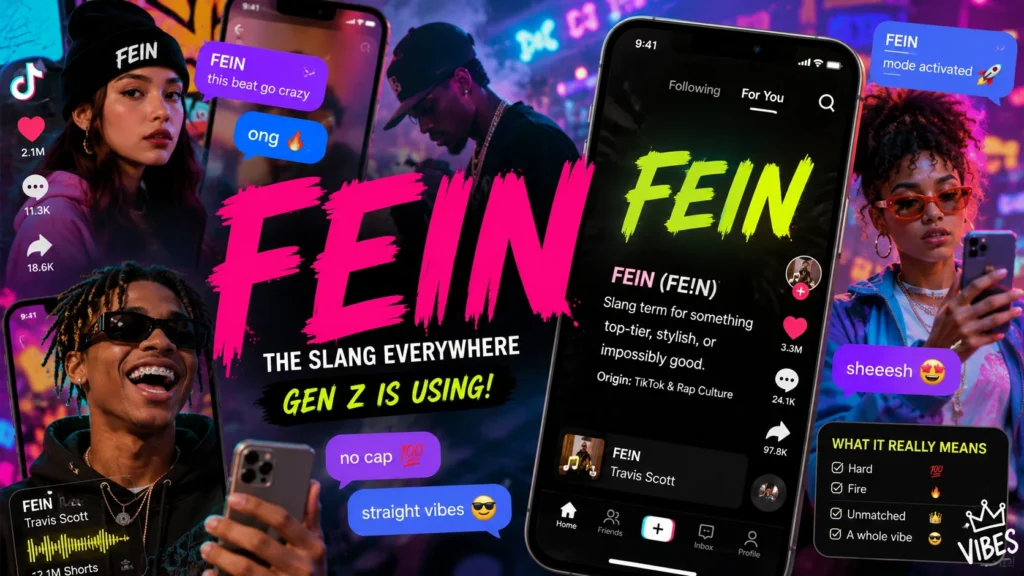
The term became especially popular through social media platforms such as TikTok, Instagram, Snapchat, and hip-hop culture. Many users say someone is a “fein” when they cannot stop talking about, wanting, or chasing something. The popularity of the song FE!N by Travis Scott featuring Playboi Carti also pushed the term further into mainstream culture.
Quick definition: A fein is someone who intensely wants, craves, or obsessively seeks something.
| Term | Meaning |
|---|---|
| Fein | Slang spelling of fiend |
| Fiend | Someone who strongly craves something |
| FE!N | Popular Travis Scott song title |
| Fein in slang | Obsessed, addicted, eager, desperate |
| Fein in texting | Someone who can’t stop wanting something |
What Is Fein?
Language changes fast. One week a word barely exists online. The next week it seems to appear in every comment section, meme, and TikTok video.
That is exactly what happened with fein.
If you’ve seen comments like:
- “Bro is a fein.”
- “You’re such a fein.”
- “Everyone became a fein after that song.”
- “Stop acting like a fein.”
You may have wondered what the word actually means.
At its core, fein means someone who intensely craves, wants, or obsesses over something. The word is often playful rather than serious. People use it to joke about friends who cannot stop talking about a favorite artist, game, food, trend, or person.
In many situations, calling someone a fein means they are acting overly eager or excessively invested in something.
The exact meaning depends on context, which explains why the word appears in so many different situations online.
Fein Meaning in Slang
What Does Fein Mean in Slang?
The most common slang meaning of fein is:
A person who is obsessed with, addicted to, or constantly seeking something.
The slang version is usually less serious than the traditional meaning of fiend.
For example:
- A sneaker fein constantly buys shoes.
- A gaming fein spends all day playing games.
- A music fein never stops discussing new albums.
- A coffee fein cannot function without coffee.
In online conversations, the word often exaggerates someone’s enthusiasm.
Examples of Fein Slang Usage
| Example | Meaning |
|---|---|
| He’s a Travis Scott fein. | He’s obsessed with Travis Scott. |
| She’s a coffee fein. | She constantly wants coffee. |
| Bro is a gaming fein. | He is obsessed with gaming. |
| You’re such a fein. | You’re overly eager or obsessed. |
| They’re concert feins. | They constantly chase concerts. |
The key idea is intensity.
A person does not simply like something.
They want it all the time.
Why People Use Fein Instead of Fiend
The traditional word is actually fiend.
However, internet culture often changes spelling for style, humor, speed, or identity.
Just as people write:
- boi instead of boy
- dat instead of that
- finna instead of fixing to
Many users write fein instead of fiend.
Over time, the alternative spelling developed its own identity online.
Today, many younger users recognize fein immediately even if they rarely use the standard spelling.
Fein Definition and Traditional Meaning
The Original Meaning of Fiend
To understand fein fully, it helps to understand fiend.
Historically, the word fiend had much stronger meanings.
In older English, a fiend could refer to:
- An evil spirit
- A demon
- A wicked person
- Someone consumed by unhealthy desires
As language evolved, the word gradually became less dramatic.
Eventually, people started using fiend for anyone who had an intense craving.
Examples include:
- Drug fiend
- Gambling fiend
- Work fiend
- Sports fiend
Modern slang inherited this craving-based meaning.
The internet simply modified the spelling.
Is Fein a Real Word?
This question appears frequently online.
The answer depends on how you define “real.”
Fein is not traditionally listed as a standard English dictionary word in the same way as fiend.
However, language evolves through usage.
Millions of people use fein online.
As a result, the term functions as a legitimate slang expression within internet culture.
Many modern slang words began exactly the same way.
Where Does Fein Come From?
Fein Origin Explained
The modern slang term comes directly from fiend.
The transformation happened through:
- Internet communication
- Text messaging
- Social media culture
- Hip-hop communities
- Meme culture
Online users often simplify spellings.
Eventually, fein became widespread enough to stand on its own.
The rise of TikTok accelerated adoption because short-form videos spread slang incredibly fast.
How Social Media Helped Fein Spread
Social media acts like a giant language laboratory.
Words can spread globally within days.
Several factors helped fein become popular:
- Viral videos
- Memes
- Comment sections
- Influencer content
- Music trends
- Fan communities
Once enough people started using the term, new users learned it through context.
This process continues today.
What Does Fein Mean on TikTok?
Fein TikTok Meaning
TikTok played a major role in popularizing the word.
On TikTok, fein usually describes someone who:
- Wants something excessively
- Is obsessed with a trend
- Constantly seeks attention
- Cannot stop talking about something
- Acts desperate for something
Many videos use the term humorously.
For example:
“When your friend refreshes concert ticket pages every five minutes.”
Comments:
“He’s a certified fein.”
The joke is that the person wants something so badly that it becomes obvious.
Fein Trend Meaning on TikTok
The TikTok version often exaggerates behavior for entertainment.
Common examples include:
- Music feins
- Celebrity feins
- Relationship feins
- Gaming feins
- Food feins
- Shopping feins
Creators frequently use the term to mock exaggerated enthusiasm.
The humor comes from recognizing familiar behavior.
What Does Fein Mean in Texting?
Fein Meaning in Text Messages
In texting, the word usually means:
- Obsessed
- Desperate
- Addicted
- Overly eager
- Constantly wanting something
Examples:
Text Message:
“You’re asking about the game again?”
“Yeah.”
“Bro you’re a fein.”
Meaning:
The person is obsessed with the game.
Common Texting Examples
| Text | Meaning |
|---|---|
| Stop being a fein. | Stop acting obsessed. |
| He’s a fein for attention. | He constantly seeks attention. |
| You’re a coffee fein. | You always want coffee. |
| She’s a shopping fein. | She constantly shops. |
| They’re music feins. | They’re obsessed with music. |
Because texting values brevity, slang terms like fein spread rapidly.
What Does Fein Mean on Social Media?
Fein Meaning on Instagram
On Instagram, the term often appears in:
- Reels
- Comments
- Fan pages
- Meme accounts
Users frequently call someone a fein when they repeatedly post about:
- A celebrity
- A relationship
- A sports team
- A hobby
- A trend
The implication is that the person cannot get enough of the subject.
Fein Meaning on Snapchat
Snapchat users commonly use fein to describe friends who:
- Constantly send messages
- Always ask for updates
- Repeatedly check stories
- Obsess over certain people
The word usually carries a playful tone.
Most of the time it is teasing rather than insulting.
Fein Meaning on X and Online Communities
Across internet culture, fein has become shorthand for extreme enthusiasm.
You might see comments such as:
- “He’s a basketball fein.”
- “They’re anime feins.”
- “She’s a fashion fein.”
The pattern remains consistent.
The person strongly desires or follows something.
FE!N Meaning: How Travis Scott Made the Word Go Viral
What Does FE!N Mean by Travis Scott?
One of the biggest reasons people search for “what does fein mean” today is the massive popularity of FE!N, the hit song by Travis Scott featuring Playboi Carti.
The song introduced the term to millions of listeners who may never have encountered it before.
When people first saw the title, many assumed FE!N was:
- An acronym
- A secret abbreviation
- A coded phrase
- A newly invented slang term
In reality, the title references the slang concept of being a fiend or fein someone consumed by desire, craving, excitement, or obsession.
The song’s energy revolves around excess, intensity, and wanting more. Those themes align closely with the traditional slang meaning of fiend.
Why FE!N Became So Popular
The song exploded across:
- TikTok
- Instagram Reels
- YouTube Shorts
- Concert videos
- Fan edits
- Meme pages
Several factors fueled its success.
Memorable Repetition
People remember words that repeat.
The repeated use of FE!N created a catchy hook that stayed in listeners’ minds long after the song ended.
Concert Culture
Live performances helped transform the song into a cultural phenomenon.
Crowds enthusiastically shouted the chorus during concerts, which generated countless viral clips online.
Meme Adaptability
The title became perfect meme material.
Users started applying FE!N to almost anything people obsess over.
Examples included:
- Coffee FE!N
- Gaming FE!N
- Gym FE!N
- Shopping FE!N
- Anime FE!N
The word evolved beyond music and entered everyday internet language.
FE!N Song Meaning and Cultural Impact
Although listeners may interpret songs differently, FE!N generally reflects themes associated with:
- Desire
- Excitement
- Excess
- Obsession
- Constant pursuit
These themes connect naturally to the slang concept of being a fiend.
As a result, many younger users learned the word through music rather than through traditional language.
This demonstrates how modern slang often spreads.
Years ago, television influenced vocabulary.
Today, social media and music frequently drive language trends.
Fein in Rap Culture and Hip-Hop Language
Why Rap Popularizes Slang Faster Than Almost Anything Else
Hip-hop has influenced modern language for decades.
Many words that eventually become mainstream start within local communities, music scenes, or cultural movements.
Rap artists frequently:
- Create new phrases
- Reinvent old terms
- Change spellings
- Popularize regional slang
- Introduce niche expressions to global audiences
Fein followed a similar path.
The term gained additional visibility through music and online fan communities.
How Slang Evolves in Rap
A slang word rarely stays frozen.
Instead, it evolves through stages.
Stage One: Local Usage
A small group uses the term regularly.
Stage Two: Community Adoption
Friends, fans, and nearby communities begin using it.
Stage Three: Music Exposure
Songs expose the term to larger audiences.
Stage Four: Social Media Amplification
Platforms spread the term globally.
Stage Five: Mainstream Recognition
People who have never heard the original context start using the word.
Fein sits firmly in this final stage.
Millions of users now recognize it without knowing its full history.
Fein vs Fiend: What Is the Difference?
Are Fein and Fiend the Same Thing?
In most modern online contexts, yes.
Fein is essentially a slang spelling of fiend.
However, subtle differences exist.
| Fein | Fiend |
|---|---|
| Informal slang spelling | Traditional English spelling |
| Common online | Common in dictionaries |
| Popular among Gen Z | Used across generations |
| Frequent on social media | Common in formal writing |
| Internet culture term | Standard vocabulary term |
Most people use them interchangeably.
Which Spelling Should You Use?
The answer depends on context.
Use “Fiend” When:
- Writing professionally
- Creating academic content
- Following formal grammar
- Using standard English
Use “Fein” When:
- Quoting slang
- Discussing internet culture
- Writing social media content
- Referencing modern online usage
Understanding the difference helps avoid confusion.
Can Someone Be a Fiend Without Being a Fein?
Technically, yes.
Traditional usage sometimes describes a person with intense cravings in a more serious sense.
Modern slang often uses fein humorously.
For example:
- A pizza fein
- A concert fein
- A sneaker fein
These examples typically carry a playful tone rather than a serious one.
What Does Someone Mean When They Call You a Fein?
Understanding the Context
Context matters more than the word itself.
When someone calls you a fein, they usually mean one of three things.
You’re Obsessed With Something
Example:
“You’ve listened to that album 40 times.”
“You’re such a fein.”
Meaning:
You’re extremely obsessed with the album.
You Want Something Constantly
Example:
“You keep checking ticket prices.”
“You’re a fein.”
Meaning:
You really want those tickets.
You’re Acting Overly Eager
Example:
“You’ve texted five times already.”
“Stop being a fein.”
Meaning:
You’re acting excessively eager.
Is Calling Someone a Fein an Insult?
Usually not.
Most of the time the term functions as:
- Friendly teasing
- Playful joking
- Light criticism
- Humorous observation
However, tone matters.
In certain situations, it can sound negative.
For example:
- “He’s a fein for attention.”
This suggests unhealthy attention-seeking behavior.
The surrounding conversation determines whether the word feels harmless or critical.
Fein Meaning in Gen Z Slang
Why Gen Z Uses Fein So Often
Gen Z communicates differently than previous generations.
Digital platforms reward:
- Speed
- Humor
- Creativity
- Brevity
- Shared references
Words like fein thrive because they communicate complex ideas quickly.
Instead of saying:
“This person appears unusually obsessed with something.”
A Gen Z user simply says:
“He’s a fein.”
The meaning arrives instantly.
How Gen Z Expands the Meaning
Many slang terms broaden over time.
Gen Z uses fein for situations involving:
- Excitement
- Obsession
- Craving
- Enthusiasm
- Addiction
- Fandom
- Desire
Because the definition remains flexible, the term works in many contexts.
That flexibility helps slang survive.
Fein in Gen Alpha Slang
Gen Alpha increasingly encounters the term through:
- TikTok videos
- Gaming communities
- YouTube content
- Music trends
- Meme culture
As younger users adopt the word, its reach continues expanding.
This cycle mirrors the evolution of countless internet slang expressions.
Fein Meaning in Online Communication
Why Slang Matters Online
Internet communication values efficiency.
People often communicate through:
- Comments
- Captions
- Replies
- Texts
- Memes
Short slang terms save time while adding personality.
Fein works well because it immediately conveys intensity.
Examples of Fein in Everyday Online Conversations
Music Example
“You’re listening to that song again?”
“Yeah.”
“You’re a fein.”
Gaming Example
“You’ve been online all day.”
“I’m grinding levels.”
“Gaming fein.”
Sports Example
“You watched every game this week?”
“Of course.”
“Basketball fein.”
Food Example
“You ordered pizza again?”
“Yep.”
“Pizza fein.”
The formula remains remarkably consistent.
The person strongly desires or enjoys something.
Fein Meme Meaning
How Memes Changed the Word
Memes helped transform fein from a niche slang term into a mainstream internet expression.
Memes thrive on exaggeration.
Since fein already implies excessive desire, it fits meme culture perfectly.
Common meme formats include:
- People obsessing over celebrities
- Fans waiting for new releases
- Gamers refusing to log off
- Shoppers chasing limited items
- Sports fans tracking every rumor
The joke usually centers around obsession.
Why Fein Works So Well in Memes
The term succeeds because it is:
- Short
- Funny
- Flexible
- Recognizable
- Easy to understand
Many viral words disappear quickly.
Fein has shown unusual staying power because it applies to so many situations.
Fein Pronunciation
How Do You Pronounce Fein?
Most people pronounce fein similarly to:
“feen”
It rhymes with:
- seen
- green
- mean
- clean
Simple pronunciation helped the word spread quickly online.
People instantly understand how to say it once they see it.
Common Pronunciation Mistakes
Some users initially assume the word sounds like:
- fine
- fain
- feh-in
These pronunciations are uncommon in slang usage.
The dominant pronunciation remains:
FEEN
This matches how most users understand the term today.
Is Fein a Bad Word?
The Short Answer
No.
Fein is generally not considered profanity or an offensive word.
However, context still matters.
When Fein Is Harmless
Examples:
- Music fein
- Coffee fein
- Gym fein
- Movie fein
- Fashion fein
These uses are typically playful.
When Fein Can Sound Negative
Examples:
- Attention fein
- Drama fein
- Validation fein
These phrases imply unhealthy behavior.
Even then, the word itself is not offensive.
The criticism comes from the context.
Is Fein Related to Drug Slang?
Why People Ask This Question
Historically, the word fiend sometimes described people with serious addictions.
Examples included:
- Drug fiend
- Gambling fiend
- Substance fiend
Because fein comes from fiend, some users associate it with those older meanings.
Modern Usage Is Usually Different
Today, internet users apply fein much more broadly.
Someone might be a:
- Netflix fein
- Sports fein
- Coffee fein
- Gaming fein
- Travel fein
The overwhelming majority of modern uses involve enthusiasm rather than literal addiction.
As a result, the slang meaning has become much lighter than some historical uses.
Common Examples of Fein Used in Sentences
Understanding a slang word becomes much easier when you see it in real conversations.
Here are some examples that reflect how people actually use fein online and offline.
Casual Conversation Examples
Example 1
Person A: “You already watched the new episode?”
Person B: “Twice.”
Person A: “You’re a fein.”
Meaning: The person is obsessed with the show.
Example 2
Person A: “You’ve been talking about that concert for weeks.”
Person B: “I can’t wait.”
Person A: “Certified fein.”
Meaning: The person is extremely excited and obsessed.
Example 3
Person A: “You bought another pair of sneakers?”
Person B: “Maybe.”
Person A: “Sneaker fein.”
Meaning: The person constantly buys sneakers.
Social Media Examples
- “Bro is a gaming fein.”
- “She’s a Taylor Swift fein.”
- “He’s a gym fein.”
- “Y’all are food feins.”
- “That entire comment section is full of anime feins.”
Each example highlights excessive interest or enthusiasm.
Funny Fein Examples
Many users intentionally exaggerate the term.
For example:
- “My dog is a treat fein.”
- “I’m a sleep fein.”
- “My friend is a vacation fein.”
- “He’s a Wi-Fi fein.”
- “She’s a Starbucks fein.”
These playful uses helped the word become a staple of meme culture.
Why Do People Say Fein?
The Psychology Behind Slang
People use slang for more than convenience.
Slang helps individuals:
- Express identity
- Connect with communities
- Signal cultural awareness
- Create humor
- Communicate efficiently
Fein accomplishes all five.
Instead of a lengthy explanation, users can instantly communicate that someone is overly invested in something.
Group Identity and Internet Culture
Language often acts like a social badge.
Using current slang signals familiarity with:
- Internet culture
- Social media trends
- Popular music
- Meme communities
- Youth culture
This explains why words such as fein spread rapidly among younger demographics.
People enjoy participating in shared cultural language.
The Role of Humor
Humor drives many internet trends.
Calling someone a fein often creates a playful exaggeration.
For example:
If a friend mentions coffee once, nobody notices.
If they mention coffee twenty times a day, someone might joke:
“You’re a coffee fein.”
The humor comes from overstating the behavior.
Fein Meaning Across Different Platforms
Fein on TikTok
TikTok users often use fein to describe:
- Obsession with trends
- Music fandoms
- Celebrity followings
- Shopping habits
- Viral challenges
Comments frequently include:
- “He’s a fein.”
- “We’re all feins.”
- “That song turned everyone into feins.”
The term feels natural within TikTok’s fast-moving culture.
Fein on Instagram
Instagram users commonly apply the word to:
- Fashion enthusiasts
- Fitness fans
- Travel lovers
- Celebrity followers
- Luxury lifestyle accounts
Examples include:
- “Vacation fein.”
- “Gym fein.”
- “Fashion fein.”
Fein on Snapchat
Snapchat conversations often use fein more casually.
Examples:
- “You’re a fein for streaks.”
- “Stop being a fein.”
- “Story-viewing fein.”
The tone remains playful and conversational.
Fein in Gaming Communities
Gaming culture quickly adopts expressive slang.
Gamers may use fein to describe:
- Players constantly grinding
- People chasing achievements
- Fans obsessed with updates
- Competitive players
Examples:
- “Ranked fein.”
- “Battle pass fein.”
- “Achievement fein.”
Popular Variations of Fein
Like most internet slang, fein has inspired multiple variations.
Certified Fein
This phrase exaggerates the idea.
Example:
“You stayed up until 4 AM waiting for the update. Certified fein.”
Meaning:
The person’s obsession is undeniable.
Ultimate Fein
Used humorously for extreme cases.
Example:
“He bought every version of the game. Ultimate fein.”
Professional Fein
A meme variation suggesting someone has reached expert-level obsession.
Example:
“Three concerts in one month? Professional fein.”
Full-Time Fein
Used jokingly when someone seems obsessed around the clock.
Example:
“You’re checking prices again? Full-time fein.”
Related Slang Terms Similar to Fein
Glazer
A person who excessively praises someone.
Example:
“You’re glazing that athlete.”
Difference:
A glazer constantly compliments someone.
A fein constantly wants or pursues something.
Stan
A highly dedicated fan.
Example:
“She’s a stan of that singer.”
Difference:
Stan usually focuses on fandom.
Fein has broader applications.
Simp
A person who gives excessive attention to someone they like.
Difference:
Simp is relationship-focused.
Fein can apply to almost anything.
Fanboy or Fangirl
Someone deeply enthusiastic about a topic.
Difference:
Fanboy and fangirl imply fandom.
Fein emphasizes craving or obsession.
Addicted
A stronger, more serious description.
Difference:
Fein is often playful.
Addicted usually sounds more literal.
Fein vs Other Popular Gen Z Slang
| Slang Term | Meaning | Similar to Fein? |
|---|---|---|
| Stan | Dedicated fan | Somewhat |
| Simp | Excessive romantic attention | Partially |
| Glazer | Excessive praise | Partially |
| Fanatic | Extreme enthusiast | Very similar |
| Addicted | Strong dependency | Similar |
| Fiend | Original word | Nearly identical |
| Obsessed | Constant interest | Very similar |
This comparison helps clarify where fein fits within modern internet vocabulary.
Common Misunderstandings About Fein
Myth: Fein Is an Acronym
Many users assume fein stands for something.
It does not.
In most cases, it functions as a slang spelling of fiend.
Myth: Fein Started With Travis Scott
The FE!N song dramatically increased awareness.
However, the underlying slang existed before the song.
The track accelerated popularity rather than creating the term.
Myth: Fein Always Refers to Drugs
Historically, fiend sometimes appeared in addiction-related contexts.
Modern slang usage is much broader.
Today, most uses involve hobbies, interests, entertainment, or enthusiasm.
Myth: Fein Is Always Negative
Many uses are positive or humorous.
Example:
“She’s a travel fein.”
This often sounds playful rather than critical.
Myth: Only Teenagers Use Fein
While Gen Z popularized the term online, users of many ages now encounter and use it.
The internet regularly spreads slang beyond its original audience.
The Cultural Significance of Fein
A Snapshot of Modern Language
Words like fein reveal how language evolves in real time.
Previous generations experienced slang through:
- Television
- Radio
- Movies
- Local communities
Today’s slang spreads through:
- TikTok
- YouTube
- Streaming platforms
- Online gaming
- Music culture
The speed is unprecedented.
A term can move from niche usage to worldwide recognition within weeks.
The Influence of Music and Social Media
The popularity of fein demonstrates the combined power of:
- Hip-hop culture
- Social media algorithms
- Meme sharing
- Viral content
- Fan communities
Few previous generations experienced language changes at this pace.
Why Fein Will Remain Relevant
Most slang disappears quickly.
Fein has several advantages that increase its longevity:
- Easy pronunciation
- Clear meaning
- Flexible usage
- Strong meme potential
- Popular music connections
- Broad applicability
These characteristics help words survive beyond short-lived trends.
Frequently Asked Questions
What Does Fein Mean in Slang?
Fein means someone who is obsessed with, constantly wants, or intensely craves something. It is a slang spelling of fiend.
What Does Fein Mean on TikTok?
On TikTok, fein usually describes someone who is extremely enthusiastic, obsessed, eager, or constantly chasing something.
What Does Fein Mean in Texting?
In texting, fein commonly means obsessed, desperate, addicted, or overly eager regarding a specific interest.
What Does FE!N Mean by Travis Scott?
The song title references the slang concept of a fiend or fein someone driven by intense desire, excitement, or obsession.
Is Fein a Real Word?
Fein functions as a real slang word through widespread usage, although fiend remains the traditional dictionary spelling.
Is Fein a Bad Word?
No. Fein is generally not considered offensive or profane. The tone depends on context.
What Is the Difference Between Fein and Fiend?
Fiend is the traditional English spelling. Fein is the modern slang spelling commonly used online and in social media culture.
Why Is Everyone Saying Fein?
The term became significantly more popular because of social media trends, meme culture, TikTok content, hip-hop influence, and the success of Travis Scott’s FE!N.
What Does Someone Mean When They Call You a Fein?
They usually mean you are extremely interested in, obsessed with, or constantly seeking something.
Where Did Fein Come From?
Fein developed as a slang spelling variation of fiend and spread through internet culture, texting, social media platforms, and music communities.
Final Thoughts
If you’ve been wondering what does fein mean, the answer is surprisingly simple.
A fein is generally someone who intensely wants, craves, pursues, or obsesses over something. The term comes from the traditional word fiend, yet modern internet culture transformed the spelling and expanded its popularity.
Today, you’ll encounter fein across:
- TikTok
- Snapchat
- YouTube
- Gaming communities
- Meme pages
- Rap culture
- Everyday text conversations
The rise of FE!N by Travis Scott and Playboi Carti introduced the word to an even larger audience. Combined with social media’s ability to spread trends instantly, fein became one of the most recognizable slang expressions in modern online communication.
Whether someone is a coffee fein, gaming fein, sneaker fein, music fein, or travel fein, the message remains largely the same:
They can’t get enough of it.
That simple idea explains why the word continues to thrive across internet culture, Gen Z slang, meme communities, and social media conversations worldwide.

Michael Anderson is a content writer specializing in word meanings, definitions and clear explanations of modern terms and phrases.