Last Updated on June 10, 2026
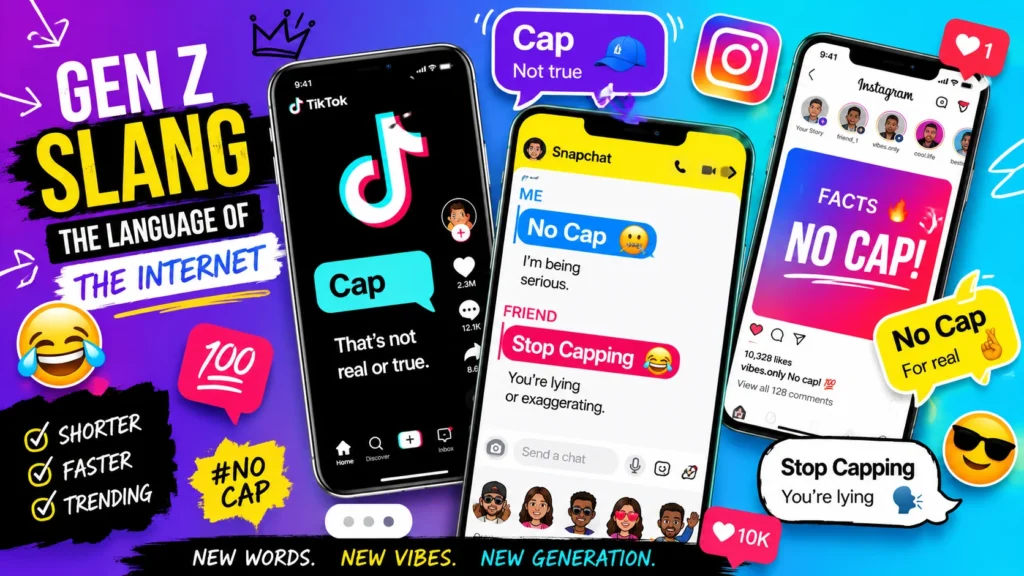
What does cap mean? In modern slang, cap means a lie, false statement, exaggeration, or something that is not true. When someone says “that’s cap,” they mean a person is lying or stretching the truth. The phrase “no cap” means “no lie,” “for real,” or “I’m being completely honest.” The term became popular through hip-hop culture, social media, texting, TikTok, Snapchat, Instagram, and Gen Z internet culture.
Language changes fast.
A few years ago, many people had never heard someone say “that’s cap.” Today, you’ll see the phrase everywhere. It’s in TikTok comments, Snapchat messages, Instagram captions, gaming chats, YouTube videos, memes, and everyday conversations.
If you’ve ever wondered what does cap mean, you’re not alone.
The slang term cap simply means a lie, exaggeration, or false statement. When someone says “that’s cap,” they’re calling out something they believe isn’t true.
Think of it this way:
Cap = False
No Cap = True
That’s the easiest way to remember it.
For example:
- “I can run a mile in two minutes.”
- “Bro, that’s cap.”
In this conversation, the second person believes the claim is untrue or exaggerated.
The term has become one of the most recognizable pieces of modern internet slang. Millions of people use it daily across social media and text messaging platforms.
Cap Meaning in Slang
The modern cap slang meaning revolves around dishonesty, exaggeration, or making unrealistic claims.
When someone uses the word cap, they usually mean one of three things:
| Meaning | Description | Example |
|---|---|---|
| Lie | Completely false statement | “I own ten mansions.” |
| Exaggeration | Stretching the truth | “I’m the best player alive.” |
| Fake claim | Statement lacking credibility | “Everyone agrees with me.” |
The phrase often appears in casual conversations where people challenge questionable statements.
How People Use Cap in Daily Conversations
Modern slang often develops shortcuts for expressing emotions and opinions.
Instead of saying:
- “I don’t believe you.”
- “That statement seems false.”
- “You’re exaggerating.”
People simply say:
- “Cap.”
It’s quick, direct, and instantly understood by many internet users.
Examples of Cap in Conversations
Example 1
Person A: “I never study and still get perfect grades.”
Person B: “That’s cap.”
Example 2
Person A: “I met a celebrity yesterday.”
Person B: “Cap.”
Example 3
Person A: “I can beat everyone here in one game.”
Person B: “Big cap.”
In each example, the listener doubts the claim.
Why Cap Became So Popular
The internet rewards speed.
People prefer short phrases that communicate ideas instantly.
Words like:
- Cap
- No cap
- Bet
- Sus
- Flex
- W
- L
allow users to express opinions with minimal effort.
Cap gained popularity because it solves a common communication problem.
People constantly encounter questionable claims online.
Instead of writing:
“I don’t think that’s accurate.”
they can simply type:
“Cap.”
One word does the job.
What Does No Cap Mean?
If cap means a lie, then no cap meaning becomes much easier to understand.
No cap means no lie, honestly, genuinely, or truthfully.
When someone says “no cap,” they want listeners to know they are serious.
They’re emphasizing authenticity.
Simple No Cap Definition
Think about the phrase this way:
| Phrase | Meaning |
| Cap | Lie |
| No Cap | Truth |
| Capping | Lying |
| Stop Capping | Stop lying |
The relationship between these expressions makes them easy to learn.
Examples of No Cap
Here are some common examples.
Example 1
“I’m exhausted after that workout, no cap.”
Meaning:
The speaker is genuinely tired.
Example 2
“That was the best burger I’ve ever had, no cap.”
Meaning:
The speaker honestly believes it.
Example 3
“No cap, this movie changed my life.”
Meaning:
The person is expressing a sincere opinion.
In each situation, “no cap” works like an honesty marker.
Why People Say No Cap
Humans naturally look for credibility.
When speaking online, people can’t rely on body language, facial expressions, or tone of voice.
As a result, internet users developed verbal signals that communicate honesty.
“No cap” became one of those signals.
It tells listeners:
- I’m serious.
- I’m not joking.
- I’m telling the truth.
- I genuinely mean this.
That’s why you’ll see it frequently on social media.
No Cap Versus For Real
Many people compare “no cap” to older expressions.
Here are some close equivalents:
| Modern Slang | Similar Meaning |
| No cap | For real |
| No cap | Honestly |
| No cap | Seriously |
| No cap | Truthfully |
| No cap | Not kidding |
Although the wording differs, the purpose remains similar.
Each phrase reinforces sincerity.
What Does Capping Mean?
Another common question is:
What does capping mean?
The answer is simple.
Capping means lying, exaggerating, bluffing, or making claims that are not entirely true.
If cap is the noun form, capping is the action.
Understanding Capping
Imagine someone says:
“I made a million dollars this week.”
If the statement isn’t true, another person might respond:
“You’re capping.”
The accusation suggests dishonesty or exaggeration.
Common Signs Someone Is Capping
People often use the term when they notice:
- Unrealistic stories
- Contradictory details
- Excessive bragging
- Fake achievements
- Obvious exaggerations
- Unsupported claims
That doesn’t mean the person is definitely lying.
However, listeners may believe they are stretching the truth.
Examples of Capping
Gaming Example
Player:
“I’m the number one player in the world.”
Friend:
“Stop capping.”
School Example
Student:
“I finished the entire project in ten minutes.”
Friend:
“You’re capping.”
Sports Example
Person:
“I could easily beat a professional athlete.”
Friend:
“That’s pure cap.”
These examples demonstrate how the phrase works naturally in conversation.
Where Did Cap Slang Come From?
Many internet users know the meaning of cap.
Far fewer know where it came from.
The story begins long before TikTok existed.
Early Roots of Cap
The slang term traces back to African American Vernacular English (AAVE).
For decades, variations of the word appeared in spoken language within Black communities in the United States.
Over time, the meaning evolved around boasting, exaggeration, and false claims.
Eventually, the word became associated directly with lying.
Language often follows this pattern.
Words start in specific communities before spreading into mainstream culture.
Cap followed that exact path.
The Role of Hip-Hop Culture
Hip-hop played a major role in popularizing cap.
Artists used the expression in lyrics, interviews, and everyday speech.
Fans adopted the terminology.
Then social media accelerated the process.
What once existed in local communities suddenly reached global audiences.
A teenager in one country could hear a slang term online and start using it the same day.
That’s exactly what happened with cap.
How Social Media Made Cap Go Viral
Social platforms transformed slang into global vocabulary.
Several factors helped:
- Short-form videos
- Meme culture
- Comment sections
- Viral challenges
- Influencer content
- Online communities
Once creators began using phrases like “that’s cap” and “no cap,” millions of viewers copied them.
The result was explosive growth.
Today, the phrase is recognized by people who have never listened to hip-hop and may not know its origins.
Yet the influence remains significant.
Cap Meaning vs No Cap Meaning
Many people confuse these terms initially.
Fortunately, the difference is straightforward.
| Expression | Meaning |
| Cap | Lie |
| No Cap | Truth |
| Capping | Lying |
| Stop Capping | Stop lying |
| Big Cap | Huge lie |
| Capper | Person who lies |
Remember this chart and you’ll understand most conversations involving the word.
Why Cap Became Part of Modern Internet Culture
Every generation develops its own vocabulary.
The internet accelerates that process.
Gen Z and younger internet users embraced cap because it is:
- Short
- Memorable
- Versatile
- Expressive
- Easy to understand
The word also fits perfectly into modern digital communication.
One word can communicate skepticism, disbelief, humor, and criticism.
That efficiency helped fuel its popularity.
Today, cap remains one of the most recognizable internet slang expressions in online culture.
Cap Meaning in Text Messages
Texting changed the way people communicate.
Instead of writing long explanations, people often rely on abbreviations, slang, emojis, and internet expressions. The word cap fits perfectly into this style because it is short, easy to type, and instantly communicates disbelief.
When someone uses cap in a text message, they are usually saying that a statement is false, exaggerated, or hard to believe.
What Does Cap Mean in Text?
In texting, cap means lie or exaggeration.
For example:
Friend 1: “I finished the entire season in one day.”
Friend 2: “Cap.”
The second person doesn’t believe the claim.
The response is short, but the meaning is clear.
Examples of Cap in Text Conversations
| Text Message | Meaning |
|---|---|
| That’s cap. | I don’t believe you. |
| Big cap. | That’s a huge lie. |
| Stop capping. | Stop lying. |
| No cap. | I’m telling the truth. |
| You’re capping. | You’re exaggerating. |
These phrases appear constantly in personal messages, group chats, gaming chats, and social media comments.
Why Cap Works So Well in Texting
Several factors explain its popularity:
- Extremely short
- Easy to understand
- Fits internet culture
- Works across many situations
- Expresses disbelief instantly
Modern texting rewards efficiency.
Instead of writing an entire paragraph explaining why you doubt someone, a single word accomplishes the same goal.
Cap Meaning in Chat and Online Conversations
The phrase isn’t limited to text messages.
You’ll find it throughout online communication.
People use it in:
- Group chats
- Gaming servers
- Live streams
- Comment sections
- Forums
- Direct messages
In online conversations, cap often serves as a quick reaction.
Someone makes a questionable statement.
Others respond with:
- “Cap.”
- “Big cap.”
- “Stop capping.”
The exchange happens almost instantly.
Cap as a Reaction Word
Unlike traditional slang, cap functions almost like a reaction emoji.
For example:
Person A: “I could beat a professional boxer.”
Person B: “Cap.”
The response communicates disbelief without needing additional explanation.
This simplicity is one reason the term spread so quickly.
Cap Meaning on TikTok
Many people first encounter the term on TikTok.
The platform helped push countless slang terms into mainstream culture.
Cap became one of the biggest.
What Does Cap Mean on TikTok?
On TikTok, cap carries the same meaning:
A lie, exaggeration, or false claim.
However, creators often use it humorously.
You’ll see videos where someone makes an outrageous statement.
Comments quickly fill with:
- “Cap.”
- “That’s cap.”
- “Big cap.”
- “No cap though.”
Popular TikTok Examples
A creator says:
“I haven’t slept in three days.”
Comments:
- “Cap.”
- “Huge cap.”
- “No way.”
Another creator says:
“This is the best pizza in the world.”
Comments might include:
- “No cap.”
- “Facts.”
- “Actually true.”
TikTok’s fast-paced nature made cap a perfect fit.
Short videos require quick reactions.
Cap delivers that reaction in a single word.
Why TikTok Accelerated the Spread of Cap
Several reasons contributed:
- Viral videos
- Influencer adoption
- Meme culture
- Comment engagement
- Younger audiences
Once popular creators started using the phrase regularly, millions of viewers followed.
That’s how internet slang often spreads.
A small phrase becomes a global trend almost overnight.
What Does Cap Mean on Snapchat?
Snapchat focuses heavily on casual conversations.
Because of that, slang appears frequently.
Snapchat Cap Meaning
On Snapchat, cap still means:
- Lie
- False statement
- Exaggeration
- Fake claim
A typical exchange might look like this:
Friend 1:
“I got 100% on every exam.”
Friend 2:
“Cap.”
The meaning remains unchanged.
Common Snapchat Expressions
Users often combine cap with other slang.
Examples include:
- That’s cap.
- Big cap.
- Stop capping.
- No cap.
- You capping.
The platform’s younger audience helped make these expressions part of everyday communication.
What Does Cap Mean on Instagram?
Instagram introduced slang to audiences beyond texting and gaming communities.
Today, cap appears throughout:
- Reels
- Stories
- Comments
- Captions
- Direct messages
Instagram Cap Meaning
The definition remains consistent.
Cap signals skepticism.
When users think a statement isn’t believable, they may comment:
- Cap.
- Big cap.
- Stop capping.
Cap in Instagram Comments
Suppose someone posts:
“I wake up at 4 AM every day and never feel tired.”
Comments might include:
- “Cap.”
- “No chance.”
- “Big cap.”
These responses indicate doubt.
They suggest followers don’t fully believe the claim.
Cap Meaning on X and Other Social Platforms
The slang term also appears frequently on social platforms.
Whether it’s social discussions, sports debates, entertainment news, or memes, cap often emerges when users disagree.
Why Cap Thrives Online
Online environments create perfect conditions for slang.
People communicate quickly.
Attention spans are shorter.
Users prefer concise language.
Cap satisfies all of those requirements.
One word can express:
- Doubt
- Humor
- Criticism
- Skepticism
- Disagreement
That’s powerful for such a short expression.
What Does Stop Capping Mean?
One of the most common variations is stop capping.
Stop Capping Meaning
The phrase means:
Stop lying.
Or:
Stop exaggerating.
It directly challenges a statement.
Examples of Stop Capping
Person:
“I could beat every professional athlete.”
Response:
“Stop capping.”
Person:
“I’ve never made a mistake.”
Response:
“Stop capping.”
The phrase is often playful.
Friends use it jokingly.
However, it can also be serious when someone genuinely doubts a claim.
Why People Say Stop Capping
The phrase is stronger than simply saying cap.
Compare the two:
| Phrase | Meaning |
|---|---|
| Cap | I don’t believe that. |
| Stop Capping | Stop saying things that aren’t true. |
The second version is more direct.
That’s why it’s commonly used among friends during debates or playful arguments.
What Does Big Cap Mean?
Another popular expression is big cap.
Big Cap Definition
Big cap means:
A major lie or an obvious exaggeration.
It implies that the statement isn’t just slightly inaccurate.
It’s completely unbelievable.
Examples of Big Cap
Person:
“I’m richer than every billionaire.”
Response:
“Big cap.”
Person:
“I’ve never lost a game in my life.”
Response:
“That’s big cap.”
The phrase increases the intensity.
Instead of saying something is questionable, you’re suggesting it is clearly false.
Cap vs Big Cap
| Expression | Strength |
|---|---|
| Cap | Lie |
| Big Cap | Huge lie |
| Massive Cap | Extreme exaggeration |
The stronger the phrase, the greater the disbelief.
What Does Capper Mean?
The slang ecosystem created several related words.
One of them is capper.
Capper Meaning
A capper is:
Someone who lies frequently or exaggerates often.
It’s a label rather than an action.
Example
Person A:
“He’s always making up stories.”
Person B:
“Yeah, he’s a capper.”
The term describes a person’s behavior.
When People Use Capper
People may use the word when discussing:
- Chronic exaggerators
- Attention seekers
- Story embellishers
- Habitual liars
In many cases, the term is used humorously among friends.
What Does Capped Mean?
The word capped appears occasionally in online conversations.
Capped Meaning
Depending on context, capped may mean:
- Lied
- Exaggerated
- Made a false claim
Example:
“He capped about his score.”
Meaning:
“He lied about his score.”
Although capped is less common than capping or cap, it still appears in some conversations.
Cap Meaning in Gaming
Gaming communities adopted cap early.
Competitive games naturally involve bragging, trash talk, and bold claims.
That environment helped slang flourish.
How Gamers Use Cap
Common situations include:
- Claiming high rankings
- Boasting about skills
- Discussing statistics
- Arguing about achievements
Example:
Player:
“I never lose.”
Teammate:
“Cap.”
The response signals disbelief.
Why Gaming Communities Love the Term
Gaming conversations move quickly.
Players need short reactions.
Cap provides:
- Speed
- Clarity
- Humor
- Competitive energy
As a result, it became a regular part of gaming vocabulary.
Cap Meaning in Meme Culture
Memes played a major role in spreading cap slang.
Internet humor often revolves around exaggeration.
Cap became a perfect tool for responding to outrageous content.
Cap in Memes
A typical meme might contain:
- An unbelievable claim
- An edited image
- An exaggerated story
Comments immediately fill with:
- Cap.
- Big cap.
- Stop capping.
The phrase acts almost like a meme itself.
Why Memes Help Slang Spread
Memes travel quickly.
People share them across multiple platforms.
Each share introduces new audiences to the slang.
This process helped transform cap from a niche expression into a mainstream internet term.
Why Gen Z Uses Cap So Frequently
Every generation creates language that reflects its culture.
For Gen Z, internet communication shaped vocabulary more than any previous generation.
Cap became popular because it offers a fast way to express doubt.
Reasons for Its Popularity
- Easy to remember
- Easy to type
- Universally understood online
- Works in many situations
- Fits modern communication styles
The term also creates a sense of belonging.
Using shared slang helps people connect with online communities.
Is Cap Only for Gen Z?
No.
Although Gen Z popularized it online, people of many age groups now understand and use the term.
Like many slang expressions, it eventually moved beyond its original audience.
Today, you’ll find cap used by:
- Teenagers
- College students
- Gamers
- Content creators
- Social media users
- Everyday internet users
The phrase has become part of mainstream digital language.
How to Use Cap Correctly in a Sentence
Understanding the definition is one thing.
Using the term naturally is another.
Many people learn the meaning of cap but feel unsure about when to use it in real conversations. Fortunately, the rules are simple.
The word usually appears when someone:
- Makes a claim that seems false
- Exaggerates a story
- Brags excessively
- Says something difficult to believe
Everyday Examples of Cap
Here are some natural examples:
Example 1
“I own five private jets.”
Response:
“That’s cap.”
Example 2
“He says he never studies and still gets perfect grades.”
Response:
“Sounds like cap.”
Example 3
“She claims she met ten celebrities this weekend.”
Response:
“Cap.”
Notice how the word acts as a reaction.
It doesn’t require a long explanation.
Everyday Examples of No Cap
The phrase no cap works differently.
It emphasizes honesty.
Examples:
- “That was the best concert I’ve ever attended, no cap.”
- “No cap, I’m exhausted.”
- “This restaurant is amazing, no cap.”
- “No cap, that’s the funniest thing I’ve seen all week.”
In these examples, the speaker is reinforcing sincerity.
Everyday Examples of Capping
Examples include:
- “He’s capping about his salary.”
- “Stop capping and tell the truth.”
- “You’re clearly capping.”
- “Everyone knows you’re capping.”
The word functions as an action.
Someone is actively exaggerating or lying.
When Should You Use Cap?
Like any slang term, context matters.
Cap works best in casual settings.
Appropriate Situations
You can use cap in:
- Text messages
- Social media comments
- Casual conversations
- Gaming chats
- Group chats
- Friendly discussions
- Online communities
These environments naturally accept slang.
Situations Where You Should Avoid Cap
The term may sound unprofessional in:
- Business emails
- Academic papers
- Job interviews
- Formal presentations
- Professional reports
- Official correspondence
In those situations, traditional language works better.
Instead of saying:
“That’s cap.”
You might say:
- “That statement appears inaccurate.”
- “I disagree with that claim.”
- “The information may not be correct.”
Context always matters.
Common Mistakes People Make When Using Cap
Many newcomers misunderstand how the slang works.
Here are the most common errors.
Using Cap to Mean Something Good
Some people mistakenly assume cap means something positive.
It doesn’t.
Cap almost always refers to a lie, exaggeration, or questionable statement.
Incorrect:
“That movie was cap.”
Correct:
“That movie was amazing.”
Confusing Cap With No Cap
This mistake is extremely common.
Remember:
| Phrase | Meaning |
|---|---|
| Cap | Lie |
| No Cap | Truth |
| Capping | Lying |
| Stop Capping | Stop Lying |
The addition of “no” completely changes the meaning.
Using Cap in Formal Writing
Cap is internet slang.
Professional audiences may not understand it.
Always consider your audience before using modern slang expressions.
What Is the Opposite of Cap?
One of the most common questions online is:
What is the opposite of cap?
The answer is straightforward.
The opposite of cap is:
- No cap
- Truth
- Honesty
- Authenticity
- Genuine statement
- Real talk
- Facts
Comparison Table
| Concept | Meaning |
|---|---|
| Cap | Lie |
| No Cap | Truth |
| Fake | Not Genuine |
| Authentic | Genuine |
| Exaggeration | Accurate Statement |
| Bluff | Honesty |
This relationship explains why “no cap” became so popular.
People needed a quick way to signal truthfulness.
Why Do People Say Cap?
Language evolves because people seek efficiency.
Cap became popular because it communicates a complex idea instantly.
Instead of saying:
“I believe that statement contains inaccuracies.”
People simply say:
“Cap.”
The meaning remains clear.
Cultural Reasons Behind Cap’s Popularity
Several forces contributed to its growth.
Internet Culture
Online communication favors brevity.
Short phrases spread faster than long explanations.
Meme Culture
Memes thrive on quick reactions.
Cap became one of the internet’s favorite reaction words.
Social Media Trends
Platforms reward simple, memorable language.
Cap fits perfectly.
Youth Culture
Young people often create and spread new slang.
Cap became one of the defining expressions of modern youth communication.
Why Did Cap Become Viral?
Not every slang term survives.
Many disappear within months.
Cap succeeded because it solved a communication need.
Factors Behind Its Success
| Factor | Impact |
|---|---|
| Simplicity | Easy to remember |
| Flexibility | Works in many contexts |
| Social Media | Massive exposure |
| Humor | Creates entertaining interactions |
| Memes | Increased visibility |
| Influencers | Helped popularize usage |
The combination created a perfect viral formula.
Millions of users adopted the term across multiple platforms.
What Does Cap Mean From a Girl?
The meaning doesn’t change based on who says it.
When a girl says:
“That’s cap.”
She usually means:
- That’s not true.
- I don’t believe that.
- You’re exaggerating.
Example
Person:
“I can finish this project in five minutes.”
Girl:
“Cap.”
The meaning remains exactly the same.
The speaker’s gender doesn’t alter the definition.
What Does Cap Mean From a Guy?
The same rule applies.
When a guy says:
“That’s cap.”
He is generally expressing doubt.
Example
Person:
“I’ve never failed a test.”
Guy:
“That’s cap.”
The interpretation remains identical.
Cap always points toward disbelief, exaggeration, or dishonesty.
Is Cap a Bad Word?
A common misconception is that cap is offensive.
In reality, it is generally considered mild slang.
Why Cap Is Usually Not Offensive
The term does not contain profanity.
Most people use it casually.
It often appears in playful conversations.
Examples:
- Friendly debates
- Group chats
- Social media comments
- Gaming discussions
When Cap Could Cause Problems
Tone matters.
Calling someone a liar repeatedly can create tension.
Even harmless slang can sound rude depending on the situation.
Always consider:
- Your relationship with the person
- The context
- The overall tone of the conversation
The word itself isn’t offensive.
However, the way it’s used can affect how people react.
Cap Meaning Compared to Similar Slang Terms
Modern internet slang includes many related expressions.
Understanding the differences helps avoid confusion.
Slang Comparison Table
| Slang Term | Meaning |
|---|---|
| Cap | Lie |
| No Cap | Truth |
| Facts | True Statement |
| Sus | Suspicious |
| Flex | Showing Off |
| Bet | Okay / Agreed |
| Bluff | False Confidence |
| Fronting | Pretending |
| Fake | Not Genuine |
| Real | Authentic |
These terms often appear together in social media conversations.
The Evolution of Cap in Modern Language
Slang evolves constantly.
Some expressions disappear.
Others become permanent parts of everyday speech.
Cap has already achieved remarkable staying power.
Signs of Long-Term Influence
The term appears across:
- TikTok
- Snapchat
- X
- YouTube
- Gaming communities
- Meme culture
- Group chats
- Everyday conversations
Few slang terms achieve this level of adoption.
Future of the Word Cap
No one can predict exactly how language will evolve.
However, cap has already become deeply embedded in internet culture.
Even as new slang emerges, the term continues to remain relevant.
Its simplicity gives it staying power.
Quick Reference Guide
If you only remember one section from this article, remember this table.
| Phrase | Meaning |
|---|---|
| Cap | Lie |
| No Cap | Truth |
| Capping | Lying |
| Stop Capping | Stop Lying |
| Big Cap | Huge Lie |
| Capper | Person Who Lies |
| Capped | Lied or Exaggerated |
This chart covers most situations you’ll encounter online.
Frequently Asked Questions
What does cap mean in slang?
Cap means a lie, exaggeration, false statement, or something that is not true.
What does cap mean in texting?
In texting, cap means someone believes a statement is false or exaggerated.
What does cap mean on TikTok?
On TikTok, cap means a lie or unbelievable claim. Users often comment “cap” when they doubt a video’s statement.
What does cap mean on Snapchat?
On Snapchat, cap has the same meaning. It refers to lying, exaggerating, or making questionable claims.
What does cap mean on Instagram?
On Instagram, users say cap when they think a post, caption, story, or comment is not entirely truthful.
What does no cap mean?
No cap means no lie, honestly, genuinely, or truthfully.
What does capping mean?
Capping means lying, exaggerating, bluffing, or stretching the truth.
What does stop capping mean?
Stop capping means stop lying or stop exaggerating.
What does big cap mean?
Big cap refers to a major lie or an obvious exaggeration.
What does capper mean?
A capper is someone who frequently lies or exaggerates.
Is cap a bad word?
No. Cap is generally considered mild internet slang and is not typically viewed as offensive.
Where did cap slang originate?
The slang term developed from African American Vernacular English (AAVE) before becoming popular through hip-hop culture and social media.
Why do people say no cap?
People use no cap to emphasize honesty and show they are speaking truthfully.
What is the opposite of cap?
The opposite of cap is no cap, truth, honesty, authenticity, or genuine statements.
Can adults use cap?
Yes. Although younger generations helped popularize the term, people of all ages now understand and use it.
Final Thoughts
If you’ve been wondering what does cap mean, the answer is surprisingly simple.
In modern slang, cap means a lie, exaggeration, bluff, or false statement. When someone says “that’s cap,” they’re expressing disbelief. When someone says “no cap,” they’re emphasizing honesty and truthfulness.
The expression grew from AAVE and hip-hop culture before exploding across TikTok, Snapchat, Instagram, YouTube, gaming communities, and social media. Today, it stands as one of the most recognizable examples of modern internet slang.
Whether you encounter phrases like cap, no cap, stop capping, big cap, or capper, they all revolve around a central idea: distinguishing between truth and exaggeration.
Now when someone comments “cap” under a post or text message, you’ll know exactly what they mean—no cap.

Sophia Bennett is a professional writer focused on explaining word meanings, expressions and everyday language in a simple and engaging way.