Last Updated on June 11, 2026
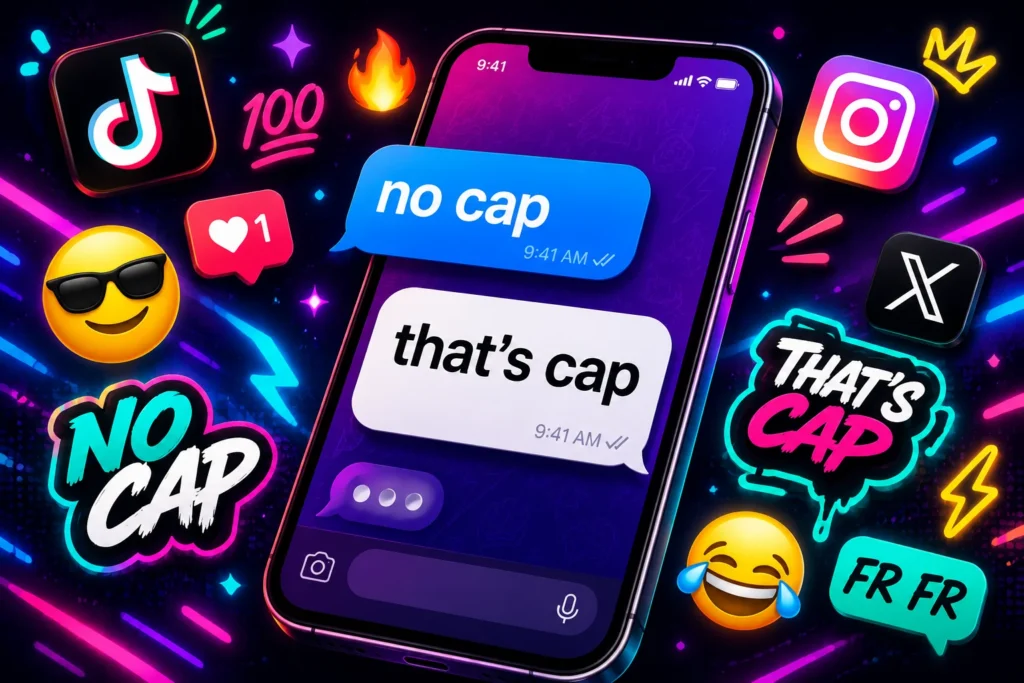
“No cap” means no lie, completely true, or I’m being honest. It’s a popular slang phrase used in texting, social media, and everyday conversation to emphasize authenticity. The opposite of “no cap” is “cap,” which means a lie or exaggeration
You’ve probably seen it dropped in comments, captions, or texts. Someone says, “That was the best game ever, no cap.” Another replies, “Stop capping.”
At first glance, it feels cryptic. Almost like a code.
But once you crack it, you’ll notice it everywhere.
Let’s break it down clearly so you never second-guess it again.
What Does No Cap Mean in Slang and Texting?
The Exact No Cap Meaning (Clear and Direct)
“No cap” means:
- No lie
- I’m telling the truth
- This is completely real
- I’m not exaggerating
It acts like a verbal stamp of honesty.
Instead of saying, “I’m serious,” people say, “no cap.”
Short. Sharp. Memorable.
Why This Phrase Hits So Hard
Language today moves fast. People want impact without wasting words.
“No cap” works because:
- It’s two syllables
- It carries strong intent
- It fits perfectly in texting and social media
- It sounds natural in conversation
In simple terms, it delivers truth with style.
No Cap Meaning in Text Messages and Chat
When you’re texting, tone can disappear. That’s where phrases like “no cap” step in.
They help you:
- Show you’re not joking
- Emphasize seriousness
- Add emotion without extra words
Example:
- “I stayed up all night working, no cap.”
Without “no cap,” the sentence feels plain. With it, the statement feels more believable.
No Cap Meaning in Social Media Context
Scroll through TikTok or Instagram. You’ll see it everywhere.
Common uses include:
- Captions → “Best day ever, no cap”
- Comments → “No cap, this is wild”
- Replies → “That’s facts, no cap”
It’s not just language. It’s a signal of authenticity.
What Does Cap Mean in Slang? (Understanding the Opposite)
Cap Meaning Explained Simply
To understand “no cap,” you need to understand “cap.”
“Cap” means:
- A lie
- Something fake
- An exaggeration
If someone says “that’s cap,” they’re calling something out as false.
Real Examples of Cap in Conversation
- “You said you ran 20 miles? That’s cap.”
- “He claims he never sleeps. Cap.”
- “Stop capping, be honest.”
The tone can be playful or confrontational. Context decides.
Cap vs No Cap Meaning (Side-by-Side Breakdown)
| Phrase | Meaning | Usage Purpose |
|---|---|---|
| Cap | Lie / exaggeration | Calling something out |
| No cap | Truth / honesty | Confirming truth |
This contrast gives the phrase its power.
Why “Cap” Became Synonymous With Lying
Words evolve through culture. “Cap” didn’t originally mean lying.
Over time, communities reshaped its meaning. Eventually, it became shorthand for dishonesty.
That shift didn’t happen randomly. It grew from real usage patterns in speech.
Why Do People Say No Cap? (The Psychology Behind It)
The Need to Be Believed
People crave credibility. Especially online.
When you say something bold, others might doubt you.
That’s where “no cap” comes in.
It signals:
- Confidence
- Honesty
- Authenticity
The Role of Digital Communication
Online conversations lack tone, body language, and facial expressions.
So people rely on language cues.
“No cap” fills that gap perfectly.
Social Validation and Language Trends
When a phrase becomes popular, people adopt it to fit in.
It’s social proof in action.
Here’s how it spreads:
- Someone influential uses it
- Others repeat it
- It becomes mainstream
Before long, everyone’s saying it.
No Cap Meaning in Gen Z Language
Why Gen Z Uses “No Cap” So Often
Gen Z values:
- Authenticity
- Direct communication
- Expressive language
“No cap” checks all those boxes.
How It Fits Into Youth Communication
Gen Z slang is:
- Fast
- Creative
- Context-driven
“No cap” blends into this style seamlessly.
Examples in Gen Z Conversations
- “This class is actually hard, no cap.”
- “That show is addictive, no cap.”
- “I’m exhausted, no cap.”
Each sentence feels casual yet expressive.
No Cap Meaning in Everyday Conversation
Using No Cap Naturally
You don’t need to force it. It works best when it flows.
Examples:
- “That burger was amazing, no cap.”
- “I’ve never been this tired, no cap.”
Tone Variations You Should Know
“No cap” can shift meaning slightly based on tone.
- Serious tone → emphasizing truth
- Playful tone → exaggeration with humor
Example:
- “I’m the best player alive, no cap” (likely joking)
When It Sounds Awkward
Sometimes it doesn’t fit.
Avoid using it in:
- Job interviews
- Formal writing
- Professional emails
It clashes with formal tone.
No Cap Examples in Sentences (Real and Practical)
Everyday Usage Examples
- “That movie was incredible, no cap.”
- “I studied for five hours straight, no cap.”
- “This game is impossible, no cap.”
Social Media Style Examples
- “Best vacation ever, no cap 🔥”
- “No cap, this hits different”
- “That’s the truth, no cap”
Humor and Irony Examples
- “I’m the smartest person alive, no cap”
- “I woke up at 5 AM, no cap”
Sometimes it’s meant to be funny.
Key Takeaways So Far
- “No cap” means no lie or complete truth
- “Cap” means lie or exaggeration
- It’s widely used in texting and social media
- It reflects authenticity in modern language
What’s Coming Next
In the next part, you’ll discover:
- The true origin of no cap slang
- Its deep connection to hip-hop culture and AAVE
- How it went from niche slang to global trend
- Advanced usage tips most people miss
Stay with it. It gets even more interesting.
No cap.
Where Did No Cap Come From? (Origin of No Cap Slang Explained)
The Real Origin of No Cap in Language
Every slang term has a story. “No cap” didn’t just appear out of thin air.
It developed within African American Vernacular English (AAVE), a rich and influential linguistic system that has shaped modern slang across the globe.
In AAVE, words often carry layered meanings. Over time, “cap” evolved to mean lying or exaggerating. From there, “no cap” naturally formed as the opposite.
Language evolves through usage, not rules. That’s exactly what happened here.
The Cultural Weight Behind the Phrase
Understanding “no cap” means recognizing its cultural roots.
AAVE has contributed countless expressions to mainstream English, including:
- “Lit”
- “Flex”
- “Woke”
- “Bussin”
“No cap” belongs to this same lineage.
It’s more than slang. It’s a reflection of cultural creativity and expression.
How Hip-Hop Amplified No Cap Meaning
Music didn’t invent “no cap,” but it made it famous.
Hip-hop artists began using it in lyrics to:
- Emphasize authenticity
- Reinforce credibility
- Connect with audiences
When listeners hear a phrase repeated in songs, it sticks.
That repetition builds familiarity. Familiarity turns into adoption.
Why Music Drives Slang Faster Than Anything Else
Music travels. Fast.
A single viral track can introduce millions of people to a phrase overnight.
Here’s how the cycle works:
- Artists use a phrase
- Fans repeat it
- Social media amplifies it
- The phrase becomes mainstream
“No cap” followed this exact path.
How No Cap Became a Global Trend
The Social Media Explosion
Once “no cap” hit platforms like TikTok, everything changed.
Suddenly:
- Millions of users saw it daily
- Influencers repeated it constantly
- Memes spread it even further
What started as niche slang became global language.
Why TikTok Accelerated the Trend
TikTok thrives on repetition.
Short videos loop. Phrases repeat. Trends explode.
“No cap” fits perfectly because:
- It’s short
- It’s expressive
- It works in captions and speech
That combination made it unstoppable.
The Role of Memes in Popularizing No Cap
Memes act like cultural shortcuts.
They simplify ideas into shareable formats.
Examples of “no cap” in memes:
- “This is the best food ever, no cap” (with exaggerated visuals)
- “I’m not sleeping tonight, no cap”
Memes don’t just spread phrases. They reinforce meaning.
No Cap Meaning on TikTok, Instagram, and Snapchat
No Cap Meaning on TikTok
On TikTok, “no cap” often appears in:
- Storytelling videos
- Reaction clips
- Viral challenges
Creators use it to:
- Add emphasis
- Build relatability
- Strengthen emotional impact
No Cap Meaning on Instagram
Instagram users prefer clean, punchy captions.
Examples:
- “Best night ever, no cap”
- “This changed everything, no cap”
It fits perfectly into short-form expression.
No Cap Meaning on Snapchat
Snapchat thrives on quick, casual communication.
“No cap” appears in:
- Direct messages
- Stories
- Quick replies
It adds clarity without extra effort.
No Cap Usage in Conversation (Advanced Guide)
How to Sound Natural Using No Cap
The key is simplicity.
Don’t force it. Let it flow.
Natural examples:
- “That was actually fun, no cap.”
- “I didn’t expect that, no cap.”
Sentence Placement Matters
“No cap” usually appears at the end of a sentence.
Why?
Because it acts as a truth marker.
Example:
- “That’s the best pizza I’ve had, no cap.”
Placing it elsewhere can sound awkward.
Variations You Might Hear
People don’t always use it the same way.
Common variations include:
- “No cap at all”
- “No cap, seriously”
- “I’m not capping”
Each variation keeps the same core meaning.
No Cap vs Cap vs Stop Capping (Full Breakdown)
Understanding “Stop Capping”
“Stop capping” means:
- Stop lying
- Stop exaggerating
- Be honest
It directly calls someone out.
Full Comparison Table
| Phrase | Meaning | Usage Context |
|---|---|---|
| Cap | Lie or exaggeration | Calling something false |
| No cap | Truth or honesty | Confirming truth |
| Stop capping | Stop lying | Confronting someone |
Real Conversation Example
- Person A: “I made $10,000 in one day.”
- Person B: “Stop capping.”
- Person A: “I’m serious, no cap.”
This exchange shows how the terms interact.
No Cap Meaning in Rap Songs and Music Culture
Why Artists Use “No Cap”
Artists use “no cap” to:
- Build credibility
- Emphasize truth
- Strengthen lyrical impact
It adds authenticity to their message.
How Repetition Builds Meaning
When listeners hear a phrase repeatedly, they:
- Understand it faster
- Remember it longer
- Start using it themselves
That’s how slang scales.
Music as a Language Engine
Music doesn’t just entertain. It shapes language.
Many modern slang terms follow this path:
- Start in communities
- Enter music
- Spread globally
“No cap” is a textbook example.
No Cap Synonyms and Related Slang
Slang Words Similar to No Cap
Here are phrases with similar meaning:
- For real
- Deadass
- On God
- No lie
Each has a slightly different tone.
Comparison Table of Similar Slang
| Phrase | Meaning | Tone Level |
|---|---|---|
| No cap | No lie | Casual |
| Deadass | Completely serious | Strong slang |
| On God | Swearing truth | Intense |
| For real | Genuine | Neutral |
When to Use Each One
- Use “no cap” for casual emphasis
- Use “deadass” for stronger emotion
- Use “for real” in broader contexts
Choosing the right phrase depends on tone.
Why No Cap Works So Well in Modern Communication
The Power of Short Expressions
Modern communication favors:
- Speed
- Clarity
- Impact
“No cap” delivers all three.
Authenticity in the Digital Age
People distrust exaggeration.
They want real experiences.
“No cap” signals:
- Honesty
- Transparency
- Confidence
The Psychology of Trust in Language
When someone adds “no cap,” it:
- Reinforces belief
- Reduces doubt
- Strengthens connection
It’s a small phrase with big impact.
Common Mistakes People Make With “No Cap” (And How to Avoid Them)
Using No Cap in the Wrong Context
One of the biggest mistakes people make is dropping “no cap” where it simply doesn’t belong.
For example:
- “Dear Manager, I completed the report, no cap.” ❌
That sounds awkward. It breaks tone instantly.
“No cap” belongs in casual communication, not formal writing.
Overusing the Phrase
Like any trend, overuse kills impact.
If you say “no cap” in every sentence, it loses its punch.
Bad example:
- “That was fun, no cap. I enjoyed it, no cap. Let’s go again, no cap.”
It starts to feel repetitive.
Use it where it adds value. Skip it when it doesn’t.
Misunderstanding the Tone
Some people assume “no cap” always sounds serious.
Not true.
Tone shifts depending on context:
- Serious → “I worked all night, no cap.”
- Playful → “I’m the best player alive, no cap.”
If you miss the tone, you miss the meaning.
Confusing It With Literal Meanings
“Cap” has nothing to do with hats here.
Still, beginners sometimes misunderstand it literally.
Remember:
- Cap = lie
- No cap = truth
Keep it simple.
Is No Cap Still Trending in 2026?
Current Status of No Cap Meaning
“No cap” remains widely used in 2026. You’ll still see it across:
- TikTok videos
- Instagram captions
- Snapchat chats
- YouTube comments
However, its peak hype has cooled slightly.
The Lifecycle of Slang
Every slang term follows a pattern:
| Stage | Description |
|---|---|
| Emerging | Used by small communities |
| Growing | Spreads through media |
| Mainstream | Used by everyone |
| Declining | Replaced by new slang |
“No cap” sits between mainstream and early decline.
Will No Cap Disappear?
Not completely.
Some slang fades. Some sticks around.
“No cap” has strong cultural roots, which gives it staying power.
It may evolve rather than vanish.
Why Understanding Slang Like No Cap Matters
Language Is Always Evolving
Language doesn’t stand still.
New words appear. Old ones shift meaning.
If you ignore slang, you miss how people actually communicate.
Slang Builds Connection
Using the right phrase at the right time creates connection.
It shows you:
- Understand modern communication
- Relate to your audience
- Speak their language
But Context Still Rules
Knowing slang isn’t enough.
You need to know when to use it.
That’s what separates fluent speakers from awkward ones.
No Cap Cheat Sheet (Quick Reference Guide)
Core Meanings
- No cap = no lie, truth
- Cap = lie, exaggeration
- Stop capping = stop lying
Usage Rules
- Use in casual conversations
- Avoid in formal situations
- Place at the end of sentences
- Don’t overuse
Quick Examples
- “That was amazing, no cap.”
- “You’re lying, that’s cap.”
- “Stop capping and be real.”
No Cap Example Sentences (Advanced and Real-Life)
Casual Conversation Examples
- “That restaurant is underrated, no cap.”
- “I’ve never been this tired, no cap.”
- “That game is addictive, no cap.”
Social Media Examples
- “Best experience ever, no cap 🔥”
- “No cap, this hits different”
- “That’s facts, no cap”
Humor and Sarcasm Examples
- “I woke up at 6 AM willingly, no cap”
- “I love doing homework, no cap”
Sometimes it’s used ironically. Context tells the truth.
Frequently Asked Questions
What does no cap mean in slang?
“No cap” means no lie or completely true. It emphasizes honesty in a statement.
What is the meaning of no cap in texting?
In texting, “no cap” shows the message is serious and not exaggerated.
Why do people say no cap?
People say it to:
- Add credibility
- Emphasize truth
- Sound relatable
What does stop capping mean?
“Stop capping” means stop lying or exaggerating.
What does cap vs no cap mean?
- Cap = lie
- No cap = truth
They are direct opposites.
How do you use no cap in a sentence?
Example:
- “That was the best meal ever, no cap.”
Is no cap good or bad?
It’s neutral. It depends on how you use it.
In casual settings, it works well.
What does no cap mean in Gen Z language?
In Gen Z language, it signals:
- Honesty
- Authenticity
- Confidence
Final Thoughts
You started with a simple question:
What does no cap mean?
Now you know much more than just the definition.
You understand:
- Its true meaning
- Its cultural roots
- Its usage in real conversations
- Its place in modern language
That’s how you move from confusion to confidence.
Use it naturally. Use it wisely.
And when you say something bold, you already know how to back it up.
No cap.

Sophia Bennett is a professional writer focused on explaining word meanings, expressions and everyday language in a simple and engaging way.