
Last Updated on June 9, 2026
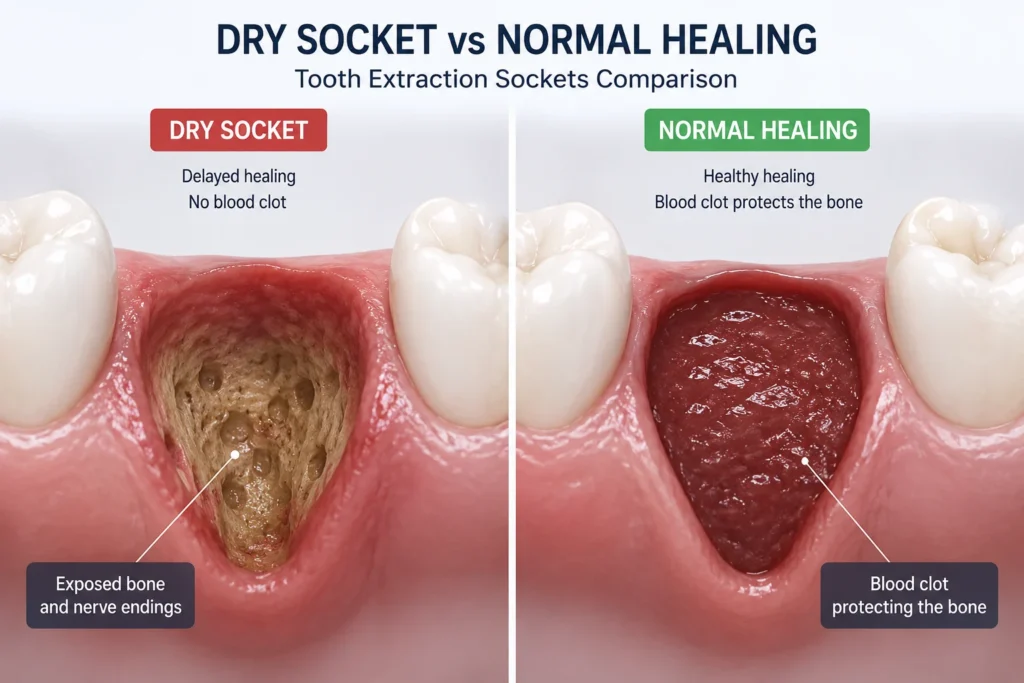
Dry socket looks like an empty or hollow tooth socket where the blood clot is missing. Instead of a dark red clot, you may see exposed white or gray bone, a dry surface, and little healing tissue. It usually appears 2–5 days after a tooth extraction and often comes with severe pain, bad breath, and a foul taste.
You walk out of the dentist’s office thinking the hard part is over. The tooth is gone. Relief should follow.
But a few days later, something feels off.
The pain spikes instead of fading. Your mouth tastes strange. When you check the mirror, the socket doesn’t look right.
That’s where confusion starts.
Most people don’t know what normal healing looks like. Even fewer know how to spot a problem early. And that’s exactly why this guide exists.
Understanding what dry socket looks like can save you from days of intense discomfort. It also helps you act fast before things get worse.
Think of your tooth socket like a construction site. The blood clot acts as the foundation. Remove that foundation, and everything stalls.
That’s dry socket in simple terms.
What Is Dry Socket and Why It Changes the Socket Appearance
Dry socket, medically known as alveolar osteitis, is one of the most common complications after tooth extraction.
It happens when the protective blood clot either:
- Never forms properly
- Gets dislodged too early
- Breaks down before healing begins
Without that clot, the underlying bone and nerves become exposed.
That’s where both the appearance and the pain begin to change.
What normally happens after extraction
- A blood clot forms within hours
- The clot protects the bone
- New tissue begins forming
- The socket gradually closes
What happens in dry socket
- The clot disappears
- Bone becomes visible
- Healing stops or slows dramatically
- Pain increases instead of decreasing
So when people ask, what does dry socket look like, the real answer comes down to one thing.
It looks like a socket that never started healing properly.
What Does Dry Socket Look Like? (Clear Visual Signs You Can’t Ignore)
Let’s break this down in a way that actually helps you identify it.
Empty or Hollow Tooth Socket
The first thing you’ll notice is the depth.
A healthy socket looks filled. A dry socket looks like a small crater.
Instead of a soft, rounded surface, you see:
- A deep hole
- A hollow center
- No visible clot filling the space
It almost looks like something is missing. Because it is.
Exposed Bone (White or Gray Appearance)
This is the most important visual sign.
Inside the socket, you may see:
- White patches
- Grayish bone
- Hard surfaces instead of soft tissue
Bone should never be visible during normal healing.
If you see it, the clot is gone.
Dry, Dull Surface Instead of Moist Tissue
Healthy healing tissue looks slightly shiny and moist.
Dry socket looks:
- Flat
- Dull
- Dehydrated
There’s no healthy tissue layer forming over the area.
It resembles dry skin rather than living gum tissue.
Missing or Disintegrated Blood Clot
Normally, the clot appears as a dark red or maroon layer.
With dry socket:
- The clot is completely gone
- Or partially broken apart
- Or looks thin and unstable
No clot means no protection.
Food and Debris Trapped in the Socket
Because the socket is open, food easily gets stuck inside.
You might notice:
- Dark particles
- Uneven texture
- Bits of food lodged in the hole
This often worsens the smell and irritation.
Gum Tissue Looks Irritated Instead of Healing
The surrounding gums may:
- Look slightly red
- Feel tender
- Appear inflamed
However, swelling is usually mild compared to infection.
Dry Socket vs Normal Healing Appearance (Side-by-Side Comparison)
| Feature | Normal Healing Socket | Dry Socket Appearance |
|---|---|---|
| Blood clot | Thick, dark red | Missing or dissolved |
| Tissue | Pink and forming | Absent or minimal |
| Surface | Moist and smooth | Dry and rough |
| Bone visibility | Not visible | Clearly visible |
| Depth | Gradually filling | Deep and hollow |
| Smell | Neutral | Foul odor |
How to Identify Dry Socket Early Before It Gets Worse
Spotting dry socket early makes a huge difference.
You don’t need medical training. You just need to pay attention.
Watch for visual clues
- The socket suddenly looks deeper
- The dark clot disappears
- The area turns pale or gray
- Healing seems to pause
Pay attention to timing
Dry socket rarely happens immediately.
It usually develops:
- Between day 2 and day 5
- After initial healing seems fine
Notice the pain pattern
Here’s the biggest giveaway.
Normal healing:
- Pain decreases daily
Dry socket:
- Pain increases suddenly
- Pain spreads to jaw, ear, or head
Timeline: When Dry Socket Develops and What You’ll See
First 24–48 Hours
- Blood clot forms
- Socket looks dark red
- Mild swelling present
Everything looks normal here.
Day 3 to Day 5 (Critical Window)
This is where things change.
You may notice:
- Clot disappears
- Socket looks empty
- Pain spikes sharply
This is when most people first notice something is wrong.
Day 5 and Beyond
If untreated:
- Bone becomes clearly visible
- Socket remains open
- Pain becomes persistent
Healing stalls completely.
What Dry Socket Feels Like Alongside Its Appearance
The visual signs matter. But the pain tells the full story.
Common symptoms
- Severe throbbing pain
- Pain radiating to ear or neck
- Persistent bad breath
- Metallic or foul taste
Real-life comparison
Normal extraction pain feels like soreness after a workout.
Dry socket feels like a sharp, pulsing nerve pain that doesn’t let up.
Early Warning Signs Most People Miss
Before the full dry socket develops, subtle signs appear.
Watch for:
- Slight loss of clot color
- Increasing sensitivity to air
- Unusual dryness in the socket
- Mild bad taste starting early
Catching it here can prevent severe pain later.
Why Appearance Matters More Than You Think
Many people ignore visual signs because they focus only on pain.
That’s a mistake.
Sometimes the socket shows clear warning signs before pain peaks.
If you check early, you can:
- Get treatment faster
- Avoid intense discomfort
- Heal more quickly
Think of it like spotting a crack before a wall collapses.
Quick Self-Check Guide
Ask yourself:
- Do I see a dark clot or an empty hole
- Does the socket look moist or dry
- Is the pain improving or worsening
If the answers feel wrong, trust your instinct.
What Causes Dry Socket After Tooth Extraction
You might be wondering, why does this even happen in the first place?
Dry socket doesn’t appear randomly. It usually comes down to one key issue.
The blood clot gets disturbed.
Once that happens, the healing process collapses quickly.
Let’s break it down in a way that actually makes sense.
Mechanical Causes That Dislodge the Blood Clot
These are the most common triggers. They physically remove the clot from the socket.
Smoking and Tobacco Use
Smoking is the number one cause.
Why?
- The suction motion pulls the clot out
- Chemicals slow healing
- Blood flow decreases
Even one cigarette can increase risk.
Using a Straw
It sounds harmless. It’s not.
The suction created while drinking:
- Pulls the clot loose
- Creates pressure inside the mouth
That tiny habit can undo the entire healing process.
Aggressive Rinsing or Spitting
Many people try to “clean” the area too soon.
That backfires.
- Strong rinsing dislodges the clot
- Frequent spitting creates pressure
- Healing tissue gets disturbed
Gentle care works better than force.
Touching the Area with Tongue or Fingers
It’s tempting. You keep checking the socket.
But every touch:
- Irritates the wound
- Disrupts early healing
- Weakens the clot
Leave it alone as much as possible.
Biological Factors That Increase Dry Socket Risk
Sometimes, even if you do everything right, your body still plays a role.
Poor Blood Supply
Healing depends on circulation.
If blood flow is limited:
- Clot formation weakens
- Tissue regeneration slows
- The socket dries out
This is more common in older adults.
Bacterial Activity
Your mouth contains bacteria. That’s normal.
However, in some cases:
- Bacteria break down the clot
- Infection risk increases
- Healing becomes unstable
Good oral hygiene helps reduce this risk.
Hormonal Influences
Hormones affect healing more than people realize.
For example:
- Estrogen can impact clot stability
- Some medications increase risk
This is why dry socket may occur more often in certain individuals.
Procedure-Related Causes You Should Know
Not all extractions are the same.
Some procedures naturally carry higher risk.
Wisdom Tooth Extraction
This is where dry socket shows up most often.
Reasons include:
- Deep surgical site
- Bone exposure
- Difficult access for cleaning
If you had wisdom teeth removed, your risk is already higher.
Traumatic or Complex Extraction
If the dentist had to:
- Break the tooth
- Remove bone
- Apply extra force
Then the tissue experiences more stress.
That increases the chance of clot failure.
Who Is Most at Risk for Dry Socket
Let’s get specific.
Certain groups face a higher risk, even with proper care.
High-Risk Individuals
- Smokers
- People with poor oral hygiene
- Patients with previous dry socket
- Those undergoing wisdom tooth removal
- Individuals with underlying health conditions
Risk Breakdown Table
| Risk Factor | Why It Matters |
|---|---|
| Smoking | Dislodges clot and reduces healing |
| Poor hygiene | Increases bacteria |
| Complex extraction | Causes trauma to tissue |
| Hormonal factors | Affects clot stability |
| Previous dry socket | Higher recurrence risk |
Dry Socket vs Infection: Critical Differences You Must Know
Many people confuse these two.
They sound similar. They feel similar.
But they’re not the same.
Key Differences at a Glance
| Feature | Dry Socket | Infection |
|---|---|---|
| Cause | Lost blood clot | Bacterial buildup |
| Appearance | Dry, exposed bone | Pus, swelling |
| Pain | Sharp and radiating | Throbbing and constant |
| Smell | Foul odor | Often strong odor |
| Fever | Rare | Common |
Why This Matters
Treatments differ.
- Dry socket requires protective dressing
- Infection may require antibiotics
Misidentifying it can delay proper care.
How Dentists Diagnose Dry Socket
Here’s the good news.
Diagnosis is simple and quick.
A dentist doesn’t need complicated tests.
What They Look For
- Missing blood clot
- Visible bone inside the socket
- Dry, hollow appearance
- Pain level and pattern
In most cases, a visual exam is enough.
What You Can Expect During the Visit
The dentist may:
- Gently clean the socket
- Remove debris
- Apply a medicated dressing
Relief often begins within hours.
Treatment for Dry Socket: What Actually Works
Now let’s talk solutions.
Because once dry socket starts, you want relief fast.
Professional Treatment (Most Effective)
This is the fastest way to reduce pain.
Medicated Dressing
The dentist places a soothing material inside the socket.
Benefits include:
- Immediate pain relief
- Protection for exposed bone
- Faster healing environment
Cleaning the Socket
Before applying treatment, the dentist:
- Flushes out debris
- Removes bacteria
- Prepares the area for healing
Pain Management
Depending on severity:
- Over-the-counter pain relief may help
- Stronger medication may be prescribed
At-Home Care for Dry Socket
While professional care is best, you can support healing at home.
What Helps
- Gentle saltwater rinses
- Soft foods like yogurt or soup
- Staying hydrated
- Keeping the area clean
What to Avoid at All Costs
- Smoking
- Drinking through straws
- Hard or crunchy foods
- Touching the socket
Think of the socket as fragile ground.
Handle it gently.
How Long Does Dry Socket Last
This question comes up a lot.
And the answer depends on treatment.
With Proper Treatment
- Pain relief: 24–72 hours
- Healing time: 1–2 weeks
Without Treatment
- Pain lasts longer
- Healing slows significantly
- Risk of complications increases
Healing Stages vs Dry Socket Disruption
Understanding normal healing helps you spot problems faster.
Normal Healing Timeline
| Day | What You See |
|---|---|
| Day 1 | Blood clot forms |
| Day 2–3 | Early tissue growth |
| Day 4–7 | Pink healing tissue |
| Week 2 | Socket closing |
Dry Socket Timeline
| Day | What Happens |
|---|---|
| Day 1–2 | Clot forms initially |
| Day 3–5 | Clot dislodges |
| Day 5+ | Bone exposed, pain increases |
Advanced Signs of Dry Socket Most People Ignore
Some signs don’t look obvious at first.
But they matter.
Subtle Visual Clues
- Socket looks pale instead of red
- Depth doesn’t decrease over time
- Tissue fails to form
- Surface looks unusually dry
Sensory Clues
- Sharp pain when breathing through mouth
- Sensitivity to cold air
- Persistent bad taste
Wisdom Tooth Dry Socket: Why It’s More Common
Wisdom teeth create the perfect conditions for dry socket.
Reasons Include
- Hard-to-reach location
- Larger wound size
- Increased surgical trauma
What It Looks Like
- Deep hole at the back of the mouth
- White or gray bone visible
- Surrounding tissue looks irritated
Pain here can feel more intense due to nerve proximity.
Bad Breath and Foul Taste Explained
This is one of the most noticeable symptoms.
And one of the most uncomfortable.
Why It Happens
- Food gets trapped in the socket
- Bacteria build up
- Tissue begins to break down
What It Feels Like
- Bitter taste that won’t go away
- Metallic sensation
- Persistent unpleasant breath
If brushing doesn’t fix it, something deeper is wrong.
How to Prevent Dry Socket After Tooth Extraction
Now let’s talk about the part that matters most.
Avoiding dry socket entirely.
Because once you’ve seen what dry socket looks like and how painful it feels, prevention becomes a priority.
The good news?
Most cases are preventable with the right habits.
Protect the Blood Clot at All Costs
Everything comes down to this one rule.
Do not disturb the clot.
Think of it as a natural bandage your body created.
If it stays in place, healing continues smoothly.
If it gets removed, dry socket begins.
Simple Habits That Prevent Dry Socket
These small actions make a big difference.
Avoid Smoking Completely
Even a single cigarette can:
- Dislodge the clot
- Reduce blood flow
- Delay healing
Dentists recommend avoiding smoking for at least 72 hours, though longer is safer.
Skip Straws and Suction
Suction creates pressure inside your mouth.
That pressure can:
- Pull out the clot
- Disrupt early healing
Drink normally. No shortcuts.
Eat Soft Foods First
Your diet affects healing more than you think.
Stick to:
- Yogurt
- Mashed potatoes
- Soup
- Smooth foods
Avoid:
- Crunchy snacks
- Hard foods
- Sticky items
Keep Oral Hygiene Gentle
Cleanliness matters. Aggression doesn’t.
- Brush carefully around the area
- Avoid direct contact with the socket
- Use gentle rinses only after 24 hours
Follow Your Dentist’s Instructions Exactly
Every extraction is slightly different.
Your dentist may give specific guidelines.
Follow them closely.
They’re designed to protect your healing.
Day-by-Day Recovery Plan After Tooth Extraction
Let’s simplify recovery with a practical timeline.
First 24 Hours
Focus on protection.
- Rest and avoid activity
- Keep gauze in place as instructed
- Avoid rinsing or spitting
Your goal is to allow the clot to form undisturbed.
Day 2 to Day 3
Healing begins.
- Start gentle rinsing if advised
- Continue soft foods
- Avoid pressure inside the mouth
At this stage, things should feel stable.
Day 3 to Day 5
Critical window.
This is when dry socket usually appears.
Stay cautious:
- No smoking
- No straws
- No aggressive cleaning
If pain suddenly increases, take it seriously.
Day 5 and Beyond
Healing should improve daily.
You should notice:
- Less pain
- Closing socket
- Healthier gum appearance
If not, it’s time to reassess.
When to Call Your Dentist Immediately
Don’t wait if something feels wrong.
Early treatment saves you from severe pain.
Warning Signs You Should Never Ignore
- Severe pain after day two
- Pain spreading to ear or jaw
- Visible bone in the socket
- Persistent bad breath or foul taste
- Socket looks empty or dry
Why Early Action Matters
The sooner you act:
- The faster pain relief begins
- The quicker healing resumes
- The lower the risk of complications
Waiting only makes things worse.
Does Dry Socket Heal on Its Own
Technically, yes.
But that doesn’t mean you should ignore it.
What Happens Without Treatment
- Pain lasts longer
- Healing slows down
- Risk of infection increases
Why Treatment Is Better
Professional care:
- Protects exposed bone
- Reduces pain quickly
- Speeds up recovery
Think of it as taking a shortcut back to normal healing.
Long-Term Effects of Dry Socket
Most cases heal without permanent damage.
However, untreated dry socket can lead to:
- Prolonged pain
- Delayed healing
- Increased infection risk
That’s why early care matters.
Frequently Asked Questions
What does dry socket look like in simple terms
It looks like an empty hole where the blood clot is missing. You may see white or gray bone instead of red healing tissue.
How do I know if my tooth socket is healing normally
A normal socket looks dark red at first, then gradually turns pink as tissue forms. Pain should decrease each day.
When does dry socket usually start
Dry socket typically develops between day 2 and day 5 after tooth extraction.
Can I see dry socket myself at home
Yes. With good lighting, you can often spot an empty socket, missing clot, or exposed bone.
Is dry socket more common with wisdom teeth
Yes. Wisdom tooth extractions have a higher risk due to location and surgical complexity.
How painful is dry socket compared to normal healing
Dry socket pain is significantly more intense. It often feels sharp, throbbing, and spreads to nearby areas.
How long does dry socket last
With treatment, pain improves within a few days and healing completes within 1–2 weeks.
Conclusion
Let’s bring it all together.
When people ask, what does dry socket look like, the answer is clear once you know what to look for.
- Empty or hollow socket
- Missing blood clot
- Exposed white or gray bone
- Dry, dull surface
- Lack of healing tissue
Key Symptoms That Confirm It
- Severe, worsening pain
- Pain radiating to ear or jaw
- Foul taste in the mouth
- Persistent bad breath
The Big Picture
A healthy socket improves daily.
A dry socket does the opposite.
It stalls, exposes and hurts.

Michael Anderson is a content writer specializing in word meanings, definitions and clear explanations of modern terms and phrases.