
Last Updated on July 5, 2026
Noel means “Christmas” and comes from the French word Noël, which originated from the Latin word natalis, meaning “birth.” The term is strongly associated with the birth of Jesus Christ and is often used in Christmas songs, greetings, and traditions. Noel is also a popular first name that traditionally means “born at Christmas” or “of Christmas.”
Every December, the word Noel seems to appear everywhere. You see it on greeting cards, Christmas decorations, holiday songs, and even people’s names. Yet many people still ask a simple question:
What does Noel mean?
At first glance, Noel looks like an ordinary word connected to Christmas. In reality, it has a fascinating history that stretches back centuries and carries deep religious, cultural, and linguistic significance.
For some people, Noel means Christmas itself. For others, it represents the birth of Jesus Christ. It is also a first name given to kids in many countries around the world.
The story behind this small word is much richer than most people realize.
This guide explores the meaning of Noel, its origins, its connection to Christianity, why people are named Noel, and why the word remains one of the most recognizable symbols of the holiday season.
What Does Noel Mean?
The simplest answer is this:
Noel means Christmas or the celebration of Christ’s birth.
The word is especially common in French-speaking countries, where Noël is the standard word for Christmas.
In English-speaking countries, Noel usually appears in:
- Christmas songs
- Holiday decorations
- Greeting cards
- Church services
- Personal names
Although many people use the term without thinking about its history, Noel carries centuries of tradition and symbolism.
The Simple Definition
Depending on the context, Noel can mean several closely related things.
| Usage | Meaning |
| Holiday term | Christmas |
| Religious meaning | The birth of Jesus Christ |
| Personal name | Born during Christmas season |
| Traditional expression | Celebration of Christ’s birth |
| Literary usage | Christmas song or carol |
In nearly every case, the central idea remains the same:
Noel represents Christmas and the joyful celebration surrounding it.
How Do You Pronounce Noel?
Pronunciation often confuses people because different countries say it differently.
Common pronunciations include:
- No-el (two syllables)
- Nole (one syllable in some English-speaking regions)
- No-elle (feminine form, Noelle)
The French spelling, Noël, includes two dots above the “e.” This mark is called a diaeresis and indicates that the vowels should be pronounced separately.
The Origin and Etymology of Noel
The history of Noel is surprisingly old.
Its roots go back nearly two thousand years.
The French Origin
The modern word comes directly from the French word:
Noël
In French, Noël simply means:
Christmas
The word became widely used during the Middle Ages and eventually spread into English and several other European languages.
Even today, people in France wish one another:
Joyeux Noël
which means:
Merry Christmas.
The Latin Roots of Noel
Before it became Noël, the word existed in Latin.
Scholars trace its origin to:
natalis
which means:
birth or birthday.
Another important phrase is:
dies natalis
which literally means:
day of birth.
Early Christians used this phrase when discussing the birth of Jesus Christ.
Over centuries, the word gradually changed:
| Time Period | Word Form | Meaning |
| Ancient Latin | Natalis | Birth |
| Medieval Latin | Natalis Domini | Birth of the Lord |
| Old French | Noël | Christmas |
| Modern English | Noel | Christmas |
Language naturally changes over time. Words become shorter, pronunciation shifts, and meanings evolve.
Noel is an excellent example of this process.
How Noel Entered the English Language
English borrowed many words from French after the Norman Conquest of 1066.
These borrowed words influenced religion, law, literature, and everyday speech.
Noel eventually became part of English vocabulary and developed several meanings:
- Christmas
- Christmas celebration
- Christmas song
- A personal name
Even today, English speakers often use Noel in festive decorations because it immediately evokes the spirit of Christmas.
Why Does Noel Mean Christmas?
The answer lies in Christianity.
Christmas celebrates the birth of Jesus Christ.
Since Noel comes from a word meaning “birth,” it naturally became associated with Christ’s birth and eventually with the entire Christmas holiday.
The Religious Meaning
For Christians, Christmas is more than gifts and decorations.
It commemorates one of the most important events in Christian history:
the birth of Jesus in Bethlehem.
Because Noel evolved from words meaning “birth,” it became deeply tied to the Nativity story.
Many churches still use the word during:
- Christmas Eve services
- Nativity celebrations
- Religious songs
- Seasonal prayers
In this context, Noel symbolizes:
- Hope
- Joy
- Salvation
- New beginnings
- The arrival of Christ
Noel as a Symbol of Celebration
Throughout history, Christmas celebrations have included:
- Singing
- Feasting
- Gift giving
- Worship
- Family gatherings
Noel gradually became a symbol for all of these traditions.
Today, when someone says:
“The spirit of Noel”
they usually mean:
- The joy of Christmas
- The warmth of family
- The generosity of the season
- The celebration of Christ’s birth
What Does The First Noel Mean?
Few Christmas songs are as famous as The First Noel.
The carol has been sung for centuries and remains one of the most beloved Christmas hymns.
Meaning of The First Noel
The title can be understood as:
The First Christmas Announcement
or
The First News of Christ’s Birth
The song tells the story of the shepherds learning about the birth of Jesus.
The word Noel in this context refers directly to the Nativity.
Why Is the Song Important?
The carol remains popular because it combines:
- Religious storytelling
- Beautiful melodies
- Historical traditions
- Christmas symbolism
Its lyrics remind listeners of the central message of Christmas:
hope and joy brought by the birth of Jesus Christ.
Interesting Facts About The First Noel
| Fact | Details |
| Origin | Traditional English Christmas carol |
| Age | Several hundred years old |
| Theme | Birth of Jesus |
| Main message | Announcement of Christ’s birth |
| Popularity | Sung worldwide every Christmas |
Is Noel a Name?
Yes.
Noel is both a word and a personal name.
In many countries, people are named Noel because of its connection to Christmas.
What Does the Name Noel Mean?
As a first name, Noel generally means:
- Christmas
- Born during Christmas
- Child of Christmas
- Celebration of Christ’s birth
The meaning is joyful and festive, which explains its lasting popularity.
Is Noel a Boy or Girl Name?
Traditionally:
| Name | Gender |
| Noel | Masculine |
| Noelle | Feminine |
| Noël | Masculine in French |
| Noëlle | Feminine in French |
Modern naming practices have made Noel increasingly unisex in several countries.
Why Parents Choose the Name Noel
Parents often choose the name because it symbolizes:
- Joy
- Peace
- Faith
- Celebration
- New beginnings
Some children receive the name simply because they were born in December or near Christmas Day.
Others receive it because parents appreciate its religious meaning.
The Meaning of Noelle
Noelle is the feminine version of Noel.
The meaning remains nearly identical.
It generally means:
Christmas or born on Christmas Day.
The name became especially popular during the twentieth century and remains a favorite in many English-speaking countries.
People often associate Noelle with:
- Kindness
- Warmth
- Celebration
- Winter holidays
Noel as a Surname
Although less common, Noel is also a surname.
In this case, the family name usually developed from one of two situations:
- An ancestor was born at Christmas.
- An ancestor participated in Christmas celebrations.
Many European surnames developed from occupations, places, or special occasions.
Noel fits into the category of surnames connected to significant events.
Why Are Some People Named Noel?
The tradition is older than many people realize.
During the Middle Ages, names often reflected important religious days.
Christmas was one of the most significant celebrations in Christian communities.
Children born during the holiday season sometimes received names such as:
- Noel
- Noelle
- Natalie
- Natalia
- Christian
These names commemorated the season of their birth.
Christmas Names Around the World
| Name | Meaning | Origin |
| Noel | Christmas | French |
| Noelle | Christmas | French |
| Natalie | Birthday of the Lord | Latin |
| Natalia | Christmas Day | Latin |
| Christian | Follower of Christ | Latin |
The connection between these names and Christmas demonstrates how deeply the holiday influenced naming traditions throughout history.
Noel in Different Languages and Cultures
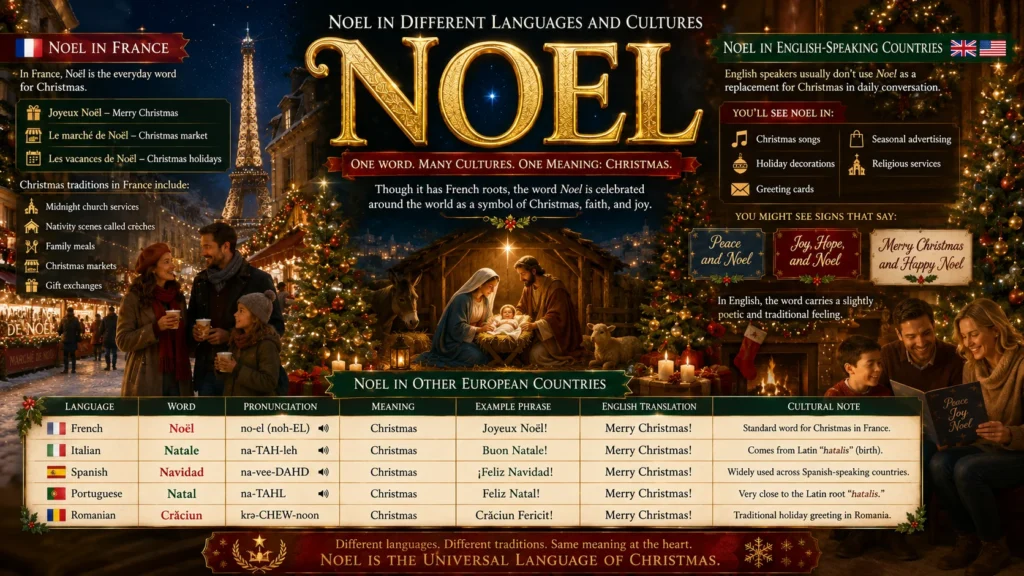
The word Noel may have French roots, but its influence extends far beyond France. Across the world, the term has become a symbol of Christmas, faith, and celebration.
Different cultures use the word in unique ways, yet the central meaning remains remarkably consistent.
Noel in France
In France, Noël is simply the standard word for Christmas.
You will hear phrases such as:
- Joyeux Noël – Merry Christmas
- Le marché de Noël – Christmas market
- Les vacances de Noël – Christmas holidays
For French speakers, Noël isn’t an old-fashioned or poetic term. It is the everyday word for Christmas itself.
Christmas traditions in France often include:
- Midnight church services
- Nativity scenes called crèches
- Family meals
- Christmas markets
- Gift exchanges
The word Noël appears in almost every aspect of the season.
Noel in English-Speaking Countries
English speakers usually don’t use Noel as a replacement for Christmas in daily conversation.
Instead, the word appears in:
- Christmas songs
- Holiday decorations
- Greeting cards
- Seasonal advertising
- Religious services
You might see signs that say:
- Peace and Noel
- Joy, Hope, and Noel
- Merry Christmas and Happy Noel
In English, the word carries a slightly poetic and traditional feeling.
Noel in Other European Countries
Several European languages share similar roots.
| Language | Word | Meaning |
| French | Noël | Christmas |
| Italian | Natale | Christmas |
| Spanish | Navidad | Christmas |
| Portuguese | Natal | Christmas |
| Romanian | Crăciun | Christmas |
The words Natal and Natale are particularly interesting because they still closely resemble the original Latin root natalis, meaning birth.
What Does Noel Mean in Christianity?
For Christians, Noel has a much deeper meaning than a holiday greeting.
It represents the birth of Jesus Christ and the fulfillment of biblical prophecy.
Noel and the Nativity Story
According to Christian tradition, Jesus was born in Bethlehem to Mary and Joseph.
The event is celebrated every year on December 25.
The Nativity story includes:
- The angel Gabriel’s announcement
- The journey to Bethlehem
- The birth in a manger
- The shepherds visiting Jesus
- The arrival of the Wise Men
Because Noel is associated with Christ’s birth, the word became a shorthand expression for the entire event.
Does Noel Appear in the Bible?
A common question is:
Is Noel a biblical word?
The answer is:
No, the word Noel does not appear in the Bible itself.
The term developed centuries after the biblical texts were written.
However, its meaning is closely tied to biblical events because it refers to the celebration of Jesus’ birth.
Christian Symbolism of Noel
For many believers, Noel symbolizes:
- God’s love
- Hope for humanity
- New beginnings
- Peace
- Joy
- Redemption
This spiritual meaning explains why the word remains important in Christian worship.
The Spiritual Meaning of Noel
The spiritual significance of Noel goes beyond history and language.
Many people see it as a symbol of renewal and hope.
A Celebration of New Life
Because the word ultimately comes from a term meaning birth, Noel naturally represents:
- New beginnings
- Fresh opportunities
- Renewal of faith
- Spiritual rebirth
Christmas itself often encourages people to reflect on:
- Family
- Kindness
- Gratitude
- Generosity
Noel captures all of these ideas in a single word.
Noel as a Symbol of Hope
The Christmas story centers on hope.
For Christians, the birth of Jesus represents:
- Hope during difficult times
- Light in darkness
- Peace amid conflict
- Love and compassion
That is why many churches describe Christmas as:
The season of hope and Noel.
Why Do People Say Noel at Christmas?
Many people use the word without fully understanding its meaning.
So why has it become such a common Christmas expression?
The Influence of Music
Christmas music played a huge role in making Noel famous.
Songs such as:
- The First Noel
- Noël Nouvelet
- Various church hymns
introduced the word to millions of people.
As these songs spread across Europe and North America, the term became deeply associated with the holiday season.
The Influence of Decorations and Greetings
Holiday decorations often feature words such as:
- Peace
- Joy
- Believe
- Noel
The word is short, elegant, and instantly recognizable.
Because of this, it became one of the most popular Christmas decoration terms in the world.
Noel in Literature and Popular Culture
The word Noel has appeared in books, songs, films, and art for centuries.
Its connection to Christmas makes it a powerful symbol in storytelling.
Noel in Christmas Literature
Many classic holiday stories use Noel to create a festive atmosphere.
Writers often choose the word because it evokes:
- Warmth
- Family traditions
- Celebration
- Nostalgia
The mere appearance of the word can instantly remind readers of Christmas.
Noel in Music
Christmas music probably contributed more than anything else to the popularity of Noel.
Traditional carols have preserved the term for hundreds of years.
Some of the best-known examples include:
- The First Noel
- Noël Nouvelet
- Christmas cantatas and hymns
These songs helped carry the word across generations.
Noel in Movies and Television
Modern media continues to use Noel as a Christmas symbol.
The word frequently appears in:
- Holiday films
- Television specials
- Greeting cards
- Seasonal advertisements
- Children’s books
Even people who don’t celebrate Christmas often recognize Noel because of its strong cultural presence.
Interesting Facts About the Word Noel
The history of Noel contains many fascinating details.
The Two Dots in Noël Have a Purpose
The dots over the “e” are called a diaeresis.
They tell readers to pronounce the word in two syllables:
No-el
Without the mark, pronunciation would be different.
Noel Has Been Used for Centuries
The word entered English during the Middle Ages and has remained part of Christmas vocabulary ever since.
Noel Was Once Used for Christmas Songs
In older French traditions, a noël could refer to a Christmas carol itself.
This meaning eventually faded but still appears in historical writings.
Noel Is Popular as a Name Worldwide
The name Noel and its variations continue to be used in many countries.
Popular forms include:
- Noel
- Noelle
- Noël
- Noëlle
The Meaning of Noel Has Stayed Remarkably Consistent
Many words change dramatically over time.
Noel is unusual because its connection to Christmas and birth has remained largely unchanged for centuries.
Quick Facts About Noel
| Fact | Information |
| Origin | French |
| Root Word | Latin natalis |
| Literal Meaning | Birth |
| Common Meaning | Christmas |
| Religious Meaning | Celebration of Christ’s birth |
| Feminine Form | Noelle |
| Famous Song | The First Noel |
| Pronunciation | No-el |
Common Misconceptions About Noel
Several myths surround the word.
Let’s clear up the most common ones.
Noel Does Not Mean Jesus
Noel refers to Christmas or the celebration of Christ’s birth.
It is not another name for Jesus.
Noel Is Not Exclusively a Name
Many people think Noel is only a first name.
In reality, the word existed as a Christmas term long before it became a personal name.
Noel Is Not an English Word Originally
The term comes from French and ultimately from Latin.
English adopted the word later.
Noel Does Not Mean Winter
Although people associate Noel with winter, the actual meaning centers on birth and Christmas.
Frequently Asked Questions
What does Noel literally mean?
The word ultimately comes from the Latin natalis, meaning birth.
What does Noel mean in English?
In English, Noel usually means Christmas or the Christmas season.
Is Noel another word for Christmas?
Yes. In French, Noël is the standard word for Christmas.
What does Noel mean spiritually?
Spiritually, Noel symbolizes hope, peace, joy, and the birth of Jesus Christ.
Is Noel a boy or girl name?
Traditionally, Noel is masculine and Noelle is feminine, though Noel is now considered unisex in some places.
Why is the song called The First Noel?
The title refers to the first announcement or celebration of Christ’s birth.
What is the biblical meaning of Noel?
The word itself does not appear in the Bible, but it is strongly associated with the Nativity and the birth of Jesus.
Why are people named Noel?
Many people receive the name because they were born around Christmas or because their families appreciate its religious meaning.
What does Noel mean in French?
In French, Noël simply means Christmas.
Is Noel a religious word?
It can be both religious and cultural depending on how it is used.
Final Thoughts
At its heart, Noel means Christmas and traces its origins to a Latin word meaning birth. Through centuries of language and tradition, it became deeply connected to the celebration of Jesus Christ’s birth and eventually evolved into one of the world’s most recognizable holiday words.
Today, Noel carries several meanings at once.
It can refer to:
- Christmas itself
- The birth of Jesus Christ
- A season of joy and celebration
- A traditional Christmas song
- A personal name associated with Christmas
Few words capture the spirit of an entire holiday in such a simple and elegant way.
Whether you hear it in a church hymn, see it on a greeting card, or meet someone named Noel, the word continues to symbolize hope, celebration, and the joy of Christmas.
Noel is more than just a word. It is a centuries-old reminder of birth, renewal, and the enduring spirit of the Christmas season.

Sophia Bennett is a professional writer focused on explaining word meanings, expressions and everyday language in a simple and engaging way.