Last Updated on June 10, 2026
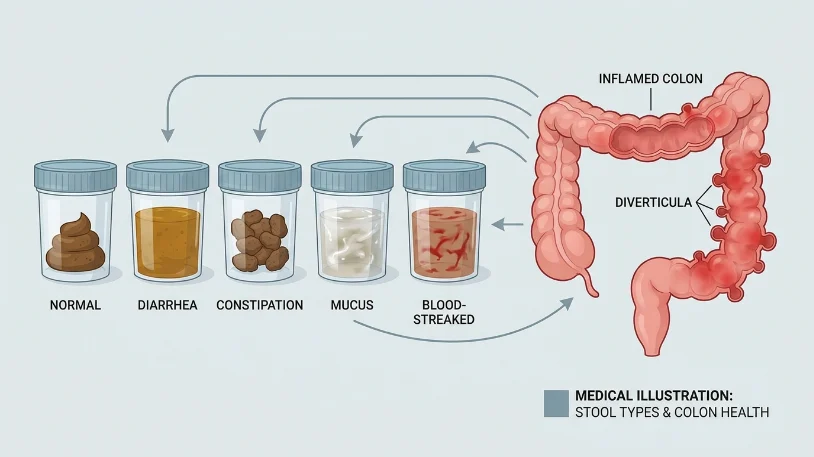
What does poop look like with diverticulitis? Poop with diverticulitis can vary widely. You may notice loose or watery stool, hard and lumpy stool, narrow or pencil-thin stool, mucus in stool, or blood (bright red or dark). These changes happen due to inflammation in the colon. While some changes are mild, persistent blood, black stool, or severe changes in bowel habits require medical attention.
What Does Poop Look Like With Diverticulitis?
If you’re here, you’re probably noticing something different in your bowel movements. Maybe your stool looks thinner than usual. Maybe there’s mucus. Or worse, blood.
Here’s the truth. Diverticulitis stool appearance is not one size fits all.
Sometimes nothing changes at all. Other times, your stool becomes the first warning sign that something is off in your gut.
That’s why understanding bowel movements with diverticulitis matters. It gives you a window into what’s happening inside your colon.
What Is Diverticulitis (And Why It Affects Your Stool)
Diverticulitis happens when small pouches in your colon called diverticula become inflamed or infected.
Think of your colon like a flexible tube. Over time, weak spots can bulge outward. These bulges form pockets.
Now imagine food, bacteria, or waste getting trapped there.
That’s when inflammation kicks in.
Why This Changes Stool Appearance
Inflammation disrupts how your colon works:
- It alters water absorption
- It speeds up or slows down bowel movement
- It irritates the lining, causing mucus or bleeding
- It can physically narrow the colon, changing stool shape
The result? Noticeable changes in poop appearance, consistency, and frequency.
What Normal Poop Looks Like (Baseline You Should Know)
Before diving into abnormal patterns, you need a baseline.
The Bristol Stool Chart is the gold standard for stool types.
Normal Stool Characteristics
- Medium brown color
- Smooth, sausage-like shape
- Soft but formed
- Easy to pass
Stool Types Overview
| Type | Appearance | Meaning |
|---|---|---|
| Type 1 | Hard lumps | Severe constipation |
| Type 2 | Lumpy sausage | Mild constipation |
| Type 3 | Cracked sausage | Normal |
| Type 4 | Smooth sausage | Ideal |
| Type 5 | Soft blobs | Slightly loose |
| Type 6 | Mushy | Diarrhea |
| Type 7 | Liquid | Severe diarrhea |
When diverticulitis hits, your stool often shifts away from Types 3–4.
Diverticulitis Stool Appearance: What Actually Changes
Let’s break down the real, observable changes people experience.
Loose or Watery Stool (Diarrhea)
During a flare-up, inflammation can speed things up.
Food moves too quickly through your colon. Your body doesn’t absorb enough water.
What you’ll notice:
- Mushy or fully liquid stool
- Frequent bowel movements
- Urgency (you can’t hold it long)
Why it happens:
- Inflamed colon = faster transit
- Reduced water absorption
Hard, Lumpy Stool (Constipation)
Oddly enough, the opposite can also happen.
Pain and inflammation can slow your digestive system down.
What you’ll notice:
- Small, hard pellets
- Straining during bowel movements
- Feeling like you didn’t fully empty
Why it happens:
- Reduced movement in the colon
- Fear of pain leads to holding stool
Narrow or Pencil-Thin Stool
This one worries a lot of people and for good reason.
Inflammation can narrow sections of your colon.
What you’ll notice:
- Thin, ribbon-like stool
- Consistent shape change over time
Important note:
Occasional thin stool isn’t a big deal. Persistent thin stool needs evaluation.
Mucus in Stool
This is one of the most common but overlooked signs.
Your colon produces mucus to protect itself.
When inflamed, it produces more.
What you’ll notice:
- Clear, white, or jelly-like coating
- Slimy texture on stool
Why it happens:
- Irritated intestinal lining
- Protective response
Blood in Stool (Major Warning Sign)
This is where things get serious.
Inflamed diverticula can bleed.
What you’ll notice:
- Bright red streaks → lower colon bleeding
- Dark red or maroon → deeper bleeding
- Black stool → digested blood (urgent)
Diverticulitis Poop Color: What Each Color Means
Color tells a story.
Here’s how to read it.
Stool Color Breakdown
| Color | What It Means | Should You Worry? |
|---|---|---|
| Brown | Normal digestion | No |
| Yellow | Fat malabsorption or fast transit | Sometimes |
| Green | Rapid digestion or diet | Usually not |
| Red | Fresh blood | Yes |
| Maroon | Internal bleeding | Yes |
| Black | Digested blood | Urgent |
Why Is My Poop Different With Diverticulitis?
Short answer? Inflammation changes everything.
Long answer? Let’s break it down.
Key Mechanisms
- Disrupted water balance → diarrhea or constipation
- Muscle spasms → irregular bowel movements
- Tissue irritation → mucus production
- Bleeding pockets → visible blood
- Narrowing pathways → thin stool
Your colon isn’t just a pipe. It’s an active system. When inflamed, it behaves unpredictably.
Diverticulitis Diarrhea vs Constipation Stool
Both can happen. Sometimes even in the same week.
Comparison Table
| Feature | Diarrhea | Constipation |
|---|---|---|
| Stool consistency | Loose, watery | Hard, dry |
| Frequency | High | Low |
| Pain | Cramping | Straining |
| Cause | Fast movement | Slow movement |
| Risk | Dehydration | Blockage |
Diverticulitis vs IBS Stool Differences
Irritable Bowel Syndrome can look similar.
But key differences stand out.
Side-by-Side Comparison
| Feature | Diverticulitis | IBS |
|---|---|---|
| Inflammation | Yes | No |
| Fever | Possible | No |
| Blood in stool | Possible | Rare |
| Pain severity | Sharp, localized | Cramping, diffuse |
| Infection | Possible | No |
Diverticulitis vs Colon Cancer Stool Symptoms
Colon Cancer also causes stool changes.
Key Differences
- Cancer causes progressive, persistent changes
- Diverticulitis causes sudden flare-ups
Shared symptoms:
- Thin stool
- Blood in stool
Unique warning signs of cancer:
- Unexplained weight loss
- Long-term fatigue
Early Signs of Diverticulitis in Stool
Sometimes stool changes show up early.
Watch for:
- Slight increase in mucus
- Irregular bowel habits
- Occasional constipation or diarrhea
- Mild shape changes
These signs often appear before pain intensifies.
When Should You Worry About Stool Changes?
Not every change matters.
But some demand attention.
Red Flags
- Persistent blood in stool
- Black or tarry stool
- Severe abdominal pain
- Fever with bowel changes
- Sudden, lasting shift in stool shape
Real-Life Patterns (What People Actually Experience)
People rarely experience just one symptom.
Most report combinations like:
- Loose stool + mucus + urgency
- Constipation + pain + thin stool
- Normal stool + occasional blood streaks
Patterns matter more than one-off changes.
How Long Do Stool Changes Last?
It depends on the flare.
Typical Timeline
- Mild flare → 3 to 7 days
- Moderate → 1 to 2 weeks
- Severe → longer with treatment
Even after recovery, stool may take time to normalize.
Does Diverticulitis Cause Mucus in Stool?
Yes. Frequently.
Mucus acts like a protective layer.
When your colon feels attacked, it produces more.
What It Looks Like
- Transparent or cloudy gel
- Mixed with stool or separate
Small amounts aren’t dangerous. Persistent mucus deserves attention.
Can Diverticulitis Cause Thin Stools?
Yes. Especially during inflammation.
But context matters.
Occasional vs Persistent
- Occasional → usually harmless
- Persistent → investigate further
Practical Stool Monitoring (Simple But Powerful)
You don’t need fancy tools.
Just pay attention.
Track These Daily
- Color
- Shape
- Frequency
- Pain level
- Presence of mucus or blood
Example Log
| Day | Stool Type | Color | Notes |
|---|---|---|---|
| Monday | Type 6 | Yellow | Urgency |
| Tuesday | Type 2 | Brown | Straining |
| Wednesday | Type 4 | Brown | Normal |
Patterns reveal more than memory.
Diet and Its Impact on Stool Appearance
Food directly affects stool.
During diverticulitis:
During Flare
- Low-fiber diet
- Soft foods
- Plenty of fluids
After Recovery
- Gradually increase fiber
- Add fruits, vegetables, whole grains
Common Myths About Diverticulitis Stool
Let’s clear things up.
Myth vs Fact
- Myth: Stool always changes
Fact: Some people see no change - Myth: Blood always means diverticulitis
Fact: Many conditions cause bleeding - Myth: Thin stool = cancer
Fact: Not always, but monitor persistence
FAQs
Can diverticulitis change stool color?
Yes, it can. When you have Diverticulitis, inflammation affects how your colon processes waste. That can shift stool color.
Common changes include:
- Brown → still normal in many cases
- Yellow → faster digestion or poor fat absorption
- Red or maroon → possible bleeding
- Black → digested blood (more serious)
A single color change isn’t always a problem. But if unusual colors stick around, you should take it seriously.
What are stool symptoms of diverticulitis?
Stool changes often show up alongside pain and digestive discomfort.
Most common diverticulitis stool symptoms:
- Loose or watery stool (diarrhea)
- Hard, lumpy stool (constipation)
- Mucus mixed with stool
- Narrow or thin stool shape
- Blood in stool
These changes don’t always appear together. Sometimes you’ll only notice one.
What does stool look like during a diverticulitis flare?
During a flare, your bowel movements can become unpredictable.
You might see:
- Mushy or watery stool if your colon speeds up
- Dry, pellet-like stool if things slow down
- Slimy coating from mucus
- Streaks of blood in more severe cases
The key difference during a flare is instability. Your stool won’t feel consistent from day to day.
Is stool different with diverticulitis all the time?
No, not always.
Many people with diverticular disease have completely normal stool between flare-ups. Changes usually appear when inflammation is active.
Think of it like this:
- No inflammation → normal bowel habits
- Active inflammation → noticeable stool changes
Does diverticulitis cause mucus in stool?
Yes, it often does.
When your colon lining becomes irritated, it produces extra mucus to protect itself.
What mucus looks like:
- Clear or white jelly-like substance
- Coating the stool or appearing separately
Small amounts can happen occasionally. Frequent mucus is worth paying attention to.
Can diverticulitis cause thin stools?
Yes, especially during inflammation.
Swelling inside the colon can narrow the passage where stool travels.
Result:
- Pencil-thin or ribbon-like stool
If this happens once or twice, it’s usually not urgent.
If it happens consistently, you should get it checked.
Does diverticulitis cause black or red stool?
It can.
- Bright red stool → fresh bleeding in the lower colon
- Maroon stool → deeper internal bleeding
- Black stool → digested blood (more serious)
Blood in stool should never be ignored. Even if diverticulitis is the cause, you still need medical evaluation.
Why is my poop different with diverticulitis?
Because your colon isn’t working normally.
Inflammation affects:
- How quickly waste moves
- How much water gets absorbed
- How your intestinal lining responds
That leads to changes in:
- Shape
- Color
- Consistency
How do bowel movements change with diverticulitis?
Bowel habits often become irregular.
You might experience:
- Switching between diarrhea and constipation
- Increased urgency
- Incomplete bowel movements
- Pain during or after passing stool
It’s not just what your stool looks like. It’s also how your body handles it.
Is bloody stool a sign of diverticulitis?
It can be, but don’t assume.
Conditions like:
- Hemorrhoids
- Colon Cancer
can also cause bleeding.
Important:
If you see blood more than once, or in large amounts, get medical help.
When should I worry about stool changes?
Watch for patterns, not just one-off events.
Seek medical attention if you notice:
- Persistent blood in stool
- Black or tarry stool
- Severe abdominal pain
- Fever with bowel changes
- Long-lasting thin stools
These signs may point to something more serious than a simple flare.
How to recognize diverticulitis from stool alone?
You usually can’t rely on stool alone.
Stool changes help, but doctors look at the full picture:
- Pain (often lower left abdomen)
- Fever
- Nausea
- Changes in bowel habits
Stool is a clue, not a diagnosis.
Does diverticulitis always cause diarrhea or constipation?
No.
Some people experience both. Others experience neither.
Your body may:
- Lean toward diarrhea
- Lean toward constipation
- Alternate between the two
That’s why patterns matter more than individual symptoms.
How long do stool changes last with diverticulitis?
It depends on the severity of the flare.
Typical ranges:
- Mild flare → a few days
- Moderate flare → up to two weeks
- Severe flare → longer with treatment
Even after symptoms improve, your stool may take time to return to normal.
Final Thought
Your stool tells a story. Not always a pleasant one, but an important one.
Ignore it, and you miss early warning signs. Pay attention, and you gain insight into your gut health.
If something feels off, it probably is.
And when in doubt, don’t guess. Get it checked.

Sophia Bennett is a professional writer focused on explaining word meanings, expressions and everyday language in a simple and engaging way.