
Last Updated on June 9, 2026
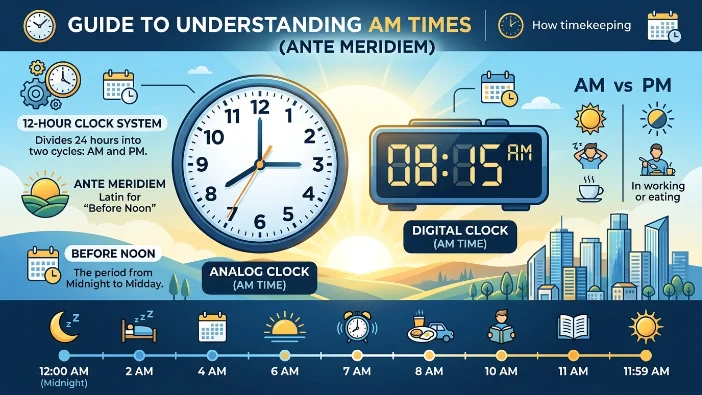
AM stands for Ante Meridiem, a Latin phrase that means “before midday” or “before noon.” In the 12-hour clock system, AM refers to the time period that begins at 12:00 AM (midnight) and ends at 11:59 AM, just before noon. AM is used to distinguish morning hours from PM (Post Meridiem), which refers to afternoon and evening hours.
If you’ve ever looked at a clock and wondered, what does AM stand for, you’re not alone.
The abbreviation AM appears on digital clocks, smartphones, calendars, schedules, airline tickets, school timetables, and countless other places. Despite seeing it every day, many people don’t know its exact meaning or where it comes from.
The AM full form is:
Ante Meridiem
This phrase comes from Latin and translates to:
Before midday
Before noon
In simple terms, AM refers to all times that occur after midnight and before noon.
For example:
| Time | Designation |
|---|---|
| 12:00 AM | Midnight |
| 1:00 AM | Early morning |
| 6:00 AM | Morning |
| 9:00 AM | Morning |
| 11:00 AM | Late morning |
| 11:59 AM | One minute before noon |
Once the clock reaches noon, the designation changes from AM to PM.
Understanding AM is important because it helps distinguish morning hours from afternoon and evening hours in the 12-hour clock system.
AM Meaning Explained
The simplest way to understand AM meaning is to think of it as the first half of a day.
Every day contains 24 hours.
The 12-hour clock divides those 24 hours into two sections:
| Period | Meaning |
|---|---|
| AM | Before noon |
| PM | After noon |
The AM period begins exactly at midnight and continues until one minute before noon.
Many people associate AM exclusively with morning. While that’s mostly true, there’s one important exception.
Midnight Is Also AM
The AM cycle actually starts at:
12:00 AM
This means midnight belongs to the AM period.
After midnight, time progresses like this:
- 12:00 AM
- 1:00 AM
- 2:00 AM
- 3:00 AM
- 4:00 AM
- 5:00 AM
And continues until:
11:59 AM
At noon, PM begins.
AM Full Form in English
Many people search for AM full form in English because they encounter the abbreviation without knowing its origin.
The answer is straightforward:
| Abbreviation | Full Form |
|---|---|
| AM | Ante Meridiem |
The phrase originates from Latin.
Breaking it down:
| Latin Word | Meaning |
|---|---|
| Ante | Before |
| Meridiem | Midday or Noon |
Together they form:
Ante Meridiem = Before Midday
This Latin expression has remained in use for centuries and continues to be the standard designation in the 12-hour time format used across many countries.
What Does Ante Meridiem Mean?
To fully understand AM, it helps to understand ante meridiem meaning.
The word “meridian” comes from the same Latin root as meridiem.
Historically, noon was considered the moment when the sun crossed the local meridian and reached its highest point in the sky.
Because of this:
- Before the sun reached its highest point = Ante Meridiem
- After the sun passed its highest point = Post Meridiem
That’s why the terms became associated with timekeeping.
Simple Translation
| Latin PhraseEnglish Meaning | |
|---|---|
| Ante Meridiem | Before Noon |
| Post Meridiem | After Noon |
These terms may sound ancient, yet billions of people still use them every day without realizing they originated in Latin.
Why Do We Use AM and PM?
The question often follows naturally:
Why do we use AM and PM at all?
The answer lies in avoiding confusion.
Imagine if clocks simply repeated numbers from 1 to 12 without any additional labels.
If someone says:
“Meet me at 7 o’clock.”
Do they mean:
- 7:00 in the morning?
- 7:00 in the evening?
Without AM or PM, there would be uncertainty.
AM and PM solve that problem immediately.
Example
| Time Written | Actual Meaning |
|---|---|
| 7:00 AM | Morning |
| 7:00 PM | Evening |
| 9:00 AM | Morning meeting |
| 9:00 PM | Night event |
This distinction makes scheduling easier and reduces misunderstandings.
The History of AM and PM
Timekeeping has fascinated civilizations for thousands of years.
Long before digital clocks existed, people measured time using:
- Sundials
- Water clocks
- Candle clocks
- Astronomical observations
Ancient societies noticed a natural division of the day.
The sun rises.
The sun reaches its highest point.
The sun sets.
This cycle naturally separated the day into two major periods.
Ancient Roman Influence
The Romans heavily influenced modern time notation.
Latin served as the language of administration, science, and scholarship throughout much of Europe.
As mechanical clocks became more common, Latin terms such as:
- Ante Meridiem
- Post Meridiem
were adopted into timekeeping systems.
Over time these phrases became abbreviated:
- AM
- PM
Those abbreviations remain widely used today.
How the 12-Hour Clock System Works
To understand AM in time, you need to understand the 12-hour clock.
Unlike the 24-hour clock, the 12-hour clock repeats the numbers 1 through 12 twice every day.
First Cycle
AM hours:
| Hour |
|---|
| 12 AM |
| 1 AM |
| 2 AM |
| 3 AM |
| 4 AM |
| 5 AM |
| 6 AM |
| 7 AM |
| 8 AM |
| 9 AM |
| 10 AM |
| 11 AM |
Second Cycle
PM hours:
| Hour |
|---|
| 12 PM |
| 1 PM |
| 2 PM |
| 3 PM |
| 4 PM |
| 5 PM |
| 6 PM |
| 7 PM |
| 8 PM |
| 9 PM |
| 10 PM |
| 11 PM |
This creates a complete 24-hour day.
This cycle repeats every day.
AM in Time: Understanding Morning Hours
When people refer to AM, they usually mean the morning period.
Morning hours include:
| Time | Typical Activity |
|---|---|
| 5 AM | Early workouts |
| 6 AM | Sunrise routines |
| 7 AM | Breakfast |
| 8 AM | School starts |
| 9 AM | Work begins |
| 10 AM | Business hours |
| 11 AM | Late morning |
These hours fall under the AM designation because they occur before noon.
Common Morning Time Blocks
Early Morning
- 12 AM to 5:59 AM
Morning
- 6 AM to 9:59 AM
Late Morning
- 10 AM to 11:59 AM
Although these categories are informal, they help people organize daily schedules.
What Does 12 AM Mean?
Few time expressions create more confusion than 12 AM.
Many people mistakenly think 12 AM refers to noon.
It does not.
Correct Meaning of 12 AM
12 AM = Midnight
It marks:
- The beginning of a new day
- The start of the AM cycle
- 00:00 in the 24-hour clock system
Conversion Table
| 12-Hour Time | 24-Hour Time |
|---|---|
| 12:00 AM | 00:00 |
| 12:30 AM | 00:30 |
| 1:00 AM | 01:00 |
| 2:00 AM | 02:00 |
Think of 12 AM as the exact moment one day ends and another begins.
What Does 1 AM Mean?
1 AM means one hour after midnight.
It belongs to the very early morning period.
Examples
- A late-night movie might end at 1 AM.
- Airport departures sometimes occur at 1 AM.
- Shift workers often start work around 1 AM.
In the 24-hour clock system:
| 12-Hour | 24-Hour |
|---|---|
| 1:00 AM | 01:00 |
This conversion helps travelers and professionals avoid scheduling mistakes.
What Does 6 AM Mean?
6 AM is one of the most recognized morning hours.
For many people, it represents the beginning of the day.
Typical activities at 6 AM include:
- Exercise
- Running
- Morning walks
- Preparing breakfast
- Commuting
In many regions, sunrise occurs around this time during parts of the year.
Time Conversion
| 12-Hour | 24-Hour |
|---|---|
| 6:00 AM | 06:00 |
Because it occurs before noon, it remains part of the AM period.
What Does 11 AM Mean?
11 AM is the final full hour before noon.
It falls within the late morning category.
Many workplaces schedule:
- Meetings
- Appointments
- Calls
- Presentations
during this hour.
Time Conversion
| 12-Hour | 24-Hour |
|---|---|
| 11:00 AM | 11:00 |
At 11:59 AM, the AM cycle is almost complete.
One minute later, noon arrives and PM begins.
AM Meaning on Digital Clocks
Digital clocks display AM to help users identify the correct half of the day.
For example:
06:15 AM
means:
- Six fifteen in the morning
- Before noon
- Morning hours
Without the AM indicator, people might confuse it with:
06:15 PM
which occurs in the evening.
This small abbreviation plays a huge role in accurate time communication.
AM Meaning in Scheduling and Calendars
Modern scheduling relies heavily on AM and PM notation.
You’ll find AM indicators on:
- Calendar invitations
- Flight reservations
- Medical appointments
- School schedules
- Business meetings
- Event registrations
For example:
Doctor Appointment: 9:30 AM
This immediately tells you the appointment occurs before noon.
Without AM or PM, scheduling errors would become far more common.
AM vs PM Explained
One of the most common questions people ask after learning what AM stands for is how AM differs from PM.
Although both abbreviations belong to the 12-hour clock system, they represent opposite halves of the day.
| Abbreviation | Full Form | Meaning |
|---|---|---|
| AM | Ante Meridiem | Before Noon |
| PM | Post Meridiem | After Noon |
The distinction is simple.
- AM covers the period from midnight to just before noon.
- PM covers the period from noon to just before midnight.
Quick Comparison
| Time | Designation |
|---|---|
| 3:00 AM | Early Morning |
| 9:00 AM | Morning |
| 12:00 PM | Noon |
| 3:00 PM | Afternoon |
| 7:00 PM | Evening |
| 11:00 PM | Night |
Whenever you see AM, think before noon.
Whenever you see PM, think after noon.
Difference Between AM and PM
Although AM and PM seem straightforward, many people still mix them up.
The easiest way to remember the difference is to focus on noon.
AM
- Begins at midnight
- Ends before noon
- Covers all morning hours
- Means before midday
PM
- Begins at noon
- Ends before midnight
- Covers afternoon and evening hours
- Means after midday
AM vs PM Table
| Feature | AM | PM |
|---|---|---|
| Full Form | Ante Meridiem | Post Meridiem |
| Meaning | Before Noon | After Noon |
| Starts | 12:00 AM | 12:00 PM |
| Ends | 11:59 AM | 11:59 PM |
| Associated With | Morning | Afternoon and Evening |
| 24-Hour Equivalent | 00:00–11:59 | 12:00–23:59 |
Think of noon as the dividing line.
Everything before it belongs to AM.
Everything after it belongs to PM.
Is Midnight AM or PM?
This question has confused students, travelers, and professionals for generations.
The Correct Answer
Midnight is 12:00 AM.
Midnight marks:
- The beginning of a new day
- The start of the AM period
- 00:00 in 24-hour time
Midnight Timeline
11:59 PM
   ↓
12:00 AM (Midnight)
   ↓
12:01 AM
Because midnight starts the new day, it belongs to the AM designation.
Why the Confusion Exists
The confusion happens because midnight sits between two calendar days.
For example:
Monday 11:59 PM
Tuesday 12:00 AM
Tuesday 12:01 AM
Midnight acts as the transition point.
That transition often causes misunderstandings when people schedule events.
Best Practice
To avoid confusion, many organizations write:
- Midnight
- 00:00
- Start of Day
instead of simply using 12 AM.
Is Noon AM or PM?
Another common question concerns noon.
The Correct Answer
Noon is 12:00 PM.
Noon represents:
- Midday
- The exact middle of the daytime cycle
- The beginning of the PM period
Noon Timeline
11:59 AM
   ↓
12:00 PM (Noon)
   ↓
12:01 PM
At the moment noon arrives, AM ends and PM begins.
Simple Rule
Remember this:
| Time | Designation |
|---|---|
| Midnight | 12:00 AM |
| Noon | 12:00 PM |
This rule eliminates most time-format confusion.
When Does AM Start?
AM begins at:
12:00 AM
That exact moment marks the start of a new calendar day.
AM Starting Point
| Event | Time |
|---|---|
| New Day Begins | 12:00 AM |
| AM Starts | 12:00 AM |
| Midnight | 12:00 AM |
From there, AM continues through:
- 1 AM
- 2 AM
- 3 AM
- 4 AM
- 5 AM
- 6 AM
- 7 AM
- 8 AM
- 9 AM
- 10 AM
- 11 AM
The cycle continues uninterrupted until noon.
When Does AM End?
AM ends at:
11:59:59 AM
One second later, PM begins.
End of AM Timeline
11:58 AM
11:59 AM
11:59:59 AM
↓
12:00 PM
At noon, the clock transitions into the PM period.
This makes noon the dividing line between the two halves of the day.
Why Is It Called AM?
The answer goes back thousands of years.
Ancient civilizations tracked the movement of the sun across the sky.
As the sun rose and approached its highest point, people viewed that period as the first half of the day.
The Latin phrase Ante Meridiem literally described this period.
Word Origins
| Word | Meaning |
|---|---|
| Ante | Before |
| Meridiem | Midday |
Combined, they mean:
Before Midday
The phrase eventually became abbreviated to AM.
Despite centuries of technological advancement, the abbreviation remains unchanged.
What Language Does AM Come From?
AM comes from the Latin language.
Latin influenced:
- Science
- Law
- Medicine
- Education
- Timekeeping
Many modern abbreviations still originate from Latin.
Examples include:
| Abbreviation | Latin Origin |
|---|---|
| AM | Ante Meridiem |
| PM | Post Meridiem |
| etc. | Et Cetera |
| i.e. | Id Est |
| e.g. | Exempli Gratia |
Because Latin served as a scholarly language for centuries, many of its terms became permanent fixtures in everyday life.
AM Meaning in the 12-Hour Clock System
The 12-hour clock system divides the day into two equal sections.
First Half
12:00 AM → 11:59 AM
Second Half
12:00 PM → 11:59 PM
Each half contains 12 hours.
Together they form the complete 24-hour day.
Full Daily Cycle
| 12-Hour Time | Period |
|---|---|
| 12 AM–11:59 AM | AM |
| 12 PM–11:59 PM | PM |
This system remains the standard format in many countries.
AM Meaning in Daily Life
People use AM dozens of times every day without thinking about it.
Common Examples
Work Schedules
- 8:00 AM shift start
- 9:00 AM meeting
- 11:00 AM presentation
School Schedules
- 7:30 AM arrival
- 8:00 AM classes begin
- 11:30 AM lunch period
Transportation
- 6:15 AM train
- 7:45 AM flight
- 10:30 AM bus departure
Healthcare
- 8:00 AM checkup
- 9:30 AM dental appointment
- 11:15 AM consultation
AM notation keeps these schedules clear and organized.
AM Meaning on Analog and Digital Clocks
Modern clocks display time differently.
Analog Clocks
Traditional clocks with hands usually do not show AM or PM.
People determine the period from context.
Digital Clocks
Digital devices often display:
7:45 AM
or
07:45 AM
This removes ambiguity.
Devices That Commonly Display AM
- Smartphones
- Smartwatches
- Alarm clocks
- Computers
- Vehicle dashboards
- Digital calendars
The AM indicator helps users instantly recognize morning times.
12-Hour Clock vs 24-Hour Clock
Different countries use different time formats.
12-Hour Clock
Uses:
- AM
- PM
Example:
8:00 AM
8:00 PM
24-Hour Clock
Uses numbers from 00:00 to 23:59.
Example:
08:00
20:00
Comparison Table
| 12-Hour Format | 24-Hour Format |
|---|---|
| 12:00 AM | 00:00 |
| 1:00 AM | 01:00 |
| 6:00 AM | 06:00 |
| 9:00 AM | 09:00 |
| 12:00 PM | 12:00 |
| 3:00 PM | 15:00 |
| 6:00 PM | 18:00 |
| 9:00 PM | 21:00 |
The 24-hour format eliminates confusion because every hour appears only once.
Countries That Commonly Use AM and PM
Many English-speaking countries rely heavily on the 12-hour clock.
Examples include:
- United States
- Canada
- Australia
- New Zealand
- Philippines
Other countries often prefer the 24-hour system for official use.
Examples include:
- Germany
- France
- Spain
- Italy
- Sweden
Even in countries that favor 24-hour time, people frequently understand AM and PM.
Common Mistakes People Make With AM
Even adults sometimes make mistakes when using AM notation.
Confusing Noon and Midnight
Incorrect:
- 12 AM = Noon
Correct:
- 12 AM = Midnight
- 12 PM = Noon
Mixing Up Morning and Evening
Incorrect:
- 7 PM for a breakfast meeting
Correct:
- 7 AM for a breakfast meeting
Forgetting AM or PM Entirely
Writing:
Meeting at 8:00
can cause confusion.
Instead write:
Meeting at 8:00 AM
or
Meeting at 8:00 PM
Clear communication prevents scheduling mistakes.
Complete AM Time Conversion Table
| AM Time | 24-Hour Time |
|---|---|
| 12:00 AM | 00:00 |
| 1:00 AM | 01:00 |
| 2:00 AM | 02:00 |
| 3:00 AM | 03:00 |
| 4:00 AM | 04:00 |
| 5:00 AM | 05:00 |
| 6:00 AM | 06:00 |
| 7:00 AM | 07:00 |
| 8:00 AM | 08:00 |
| 9:00 AM | 09:00 |
| 10:00 AM | 10:00 |
| 11:00 AM | 11:00 |
This table helps convert AM times into 24-hour notation quickly and accurately.
Interesting Facts About AM
AM Is Older Than Mechanical Clocks
The concept behind AM predates modern clocks by centuries.
AM Comes From Astronomy
Ancient timekeeping relied heavily on the sun’s position.
Billions Use AM Daily
AM remains one of the most widely recognized abbreviations in the world.
AM Covers Nearly Half the Day
AM spans 12 hours out of every 24-hour cycle.
AM Is Part of International Scheduling
Airlines, businesses, schools, and hospitals use AM notation every day.
How AM Is Used Around the World
Although the concept of AM is universal within the 12-hour clock system, different countries display and communicate time in different ways.
Some countries primarily use the 12-hour format, while others prefer the 24-hour format for official purposes.
Countries That Commonly Use AM and PM
| Country | Common Time Format |
|---|---|
| United States | 12-Hour Clock |
| Canada | 12-Hour Clock |
| Australia | 12-Hour Clock |
| New Zealand | 12-Hour Clock |
| Philippines | 12-Hour Clock |
| India | Mixed Usage |
| Pakistan | Mixed Usage |
| United Kingdom | Mixed Usage |
Countries That Prefer the 24-Hour Clock
| Country | Common Time Format |
|---|---|
| Germany | 24-Hour Clock |
| France | 24-Hour Clock |
| Spain | 24-Hour Clock |
| Italy | 24-Hour Clock |
| Sweden | 24-Hour Clock |
| Norway | 24-Hour Clock |
| Denmark | 24-Hour Clock |
Even in countries that favor military or 24-hour time, most people still understand the AM abbreviation.
AM in Professional Scheduling
Businesses depend on accurate time notation every day.
A simple AM or PM mistake can result in:
- Missed meetings
- Missed flights
- Appointment conflicts
- Delivery delays
- Scheduling errors
Examples of Professional AM Usage
| Event | Time |
|---|---|
| Executive Meeting | 8:00 AM |
| Staff Briefing | 9:00 AM |
| Medical Appointment | 10:30 AM |
| School Assembly | 7:45 AM |
| Flight Departure | 6:15 AM |
In professional environments, many organizations use the 24-hour clock to reduce ambiguity.
For example:
| 12-Hour Format | 24-Hour Format |
|---|---|
| 6:00 AM | 06:00 |
| 8:00 AM | 08:00 |
| 11:00 AM | 11:00 |
AM in Technology and Digital Devices
Technology has made AM notation more visible than ever.
Most devices automatically display AM or PM when configured for a 12-hour clock.
Devices That Use AM Notation
- Smartphones
- Tablets
- Computers
- Smartwatches
- Fitness trackers
- Digital alarm clocks
- Vehicle infotainment systems
- Smart home devices
When you set an alarm for 6:00 AM, the device understands that you mean morning rather than evening.
This distinction helps prevent costly mistakes.
Imagine setting a flight reminder for 5:00 PM instead of 5:00 AM. A single letter can completely change the schedule.
AM in Aviation and Transportation
Transportation industries place a huge emphasis on accurate time communication.
Many airlines avoid confusion by using the 24-hour clock.
Example
| Standard Time | 24-Hour Time |
|---|---|
| 5:00 AM | 05:00 |
| 8:00 AM | 08:00 |
| 11:00 AM | 11:00 |
Using a 24-hour format eliminates the possibility of confusing morning departures with evening departures.
This practice is especially important in:
- Aviation
- Rail systems
- Maritime operations
- Emergency services
- Military organizations
AM in Education
Students encounter AM notation from an early age.
Schools teach the 12-hour clock system to help children understand:
- Time measurement
- Daily schedules
- Morning routines
- Calendar planning
- Clock reading skills
Typical School Schedule
| Activity | Time |
|---|---|
| School Opens | 7:30 AM |
| First Class | 8:00 AM |
| Morning Break | 10:00 AM |
| Lunch | 11:30 AM |
Understanding AM allows students to organize their day effectively.
Why the 12-Hour Clock Still Exists
Some people wonder why society continues using AM and PM when the 24-hour clock exists.
The answer is simple.
The 12-hour clock is deeply familiar to millions of people.
Benefits of the 12-Hour Clock
- Easy to read
- Easy to speak
- Widely understood
- Common in daily conversation
- Familiar across generations
Benefits of the 24-Hour Clock
- Eliminates ambiguity
- Preferred in technical fields
- Useful for transportation
- Reduces scheduling errors
Both systems work effectively. The choice often depends on culture, industry, and personal preference.
Key AM Facts
| Question | Answer |
|---|---|
| What does AM stand for? | Ante Meridiem |
| What does Ante Meridiem mean? | Before Noon |
| When does AM begin? | 12:00 AM |
| When does AM end? | 11:59 AM |
| Is midnight AM? | Yes |
| Is noon AM? | No |
| Is 12 AM midnight? | Yes |
| Is 12 PM noon? | Yes |
AM Cheat Sheet
Remember These Rules
✅ AM means before noon
✅ PM means after noon
✅ 12 AM is midnight
✅ 12 PM is noon
✅ AM covers morning hours
✅ PM covers afternoon and evening hours
Easy Memory Trick
Think of the letter A in AM as:
A = Ahead of Noon
Think of the letter P in PM as:
P = Past Noon
While not the literal definition, this trick helps many people remember the difference quickly.
Frequently Asked Questions
What does AM stand for?
AM stands for Ante Meridiem, a Latin phrase meaning before noon or before midday.
What is the full form of AM?
The full form of AM is Ante Meridiem.
What does AM mean in time?
AM refers to the period from midnight until just before noon in the 12-hour clock system.
Is AM before noon?
Yes. AM covers all times before noon.
What does PM stand for?
PM stands for Post Meridiem, which means after noon.
Is 12 AM midnight?
Yes. 12 AM represents midnight and marks the beginning of a new day.
Is 12 PM noon?
Yes. 12 PM represents noon and marks the beginning of the PM period.
When does AM begin?
AM begins at 12:00 AM.
When does AM end?
AM ends at 11:59 AM.
Why do we use AM and PM?
AM and PM help distinguish morning hours from afternoon and evening hours in the 12-hour clock system.
What language does AM come from?
AM comes from Latin and is derived from the phrase Ante Meridiem.
Conclusion
So, what does AM stand for?
AM stands for Ante Meridiem, a Latin phrase that means before noon or before midday. It represents the first half of the day in the 12-hour clock system, beginning at 12:00 AM (midnight) and ending at 11:59 AM, just before noon.
Understanding the AM meaning, AM full form, and AM definition makes it much easier to read schedules, set alarms, organize appointments, and communicate time accurately. Whether you’re checking a digital clock, planning a meeting, catching a flight, or scheduling a doctor’s appointment, AM serves as a simple yet essential part of modern timekeeping.
Remember the two rules that eliminate almost all confusion:
- 12 AM = Midnight
- 12 PM = Noon
Once you know those rules, using AM and PM correctly becomes second nature.

Michael Anderson is a content writer specializing in word meanings, definitions and clear explanations of modern terms and phrases.