Last Updated on June 9, 2026
ASL in text generally stands for Age, Sex, Location. It became popular in online chat rooms and messaging platforms as a quick conversation starter. When someone types “ASL?” they are usually asking for your age, gender, and location. While ASL can also refer to American Sign Language, the slang meaning is far more common in texting, social media conversations, and online chats. Understanding the context helps determine which meaning is intended.
What Does ASL Mean in Text?
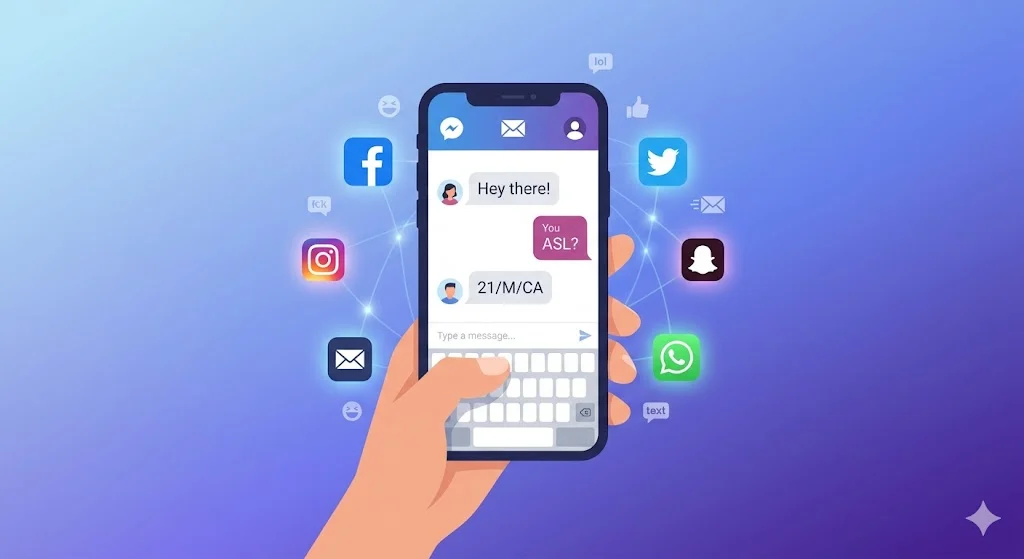
ASL usually means “Age, Sex, Location” in text messages, online chat rooms, and internet slang. People use it as a quick way to ask someone’s age, gender, and where they live. For example, if someone sends “ASL?” in a chat, they are asking for basic personal information to start a conversation.
However, ASL can also mean American Sign Language depending on the context. In texting and online messaging, though, the most common slang meaning remains Age, Sex, Location.
What Does ASL Mean in Text Messages?
If you’ve received a message saying simply “ASL?”, you might wonder what the sender means.
In texting language, ASL is an internet acronym that stands for:
| Letter | Meaning |
| A | Age |
| S | Sex |
| L | Location |
The phrase acts as a shortcut for asking three personal questions at once.
Instead of typing:
- How old are you?
- Are you male or female?
- Where are you from?
A person can simply type:
“ASL?”
This abbreviation became one of the earliest forms of internet shorthand and remains recognizable today.
Although newer generations use different slang terms, ASL still appears in online conversations, gaming communities, chat applications, and social media interactions.
Understanding the Full ASL Meaning
To understand ASL completely, it helps to break down each component.
Age
The first letter asks for a person’s age.
Examples:
- 16
- 21
- 30
- 45
Age often helps people understand who they are talking to online.
Sex
Historically, the word “sex” referred to biological gender.
Typical responses included:
- M (Male)
- F (Female)
Today, many people prefer using the term gender instead. Modern online communication has evolved significantly since ASL first became popular.
Location
The final letter asks where someone lives.
Examples:
- New York
- Texas
- California
- London
- Toronto
Sometimes people provide a city.
Sometimes they only mention a country or region for privacy reasons.
Why Do People Say ASL in Text?
ASL exists for one simple reason:
Speed.
Internet users have always looked for faster ways to communicate.
Before smartphones existed, people chatted using:
- Online chat rooms
- Instant messengers
- IRC networks
- Early social networking websites
- Gaming communities
Typing full questions repeatedly took time.
As a result, abbreviations became common.
ASL quickly emerged as one of the most popular conversation starters because it gathered basic information immediately.
Instead of writing three separate questions, users could type only three letters.
That efficiency helped ASL spread across the internet.
The History of ASL in Online Chat
Long before TikTok videos and Snapchat stories existed, internet users spent hours in chat rooms.
During the late 1990s and early 2000s, platforms such as:
- AOL Chat Rooms
- Yahoo Messenger
- MSN Messenger
- ICQ
- Internet Relay Chat (IRC)
dominated online communication.
One of the first questions people often asked was:
“ASL?”
The phrase became almost universal.
A typical conversation looked like this:
User 1: ASL?
User 2: 18/F/Chicago
User 1: Nice to meet you.
This format became so common that many internet users instantly recognize ASL even decades later.
How ASL Is Used in Texting Today
Although ASL originated in old-school chat rooms, it hasn’t completely disappeared.
People still use it in:
- Text messages
- Gaming chats
- Discord servers
- Online forums
- Social media conversations
- Live streams
- Dating discussions
Today’s usage often falls into two categories.
Genuine Information Request
Sometimes people truly want basic information.
Example:
Person A: Hey.
Person B: Hi.
Person A: ASL?
In this case, the person is asking age, sex, and location.
Joke or Nostalgic Usage
Many internet veterans use ASL humorously.
Example:
Friend 1: Remember old chat rooms?
Friend 2: ASL? 😂
Here, ASL serves as a nostalgic reference to early internet culture.
ASL Meaning in Texting vs Social Media
The meaning often remains identical across platforms.
However, context matters.
| Platform | Common Meaning |
| Text Messages | Age, Sex, Location |
| Snapchat | Age, Sex, Location |
| TikTok | Usually Age, Sex, Location |
| Instagram DMs | Age, Sex, Location |
| Gaming Chats | Age, Sex, Location |
| Online Forums | Age, Sex, Location |
| Educational Contexts | American Sign Language |
The surrounding conversation usually reveals the intended meaning.
ASL Meaning on Snapchat
Snapchat users occasionally use ASL when starting conversations with new people.
For example:
“ASL?”
The sender wants quick personal information before continuing the discussion.
Because Snapchat often connects strangers through mutual friends or public features, abbreviations like ASL still appear.
That said, younger users increasingly rely on newer slang expressions.
ASL Meaning on TikTok
TikTok introduced a new generation to countless internet abbreviations.
ASL appears in:
- Comments
- Direct messages
- Livestream chats
- Meme videos
Most of the time, TikTok users mean:
Age, Sex, Location
However, some creators use ASL jokingly to reference internet culture from the 1990s and early 2000s.
The acronym has become part slang term and part internet history lesson.
ASL Meaning on Instagram
Instagram users sometimes encounter ASL in direct messages.
A conversation may begin like this:
“Hey, ASL?”
The sender wants basic demographic information.
Since Instagram supports messaging between people who may not know each other personally, ASL occasionally appears as a conversation starter.
Still, many users choose not to share personal information with strangers.
ASL Meaning in Online Chat Rooms
Online chat rooms helped create the popularity of ASL.
In these environments, users usually know very little about one another.
Because of that, ASL became a quick introduction method.
A response might look like:
- 19/F/Florida
- 22/M/Texas
- 25/F/Canada
The format remains recognizable even today.
Examples of ASL Used in Texting
Seeing real examples makes the meaning easier to understand.
Example 1
Person A: ASL?
Person B: 22/F/New York
Example 2
Person A: Nice profile. ASL?
Person B: 20/M/California
Example 3
Person A: ASL?
Person B: Prefer not to share location.
Example 4
Person A: ASL lol
Person B: Feels like it’s 2003 again.
How to Respond to ASL in Text
There isn’t one correct response.
You have several options.
Share Information
If you feel comfortable:
21/F/Texas
Simple and direct.
Share Partial Information
You might limit details.
Example:
21/F/USA
This protects more privacy.
Ask Why
You can respond:
Why do you ask?
This helps you understand the person’s intentions.
Decline Politely
Privacy matters online.
Example:
I’d rather not share personal information.
That’s perfectly acceptable.
Is ASL Safe to Answer?
The answer depends on the situation.
When chatting with trusted friends, sharing basic information may feel harmless.
When talking to strangers, caution becomes important.
Consider avoiding:
- Exact addresses
- Phone numbers
- School information
- Workplace details
- Sensitive personal data
Many internet safety experts recommend sharing only the information you feel comfortable revealing publicly.
A good rule exists:
If something feels suspicious, trust your instincts.
When ASL Means American Sign Language
Not every use of ASL refers to Age, Sex, Location.
ASL also stands for American Sign Language, one of the most widely used sign languages in North America.
Examples:
- “I’m learning ASL.”
- “Do you know ASL?”
- “ASL classes start Monday.”
In these situations, ASL clearly refers to American Sign Language rather than texting slang.
Context determines the meaning.
How to Tell Which ASL Meaning Is Intended
The easiest way is to examine the conversation.
ASL Means Age, Sex, Location
Examples:
- ASL?
- What’s your ASL?
- ASL please
ASL Means American Sign Language
Examples:
- Learning ASL
- ASL interpreter
- ASL course
- ASL dictionary
- ASL alphabet
The surrounding words usually remove any confusion.
Common Misunderstandings About ASL
Many people misunderstand ASL because it has multiple meanings.
Myth: ASL Always Means American Sign Language
False.
In texting slang, ASL commonly means Age, Sex, Location.
Myth: Nobody Uses ASL Anymore
False.
Usage has declined since early chat-room days, yet it still appears online.
Myth: ASL Is a New Slang Term
False.
ASL is actually one of the oldest internet abbreviations still recognized today.
Myth: Everyone Should Answer ASL Questions
False.
You never have to share personal information online if you don’t want to.
What Does ASL Mean in a Text From a Girl?
One of the most common search queries is:
“What does ASL mean in a text from a girl?”
The answer is usually straightforward.
In most cases, a girl using ASL means exactly the same thing as anyone else using it:
Age, Sex, Location.
She may be:
- Starting a conversation
- Learning more about you
- Checking whether you’re in a similar age group
- Determining whether you live nearby
- Breaking the ice in an online chat
For example:
Girl: ASL?
You: 22/M/Florida
Girl: Nice. I’m 21/F/Texas.
The acronym itself doesn’t indicate romantic interest.
Instead, it functions as a conversation starter.
The real meaning depends on what happens after the question.
Does ASL Mean Someone Likes You?
Not necessarily.
People often assume ASL signals flirting.
Sometimes it does.
Often it doesn’t.
Someone may simply want to know:
- Who they’re talking to
- Whether you’re their age
- Whether you’re from the same area
Think of ASL as the online equivalent of asking:
“Tell me a little about yourself.”
The question alone doesn’t reveal the sender’s intentions.
What Does ASL Mean in a Text From a Guy?
The meaning remains the same.
When a guy sends:
“ASL?”
He’s usually asking:
- How old are you?
- Are you male or female?
- Where are you from?
In social conversations, gaming communities, and messaging apps, this abbreviation helps people gather basic information quickly.
For example:
Guy: ASL?
You: 20/F/Chicago
Guy: Cool. I’m 21/M/Michigan.
The exchange simply establishes basic context.
Why Would a Guy Ask ASL?
Several reasons exist.
He may want to:
- Start a conversation
- Find people his age
- Connect with local users
- Join group discussions
- Make new friends online
The acronym itself doesn’t automatically indicate anything beyond curiosity.
ASL Meaning for Teenagers
Teenagers often encounter ASL on:
- Snapchat
- TikTok
- Discord
- Gaming platforms
- Group chats
Many younger users discover the term through memes or older internet users.
While newer slang dominates today’s internet culture, ASL still appears frequently enough that understanding it remains useful.
Why Teenagers Should Be Careful With ASL
Sharing personal information online requires caution.
Before answering ASL questions from strangers, consider:
- Who is asking?
- Why are they asking?
- Is the conversation trustworthy?
- Are you comfortable sharing details?
A safer response might look like:
17/F/USA
rather than sharing your exact city.
Privacy matters in digital communication.
Why ASL Became So Popular
Every popular internet abbreviation solves a problem.
ASL solved several.
It Saved Time
Instead of typing three separate questions, users typed three letters.
It Created Instant Context
People immediately learned basic information about one another.
It Worked Across Platforms
ASL spread through:
- Chat rooms
- Forums
- Messenger apps
- Gaming communities
- Social networks
It Became Internet Culture
Eventually, ASL became more than an abbreviation.
It became part of online history.
Many internet users remember it as one of the first slang terms they ever learned.
The Evolution of Internet Slang
ASL belongs to a larger family of internet abbreviations.
As online communication evolved, users created countless shortcuts.
Early internet slang focused on speed.
Examples included:
| Acronym | Meaning |
| ASL | Age, Sex, Location |
| BRB | Be Right Back |
| LOL | Laughing Out Loud |
| AFK | Away From Keyboard |
| IDK | I Don’t Know |
| IMO | In My Opinion |
As social media grew, new slang emerged.
Examples include:
| Modern Slang | Meaning |
| FR | For Real |
| NGL | Not Gonna Lie |
| TBH | To Be Honest |
| RN | Right Now |
| WYD | What Are You Doing |
| LMK | Let Me Know |
Despite changing trends, ASL remains recognizable because of its long history.
ASL in Gaming Communities
Gaming platforms still feature ASL from time to time.
You’ll occasionally see it in:
- Multiplayer games
- Voice chat communities
- Discord servers
- Gaming forums
- Livestream chats
A player might ask:
“ASL?”
to learn more about teammates.
However, many gaming communities now prefer broader introductions rather than traditional ASL questions.
Why Gamers Still Recognize ASL
Gaming culture often preserves older internet terminology.
Many experienced gamers grew up during the era when ASL dominated online chats.
As a result, the abbreviation remains familiar even if it isn’t used daily.
ASL in Dating Conversations
Dating environments often encourage people to learn basic information quickly.
Because of this, ASL sometimes appears in:
- Dating apps
- Social networking platforms
- Private messages
- Community groups
A typical exchange may look like:
Person A: ASL?
Person B: 25/F/California
While convenient, many modern users prefer asking questions naturally instead of relying on abbreviations.
For example:
- How old are you?
- Where are you from?
- What do you do for fun?
These questions often feel more personal and conversational.
How ASL Fits Into Digital Communication
Digital communication constantly evolves.
Yet the goals remain surprisingly consistent.
People want to:
- Meet others
- Exchange information
- Build relationships
- Join communities
- Start conversations
ASL addressed those goals efficiently.
That’s one reason it survived for decades while countless other abbreviations disappeared.
Digital Communication Trends
Today’s users value:
- Speed
- Convenience
- Personalization
- Authentic conversations
ASL helped establish the foundation for many modern communication shortcuts.
Common Ways People Reply to ASL
Responses vary depending on comfort level.
Full Response
24/M/Ohio
Partial Response
24/M/USA
General Response
Early 20s, male, United States
Privacy-Focused Response
I’d rather not share personal details.
All of these responses are acceptable.
The choice depends entirely on personal preference.
ASL Etiquette in Online Conversations
Good online etiquette helps create positive interactions.
If you’re asking ASL:
- Be respectful
- Accept boundaries
- Avoid pressuring people
- Understand privacy concerns
If you’re answering ASL:
- Share only what feels comfortable
- Trust your instincts
- Avoid revealing sensitive details
Healthy online communication depends on mutual respect.
Other Meanings of ASL You Should Know
Although Age, Sex, Location dominates texting slang, ASL has several additional meanings.
American Sign Language
The most common alternative meaning.
Example:
“I am studying ASL.”
Automated Specification Language
Used in technical fields.
Average Sentence Length
Sometimes used in writing analysis and linguistics.
Age-Sex-Location
The internet slang meaning discussed throughout this article.
Context almost always reveals the intended definition.
ASL Compared to Other Popular Texting Abbreviations
Internet slang can feel overwhelming.
The following table compares ASL with other common abbreviations.
| Acronym | Meaning | Usage |
| ASL | Age, Sex, Location | Introduction |
| TBH | To Be Honest | Opinions |
| NGL | Not Gonna Lie | Honest statements |
| FR | For Real | Agreement |
| SMH | Shaking My Head | Disappointment |
| IMO | In My Opinion | Personal viewpoint |
| IDK | I Don’t Know | Uncertainty |
| WYD | What Are You Doing | Conversation starter |
| RN | Right Now | Current activity |
| LMK | Let Me Know | Request for updates |
| TTYL | Talk To You Later | Ending conversations |
Understanding these terms makes online communication much easier.
Why Some People No Longer Use ASL
Language changes constantly.
Several factors reduced ASL’s popularity.
Social Profiles Provide Information
People can often see:
- Age
- Location
- Interests
- Photos
before starting a conversation.
Privacy Concerns Increased
Many users now prefer keeping personal details private.
New Conversation Styles Emerged
Modern users often start conversations with:
- Shared interests
- Hobbies
- Memes
- Current events
instead of demographic questions.
Social Media Changed Communication
Platforms provide context automatically.
As a result, ASL became less necessary than it once was.
Is ASL Still Relevant Today?
Yes.
Although usage has declined, ASL remains relevant because:
- Millions recognize it
- It appears in online discussions
- It remains part of internet culture
- Older users still use it
- Younger users encounter it through memes and social media
A slang term doesn’t need to dominate conversations to remain important.
ASL continues to hold cultural significance online.
Frequently Asked Questions
What does ASL mean in text?
ASL usually means Age, Sex, Location. It is an internet abbreviation used to ask for basic personal information during online conversations.
What does ASL stand for in texting?
ASL stands for:
- Age
- Sex
- Location
It serves as a quick introduction question.
What does ASL mean in chat?
In online chat rooms and messaging platforms, ASL generally means Age, Sex, Location.
What does ASL mean on Snapchat?
On Snapchat, ASL typically means Age, Sex, Location and functions as a conversation starter.
What does ASL mean on TikTok?
Most TikTok users use ASL to mean Age, Sex, Location, although some use it humorously as a reference to early internet culture.
What does ASL mean on Instagram?
In Instagram direct messages, ASL commonly refers to Age, Sex, Location.
Is ASL internet slang?
Yes.
ASL is one of the oldest and most recognizable examples of internet slang.
Is ASL still used today?
Yes.
While less common than in the early internet era, ASL still appears in texting, social media, gaming communities, and online conversations.
What should I say when someone asks ASL?
You can:
- Answer fully
- Share limited information
- Ask why they’re asking
- Politely decline
The decision depends on your comfort level.
Is it safe to answer ASL?
It depends on the situation.
Never feel obligated to share personal information with strangers online.
Does ASL always mean Age, Sex, Location?
No.
ASL can also mean American Sign Language and several other specialized terms.
How can I tell which ASL meaning is correct?
Look at the context.
If someone asks “ASL?” in a chat, they usually mean Age, Sex, Location.
If someone discusses learning ASL, they almost certainly mean American Sign Language.
Conclusion
So, what does ASL mean in text?
In most texting, messaging, chat, and social media situations, ASL stands for Age, Sex, Location. The abbreviation emerged during the early days of internet chat rooms and quickly became one of the most recognizable conversation starters online.
Although digital communication has evolved dramatically, ASL remains a well-known piece of internet slang. You can still encounter it on Snapchat, TikTok, Instagram, gaming platforms, forums, and messaging apps.
The key to understanding ASL lies in context. When someone sends “ASL?” they are usually requesting basic personal information. In educational or accessibility-related discussions, however, ASL often refers to American Sign Language.
Whether you see it in a nostalgic meme, a direct message, or an online chat room, ASL continues to represent an important chapter in the history of internet communication. Understanding its meaning helps you navigate online conversations with greater confidence and awareness.

Sophia Bennett is a professional writer focused on explaining word meanings, expressions and everyday language in a simple and engaging way.