
Last Updated on June 6, 2026
“Collate” means to collect, organize, and arrange items or information in a specific order.
In printing, collate arranges pages in sequence like 1-2-3, 1-2-3 instead of grouping identical pages like 1-1-1, 2-2-2. In data and research, collating means combining and structuring information for clarity and accuracy.
“Collate” means to gather items and arrange them in a specific, logical order.
That sounds simple. Yet the word pops up in places that confuse people. Printing menus. Office workflows. Research papers. Data systems.
Here’s the thing. The meaning stays consistent across all those contexts. Only the application changes.
Think of collating like organizing a deck of cards. You don’t just collect the cards. You put them in order. That order matters.
Quick Breakdown of Collate Meaning
- Core idea: Gather + arrange
- Purpose: Create order and clarity
- Common use cases:
- Printing documents
- Organizing data
- Compiling research
- Structuring files
Simple analogy: Collating is like putting puzzle pieces in the right spots instead of dumping them in a pile.
Collate vs Uncollated: The Difference You Actually Need
This is where most people get stuck. Especially when printing.
Let’s clear it up fast.
Side-by-Side Comparison
| Feature | Collated Copies | Uncollated Copies |
|---|---|---|
| Order | Sequential (1-2-3, 1-2-3) | Grouped by page (1-1-1, 2-2-2) |
| Use Case | Reports, assignments | Bulk page distribution |
| Convenience | Ready to use | Needs manual sorting |
| Efficiency | Saves time for multi-page sets | Faster for single-page copies |
Real Example That Makes It Click
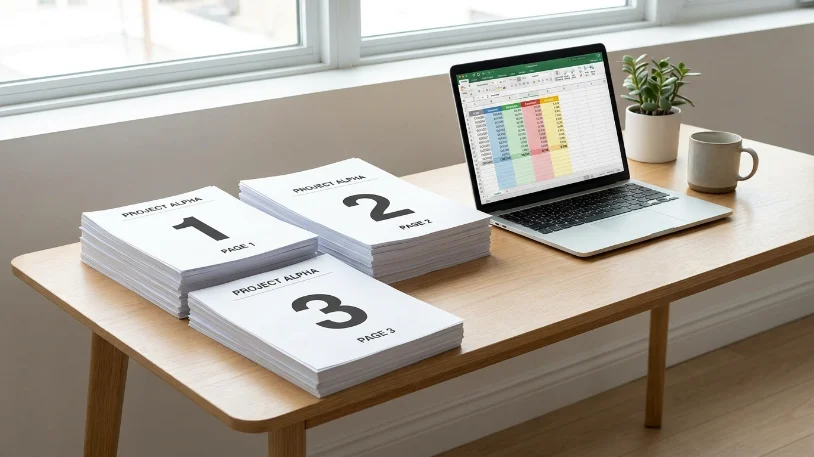
Imagine a 3-page document. You print 3 copies.
Collated Output
- Copy 1: Page 1 → Page 2 → Page 3
- Copy 2: Page 1 → Page 2 → Page 3
- Copy 3: Page 1 → Page 2 → Page 3
Everything comes out ready.
Uncollated Output
- Stack 1: Page 1, Page 1, Page 1
- Stack 2: Page 2, Page 2, Page 2
- Stack 3: Page 3, Page 3, Page 3
Now you have to sort them yourself. That’s annoying. It wastes time.
When Should You Use Each?
Use collate when:
- Printing reports
- Submitting assignments
- Preparing booklets
- Sharing multi-page documents
Use uncollated when:
- Printing handouts page by page
- Distributing single pages to groups
- Saving printer processing time
What Does Collate Mean in Printing? (Full Breakdown)
Printing is where this word shows up most often. It also creates the most confusion.
How Printers Interpret Collate
When you enable collate, your printer:
- Prints complete document sets
- Keeps pages in correct order
- Automatically organizes output
When you disable it:
- Prints identical pages in batches
- Leaves sorting up to you
Step-by-Step Printing Example
Let’s say you have:
- A 5-page document
- You need 4 copies
With Collate ON
Your printer produces:
- Set 1: Pages 1–5
- Set 2: Pages 1–5
- Set 3: Pages 1–5
- Set 4: Pages 1–5
Everything arrives ready.
With Collate OFF
Your printer produces:
- Pages 1 (×4 copies)
- Pages 2 (×4 copies)
- Pages 3 (×4 copies)
- Pages 4 (×4 copies)
- Pages 5 (×4 copies)
Now you must sort manually. That takes time. It also invites mistakes.
Why Collation Matters More Than You Think
Printing errors cost time. They also create stress in high-pressure situations.
Consider these scenarios:
- A student prints a 20-page assignment at the last minute
- An office worker prepares 50 report copies
- A teacher prints exam packets
Without collation, chaos creeps in fast.
Common Printing Mistakes (And How to Avoid Them)
- Forgetting to enable collate
- Assuming printers auto-collate
- Not checking preview settings
- Printing large batches without testing
Quick Fix Checklist
- Always check the “collate” box
- Print one test copy first
- Verify page order visually
What Does Collate Mean in Data and Research?
Now let’s shift gears.
In data and research, collate takes on a deeper meaning. The core idea stays the same. You still gather and arrange. Yet the stakes get higher.
Collate in Data Processing
In data systems, collating means:
- Combining datasets
- Organizing records
- Sorting information logically
Example
You run a survey with 1,000 responses.
Collating means:
- Grouping answers by question
- Sorting by demographics
- Structuring results into readable formats
Why Collation Matters in Data
Without collation:
- Data becomes messy
- Patterns stay hidden
- Insights get lost
With proper collation:
- Trends become visible
- Decisions improve
- Accuracy increases
Real-World Data Collation Example
Imagine a sales team tracking performance.
Raw Data
- Random sales entries
- Mixed regions
- No clear structure
After Collation
- Sorted by region
- Organized by time
- Grouped by product
Now the team can act on insights.
Collation in Research Work
Researchers rely heavily on collation.
Tasks That Require Collation
- Combining multiple studies
- Organizing literature reviews
- Structuring experimental data
Example in Academic Research
A researcher studies climate patterns.
They collate:
- Temperature data
- Rainfall records
- Historical trends
By organizing everything, they uncover patterns that would otherwise stay buried.
What Does Collate Mean in Everyday Use?
Outside technical contexts, the meaning stays practical.
You already collate things daily. You just don’t call it that.
Everyday Examples of Collation
- Organizing receipts by date
- Arranging files in folders
- Structuring meeting notes
- Sorting emails by priority
Simple Analogy
Think of laundry.
- Throwing clothes in a pile = collecting
- Sorting by color and type = collating
That second step makes everything easier later.
Why Collation Makes Life Easier
- Saves time
- Reduces confusion
- Improves productivity
- Prevents mistakes
Synonyms and Related Words (With Context)
Words matter. Using the right one sharpens your communication.
Here’s how “collate” compares to similar terms.
Comparison Table
| Word | Meaning Focus | Best Use Case |
|---|---|---|
| Collate | Arrange in order | Printing, data, documents |
| Compile | Gather information | Reports, research |
| Organize | Structure neatly | General use |
| Arrange | Put in sequence | Physical items |
| Assemble | Bring parts together | Building or grouping |
Key Insight
- Use collate when order matters
- Use compile when collection matters
- Use organize when structure matters
How to Use “Collate” in a Sentence
Let’s make it practical.
Correct Usage Examples
- “Please collate the documents before the meeting.”
- “The printer will collate copies automatically.”
- “She collated survey results into a report.”
- “We need to collate feedback from all departments.”
- “He collated the pages into a complete booklet.”
Incorrect Example (And Fix)
❌ “I collated the papers into a pile.”
✔ “I collected the papers into a pile.”
Why? Collating implies order. A pile has none.
Common Questions About Collate
Does collate mean combine?
Not exactly.
- Combine = put together
- Collate = put together in order
That difference matters.
Is collating the same as sorting?
They overlap. Yet they’re not identical.
- Sorting = arranging based on criteria
- Collating = arranging into a meaningful sequence
Should I turn on collate when printing?
Yes, if:
- You print multi-page documents
- You need ready-to-use copies
Why does my printer default to collate?
Because most users:
- Print multi-page files
- Want organized output
It saves time. It reduces effort.
Collate Settings on Popular Devices
Understanding settings prevents mistakes.
Where to Find Collate Option
Windows
- Open print dialog
- Look for “Collate” checkbox
- Enable or disable
macOS
- Click “Print”
- Expand settings
- Toggle “Collate pages”
Mobile Devices
- Open print preview
- Tap advanced settings
- Toggle collate
What the Checkbox Actually Does
- Checked = prints complete sets
- Unchecked = prints grouped pages
Simple. Yet powerful.
Bonus: When Collation Saves Time (Real Scenarios)
Collation isn’t just a technical term. It’s a time-saving habit.
Real-World Use Cases
Office Work
- Preparing reports
- Organizing documents
- Managing workflows
Education
- Printing assignments
- Structuring research
- Compiling notes
Data Management
- Sorting datasets
- Organizing analytics
- Structuring insights
Personal Productivity
- Managing files
- Organizing finances
- Planning tasks
Final Thought
Collation looks simple on the surface. Yet it drives efficiency everywhere.
When you collate well, you:
- Think clearer
- Work faster
- Avoid errors
And honestly, that small habit can make a big difference.

Sophia Bennett is a professional writer focused on explaining word meanings, expressions and everyday language in a simple and engaging way.