
Last Updated on June 19, 2026
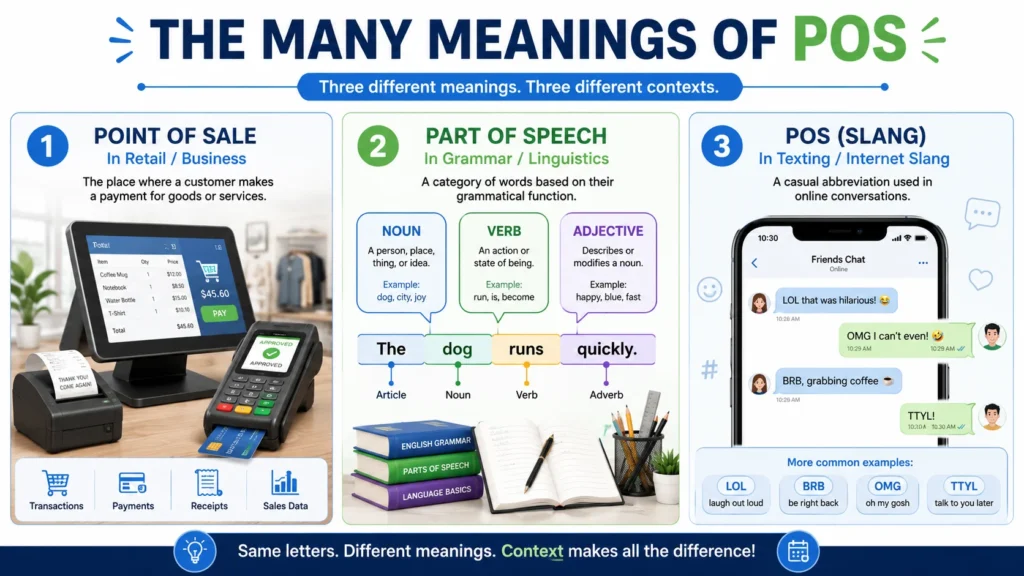
What does POS mean? POS can have several meanings depending on the context. In business and retail, POS stands for Point of Sale, which refers to the place where customer transactions occur. In texting and internet slang, POS often stands for Piece of Sh*t, a negative insult used to describe a person or thing. In grammar and linguistics, POS means Part of Speech, which classifies words as nouns, verbs, adjectives, and other categories. Understanding the surrounding conversation helps determine which POS meaning is being used.
If you’ve seen the acronym POS in a text message, social media post, business document, retail store, or grammar lesson, you may have wondered what it actually means.
The answer isn’t as simple as many people expect.
Unlike some abbreviations that carry a single definition, POS has multiple meanings. The correct interpretation depends entirely on where and how someone uses it.
For example, a cashier discussing payment systems likely means Point of Sale. A teacher explaining sentence structure probably means Part of Speech. Meanwhile, someone venting frustration in a text message could be using POS as slang.
This guide explains every major POS meaning, where people use it, and how to understand the correct definition instantly.
POS Meaning: The Quick Answer
POS is an acronym with several common meanings:
| POS Meaning | Industry or Context | Definition |
|---|---|---|
| Point of Sale | Retail and Business | The place where a customer completes a purchase |
| Piece of Sh*t | Slang and Texting | An insulting term used to criticize someone or something |
| Part of Speech | Grammar and Linguistics | A category of words such as nouns, verbs, and adjectives |
| Point of Service | Healthcare and Services | A location where services are delivered |
| Position | Technology and Data Systems | Refers to placement or location in certain technical contexts |
Among these definitions, Point of Sale, Piece of Sh*t, and Part of Speech are by far the most common.
What Does POS Stand For?
The phrase “What does POS stand for?” appears frequently because the acronym serves multiple industries and communities.
POS can stand for:
- Point of Sale
- Piece of Sh*t
- Part of Speech
- Point of Service
- Position
- Positive Operating System (rare)
- Purchase Order System (rare organizational usage)
The intended meaning becomes clear when you examine the surrounding words.
For example:
- “The POS system stopped processing payments.” → Point of Sale
- “He’s such a POS.” → Piece of Sh*t
- “A noun is a POS category.” → Part of Speech
Context is everything.
POS Meaning in Retail and Business
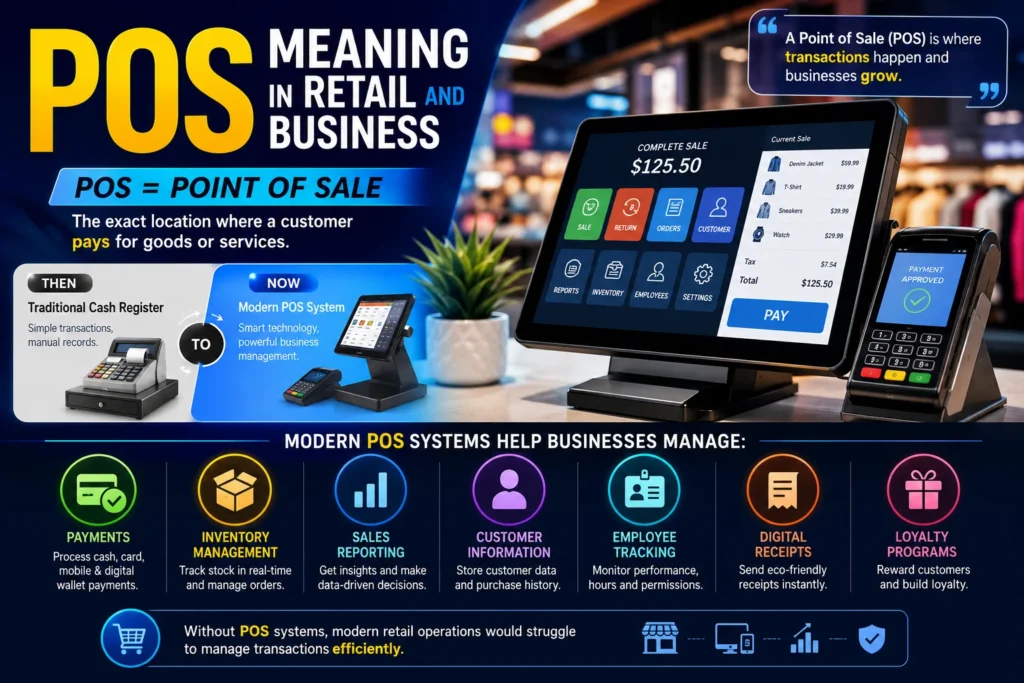
In business environments, POS almost always means Point of Sale.
A Point of Sale is the exact location where a customer pays for goods or services.
Traditionally, this was a cash register at the front of a store.
Today, POS technology includes sophisticated software and hardware that handle:
- Payments
- Inventory management
- Sales reporting
- Customer information
- Employee tracking
- Digital receipts
- Loyalty programs
Without POS systems, modern retail operations would struggle to manage transactions efficiently.
What Is a Point of Sale?
A Point of Sale refers to the place where a commercial transaction occurs.
Whenever a customer purchases an item from a store, restaurant, or online business, the POS system records and processes that transaction.
Think of it as the command center of retail operations.
The system tracks:
- Products sold
- Prices
- Taxes
- Discounts
- Inventory levels
- Payment methods
Every purchase flows through the POS platform.
How POS Systems Work
A POS system follows a straightforward process.
- Customer selects products
- Items are scanned or entered
- Total amount is calculated
- Taxes and discounts are applied
- Payment is processed
- Receipt is generated
- Inventory updates automatically
Modern systems complete this process within seconds.
Components of a POS System
A complete POS setup usually includes both hardware and software.
| Hardware | Purpose |
|---|---|
| POS Terminal | Main transaction device |
| Barcode Scanner | Reads product information |
| Receipt Printer | Produces receipts |
| Cash Drawer | Stores cash payments |
| Card Reader | Processes card transactions |
| Customer Display | Shows purchase details |
Software manages the digital side of the operation.
Common software functions include:
- Sales management
- Inventory tracking
- Customer relationship management
- Reporting tools
- Employee scheduling
- Analytics dashboards
Why Businesses Use POS Systems
Businesses depend on POS technology because it saves time and improves accuracy.
Benefits include:
- Faster checkout experiences
- Better inventory control
- Reduced human error
- Detailed sales reporting
- Improved customer service
- Easier tax reporting
For many retailers, the POS system acts as the brain of the business.
Types of POS Systems
Different businesses require different POS solutions.
Retail POS
Designed for:
- Clothing stores
- Grocery stores
- Electronics retailers
- Specialty shops
Focuses heavily on inventory management and product sales.
Restaurant POS
Built specifically for:
- Restaurants
- Cafes
- Food trucks
- Bars
Features include:
- Table management
- Kitchen order routing
- Tip tracking
- Split payments
Mobile POS
Mobile POS systems operate through:
- Smartphones
- Tablets
- Portable terminals
They’re popular among:
- Pop-up shops
- Market vendors
- Delivery services
Cloud-Based POS
Cloud POS solutions store information online.
Advantages include:
- Remote access
- Automatic updates
- Data backup
- Multi-location management
Many modern businesses prefer cloud-based systems because of their flexibility.
POS in E-Commerce
Online stores also use POS technology.
Although there isn’t a physical checkout counter, the e-commerce platform still performs Point of Sale functions.
Online POS systems handle:
- Shopping carts
- Payment gateways
- Order management
- Customer accounts
- Digital receipts
Every online purchase passes through a virtual POS environment.
Examples of POS in Business Conversations
Here are common examples:
- “The POS terminal needs an update.”
- “Our POS software tracks inventory automatically.”
- “The POS machine isn’t accepting cards.”
- “The retailer upgraded its POS system.”
- “Sales reports come directly from the POS dashboard.”
In all these examples, POS means Point of Sale.
What Is a POS Terminal?
A POS terminal is the physical device that processes customer transactions.
Years ago, a cash register handled most retail purchases.
Today’s terminals are far more advanced.
They can:
- Accept credit cards
- Process debit cards
- Handle digital wallets
- Print receipts
- Track inventory
- Connect with business software
Modern POS terminals often include touchscreen interfaces that simplify checkout procedures.
POS Terminal vs Cash Register
Many people confuse these two concepts.
Here’s the difference:
| Feature | Cash Register | POS Terminal |
|---|---|---|
| Accepts Payments | Yes | Yes |
| Tracks Inventory | No | Yes |
| Generates Reports | Limited | Extensive |
| Customer Data | No | Yes |
| Cloud Access | No | Yes |
| Analytics | No | Yes |
A POS terminal performs everything a cash register does and much more.
POS and Digital Payments
The rise of electronic payments transformed POS technology.
Modern systems support:
- Credit cards
- Debit cards
- Mobile wallets
- Contactless payments
- QR code payments
- Gift cards
As digital transactions continue growing, POS systems remain central to commerce.
POS Meaning in Banking and Payment Processing
Banks and payment processors frequently use POS terminology.
In banking, POS often refers to transactions completed through payment terminals.
For example:
- POS transaction
- POS purchase
- POS payment
- POS authorization
When you swipe, tap, or insert a card at a merchant location, the bank may categorize the activity as a POS transaction.
A bank statement might display:
POS Purchase: Grocery Store
In this case, POS identifies a transaction completed at a Point of Sale terminal.
Why Banks Use POS Codes
Financial institutions categorize transactions to improve tracking.
POS transaction labels help identify:
- Merchant purchases
- Payment terminal activity
- Card-present transactions
- Retail spending patterns
This classification helps both banks and customers monitor account activity.
What Does POS Mean in Texting?
Outside the business world, POS often takes on a completely different meaning.
In texting, messaging apps, online forums, and social media conversations, POS frequently stands for “Piece of Sh*t.”
This slang abbreviation is usually used as an insult.
People use it when expressing anger, disappointment, frustration, or strong dislike toward a person, object, situation, or behavior.
Because the phrase contains profanity, many users shorten it to POS instead of spelling out the full expression.
POS Meaning in Text Messages
When someone sends POS in a text conversation, they are usually criticizing something.
Examples include:
- “That car is a POS.”
- “My old laptop turned into a POS.”
- “He’s a complete POS for doing that.”
- “This app is a POS after the latest update.”
In each example, POS expresses dissatisfaction or contempt.
The term carries a strongly negative tone.
Why People Use POS Instead of the Full Phrase
Several reasons explain why POS became popular in texting language.
People use abbreviations because they:
- Save time
- Require fewer keystrokes
- Avoid writing profanity directly
- Make messages shorter
- Fit naturally into internet slang
The internet has always encouraged shorthand communication.
POS follows the same pattern as many other messaging acronyms.
Is POS Offensive?
Yes.
POS is generally considered offensive because it originates from a vulgar phrase.
The severity depends on:
- The relationship between speakers
- The context
- The intended tone
- The platform where it appears
Friends may use it jokingly.
Strangers may interpret it as highly insulting.
Because of that, it’s important to understand the audience before using the term.
Examples of POS in Text Conversations
Here are examples showing how people use POS in everyday messaging.
Example 1
Person A:
“Did your phone finally stop freezing?”
Person B:
“Yeah. That POS died this morning.”
Example 2
Person A:
“What happened with your ex?”
Person B:
“Turns out he’s a POS.”
Example 3
Person A:
“How was the used car?”
Person B:
“It looked great online but it was a POS.”
The surrounding conversation makes the intended meaning obvious.
POS in Group Chats
Group chats often contain abbreviations because conversations move quickly.
In fast-paced discussions, someone might write:
- “That movie was a POS.”
- “The service was POS-level bad.”
- “That scammer is a POS.”
The abbreviation helps users communicate strong opinions efficiently.
POS Meaning in Slang
When discussing internet slang, POS almost always refers to the insulting phrase.
The slang version gained popularity through:
- Text messaging
- Online gaming
- Social media
- Discussion forums
- Meme culture
- Internet communities
Today, millions of users recognize POS as a negative slang expression.
How POS Became Popular Online
Internet culture thrives on abbreviations.
As online communication evolved, users began shortening longer expressions.
POS spread because:
- It was easy to type
- It conveyed strong emotion
- Most internet users understood it
- It worked across different platforms
Over time, the acronym became part of common digital vocabulary.
Common Situations Where POS Is Used
People frequently use POS when discussing:
Poor Products
Examples:
- Broken electronics
- Low-quality appliances
- Faulty vehicles
- Unreliable software
Bad Behavior
Examples:
- Scammers
- Dishonest people
- Manipulative individuals
- Criminal activity
Frustrating Situations
Examples:
- Terrible customer service
- Defective products
- Failed transactions
- Broken technology
In each situation, POS communicates strong disapproval.
POS Compared to Other Slang Terms
| Term | Meaning | Tone |
|---|---|---|
| POS | Piece of Sh*t | Strongly negative |
| L | Loss or failure | Mild |
| Trash | Poor quality | Negative |
| Mid | Average | Mild criticism |
| Garbage | Very poor quality | Negative |
| Clown | Foolish person | Humorous insult |
POS typically carries a harsher tone than many other internet slang expressions.
Is POS Used by Younger Generations?
Yes.
POS appears frequently among:
- Teenagers
- Young adults
- Gamers
- Social media users
- Online communities
However, the abbreviation isn’t limited to younger audiences.
Adults also use it in text conversations and online discussions.
POS Meaning on Social Media
Social networking platforms helped spread POS to a wider audience.
You may encounter it on:
- TikTok
- X
- Discord
- Snapchat
The meaning usually depends on the topic being discussed.
POS Meaning on TikTok
TikTok users often use POS when commenting on:
- Viral videos
- Public figures
- Product reviews
- Relationship stories
Examples:
- “That guy is a POS.”
- “This product is a POS.”
- “The scammer in this video is a POS.”
The abbreviation allows users to express criticism without writing the entire phrase.
POS Meaning on Snapchat
Snapchat conversations tend to be casual and fast.
POS commonly appears in:
- Direct messages
- Story replies
- Group chats
The slang meaning remains the most common interpretation.
POS Meaning on Instagram
Instagram users often write POS in:
- Comments
- Captions
- Direct messages
Examples include:
- Product complaints
- Customer service criticism
- Reactions to controversial content
Again, context determines the meaning.
POS Meaning on Reddit and Online Forums
Discussion communities often use POS when debating:
- News stories
- Consumer products
- Public behavior
- Customer experiences
Since forum discussions can become emotional, POS appears frequently as a shorthand insult.
POS Meaning in Online Chat
Online chat environments create ideal conditions for abbreviations.
Whether someone is chatting in a game, community server, workplace platform, or messaging app, POS can appear unexpectedly.
POS in Gaming Communities
Gamers often use POS to describe:
- Broken equipment
- Poor teammates
- Faulty hardware
- Unfair game mechanics
Examples:
- “This controller is a POS.”
- “That hacker is a POS.”
- “The update turned the game into a POS.”
POS in Messaging Apps
Messaging applications such as:
- Messenger
- Telegram
- Discord
frequently feature abbreviations because users want to communicate quickly.
POS remains one of the more recognizable negative acronyms.
How to Understand POS in Chat
Ask yourself three questions:
- Is the conversation about retail or payments?
- Is the discussion about grammar or language?
- Is someone expressing frustration or criticism?
If frustration is present, POS likely refers to the slang meaning.
Different Meanings of POS Depending on Context
One reason people search for POS meaning is because the acronym appears in multiple industries.
The same three letters can mean entirely different things.
Quick Context Guide
| Context | Meaning |
|---|---|
| Retail Store | Point of Sale |
| Restaurant | Point of Sale |
| Banking | Point of Sale |
| Text Message | Piece of Sh*t |
| Social Media | Piece of Sh*t |
| Online Chat | Piece of Sh*t |
| Grammar Lesson | Part of Speech |
| Linguistics | Part of Speech |
| Language Learning | Part of Speech |
This simple table helps eliminate confusion.
Real-Life Context Examples
Retail Example
“Our POS system crashed during checkout.”
Meaning:
Point of Sale.
Grammar Example
“The teacher explained each POS category.”
Meaning:
Part of Speech.
“That mechanic is a POS.”
Meaning:
Piece of Sh*t.
The surrounding words reveal the correct interpretation.
How Can You Tell Which POS Meaning Is Being Used?
Context clues provide the answer.
Look for keywords around the acronym.
Clues That POS Means Point of Sale
Look for words such as:
- Store
- Checkout
- Payment
- Inventory
- Retail
- Customer
- Terminal
- Transaction
Clues That POS Means Piece of Sh*t
Look for words such as:
- Terrible
- Awful
- Scam
- Hate
- Broken
- Garbage
- Useless
- Bad
Clues That POS Means Part of Speech
Look for words such as:
- Grammar
- Noun
- Verb
- Adjective
- Language
- Sentence
- Linguistics
- Syntax
These clues make interpretation much easier.
Why POS Causes Confusion
Some acronyms have only one widely accepted definition.
POS is different.
It exists in:
- Business terminology
- Retail technology
- Banking
- Internet slang
- Social media culture
- Linguistics
- Education
Because these industries overlap online, users often encounter POS without enough context.
For example:
“I learned about POS today.”
Without additional information, it’s impossible to know whether the speaker means retail systems, grammar categories, or slang terminology.
That ambiguity explains why so many people search for the meaning of POS.
POS Meaning in Grammar
Another important definition of POS appears in grammar, linguistics, and language studies.
In these fields, POS stands for Part of Speech.
A Part of Speech is a category that groups words according to how they function in a sentence.
Every language contains parts of speech. They help speakers and writers understand sentence structure, meaning, and communication.
If you’ve ever studied English grammar, you’ve already encountered POS categories.
What Is a Part of Speech?
A Part of Speech identifies the role a word plays within a sentence.
For example:
- Nouns name people, places, or things.
- Verbs describe actions or states.
- Adjectives describe nouns.
- Adverbs modify verbs, adjectives, or other adverbs.
Linguists use POS classification to analyze language more effectively.
Main Parts of Speech in English
| Part of Speech | Function | Example |
|---|---|---|
| Noun | Names a person, place, thing, or idea | Dog, city, happiness |
| Verb | Shows action or state | Run, think, is |
| Adjective | Describes a noun | Happy, large, blue |
| Adverb | Modifies verbs or adjectives | Quickly, very |
| Pronoun | Replaces a noun | He, she, they |
| Preposition | Shows relationships | In, on, under |
| Conjunction | Connects words or clauses | And, but, because |
| Interjection | Expresses emotion | Wow!, Ouch! |
These categories form the foundation of English grammar.
Why POS Matters in Grammar
Understanding Parts of Speech helps people:
- Write clearly
- Improve sentence structure
- Learn new languages
- Understand grammar rules
- Develop communication skills
Teachers, students, editors, and language researchers rely on POS classification every day.
POS in Linguistics
Modern linguistics uses POS tagging to analyze language patterns.
Researchers examine large collections of text and assign Part of Speech labels to individual words.
For example:
| Word | POS Tag |
|---|---|
| The | Determiner |
| Cat | Noun |
| Runs | Verb |
| Quickly | Adverb |
This process helps linguists study how language works across millions of sentences.
POS Tagging in Technology
Computer systems also use POS tagging.
Applications include:
- Search engines
- Translation software
- Speech recognition
- Artificial intelligence
- Natural language processing
When a computer understands whether a word functions as a noun or verb, it can interpret text more accurately.
POS Meaning in Technology
Technology professionals sometimes use POS in ways that differ from both slang and retail terminology.
Most commonly, technology discussions reference POS systems because modern commerce depends heavily on software and hardware integration.
POS Technology in Modern Business
Today’s POS technology combines:
- Payment processing
- Inventory management
- Customer databases
- Reporting dashboards
- Employee management
- E-commerce integration
The result is a centralized business management platform.
Electronic Point of Sale Systems
Electronic Point of Sale systems, often called EPOS systems, represent an advanced version of traditional checkout solutions.
Features typically include:
- Touchscreen interfaces
- Cloud synchronization
- Inventory automation
- Customer loyalty programs
- Sales analytics
Many retailers have transitioned from traditional cash registers to EPOS technology because it improves efficiency.
POS Software
POS software controls the entire transaction process.
Common functions include:
- Product management
- Pricing control
- Tax calculations
- Sales reporting
- Customer tracking
Businesses use this software to streamline daily operations.
POS Hardware
Hardware components support software functionality.
Common examples include:
| Hardware Device | Purpose |
|---|---|
| Barcode Scanner | Reads product information |
| Receipt Printer | Produces customer receipts |
| Card Reader | Processes electronic payments |
| Cash Drawer | Stores cash |
| Customer Display | Shows purchase details |
| POS Terminal | Central checkout device |
Together, these components create a complete Point of Sale environment.
POS Meaning in Business
In business discussions, POS almost always refers to Point of Sale.
The term plays a critical role in commerce because every customer purchase passes through some type of POS process.
Why POS Is Important for Businesses
Businesses depend on POS systems to:
- Process payments
- Track sales
- Monitor inventory
- Generate reports
- Manage customer data
- Improve efficiency
Without a POS system, managing transactions becomes significantly more difficult.
Industries That Use POS Systems
Many industries rely on POS technology.
Examples include:
- Retail stores
- Restaurants
- Cafes
- Hotels
- Pharmacies
- Grocery stores
- Beauty salons
- Service businesses
Any business that accepts customer payments can benefit from a POS system.
Benefits of Modern POS Solutions
Modern POS platforms provide:
- Faster transactions
- Better customer experiences
- Real-time reporting
- Inventory accuracy
- Reduced administrative work
These advantages help businesses operate more effectively in competitive markets.
POS Meaning in Retail
Retail represents the environment most closely associated with POS.
Whenever a customer purchases a product from a store, the transaction occurs at a Point of Sale.
The Role of POS in Retail Operations
A retail POS system performs several critical functions.
It:
- Processes purchases
- Updates inventory
- Applies discounts
- Calculates taxes
- Records transaction history
- Generates receipts
Retailers use POS data to make informed business decisions.
Retail POS vs Traditional Cash Registers
Traditional cash registers primarily handled payment collection.
Modern POS systems go much further.
| Feature | Traditional Register | Retail POS System |
|---|---|---|
| Accept Payments | Yes | Yes |
| Track Inventory | No | Yes |
| Customer Profiles | No | Yes |
| Sales Reports | Limited | Advanced |
| Cloud Storage | No | Yes |
| Analytics | No | Yes |
The evolution of retail technology transformed POS into a comprehensive management tool.
POS Meaning Comparison Table
Because POS has multiple definitions, a side-by-side comparison can be helpful.
| Meaning | Full Form | Context | Common Usage |
|---|---|---|---|
| POS | Point of Sale | Retail and Business | Checkout systems and payments |
| POS | Piece of Sh*t | Slang and Texting | Negative insult |
| POS | Part of Speech | Grammar and Linguistics | Language classification |
| POS | Point of Service | Healthcare and Services | Service delivery locations |
This comparison highlights why context matters so much.
Most Common Examples of POS Usage
The following examples demonstrate how POS changes meaning depending on the situation.
Business Example
“The POS system generated today’s sales report.”
Meaning:
Point of Sale.
Retail Example
“The cashier restarted the POS terminal.”
Meaning:
Point of Sale.
Banking Example
“The statement shows a POS transaction.”
Meaning:
Point of Sale purchase.
Texting Example
“That old computer is a POS.”
Meaning:
Piece of Sh*t.
Social Media Example
“People think that influencer is a POS.”
Meaning:
Piece of Sh*t.
Grammar Example
“Verbs are an important POS category.”
Meaning:
Part of Speech.
Common Mistakes People Make When Interpreting POS
Many misunderstandings occur because people assume POS has only one definition.
Assuming the Slang Meaning Everywhere
A business article mentioning POS usually refers to Point of Sale, not slang.
Assuming the Retail Meaning Everywhere
In texting conversations, POS often has nothing to do with payment systems.
Ignoring Context Clues
Words surrounding the acronym usually reveal the intended meaning immediately.
Forgetting Grammar Usage
Students frequently encounter POS as Part of Speech in language classes.
Understanding all major definitions prevents confusion.
Frequently Asked Questions
What Does POS Stand For?
POS can stand for:
- Point of Sale
- Piece of Sh*t
- Part of Speech
- Point of Service
The intended meaning depends on context.
What Does POS Mean in a Text?
In texting, POS usually means Piece of Sh*t, a negative slang term used to criticize a person, object, or situation.
Is POS a Slang Term?
Yes. POS is a common internet slang abbreviation when it stands for Piece of Sh*t.
What Does POS Mean in Retail?
In retail, POS means Point of Sale, the location where customer transactions take place.
What Is a POS System?
A POS system is a combination of software and hardware that processes sales transactions, manages inventory, and tracks business operations.
What Does POS Mean on Social Media?
On social media, POS most often refers to the slang meaning Piece of Sh*t. However, business-related content may use Point of Sale instead.
Why Do People Use POS in Messages?
People use POS because it shortens a longer phrase and allows faster communication in texts, chats, and online discussions.
Does POS Have Multiple Meanings?
Yes. POS has several meanings including Point of Sale, Piece of Sh*t, Part of Speech, and Point of Service.
What Does POS Mean in Business?
In business environments, POS almost always means Point of Sale.
How Can I Tell Which POS Meaning Is Being Used?
Look at surrounding words and the topic being discussed.
- Payments and stores → Point of Sale
- Grammar and language → Part of Speech
- Criticism or insults → Piece of Sh*t
Context provides the answer.
Final Thoughts
So, what does POS mean?
The answer depends entirely on context.
In retail, business, banking, and commerce, POS stands for Point of Sale. It refers to the systems and locations where customer transactions occur.
In texting, social media, online chat, and internet slang, POS usually means Piece of Sh*t, an insulting expression used to show strong dissatisfaction or criticism.
In grammar and linguistics, POS means Part of Speech, a classification system that groups words according to their function within a sentence.
Although the acronym contains only three letters, it carries several widely used meanings across different industries and communities.
Whenever you encounter POS, take a moment to examine the surrounding conversation. A quick look at the context will almost always reveal the correct interpretation.

Michael Anderson is a content writer specializing in word meanings, definitions and clear explanations of modern terms and phrases.