Last Updated on June 18, 2026
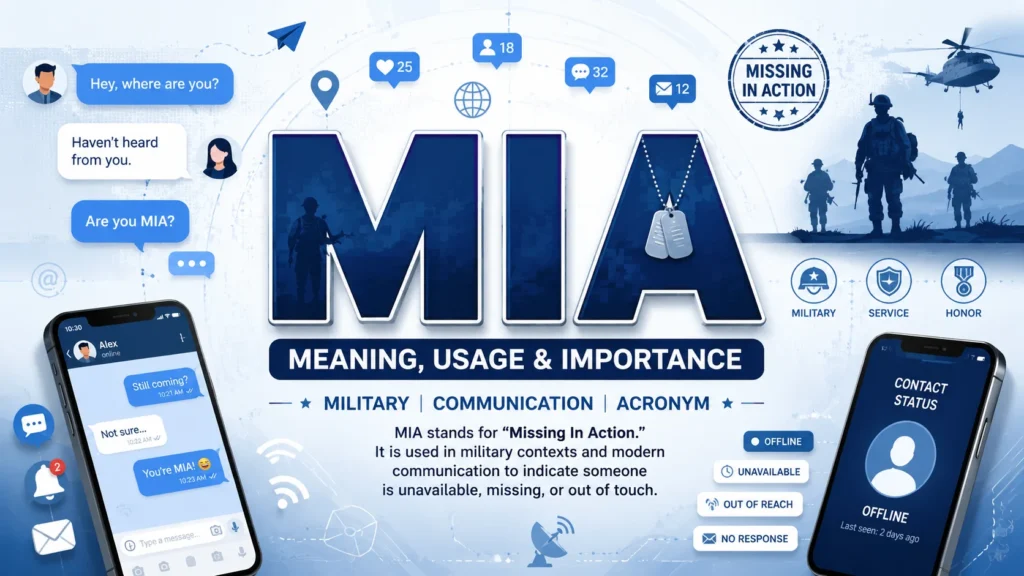
MIA stands for “Missing In Action.” The term originally comes from military terminology and refers to a service member whose whereabouts are unknown during military operations. In modern everyday language, MIA also means someone is absent, unavailable, unreachable, or suddenly not responding. People commonly use MIA in texting, social media, relationships, work, and online conversations to describe someone who has disappeared from communication for a period of time.
The term MIA appears everywhere today. You might see it in text messages, social media comments, workplace conversations, online chats, or news reports. Someone stops replying for days and a friend says, “You’ve been MIA.” A coworker misses meetings and people joke that they’re MIA. Meanwhile, military reports use the exact same abbreviation in a much more serious context.
So what does MIA mean exactly?
The answer depends on the situation. While the phrase started as a military classification, its meaning expanded into everyday language. Today, millions of people use MIA to describe someone who has temporarily disappeared, become unreachable, or stopped communicating.
Understanding the meaning of MIA helps you interpret conversations correctly and use the abbreviation naturally in different situations.
What Does MIA Mean?
The most common answer to what does MIA mean is:
MIA = Missing In Action
In its original military sense, MIA refers to a service member whose location or status is unknown during military operations.
However, modern usage has broadened significantly.
Today, people often use MIA to describe someone who:
- Has disappeared temporarily
- Is not responding to messages
- Cannot be reached
- Has stopped posting online
- Is absent without explanation
- Has gone off the radar
- Is unavailable for a period of time
Quick Definition of MIA
| Term | Meaning |
|---|---|
| MIA | Missing In Action |
| MIA Meaning in Slang | Absent or unreachable |
| MIA Meaning in Text | Not responding or disappeared |
| MIA Meaning on Social Media | Inactive or absent online |
| MIA Military Meaning | Service member whose whereabouts are unknown |
In everyday conversations, MIA rarely implies actual danger. Most people simply use it as shorthand for someone who has vanished from communication.
Simple Example
Text Message:
“You’ve been MIA all week. Everything okay?”
Meaning:
The person has not been communicating or responding recently.
MIA Full Form and MIA Definition
What Is the Full Form of MIA?
The MIA full form is:
Missing In Action
The phrase originated within military organizations to classify personnel whose location could not be confirmed during combat operations.
Over time, the abbreviation entered mainstream language and developed additional meanings in casual conversation.
Official MIA Definition
The traditional MIA definition refers to:
A military service member whose status or whereabouts are unknown during military operations.
This classification does not automatically mean the person is dead. It simply means authorities cannot determine their location or condition.
Because of that uncertainty, MIA status has historically carried tremendous emotional significance for families and military organizations.
Modern Definition of MIA
In modern English, MIA often means:
Temporarily absent, unavailable, unreachable, or missing from communication.
Examples include:
- Not answering texts
- Ignoring calls
- Taking a social media break
- Missing work temporarily
- Avoiding communication
The modern version is usually informal and non-serious.
Missing In Action Meaning Explained
To fully understand MIA, it helps to examine the phrase behind the abbreviation.
Breaking Down the Phrase
Missing
Means someone cannot currently be located.
In
Indicates a particular circumstance or situation.
Action
Refers to military activity, combat operations, or battlefield engagement.
Combined together:
Missing In Action means a person involved in military operations whose whereabouts are unknown.
Why the Phrase Matters
Military organizations need precise categories when tracking personnel.
Different classifications include:
| Status | Meaning |
|---|---|
| Active Duty | Currently serving |
| KIA | Killed In Action |
| WIA | Wounded In Action |
| POW | Prisoner of War |
| MIA | Missing In Action |
Each category communicates a specific situation.
MIA occupies a unique place because it reflects uncertainty rather than a confirmed outcome.
Emotional Weight of MIA
Unlike many modern slang abbreviations, MIA has serious historical roots.
For military families, the designation often meant:
- Waiting for answers
- Uncertainty about loved ones
- Ongoing investigations
- Hope mixed with fear
That historical significance remains part of the term’s identity today.
The History and Origin of MIA
Many internet users assume MIA originated as modern slang. In reality, the term predates social media by decades.
Early Military Origins
Military organizations have long needed systems for tracking personnel during conflicts.
As warfare became increasingly complex, armed forces developed standardized classifications for soldiers whose status could not be confirmed.
The phrase “Missing In Action” gained widespread recognition during major twentieth-century conflicts.
Growth During Major Wars
The term became especially prominent during:
- World War I
- World War II
- Korean War
- Vietnam War
In these conflicts, battlefield conditions sometimes made it impossible to determine the fate of service members immediately.
As a result, thousands of personnel received MIA status while investigations continued.
Public Awareness
News coverage brought the term into public consciousness.
Families, journalists, and government agencies frequently discussed military personnel listed as Missing In Action.
Eventually, the abbreviation MIA became recognizable even outside military circles.
Transition Into Everyday Language
Language evolves constantly.
People began borrowing military terminology for casual situations.
Someone who vanished from social events became “MIA.”
A friend who stopped responding became “MIA.”
A coworker who disappeared for several days became “MIA.”
This shift transformed MIA from a formal military classification into a widely used slang expression.
MIA Meaning in Military Terms
The military meaning remains the original and most official definition of MIA.
What Does MIA Mean in the Military?
In military terminology, MIA indicates:
A service member whose whereabouts, status, or condition cannot be confirmed during military operations.
This designation is not assigned casually.
Military authorities conduct extensive investigations before making determinations regarding personnel status.
Situations That May Lead to MIA Status
A service member may be classified as MIA if:
- Contact is lost during combat
- A mission ends without accountability for all personnel
- Aircraft disappear during operations
- Personnel become separated from units
- Evidence is insufficient to determine outcomes
Important Facts About MIA Status
Many people misunderstand MIA classification.
Here are several important facts:
| Fact | Explanation |
|---|---|
| MIA does not mean dead | Status remains uncertain |
| MIA does not mean captured | Capture may not be confirmed |
| MIA requires investigation | Authorities gather evidence continuously |
| MIA status can change | New information may emerge later |
| MIA cases may remain open for years | Some investigations continue for decades |
Military Personnel Recovery Efforts
Governments often dedicate significant resources to locating missing personnel.
These efforts may include:
- Archival research
- Witness interviews
- Battlefield investigations
- DNA identification
- International cooperation
The goal is to provide answers whenever possible.
Why MIA Matters
For military organizations, accountability is critical.
Every service member deserves recognition and investigation when their status becomes uncertain.
That principle continues to guide military recovery efforts around the world.
MIA Status Meaning
The phrase MIA status refers specifically to the condition of being classified as Missing In Action.
What Does MIA Status Mean?
MIA status means authorities cannot currently determine:
- A person’s exact location
- Their condition
- Their outcome
- Their whereabouts
This status remains active until additional evidence becomes available.
Temporary Versus Long-Term Status
Some MIA cases resolve quickly.
Others remain unresolved for years.
Possible outcomes include:
- Located safely
- Identified through investigation
- Reclassified based on evidence
- Continued unresolved status
Why Status Classifications Matter
Military systems rely on clear classifications because uncertainty creates operational and administrative challenges.
Status categories help:
- Track personnel
- Notify families
- Organize investigations
- Maintain records
- Coordinate recovery efforts
MIA vs AWOL Meaning: What’s the Difference?
People frequently confuse MIA with AWOL.
Although both involve absence, they mean completely different things.
What Does AWOL Mean?
AWOL stands for:
Absent Without Leave
This designation applies when a military member leaves duty without authorization.
MIA vs AWOL Comparison
| Term | Full Form | Meaning |
|---|---|---|
| MIA | Missing In Action | Whereabouts unknown during operations |
| AWOL | Absent Without Leave | Unauthorized absence from duty |
Key Difference
The distinction is simple:
MIA involves uncertainty.
Authorities do not know where the person is.
AWOL involves unauthorized absence.
The individual intentionally left without permission.
Example of MIA
A service member loses contact during a combat mission.
Their location cannot be confirmed.
Result:
MIA
Example of AWOL
A service member leaves their assigned post without authorization.
Their absence is voluntary.
Result:
AWOL
Why People Confuse Them
Both terms involve someone being absent.
However, the circumstances differ dramatically.
MIA concerns unknown whereabouts during operations.
AWOL concerns violating military regulations by leaving duty without permission.
Understanding this distinction helps avoid one of the most common misconceptions surrounding the MIA acronym.
MIA Meaning in Texting
The most common modern use of MIA appears in text messages. If you’ve ever received a message saying, “Where have you been? You’ve been MIA,” the sender probably wasn’t talking about military terminology.
In texting, MIA usually means someone has been absent from communication for a noticeable period.
People use it when a person:
- Stops replying to messages
- Takes a break from conversations
- Disappears from group chats
- Becomes difficult to reach
- Suddenly goes quiet online
What Does MIA Mean in Text?
The MIA meaning in text is typically:
Unavailable, absent, unreachable, or not responding.
Unlike the military definition, texting usage is informal and often playful.
Examples of MIA in Text Messages
Example 1
Person A:
“Haven’t heard from you in days.”
Person B:
“Sorry, I’ve been MIA this week.”
Meaning:
The person has been unavailable or inactive.
Example 2
“Jake has been MIA since the weekend.”
Meaning:
Jake has not been responding or communicating.
Example 3
“Why are you so MIA lately?”
Meaning:
Why have you been absent or hard to reach?
Why Texting Users Love MIA
Text messaging encourages short communication.
Instead of saying:
“You haven’t responded to anyone and you’ve been unavailable for several days.”
People simply say:
“You’ve been MIA.”
The abbreviation is quick, recognizable, and easy to understand.
MIA Meaning in Chat and Online Conversations
Online communication has expanded the use of MIA even further.
Gaming communities, forums, workplace chats, and messaging apps all use the term regularly.
What Does MIA Mean in Chat?
In chat conversations, MIA generally means:
Someone disappeared from the conversation or became inactive.
The absence may last:
- A few minutes
- Several hours
- Days
- Weeks
- Even months
The length depends on the context.
Common Chat Situations
| Situation | Meaning of MIA |
|---|---|
| Group chat | Not participating |
| Gaming chat | Player disappeared |
| Work chat | Employee inactive |
| Friend group | Person stopped responding |
| Online community | Member became absent |
Example in a Group Chat
“Sarah went MIA halfway through the discussion.”
Meaning:
Sarah suddenly stopped participating.
Example in Gaming
“Our teammate went MIA before the final round.”
Meaning:
The player disappeared or disconnected unexpectedly.
MIA in Workplace Messaging Apps
Remote work has made this usage even more common.
Employees may jokingly say:
“Sorry, I was MIA during lunch.”
Or:
“The IT guy has been MIA all morning.”
Here, MIA simply means unavailable.
MIA Slang Meaning
The slang version of MIA differs slightly from its military roots.
What Is MIA Slang Meaning?
In slang, MIA means:
Someone disappeared, vanished, stopped communicating, or became unavailable.
The phrase often carries a casual tone.
Common Slang Interpretations
MIA may suggest that someone:
- Ghosted temporarily
- Took a break
- Went silent
- Avoided communication
- Became inactive online
- Dropped out of conversations
Popular Slang Examples
“You’ve been MIA lately.”
“My best friend went MIA after graduation.”
“He disappeared and went completely MIA.”
“She’s been MIA on social media.”
Is MIA Always Negative?
Not necessarily.
Sometimes MIA simply means someone is busy.
For example:
“I’ve been MIA because of work.”
Other times it can imply frustration.
For example:
“You went MIA when everyone needed help.”
Context determines the tone.
MIA Meaning on Social Media
Social media platforms have helped popularize MIA among younger users.
When someone suddenly stops posting, commenting, or engaging online, people often describe them as MIA.
What Does MIA Mean on Social Media?
The phrase generally means:
Someone has become inactive or disappeared from online activity.
Signs Someone Is MIA Online
They may:
- Stop posting updates
- Stop commenting
- Ignore direct messages
- Disappear from stories
- Become inactive across platforms
Why People Go MIA on Social Media
There are many reasons.
Common examples include:
- Digital detoxes
- Busy schedules
- School commitments
- Work obligations
- Family responsibilities
- Mental breaks
- Vacations
Being MIA online doesn’t automatically indicate a problem.
Many people intentionally reduce their online activity.
Social Media Usage Example
“She’s been MIA from social media for months.”
Meaning:
She has not been active online for a long period.
MIA Meaning on Snapchat
Snapchat users frequently use MIA when discussing inactive friends.
What Does MIA Mean on Snapchat?
On Snapchat, MIA typically means:
Someone stopped sending snaps, viewing stories, or replying to messages.
Common Snapchat Scenarios
A user may be called MIA when they:
- Stop maintaining Snap streaks
- Ignore chats
- Stop opening messages
- Disappear from activity
Example
“My streak partner has gone MIA.”
Meaning:
The person stopped participating on Snapchat.
MIA Meaning on Instagram
Instagram users often describe inactive accounts as MIA.
What Does MIA Mean on Instagram?
The phrase usually means:
Someone stopped posting, commenting, or interacting on Instagram.
Typical Examples
“She’s been MIA on Instagram lately.”
“The creator went MIA after their last post.”
“He’s completely MIA from the platform.”
In each case, the person has become inactive or difficult to reach.
MIA Meaning on TikTok
TikTok creators and viewers frequently use the term when someone suddenly stops uploading content.
What Does MIA Mean on TikTok?
It means:
A creator or user has disappeared from regular activity.
Example
“That TikToker has been MIA for three weeks.”
Meaning:
The creator hasn’t posted content recently.
Why TikTok Users Go MIA
Common reasons include:
- Burnout
- Vacation
- Content planning
- Personal issues
- Work commitments
- Academic schedules
Many creators eventually return after a temporary break.
MIA Meaning on WhatsApp
WhatsApp conversations frequently include MIA references.
What Does MIA Mean in WhatsApp Messages?
It usually means:
Someone stopped replying or became unavailable.
Example
“Why have you been MIA on WhatsApp?”
Meaning:
Why haven’t you been responding?
Common Reasons
People may become MIA on WhatsApp because:
- Notifications are muted
- They’re busy
- They’re traveling
- They’re focusing on work
- They need personal time
Not every delayed response indicates a problem.
MIA Meaning in Relationships
Relationships introduce a more emotional interpretation of MIA.
What Does MIA Mean in a Relationship?
In relationships, MIA often means:
A partner suddenly becomes unavailable or reduces communication.
Common Relationship Situations
Someone may appear MIA when they:
- Stop texting regularly
- Ignore calls
- Cancel plans repeatedly
- Become emotionally distant
- Respond less often
Example
“My partner has been MIA all week.”
Meaning:
Communication has dropped significantly.
Is Being MIA a Relationship Red Flag?
Sometimes.
Sometimes not.
The context matters.
A person may be:
- Busy with work
- Handling family issues
- Dealing with stress
- Traveling
However, consistent unexplained absence may signal relationship concerns.
Healthy Communication Matters
Most relationship problems related to MIA behavior stem from uncertainty.
Simple communication often prevents misunderstandings.
For example:
“I’ll be busy this week and might be MIA.”
This brief explanation helps manage expectations.
MIA Friend Meaning
Friendships often involve periods when people become less available.
What Does It Mean When a Friend Is MIA?
Usually it means:
Your friend has become difficult to contact or hasn’t communicated recently.
Common Reasons Friends Go MIA
- Busy schedules
- New jobs
- Family commitments
- School responsibilities
- Travel
- Personal challenges
Example
“My best friend went MIA after moving.”
Meaning:
Communication became infrequent after relocation.
When MIA Is Normal
Adult friendships naturally experience communication gaps.
People often disappear temporarily because life becomes busy.
That doesn’t necessarily indicate a damaged friendship.
MIA From Social Media Meaning
This specific phrase has become increasingly common.
What Does MIA From Social Media Mean?
It means:
Someone intentionally or unintentionally stopped participating on social platforms.
Common Reasons
People become MIA from social media because they want to:
- Reduce screen time
- Improve focus
- Protect privacy
- Improve mental health
- Take a digital break
Signs of Being MIA From Social Media
| Behavior | Meaning |
|---|---|
| No posts | Inactive account |
| No stories | Reduced engagement |
| No comments | Limited participation |
| No likes | Temporary absence |
| No messages | Unavailable online |
Modern Trend
Digital detoxes have become increasingly popular.
As a result, temporary MIA periods are often intentional rather than accidental.
MIA From Work Meaning
Workplace conversations frequently use MIA in a professional yet informal way.
What Does MIA Mean at Work?
At work, MIA usually means:
An employee is unexpectedly unavailable or difficult to reach.
Workplace Examples
“The manager has been MIA all afternoon.”
“Our developer went MIA during the project meeting.”
“The client has been MIA for a week.”
Professional Usage
While the phrase is common, professionals should use it carefully.
In formal business communication, terms like:
- Unavailable
- Out of office
- Absent
- Away
often sound more appropriate.
MIA tends to be more conversational.
MIA From School Meaning
Students commonly use MIA to describe classmates who disappear temporarily.
What Does MIA Mean in School?
It generally means:
A student has been absent or inactive.
Example
“You’ve been MIA from class lately.”
Meaning:
The person hasn’t attended or participated recently.
Common Causes
Students may become MIA due to:
- Illness
- Exams
- Family responsibilities
- Travel
- Schedule conflicts
The phrase remains informal and should not replace official attendance terminology.
Why Do People Say MIA?
Language evolves because people prefer efficiency.
MIA communicates an entire idea using only three letters.
Reasons People Use MIA
- It’s short
- It’s widely understood
- It sounds conversational
- It works online
- It fits texting culture
- It describes absence clearly
What Makes MIA So Popular?
The term is flexible.
It works in:
- Text messages
- Social media
- Relationships
- Workplaces
- Friendships
- Gaming communities
Very few abbreviations adapt so easily across different situations.
The Core Meaning Never Changes
Whether someone is MIA on Instagram, at work, or in a group chat, the central idea remains the same:
The person is absent, unavailable, unreachable, or not actively participating.
That consistency explains why MIA continues to thrive in modern communication.
How to Use MIA in a Sentence
One reason MIA remains popular is its flexibility. You can use it in casual conversations, text messages, social media posts, workplace discussions, and everyday speech.
The key is understanding that MIA almost always refers to someone being absent, unavailable, unreachable, or unexpectedly inactive.
Everyday Examples of MIA
Here are some common examples:
- “You’ve been MIA all week.”
- “My cousin went MIA after moving to another city.”
- “The group admin has been MIA lately.”
- “She was MIA during the entire vacation.”
- “Our teammate went MIA before the meeting started.”
- “He disappeared and has been MIA ever since.”
- “I was MIA because I was studying for exams.”
- “Sorry for being MIA. Things have been hectic.”
Professional Examples
Although MIA is more informal, people still use it at work.
Examples include:
- “The client has been MIA for several days.”
- “Our project lead went MIA during the planning phase.”
- “The vendor has been MIA since last Friday.”
Social Media Examples
- “That influencer has been MIA from Instagram.”
- “Why have you been MIA on TikTok?”
- “She’s been MIA online lately.”
Relationship Examples
- “My boyfriend has been MIA all weekend.”
- “My partner went MIA after our argument.”
- “Don’t go MIA when communication matters.”
The phrase works because people instantly understand what it means.
MIA Meaning in English
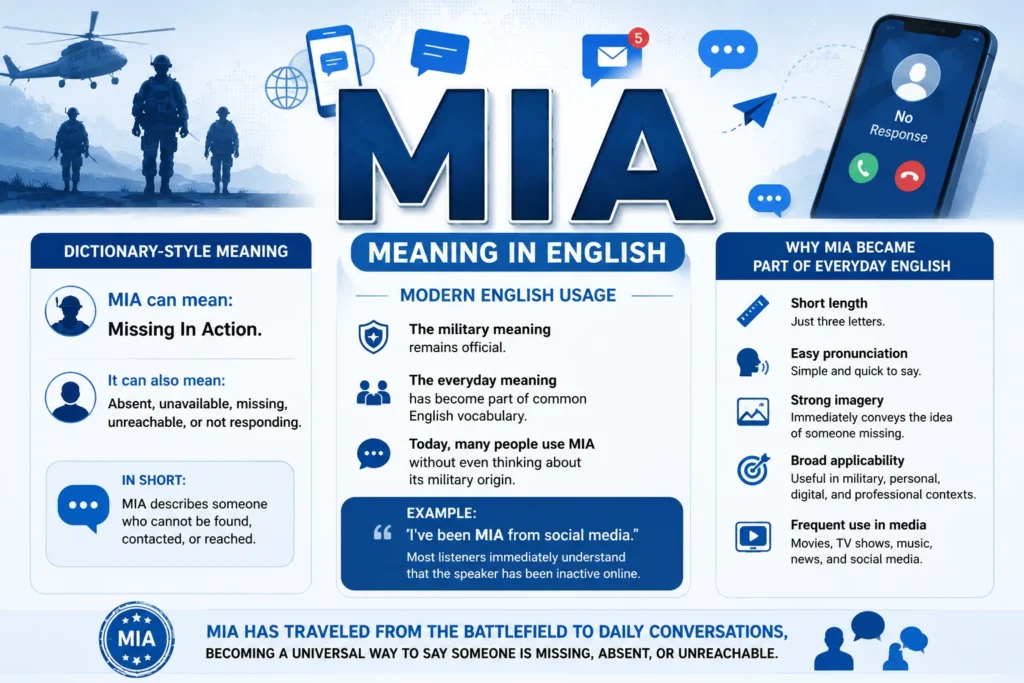
In modern English, MIA functions as both an acronym and a descriptive expression.
Dictionary-Style Meaning
MIA can mean:
Missing In Action.
It can also mean:
Absent, unavailable, missing, unreachable, or not responding.
Modern English Usage
The military meaning remains official.
The everyday meaning has become part of common English vocabulary.
Today, many people use MIA without even thinking about its military origin.
For example:
“I’ve been MIA from social media.”
Most listeners immediately understand that the speaker has been inactive online.
Why MIA Became Part of Everyday English
Several factors contributed to its popularity:
- Short length
- Easy pronunciation
- Strong imagery
- Broad applicability
- Frequent use in media
These qualities helped the term move beyond military terminology into everyday language.
Common Situations Where People Use MIA
The meaning stays consistent across different situations.
MIA Usage by Context
| Context | Meaning |
|---|---|
| Texting | Not responding |
| Social Media | Inactive online |
| Friendship | Out of contact |
| Relationship | Reduced communication |
| School | Absent or inactive |
| Work | Unavailable |
| Gaming | Offline or disconnected |
| Military | Missing In Action |
Most Common Interpretation
Outside military discussions, MIA almost always means:
Someone has temporarily disappeared from communication.
MIA Synonyms and Similar Expressions
People often use other phrases that carry similar meanings.
Common Synonyms for MIA
- Missing
- Unavailable
- Absent
- Out of touch
- Out of contact
- Unreachable
- Inactive
- Off the radar
- Disappeared
- Gone quiet
Similar Slang Expressions
| Expression | Meaning |
|---|---|
| Ghosted | Stopped responding completely |
| Off the grid | Avoiding communication |
| Off the radar | Not easily reachable |
| Out of touch | Limited communication |
| Disappeared | Suddenly absent |
| Went silent | Stopped communicating |
MIA vs Ghosting
People often confuse these terms.
MIA
Can be temporary and innocent.
Example:
“I’ve been MIA because of work.”
Ghosting
Usually involves intentionally ending communication without explanation.
Example:
“She ghosted me after our last date.”
Ghosting is often more deliberate.
MIA is broader and may not carry negative intent.
Related Acronyms Commonly Used With MIA
The internet loves abbreviations. MIA often appears alongside other common acronyms.
Popular Communication Acronyms
| Acronym | Meaning |
|---|---|
| MIA | Missing In Action |
| BRB | Be Right Back |
| AFK | Away From Keyboard |
| IMO | In My Opinion |
| TBH | To Be Honest |
| FYI | For Your Information |
| IDK | I Don’t Know |
| LOL | Laugh Out Loud |
| DM | Direct Message |
| IRL | In Real Life |
Military Acronyms Related to MIA
| Acronym | Meaning |
|---|---|
| MIA | Missing In Action |
| KIA | Killed In Action |
| WIA | Wounded In Action |
| POW | Prisoner of War |
| AWOL | Absent Without Leave |
Understanding these abbreviations helps you navigate both online conversations and military terminology.
Common Misconceptions About MIA
Many people misunderstand the meaning of MIA.
Let’s clear up the most common myths.
Myth: MIA Always Means Military
Reality:
While MIA originated in the military, most modern usage is unrelated to military operations.
Myth: MIA Means Someone Is Dead
Reality:
MIA does not mean deceased.
It means the person’s whereabouts or status are unknown.
Myth: MIA and AWOL Mean the Same Thing
Reality:
They represent different situations.
MIA involves uncertainty.
AWOL involves unauthorized absence.
Myth: Being MIA Is Always Negative
Reality:
Many people become MIA because they’re busy, traveling, studying, working, or taking a break.
Myth: MIA Is Only Used Online
Reality:
People use MIA in spoken conversations, workplaces, schools, friendships, and relationships as well.
Quick Reference Table: What Does MIA Mean?
| Term | Meaning |
|---|---|
| MIA | Missing In Action |
| MIA Full Form | Missing In Action |
| MIA Definition | Missing, absent, unavailable, or unreachable |
| MIA Meaning in Text | Not responding |
| MIA Meaning in Chat | Inactive or absent |
| MIA Meaning on Social Media | Not active online |
| MIA Meaning in Relationships | Reduced communication |
| MIA Meaning at Work | Unavailable |
| MIA Military Meaning | Service member with unknown status |
| MIA Status Meaning | Location or condition unknown |
Frequently Asked Questions
What does MIA mean?
MIA stands for Missing In Action. In everyday language, it often means someone is absent, unavailable, unreachable, or not responding.
What does MIA stand for?
MIA stands for Missing In Action.
What is MIA short for?
MIA is the abbreviation of Missing In Action.
What does MIA mean in texting?
In texting, MIA usually means someone has stopped responding or has become temporarily unavailable.
What does MIA mean in messages?
It means the person is absent, inactive, or difficult to contact.
What does MIA mean in chat?
In chat conversations, MIA refers to someone who suddenly stops participating or becomes inactive.
What does MIA mean on Snapchat?
It means a user has stopped sending snaps, replying to messages, or participating on the platform.
What does MIA mean on Instagram?
It means someone has become inactive or stopped engaging with content.
What does MIA mean on TikTok?
It usually means a creator or user has stopped posting or interacting.
What does MIA mean on social media?
It refers to someone who has disappeared from online activity for a period of time.
What does MIA mean in a relationship?
It often means a partner has become distant, unavailable, or less communicative.
What does it mean when someone is MIA?
It means they are absent, unreachable, inactive, or difficult to contact.
Why do people say MIA?
People use MIA because it’s a quick way to describe someone who has disappeared from communication.
Is MIA a slang term?
Yes. While it began as military terminology, MIA is now commonly used as slang in everyday communication.
What is the military meaning of MIA?
In military terminology, MIA means Missing In Action, referring to a service member whose whereabouts are unknown during operations.
Is MIA the same as AWOL?
No.
MIA means a person’s status or location is unknown.
AWOL means someone is absent without authorization.
Can MIA be used at work?
Yes. Informally, it can describe someone who is unavailable or difficult to reach.
Is being MIA always a bad thing?
No. People may be MIA because of work, travel, personal obligations, or a desire to disconnect temporarily.
What is the opposite of MIA?
Possible opposites include:
- Available
- Present
- Active
- Reachable
- Responsive
Is MIA commonly used today?
Yes. MIA remains one of the most widely recognized abbreviations in texting, social media, and everyday conversation.
Conclusion
If you’ve ever wondered what does MIA mean, the answer is surprisingly simple.
The acronym stands for Missing In Action, a military term used to describe personnel whose whereabouts are unknown during military operations. Over time, the phrase evolved beyond its original context and became part of everyday language.
Today, the MIA meaning most people encounter refers to someone who is absent, unavailable, unreachable, inactive, or not responding. Whether you’re talking about texting, social media, friendships, relationships, school, work, or online communities, the core idea remains the same: the person has temporarily disappeared from communication.
Because it’s short, memorable, and easy to understand, MIA continues to be one of the most widely used abbreviations in modern English. The next time someone says a friend has gone MIA or asks why you’ve been MIA lately, you’ll know exactly what they mean.

Sophia Bennett is a professional writer focused on explaining word meanings, expressions and everyday language in a simple and engaging way.