
Last Updated on June 13, 2026
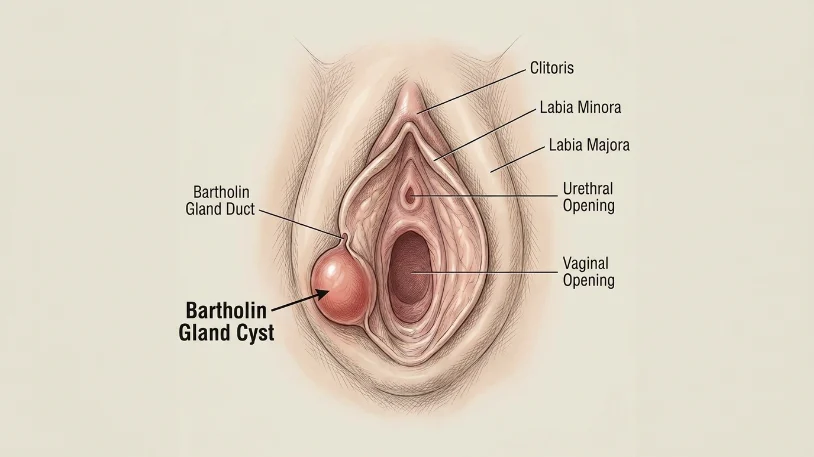
A Bartholin cyst typically appears as a smooth, round lump on one side of the vaginal opening caused by a blocked Bartholin gland. It may be small and painless or grow into a larger swelling that resembles a soft, fluid-filled bump. Infected cysts look red, swollen, and painful and may contain pus. Unlike pimples or ingrown hairs, Bartholin cysts form deeper in the vulvar region and usually occur at the 4 or 8 o’clock position. Visual identification depends on location, one-sided swelling, and texture changes over time.
Complete Visual Guide to Bartholin Cyst Appearance and Identification
A small lump near the vaginal opening can feel alarming. It often sends people searching for what does a Bartholin cyst look like pictures because the mind wants quick confirmation. Is it serious? Is it normal? Or is it something else entirely?
Here’s the truth right away. A Bartholin cyst often looks far more harmless than people expect. But its appearance changes depending on size, infection, and stage. And that’s exactly where confusion begins.
This guide breaks everything down in simple language. You’ll understand how it looks, how it feels, how it changes, and how to tell it apart from similar conditions. No vague descriptions. Just clear, real-world medical explanation.
Understanding Bartholin Cyst Appearance in Real Life
Before focusing on appearance, you need to understand where it forms. A Bartholin cyst develops in the Bartholin glands, two small glands located on each side of the vaginal opening. These glands help produce lubrication.
When the duct gets blocked, fluid gets trapped. That trapped fluid slowly forms a swelling.
Now let’s break down what that swelling actually looks like.
Bartholin Cyst Appearance: Size, Shape and Structure
A Bartholin cyst does not have one fixed look. Instead, it evolves.
Typical shape
- Round or oval lump
- Smooth surface under the skin
- Often feels like a small balloon under soft tissue
Common size range
- Tiny cyst: pea-sized (0.5–1 cm)
- Moderate cyst: grape-sized (1–3 cm)
- Large cyst: golf ball size (3–5+ cm)
Some rare cases grow even larger, but most stay under 4 cm.
Key visual clue
It almost always appears on one side only of the vaginal opening. That asymmetry is one of the strongest identification markers.
What Does a Bartholin Cyst Look Like on the Skin
The outer appearance depends heavily on size and inflammation.
Small cyst appearance
- Skin looks normal
- No redness
- Barely visible lump
- Only noticeable when touching the area
Medium cyst appearance
- Slight bulge near vaginal opening
- Skin may stretch slightly
- One-sided swelling becomes noticeable
- May look like a soft bump under the skin
Large cyst appearance
- Clear visible swelling
- One side of vaginal opening appears enlarged
- Skin may look tight or glossy
- Pressure distortion may be visible
Bartholin Cyst Location: The Most Important Visual Clue
Location matters more than size when identifying it.
A Bartholin cyst usually appears at:
- 4 o’clock or 8 o’clock position of vaginal opening
- Lower part of the vulvar region
- Just inside or near the labia majora
This precise location helps doctors differentiate it from other lumps.
What Does an Infected Bartholin Cyst Look Like
When infection occurs, the appearance changes dramatically. This is when it becomes a Bartholin abscess.
Visual changes include
- Bright redness around swelling
- Skin becomes tight and inflamed
- Lump appears larger and more raised
- Possible visible pus or drainage point
- Surrounding area may look irritated
Texture changes
- Hard and tense instead of soft
- Warm to touch
- Painful even without pressure
This stage is often the one people mistake for a serious infection or STI.
Bartholin Cyst vs Abscess Appearance Comparison Table
| Feature | Bartholin Cyst | Bartholin Abscess |
|---|---|---|
| Color | Normal or slightly pale | Red and inflamed |
| Pain | Usually none or mild | Severe pain |
| Texture | Soft or rubbery | Firm and tense |
| Temperature | Normal | Warm/hot |
| Growth speed | Slow | Rapid |
| Discharge | None | Possible pus |
What Does a Bartholin Cyst Feel Like vs Look Like
Sometimes the appearance is subtle, but the sensation gives it away.
Common feelings include
- Soft lump under skin
- Pressure when sitting
- Heaviness in vaginal area
- Mild discomfort during movement
But here’s something important.
Many small Bartholin cysts are completely painless and discovered by accident.
Bartholin Cyst Appearance Stages Over Time
A Bartholin cyst doesn’t stay the same. It changes as fluid builds or infection develops.
Stage 1: Blocked Gland (No Visible Cyst Yet)
At this stage:
- No visible lump
- No skin change
- Mild discomfort may appear
This stage often goes unnoticed.
Stage 2: Early Cyst Formation
Now the blockage becomes visible.
- Small bump forms under skin
- Skin still looks normal
- No pain in most cases
- Feels like a tiny bead under skin
Stage 3: Enlarging Cyst
This is when most people notice it.
- Visible bulge near vaginal opening
- One-sided swelling
- Mild pressure sensation
- Skin begins to stretch slightly
Stage 4: Infected Cyst (Abscess Stage)
This is the most dramatic appearance.
- Red, swollen mass
- Pain increases significantly
- Skin becomes shiny and tight
- Possible pus buildup
At this stage, walking or sitting can feel uncomfortable.
What Does a Bartholin Cyst Look Like in Pictures vs Real Life
Search results often show extreme cases. That creates confusion.
Here’s what matters:
- Real-life cysts are often subtle
- Many are not visible unless large
- Online images often show advanced abscess cases
- Early cysts rarely look dramatic
So if your symptoms don’t match extreme images, that’s normal.
Common Conditions Mistaken for Bartholin Cyst (Visual Confusion Guide)
Many people misidentify vaginal lumps. Let’s clear that up.
Ingrown Hair vs Bartholin Cyst Appearance
| Feature | Ingrown Hair | Bartholin Cyst |
|---|---|---|
| Location | Surface skin | Deeper near vaginal opening |
| Size | Small bump | Can grow large |
| Pus | Sometimes visible | Only if infected |
| Pain | Localized | Pressure-based |
Pimple vs Bartholin Cyst
- Pimples appear on skin surface
- Bartholin cyst forms deeper under tissue
- Pimples often have whitehead
- Bartholin cyst is smooth and round
Herpes vs Bartholin Cyst
This comparison is important because anxiety often spikes here.
- Herpes appears as clusters of blisters
- Bartholin cyst is a single lump
- Herpes causes burning and multiple sores
- Cyst is usually smooth and isolated
Lipoma vs Bartholin Cyst
- Lipoma = fatty tissue lump
- Bartholin cyst = fluid-filled gland blockage
- Lipoma grows slowly and stays soft
- Bartholin cyst is location-specific
Bartholin Cyst on Labia Majora: What It Looks Like
When located deeper in the labia majora:
- Swelling appears near vaginal entrance
- One side becomes noticeably fuller
- Skin may look stretched but intact
- Lump feels embedded, not surface-level
This is one of the most classic presentations.
When Bartholin Cyst Appearance Becomes Concerning
You should pay attention if you notice:
- Rapid growth within days
- Severe pain while sitting or walking
- Red or purple discoloration
- Fever or fatigue
- Persistent swelling lasting weeks
These signs often indicate infection.
Medical Facts About Bartholin Cysts You Should Know
- About 2% of women develop a Bartholin cyst at some point
- Most cases occur between ages 20–40
- Around 10–15% of cysts become infected
- Recurrence is possible in some individuals
These numbers show it is not rare, and not automatically dangerous.
How Doctors Identify Bartholin Cysts Visually
Doctors don’t rely on images alone. They check:
- Exact location near vaginal opening
- One-sided swelling pattern
- Soft vs firm texture
- Signs of infection
- Patient symptoms like pain or pressure
In most cases, no imaging is needed.
What Treatment Does to Bartholin Cyst Appearance
Warm sitz baths
- Can reduce size gradually
- Swelling softens over time
Drainage procedure
- Immediate reduction in lump size
- Temporary swelling may remain
Catheter treatment
- Prevents fluid buildup
- Area may look slightly swollen during healing
Simple Visual Identification Checklist
If you suspect a Bartholin cyst, check:
- Is it near vaginal opening?
- Is it one-sided?
- Is it smooth and round?
- Does it feel deep under skin?
- Is pain mild or pressure-based?
If most answers are yes, it likely matches Bartholin cyst appearance.
Final Thoughts
A Bartholin cyst doesn’t always look dramatic. In fact, most begin quietly and grow slowly.
The key is not just what it looks like, but where it appears and how it behaves.
If you remember one thing, make it this:
A Bartholin cyst is defined more by its location and structure than by its surface appearance alone.

Michael Anderson is a content writer specializing in word meanings, definitions and clear explanations of modern terms and phrases.