
Last Updated on June 17, 2026
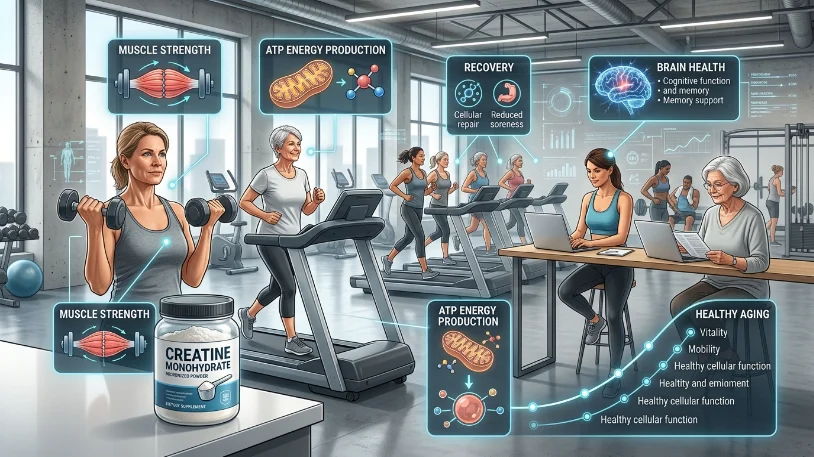
Creatine helps women produce more energy during high-intensity exercise by increasing the amount of phosphocreatine stored in muscles. Research shows that creatine can improve strength, muscle growth, workout recovery, exercise performance, and brain health. Women may also benefit from creatine during aging and menopause because it helps preserve lean muscle mass and supports physical performance. The most studied form is creatine monohydrate, and a daily dose of 3–5 grams is considered safe for most healthy women.
For years, many women avoided creatine.
Some thought it was only for bodybuilders. Others worried it would cause weight gain, bloating, or make them look bulky.
None of those beliefs tell the full story.
In reality, creatine is one of the most researched supplements in sports nutrition. Scientists have studied it for decades. The evidence consistently shows that creatine offers benefits far beyond building muscle.
So, what does creatine do for women exactly?
It helps your body produce energy faster. That extra energy can improve strength, support muscle growth, increase workout performance, enhance recovery, and even benefit brain health.
The effects aren’t limited to athletes either.
Women who lift weights, run, practice HIIT, play sports, or simply want to maintain muscle and stay healthy as they age may all benefit from creatine supplementation.
In this guide, you’ll learn:
- What creatine is
- How creatine works in women
- The benefits of creatine for women
- Whether creatine is safe
- Side effects and myths
- Dosage recommendations
- Creatine for women over 40 and menopause
- How long it takes to work
Let’s start with the basics.
What Is Creatine?
Creatine is a natural compound made from three amino acids:
- Arginine
- Glycine
- Methionine
Your body produces creatine primarily in the:
- Liver
- Kidneys
- Pancreas
After production, creatine travels through the bloodstream and gets stored mostly inside skeletal muscle.
Around 95% of the body’s creatine stores are found in muscles, while the remaining amount exists in organs such as the brain and heart.
You also get creatine from foods like:
| Food | Approximate Creatine Content |
|---|---|
| Beef | 1–2 grams per pound |
| Salmon | 1–2 grams per pound |
| Tuna | 1–1.5 grams per pound |
| Pork | 1–2 grams per pound |
| Chicken | Lower amounts |
Vegetarians and vegans often have lower creatine stores because plant foods contain almost no creatine.
This is one reason why supplementation can produce noticeable benefits in some women.
What Is Creatine Monohydrate?
When people talk about creatine supplements, they usually mean creatine monohydrate.
This form combines creatine with a water molecule.
It isn’t fancy.
It isn’t new.
And that’s exactly why it’s popular.
Creatine monohydrate has:
- The most scientific research
- Excellent safety data
- High effectiveness
- Low cost
- Strong evidence for long-term use
Other forms exist, including:
- Creatine hydrochloride (HCL)
- Buffered creatine
- Creatine ethyl ester
- Creatine nitrate
- Liquid creatine
However, no alternative consistently outperforms creatine monohydrate.
If you ask experts which creatine supplement for women is best, the answer is usually simple:
Micronized creatine monohydrate.
How Does Creatine Work in Women?
At its core, creatine is an energy supplement.
Not the kind that stimulates your nervous system like caffeine.
Instead, creatine helps your cells recycle energy faster.
Here’s how it works.
Your body uses a molecule called ATP, or adenosine triphosphate, as its main energy source.
ATP powers nearly everything you do:
- Sprinting
- Lifting weights
- Jumping
- Cycling uphill
- High-intensity interval training
- Even certain brain functions
The problem?
ATP runs out quickly.
During intense exercise, your muscles can burn through ATP stores in just a few seconds.
That’s where creatine enters the picture.
Creatine gets stored as phosphocreatine inside muscle cells.
Phosphocreatine helps regenerate ATP rapidly.
More phosphocreatine means:
- Faster ATP production
- More energy during exercise
- Better power output
- Reduced fatigue
- Improved exercise capacity
Think of ATP as cash in your wallet.
You spend it quickly during intense activity.
Creatine acts like an instant ATM refill.
The more phosphocreatine your muscles store, the faster you can replenish your energy.
That’s why creatine is especially effective for:
- Resistance training
- Sprinting
- HIIT workouts
- Team sports
- Short bursts of explosive activity
Do Women Respond Differently to Creatine?
Women and men both benefit from creatine.
However, there are some interesting differences.
Women naturally tend to have:
- Lower creatine stores
- Lower muscle creatine concentrations
- Hormonal fluctuations across the menstrual cycle
- Different muscle fiber composition
Because of these factors, some researchers believe women may experience unique benefits from creatine supplementation.
For example:
- Improved cognitive performance
- Better muscle preservation during aging
- Enhanced recovery
- Greater support during menopause
- Potential benefits during periods of sleep deprivation or stress
Researchers continue to study these areas, but the early findings are promising.
What Does Creatine Do for Women? Main Benefits Explained
If someone asks, “What does creatine do for women?” the simplest answer is this:
Creatine helps women perform better physically and may support health as they age.
But that’s only the beginning.
Let’s look at the major benefits one by one.
Creatine Helps Women Build Lean Muscle Mass
One of the biggest myths about creatine is that it automatically builds huge muscles.
That’s not how it works.
Creatine doesn’t force muscle growth.
Instead, it creates conditions that make muscle growth easier.
Because creatine increases energy availability, women can often:
- Lift heavier weights
- Perform more repetitions
- Train harder
- Recover more efficiently
Over time, those improvements may lead to:
- Increased lean muscle mass
- Higher fat-free mass
- Better body composition
- More strength gains
Importantly, creatine doesn’t make women bulky.
Muscle growth requires:
- Progressive resistance training
- Adequate nutrition
- Consistent exercise
- Sufficient protein intake
Creatine simply supports the process.
Creatine Increases Strength and Power
Strength gains are among the most studied creatine benefits.
Women who take creatine alongside resistance training often experience improvements in:
- Squat performance
- Bench press strength
- Deadlift capacity
- Explosive power
- Sprint speed
- Training volume
This happens because creatine increases phosphocreatine stores.
More phosphocreatine means:
- Faster ATP regeneration
- More available energy
- Better performance during short, intense efforts
For gym-goers, that may translate into:
- One extra rep today
- Two extra reps next week
- Larger strength improvements months later
Small improvements compound.
That’s where creatine shines.
Creatine Improves Exercise Performance
Creatine isn’t just for bodybuilders.
Many female athletes use creatine to improve:
- Training intensity
- Repeated sprint ability
- Jump performance
- Cycling power
- Running speed
- Workout capacity
The supplement is especially useful for:
- HIIT workouts
- Cross-training
- Resistance training
- Team sports
- Functional fitness
- Sprint events
However, creatine isn’t a magic performance enhancer.
You still need:
- Good programming
- Consistent training
- Proper recovery
- Adequate nutrition
Creatine amplifies your efforts.
It doesn’t replace them.
Creatine Supports Workout Recovery
Hard workouts create stress.
Your muscles experience:
- Energy depletion
- Microscopic damage
- Inflammation
- Temporary fatigue
Recovery allows your body to adapt and become stronger.
Emerging evidence suggests creatine may help women recover by:
- Replenishing cellular energy
- Supporting muscle repair
- Reducing exercise-induced muscle damage
- Improving training consistency
This doesn’t mean soreness disappears.
But some women notice they feel fresher between workouts.
And when recovery improves, training quality often improves too.
Creatine May Improve Brain Health
Here’s something many people don’t know.
Creatine isn’t only stored in muscles.
The brain also uses creatine.
Brain cells require enormous amounts of energy.
Creatine helps support that energy demand.
Researchers are studying whether creatine may help:
- Memory
- Cognitive performance
- Mental fatigue
- Concentration
- Sleep deprivation recovery
- Brain energy metabolism
Some studies suggest women may experience noticeable cognitive benefits during periods of:
- Stress
- Sleep loss
- Hormonal fluctuations
- Aging
Research is ongoing.
Still, brain health is becoming one of the most exciting areas of creatine science.
Creatine isn’t just a muscle supplement. It functions as an energy-support compound for tissues that require rapid energy production, including the brain and skeletal muscle.
Quick Summary: Benefits of Creatine for Women
| Benefit | Potential Effect |
|---|---|
| Lean muscle mass | Supports muscle growth |
| Strength | Increases power output |
| Exercise performance | Improves high-intensity exercise |
| Recovery | Helps replenish energy stores |
| Brain health | Supports cognitive function |
| Healthy aging | Preserves muscle and physical function |
| Body composition | Supports lean body mass |
In short, what does creatine do for women?
It helps women produce energy more efficiently, train harder, recover better, and potentially maintain strength and muscle throughout life.
The next sections will cover:
- Is creatine safe for women?
- Does creatine cause weight gain or bloating?
- Creatine dosage for women
- Women over 40 and menopause
- Creatine side effects in women
- When to take creatine
- Before and after results
Is Creatine Safe for Women?
One of the most common questions women ask is:
“Is creatine safe for women?”
The short answer is yes.
Creatine is one of the most extensively studied dietary supplements in sports nutrition. Researchers have examined its effects for decades across different age groups, activity levels, and health conditions.
For healthy women, creatine monohydrate has a strong safety profile when used at recommended doses.
Studies have found that creatine does not appear to:
- Damage healthy kidneys
- Harm the liver
- Negatively affect reproductive health
- Disrupt hormone balance
- Increase the risk of dehydration
- Cause muscle cramps
In fact, many of the fears surrounding creatine come from myths that have circulated for years rather than from scientific evidence.
That said, supplements aren’t one-size-fits-all.
Women with certain medical conditions, especially kidney disease or other chronic health issues, should speak with a healthcare professional before starting any supplement.
Who May Benefit Most From Creatine?
Creatine isn’t only for professional athletes.
Women from many backgrounds may benefit, including:
- Women who lift weights
- Runners and cyclists
- Female athletes
- Women doing HIIT workouts
- Vegetarians and vegans
- Women over 40
- Postmenopausal women
- Beginners starting strength training
Even women who aren’t trying to build muscle may benefit from creatine’s effects on energy production and healthy aging.
Does Creatine Make Women Gain Weight?
This question causes more confusion than almost any other.
The answer is:
Creatine can increase body weight, but usually not in the way people fear.
Most early weight gain comes from water stored inside muscle cells.
This is called intracellular water retention.
It differs from:
- Fat gain
- Puffiness under the skin
- Increased body fat percentage
Think of muscle cells as balloons.
Creatine helps those balloons hold more water and energy.
The muscles become fuller and better hydrated.
That’s very different from gaining body fat.
Why Does Creatine Cause Water Retention?
Creatine attracts water into muscle cells.
This process may:
- Increase muscle cell hydration
- Improve exercise performance
- Support muscle recovery
- Enhance training adaptations
Some women notice:
- Slight increases in scale weight
- Fuller-looking muscles
- Better muscle definition
Others notice almost no change.
Everyone responds differently.
How Much Weight Can Women Gain From Creatine?
Weight changes vary.
Some women gain:
- 1–3 pounds during the first few weeks
- Little or no weight
- Slightly more if using a loading phase
Most of this weight comes from:
- Increased muscle water content
- Potential muscle growth over time
It is not automatically fat gain.
Does Creatine Cause Bloating in Women?
Another common concern is bloating.
Many women worry that creatine will leave them looking swollen or puffy.
Fortunately, this is less common than people think.
Creatine Bloating vs Water Retention
These two terms often get mixed together.
They aren’t the same.
| Creatine Water Retention | Creatine Bloating |
|---|---|
| Occurs inside muscle cells | Usually affects the stomach |
| Can improve muscle fullness | Causes discomfort or puffiness |
| Often considered beneficial | Usually unwanted |
| Common during supplementation | Less common overall |
Most women who take moderate doses of creatine monohydrate don’t experience significant bloating.
Bloating is more likely when:
- Taking very high doses
- Starting with an aggressive loading phase
- Using poor-quality supplements
- Taking creatine on an empty stomach if sensitive
How to Reduce Creatine Bloating
If bloating occurs, these strategies may help:
- Use micronized creatine monohydrate
- Take 3–5 grams daily instead of large doses
- Split the dose throughout the day
- Drink adequate water
- Take creatine with food
Many women find that bloating disappears after the first few weeks.
Creatine Side Effects in Women
For most healthy women, side effects are mild or nonexistent.
However, like any supplement, creatine isn’t completely free of potential issues.
Possible side effects include:
- Mild stomach discomfort
- Temporary bloating
- Water retention inside muscles
- Nausea if taken in large amounts
- Digestive upset in sensitive individuals
These effects are usually:
- Temporary
- Dose-dependent
- Improved by lowering the dose
Myths About Creatine Side Effects
Let’s clear up some common myths.
| Myth | Reality |
|---|---|
| Creatine damages kidneys | No evidence in healthy individuals |
| Creatine causes hair loss | Limited evidence and no clear conclusion |
| Creatine dehydrates you | Research generally doesn’t support this |
| Creatine causes cramps | Studies do not consistently show this |
| Creatine affects female hormones negatively | Current evidence doesn’t support this |
Many of these myths originated decades ago and continue to spread online despite limited evidence.
Does Creatine Affect Female Hormones?
This is an important topic.
Women naturally experience hormonal fluctuations throughout life.
These changes occur during:
- The menstrual cycle
- Pregnancy
- Perimenopause
- Menopause
- Postmenopause
Many women wonder whether creatine interferes with these hormonal changes.
Current research suggests:
Creatine does not appear to disrupt normal female hormone function.
Researchers continue to study:
- Estrogen interactions
- Menstrual cycle effects
- Hormonal changes during aging
- Menopause-related benefits
So far, creatine appears to work primarily by improving cellular energy availability rather than altering hormone production.
Creatine and the Menstrual Cycle
Hormones influence many aspects of athletic performance.
Energy levels may fluctuate across the menstrual cycle.
Strength can vary.
Recovery may feel different from week to week.
Some researchers believe creatine may offer unique benefits during certain phases of the cycle because:
- Women may have lower creatine stores at specific times
- Hormonal fluctuations influence metabolism
- Brain energy demands may change
This area is still developing.
However, creatine remains one of the few supplements showing potential benefits across different stages of female physiology.
How Much Creatine Should Women Take?
The good news?
You don’t need complicated calculations.
For most healthy women:
3–5 grams of creatine monohydrate per day is enough.
That’s the dose most commonly used in research.
It’s simple.
Affordable.
And effective.
Standard Creatine Dosage for Women
| Goal | Daily Dose |
|---|---|
| General fitness | 3 grams |
| Strength training | 3–5 grams |
| Muscle growth | 5 grams |
| Female athletes | 3–5 grams |
| Healthy aging | 3–5 grams |
Consistency matters more than timing.
Taking creatine every day helps maintain elevated muscle creatine stores.
Should Women Do a Creatine Loading Phase?
A loading phase helps saturate muscle stores faster.
The traditional loading protocol looks like this:
| Phase | Dose |
|---|---|
| Loading | 20 grams daily for 5–7 days |
| Maintenance | 3–5 grams daily |
You typically divide the loading dose into:
- Four 5-gram servings
- Taken throughout the day
Is Loading Necessary?
Not at all.
Many women skip the loading phase entirely.
Instead, they simply take:
3–5 grams daily from day one.
The difference?
- Loading works faster.
- Regular dosing works more gradually.
Eventually, both methods reach similar creatine stores.
If you want to avoid digestive discomfort, the slow approach is often easier.
When Should Women Take Creatine?
Timing is one of the most debated topics in sports nutrition.
Fortunately, creatine timing isn’t overly complicated.
You can take creatine:
- Before workouts
- After workouts
- With breakfast
- At night
- Any time that’s convenient
The most important factor is:
Take it consistently.
Creatine Before or After Workout
Some women prefer taking creatine before training because they associate it with energy.
Others take it after workouts alongside:
- Protein shakes
- Carbohydrates
- Recovery meals
Current evidence suggests:
The difference between before and after workouts is relatively small compared to taking creatine consistently every day.
Can Women Take Creatine Every Day?
Yes.
Daily creatine intake is standard practice.
Most research protocols use:
- Continuous daily supplementation
- Long-term use
- Maintenance doses of 3–5 grams
Benefits often accumulate gradually.
Skipping days occasionally isn’t a disaster.
However, regular intake helps maintain muscle creatine saturation.
How Long Does Creatine Take to Work for Women?
This depends on:
- Your dosage
- Whether you use a loading phase
- Your muscle creatine levels
- Diet
- Training intensity
Here’s a general timeline:
| Time Frame | Possible Changes |
|---|---|
| First week | Increased muscle water content |
| 2–4 weeks | Improved workout performance |
| 4–8 weeks | Strength gains become noticeable |
| 2–3 months | Changes in muscle and body composition |
| Several months | Long-term training benefits |
Results vary.
Some women notice improvements quickly.
Others experience gradual changes that become obvious only after consistent use.
What Happens If You Stop Taking Creatine?
This surprises many people.
Creatine isn’t addictive.
Your body naturally produces creatine whether you supplement or not.
If you stop taking it:
- Muscle creatine stores slowly decline
- Water stored inside muscles may decrease
- Strength gains from training remain
- Muscle built through exercise doesn’t suddenly disappear
Think of creatine as a performance assistant.
It helps optimize your training.
It doesn’t create permanent dependence.
Quick Facts About Creatine Safety and Dosage
| Question | Answer |
|---|---|
| Is creatine safe for women? | Yes, for most healthy women |
| Does creatine cause fat gain? | No |
| Does creatine cause bloating? | Sometimes, but usually mild |
| Can women take creatine daily? | Yes |
| Recommended dosage | 3–5 grams daily |
| Is loading required? | No |
| Best type | Micronized creatine monohydrate |
| Best time to take it | Any time, as long as it’s consistent |
By now, you know how creatine works, its benefits, safety profile, and how to take it properly.
The next section will explore:
- Creatine for women over 40
- Creatine and menopause
- Creatine for weight loss and fat loss
- Creatine for runners and female athletes
- Creatine before and after results
- Who should avoid creatine
- Frequently asked questions
- Final verdict on whether women should take creatine
Creatine for Women Over 40: Why It Becomes Even More Important
Your 20s and 30s aren’t the only years when creatine can help.
In fact, many experts believe creatine may become more valuable as women age.
After age 30, the body naturally begins losing muscle mass. This process accelerates over time and can affect:
- Strength
- Balance
- Physical performance
- Bone health
- Metabolism
- Independence later in life
This age-related muscle loss is gradual. You might not notice it year to year.
However, by the time many women reach their 40s or 50s, maintaining lean muscle becomes noticeably harder.
That’s where creatine enters the conversation.
Why Women Over 40 May Benefit From Creatine
Women over 40 often experience:
- Declining muscle mass
- Slower recovery
- Reduced power output
- Hormonal changes
- Lower exercise capacity
- Increased fatigue
Creatine may help by supporting:
- Lean muscle mass
- Strength training performance
- Muscle recovery
- Physical function
- Cellular energy production
The goal isn’t necessarily to become stronger than ever.
Sometimes it’s simply about preserving what you already have.
That can make a huge difference over decades.
Creatine and Healthy Aging
Aging affects muscles in ways that aren’t always visible.
Muscle fibers shrink.
Power decreases.
Recovery slows.
The body becomes less responsive to training.
Researchers often refer to this as anabolic resistance.
In simple terms, your muscles don’t respond to exercise as efficiently as they once did.
Strength training remains the best defense.
Creatine may provide additional support by helping muscles:
- Produce energy more efficiently
- Train at higher intensities
- Recover between sessions
- Maintain lean body mass
Many women over 40 use creatine as part of a broader healthy aging strategy that includes:
- Resistance training
- Adequate protein intake
- Sleep
- Balanced nutrition
- Regular physical activity
Creatine and Menopause
Menopause changes nearly every system in the body.
Hormone levels shift.
Muscle mass declines faster.
Bone density decreases.
Energy levels may fluctuate.
For many women, workouts suddenly feel harder than they used to.
Creatine won’t stop menopause.
But it may help address some of the physical changes that occur during this stage of life.
Why Menopause Affects Muscle and Strength
Estrogen plays a role in:
- Muscle maintenance
- Bone health
- Recovery
- Energy metabolism
As estrogen declines, women may experience:
- Reduced muscle mass
- Increased body fat
- Lower strength
- Reduced exercise performance
- Slower recovery
Strength training remains one of the best ways to counter these changes.
Creatine may enhance those benefits.
Potential Benefits of Creatine During Menopause
Researchers continue studying creatine and menopause.
Current evidence suggests creatine may support:
- Muscle preservation
- Strength gains
- Physical function
- Exercise performance
- Lean body mass
- Healthy aging
Women who combine creatine with resistance training may experience better outcomes than exercise alone.
Creatine and Bone Health
Bones and muscles work together.
When muscles become stronger, bones experience healthy mechanical stress.
This stress helps maintain bone strength.
Some studies suggest creatine may indirectly support bone health by:
- Improving strength
- Increasing training capacity
- Helping women maintain muscle mass
However, creatine is not a replacement for:
- Calcium
- Vitamin D
- Weight-bearing exercise
- Medical treatment for osteoporosis
Think of it as one piece of a larger healthy aging strategy.
Can Creatine Help Women Lose Weight?
This question gets asked constantly.
The answer is:
Creatine doesn’t directly burn fat.
It’s not a stimulant.
It doesn’t suppress appetite.
And it doesn’t magically increase calorie expenditure.
However, creatine may help support fat loss indirectly.
How Creatine Supports Fat Loss
Creatine may improve:
- Workout intensity
- Training volume
- Muscle retention
- Recovery
- Strength
These improvements can make it easier to:
- Build lean muscle
- Preserve muscle during dieting
- Burn more calories through exercise
- Improve body composition
Imagine two women following the same workout plan.
One trains harder because she recovers better and lifts heavier weights.
The other doesn’t.
Over time, the first woman may build more muscle and improve her body composition more effectively.
Creatine helps create that advantage.
Creatine and Body Composition
Body composition matters more than scale weight.
Two women can weigh the same amount and look completely different.
Why?
Because:
- Muscle is denser than fat.
- Muscle changes body shape.
- Muscle improves metabolism.
Creatine may help women:
- Increase lean body mass
- Preserve muscle during weight loss
- Reduce body fat percentage over time
- Improve muscle definition
That’s why many women use creatine during:
- Fat loss phases
- Recomposition programs
- Strength-building programs
- Long-term fitness plans
Creatine for Building Muscle in Women
Muscle growth isn’t just for athletes.
Building muscle helps women:
- Stay stronger
- Improve posture
- Increase metabolism
- Support bone health
- Reduce injury risk
- Age more successfully
Creatine doesn’t build muscle by itself.
You still need:
- Resistance training
- Progressive overload
- Protein intake
- Consistency
But creatine may help you get more from your training.
How Creatine Supports Muscle Growth
Creatine may promote muscle growth through several mechanisms:
Increased Training Volume
You may perform:
- More repetitions
- More sets
- Heavier lifts
- More total work
Over time, this extra training stimulus can contribute to muscle growth.
Better Muscle Cell Hydration
Creatine draws water into muscle cells.
This:
- Increases muscle fullness
- Supports cellular function
- Creates an environment favorable for muscle adaptation
Muscles are like plants.
Well-hydrated plants grow more efficiently.
Muscle cells work similarly.
Improved Recovery
Training breaks muscles down.
Recovery builds them back stronger.
Creatine may help by:
- Restoring cellular energy
- Supporting recovery processes
- Improving workout consistency
More quality training often leads to better long-term results.
Creatine for Female Athletes
Female athletes place enormous demands on their bodies.
Whether you compete professionally or train recreationally, performance matters.
Creatine has become one of the most popular supplements among athletes because it supports:
- Power output
- Sprint performance
- Strength
- Recovery
- Repeated high-intensity efforts
Sports That May Benefit From Creatine
Creatine is especially useful for sports involving:
- Explosive movements
- Repeated sprints
- Strength
- Rapid changes of direction
Examples include:
- Soccer
- Basketball
- Volleyball
- Tennis
- Swimming
- CrossFit
- Track and field
- Weightlifting
Female Athletes and Recovery
Competition places stress on the body.
Athletes often deal with:
- Fatigue
- Muscle soreness
- Travel schedules
- Intense training blocks
Creatine may help maintain:
- Training quality
- Muscle energy stores
- Recovery capacity
- Overall performance
That’s why many sports nutrition professionals consider creatine a foundational supplement for athletes.
Creatine for Runners
At first glance, creatine and running seem like an odd match.
After all, creatine is famous for helping:
- Weightlifters
- Sprinters
- Football players
So why would runners use it?
The answer depends on the type of running.
Creatine for Sprint Runners
Sprint runners rely heavily on:
- ATP production
- Explosive power
- Fast energy systems
Creatine directly supports these systems.
Benefits may include:
- Faster sprint times
- Improved acceleration
- Greater power output
- Better repeated sprint ability
Creatine for Distance Runners
Long-distance runners may benefit differently.
Potential advantages include:
- Improved recovery
- Increased training quality
- Better strength training performance
- Preservation of lean muscle mass
However, some endurance athletes prefer to avoid creatine during competition periods because of temporary water weight changes.
Others use it year-round.
The best approach depends on:
- Training goals
- Competition schedule
- Personal preferences
Creatine and Hydration
For years, people believed creatine caused dehydration.
Research has largely challenged this idea.
Creatine actually increases water inside muscle cells.
This is different from becoming dehydrated.
Still, hydration matters.
Women taking creatine should:
- Drink water regularly
- Monitor urine color
- Increase fluid intake during intense exercise
- Pay attention to hot-weather training
Good hydration supports:
- Performance
- Recovery
- Temperature regulation
- Overall health
What Is the Best Creatine for Women?
Supplement companies love to market complicated formulas.
The reality is refreshingly simple.
For most women, the best option is:
Micronized creatine monohydrate.
Why?
Because it is:
- The most researched form
- Safe
- Affordable
- Effective
- Widely available
- Easy to mix
What to Look For in a Creatine Supplement
Choose a product that offers:
- Pure creatine monohydrate
- Third-party testing if available
- No unnecessary fillers
- Micronized powder for easier mixing
Avoid paying extra for flashy marketing claims.
More expensive doesn’t always mean better.
Quick Summary: Creatine for Women Over 40, Menopause, and Fitness Goals
| Topic | Key Takeaway |
|---|---|
| Women over 40 | May help maintain muscle and strength |
| Menopause | Can support lean mass and exercise performance |
| Fat loss | Indirectly supports body composition |
| Muscle growth | Helps improve training capacity |
| Female athletes | Enhances strength and power |
| Runners | Most useful for sprinting and training support |
| Healthy aging | Supports physical performance over time |
| Best creatine | Micronized creatine monohydrate |
At this point, you’ve learned what creatine does for women, how it works, its benefits, safety profile, dosage, and how it may support women through different life stages.
The final section will cover:
- Creatine before and after results
- Who should avoid creatine
- Frequently asked questions
- Final verdict on whether women should take creatine
- Key takeaways and conclusion
Creatine Before and After Results for Women
One of the biggest reasons women start taking creatine is simple:
They want results they can see and feel.
But creatine isn’t an overnight transformation supplement.
It works gradually by increasing muscle creatine stores and improving your ability to train consistently.
The changes you experience depend on:
- Your workout routine
- Diet
- Protein intake
- Sleep quality
- Genetics
- Training experience
- Consistency with supplementation
What Women May Notice After Starting Creatine
During the First Week
Some women notice:
- Slight increases in body weight
- Fuller-looking muscles
- Better muscle pumps during workouts
- Improved hydration inside muscles
Others notice almost nothing initially.
That’s normal.
After 2–4 Weeks
You may begin to experience:
- Increased workout capacity
- Improved strength
- More repetitions during training
- Reduced fatigue between sets
- Better recovery
These changes are often subtle at first.
Then one day, you realize the weights that used to feel heavy don’t anymore.
After 2–3 Months
Longer-term benefits may include:
- Increased lean muscle mass
- Improved body composition
- Greater strength gains
- Better athletic performance
- More consistent training
- Improved confidence in the gym
The biggest transformations usually come from:
Creatine + resistance training + adequate protein + consistency.
Creatine isn’t magic.
It’s more like upgrading the engine in your car.
You still have to drive.
But the ride becomes smoother and more powerful.
Who Should Avoid Creatine?
Creatine is safe for most healthy women.
However, there are situations where caution is appropriate.
You should talk to a healthcare professional before using creatine if you have:
- Kidney disease
- Chronic kidney problems
- Liver disease
- Serious metabolic disorders
- Any condition requiring protein or fluid restrictions
Creatine and Pregnancy
Pregnancy is an area of ongoing research.
Scientists are exploring creatine’s potential role during pregnancy, but evidence remains limited.
Because research is still developing:
- Pregnant women should consult their physician before using creatine.
- Recommendations may vary depending on medical history and individual circumstances.
Creatine While Breastfeeding
Similarly, evidence regarding creatine supplementation during breastfeeding remains limited.
If you’re:
- Pregnant
- Trying to conceive
- Breastfeeding
Speak with a qualified healthcare provider before starting supplementation.
Common Myths About Creatine for Women
Creatine has been around for decades.
So have the myths.
Let’s separate fact from fiction.
| Myth | Reality |
|---|---|
| Creatine is only for men | Women benefit too |
| Creatine makes women bulky | Muscle growth requires training and nutrition |
| Creatine causes fat gain | It does not directly increase body fat |
| Creatine damages kidneys | No evidence in healthy individuals |
| Creatine is a steroid | Creatine is not a steroid |
| Creatine causes dehydration | Research doesn’t support this |
| Women don’t need creatine | Many women can benefit from supplementation |
| Creatine is unsafe long term | Research supports its safety in healthy adults |
Many misconceptions persist because creatine became popular in bodybuilding circles.
Today, the science paints a much broader picture.
Creatine is an energy-support supplement with applications far beyond muscle size.
Frequently Asked Questions
What does creatine do for women?
Creatine helps women produce more energy during high-intensity exercise by increasing phosphocreatine stores in muscles.
Potential benefits include:
- Improved strength
- Increased lean muscle mass
- Better exercise performance
- Enhanced recovery
- Support for healthy aging
- Possible cognitive benefits
Is creatine good for women?
Yes.
Creatine is considered one of the most researched and effective supplements for women involved in:
- Strength training
- Fitness
- Running
- Team sports
- Healthy aging programs
Many women also use creatine to support muscle maintenance and physical performance as they age.
Should women take creatine every day?
Most women who supplement take creatine daily.
A daily intake of:
3–5 grams of creatine monohydrate
is commonly recommended.
Consistency matters more than timing.
Does creatine make women gain weight?
Sometimes.
However, early weight gain usually comes from:
- Increased water inside muscle cells
- Improved muscle hydration
It is not the same as:
- Fat gain
- Increased body fat percentage
Many women experience little or no change in scale weight.
Does creatine cause bloating in women?
It can.
But bloating isn’t inevitable.
Many women tolerate creatine well, especially when using:
- Micronized creatine monohydrate
- Moderate daily doses
- Consistent hydration
If bloating occurs, it is often temporary.
Does creatine help women build muscle?
Yes.
Creatine supports muscle growth by helping women:
- Train harder
- Lift heavier weights
- Perform more repetitions
- Recover more efficiently
The supplement doesn’t build muscle by itself.
It enhances the benefits of resistance training.
Can creatine help women lose weight?
Creatine doesn’t directly burn fat.
However, it may support:
- Lean muscle preservation
- Better training performance
- Improved body composition
- Long-term fat loss efforts
Many women use creatine while following weight loss or body recomposition programs.
What is the best creatine for women?
For most women, the best option is:
Micronized creatine monohydrate
It offers:
- Strong scientific support
- Excellent safety data
- High effectiveness
- Affordable pricing
More expensive forms aren’t necessarily better.
When should women take creatine?
Women can take creatine:
- Before workouts
- After workouts
- In the morning
- At night
The most important factor is:
Take it consistently every day.
How long does creatine take to work for women?
Results vary.
Many women notice:
| Time | Potential Changes |
|---|---|
| 1 week | Increased muscle hydration |
| 2–4 weeks | Better workout performance |
| 1–2 months | Strength improvements |
| 2–3 months | Changes in body composition |
| Several months | Long-term training benefits |
Consistency is key.
Creatine works best over time.
Final Verdict
So, what does creatine do for women?
A lot more than many people realize.
Creatine helps support:
- ATP production and cellular energy
- Strength and power output
- Lean muscle mass
- Exercise performance
- Workout recovery
- Healthy aging
- Brain energy metabolism
- Physical function during menopause
It isn’t a steroid.
It doesn’t magically build muscle.
And it won’t replace hard work.
But when paired with resistance training and a balanced diet, creatine can become one of the most effective supplements a woman takes.
If you’re wondering whether creatine is worth trying, here’s the simplest answer:
Creatine is safe for most healthy women, backed by decades of research, and may improve strength, muscle performance, recovery, and overall physical function.
Whether you’re:
- Starting your fitness journey
- Training for athletic performance
- Trying to build lean muscle
- Losing fat
- Navigating menopause
- Or simply aiming to stay strong as you age
Creatine may help you get more out of your efforts.
The best approach is surprisingly simple:
Choose micronized creatine monohydrate, take 3–5 grams daily, stay consistent, and focus on the habits that matter most.
Because supplements don’t replace good training.
They help you make the most of it.
And that’s exactly where creatine shines.

Michael Anderson is a content writer specializing in word meanings, definitions and clear explanations of modern terms and phrases.