
Last Updated on June 17, 2026
The judicial branch is one of the most important parts of government. While lawmakers create laws and executives enforce them, courts determine what those laws mean and how they should apply in real-life situations. Without a functioning judiciary, laws would be little more than words on paper.
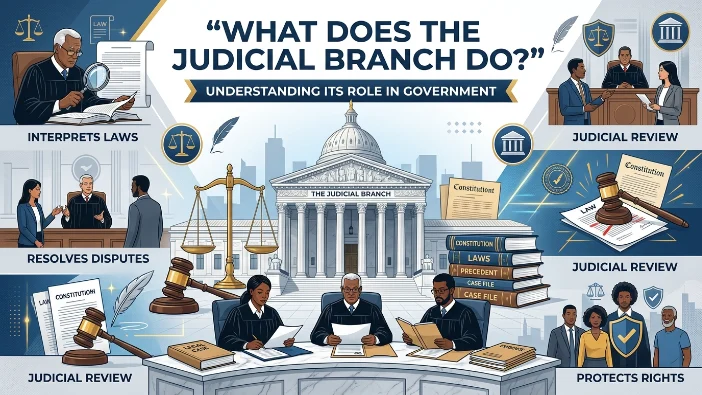
Many people ask, “What does the judicial branch do?” The answer is both simple and far-reaching. The judicial branch interprets laws, settles disputes, protects constitutional rights, reviews government actions, and ensures justice is applied fairly.
Whether a case involves a criminal offense, a business disagreement, a property dispute, or a constitutional question, the judicial branch plays a critical role in reaching a legal resolution. It serves as a safeguard against abuses of power and helps maintain stability within society.
In modern democracies, courts act as guardians of the Constitution and defenders of individual freedoms. Their decisions affect everything from voting rights and free speech to business regulations and criminal justice.
This guide explores the judicial branch in detail, including its structure, powers, responsibilities, and impact on everyday life.
What Is the Judicial Branch?
The judicial branch is the branch of government responsible for interpreting and applying laws. It consists of judges, courts, and legal institutions that work together to resolve disputes and ensure that laws are enforced fairly.
Unlike the legislative branch, which creates laws, the judicial branch focuses on understanding and applying those laws. It examines legal conflicts and determines how existing laws should be interpreted.
At its core, the judiciary answers important questions such as:
- What does a particular law mean?
- Does a law violate the Constitution?
- Was a person’s legal right violated?
- What is the proper resolution to a dispute?
These questions form the foundation of the judiciary’s work.
The Judiciary as a Neutral Referee
A useful way to understand the judiciary is to think of it as a referee in a sporting event.
Players may disagree about whether a rule was broken. The referee reviews the situation, interprets the rules, and makes a decision.
Similarly, courts examine facts, interpret laws, and issue rulings that settle disagreements.
The key difference is that judicial decisions often have long-lasting consequences that affect individuals, businesses, governments, and society as a whole.
Why the Judicial Branch Exists
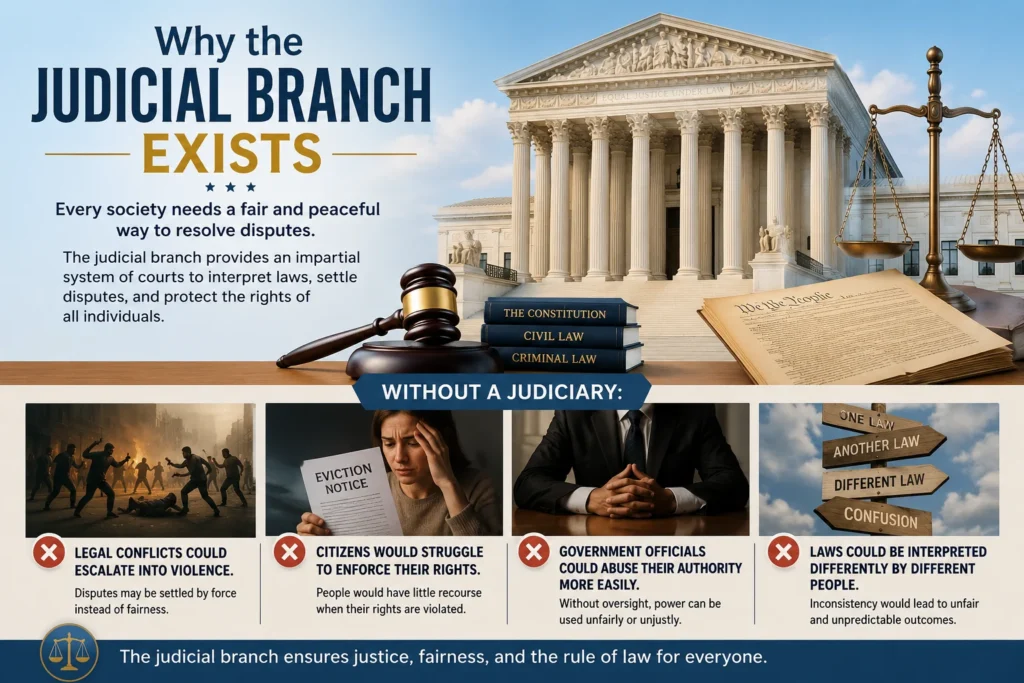
Every society needs a fair and peaceful way to resolve disputes.
Imagine a world without courts.
If someone breached a contract, stole property, or violated another person’s rights, there would be no impartial institution to determine what happened and what should be done.
Without a judiciary:
- Legal conflicts could escalate into violence.
- Citizens would struggle to enforce their rights.
- Government officials could abuse their authority more easily.
- Laws could be interpreted differently by different people.
The judicial branch prevents these problems by providing a structured legal system.
The Foundation of Justice
The judiciary helps ensure that:
- Laws are applied consistently.
- Rights are protected.
- Disputes are resolved fairly.
- Government actions remain lawful.
These goals support public trust and social stability.
When people believe courts are fair, they are more likely to accept legal outcomes even when they disagree with them.
The Structure of the Judicial Branch
The judicial branch operates through a system of courts arranged in different levels.
Each court serves a specific purpose.
Some courts hear cases for the first time. Others review decisions made by lower courts. At the top sits the highest court, which has the final authority on major legal questions.
Trial Courts
Trial courts are where most legal cases begin.
These courts hear evidence, listen to witnesses, and determine facts.
A trial court may handle:
- Criminal prosecutions
- Civil lawsuits
- Family disputes
- Property disagreements
- Contract conflicts
The trial process allows both sides to present their arguments before a judge or jury.
Appellate Courts
Not every party agrees with a trial court decision.
When legal errors are believed to have occurred, a case may move to an appellate court.
Appellate courts do not usually conduct new trials.
Instead, they review:
- Court records
- Legal arguments
- Judicial decisions
Their goal is to determine whether the law was applied correctly.
This review process helps maintain fairness and consistency throughout the legal system.
Supreme Court
The Supreme Court represents the highest level of judicial authority.
Although it hears relatively few cases compared to lower courts, its decisions often have enormous influence.
The Supreme Court typically focuses on:
- Constitutional issues
- Major legal disputes
- Conflicts among lower courts
- Significant questions affecting the nation
Its rulings often establish legal standards that shape future court decisions.
Judicial Branch Functions
Understanding the judicial branch requires understanding its primary functions.
Courts perform many responsibilities, yet several core duties define their role within government.
Interpreting Laws
One of the most important judicial branch functions is interpreting laws.
Legislation is not always perfectly clear.
Words can have multiple meanings. Circumstances can change. New technologies can create situations lawmakers never anticipated.
Courts examine legal language and determine how laws should apply.
For example, a law written decades ago may need interpretation when applied to modern digital technology.
Judges analyze:
- Statutory language
- Constitutional provisions
- Legislative intent
- Prior court decisions
This process ensures laws remain meaningful and effective.
Applying Laws to Individual Cases
Courts do more than explain laws.
They apply them.
Every legal dispute involves specific facts.
A judge must determine:
- What happened?
- Which laws apply?
- How should those laws be interpreted?
- What outcome is legally appropriate?
This process transforms abstract legal principles into real-world decisions.
Resolving Disputes
Dispute resolution is one of the oldest and most important judicial responsibilities.
Conflicts arise in countless situations.
Examples include:
- Business disagreements
- Contract disputes
- Property claims
- Family matters
- Criminal accusations
Courts provide a peaceful mechanism for resolving these issues.
Instead of allowing disagreements to escalate, parties can present evidence and receive a legally binding decision.
Protecting Individual Rights
The judicial branch serves as a powerful protector of individual freedoms.
Constitutions and laws often guarantee important rights.
These may include:
- Freedom of speech
- Freedom of religion
- Due process protections
- Equal treatment under law
- Privacy rights
When these rights are threatened, courts can intervene.
This protective function is one of the judiciary’s most significant responsibilities.
The Role of the Judicial Branch in Government
The role of the judicial branch extends beyond deciding legal disputes.
Courts influence the relationship between citizens and government.
They also help maintain the balance of power within a constitutional system.
Preserving Constitutional Principles
Constitutions establish the framework of government.
They define powers, limitations, and rights.
The judiciary helps preserve these principles by interpreting constitutional language and ensuring compliance.
This responsibility often places courts at the center of important legal debates.
Ensuring Fair Treatment
Courts strive to apply laws consistently.
Fair treatment means similar cases should receive similar outcomes.
Without judicial oversight, legal decisions could become unpredictable.
Consistency strengthens public confidence in the justice system.
Limiting Government Power
Governments possess significant authority.
However, constitutional systems typically place limits on that power.
The judiciary helps enforce those limits.
When government actions exceed legal authority, courts may intervene to protect constitutional principles.
Understanding Judicial Review
Among all judicial branch functions, judicial review is perhaps the most influential.
Judicial review gives courts the authority to evaluate laws and government actions.
What Is Judicial Review?
Judicial review is the process through which courts determine whether laws or government actions comply with constitutional requirements.
If a court concludes that a law violates the Constitution, it may declare that law unconstitutional.
This authority serves as an important check on governmental power.
Why Judicial Review Matters
Without judicial review, constitutional limitations could become difficult to enforce.
Judicial review helps:
- Protect individual freedoms
- Preserve constitutional government
- Prevent abuses of power
- Maintain checks and balances
It ensures that government officials remain accountable to constitutional principles.
Examples of Judicial Review in Practice
Judicial review can affect many areas of public life.
Courts may examine:
- Election laws
- Criminal justice policies
- Free speech restrictions
- Government regulations
- Executive actions
These decisions often influence society for decades.
Criminal Cases and the Judicial Branch
Criminal justice represents a major part of judicial activity.
Criminal cases involve allegations that an individual violated a criminal law.
In these cases, the government acts as the prosecuting party.
How Criminal Cases Work
A typical criminal case follows several stages:
- Investigation
- Arrest
- Charging
- Trial
- Verdict
- Sentencing
Throughout the process, courts ensure that legal procedures are followed.
Judges help protect constitutional rights while maintaining fairness for all parties involved.
The Importance of Due Process
Due process is a fundamental legal principle.
It requires fair treatment under the law.
Courts help ensure that defendants receive:
- Notice of charges
- Legal representation
- Fair hearings
- Opportunity to present evidence
- Protection against unlawful actions
These safeguards help prevent wrongful convictions and protect individual liberties.
Civil Cases and Legal Disputes
Not every court case involves a crime.
Many disputes arise between private individuals, businesses, or organizations.
These cases fall under civil law.
Civil courts resolve disagreements and determine legal responsibility.
Common examples include:
- Contract disputes
- Property disagreements
- Personal injury claims
- Employment conflicts
- Consumer disputes
Unlike criminal cases, civil cases generally focus on compensation rather than punishment.
A successful plaintiff may receive financial damages or other legal remedies.
The judiciary’s ability to resolve civil disputes peacefully plays a crucial role in maintaining social and economic stability.
Judges and Courts Duties: The People Behind Judicial Decisions
The judicial branch would not function without judges. They are the individuals responsible for applying the law, managing court proceedings, and ensuring that justice is administered fairly.
Many people imagine judges simply sitting in courtrooms and issuing rulings. In reality, their responsibilities extend far beyond what most people see.
Judges analyze evidence, review legal arguments, interpret statutes, examine constitutional questions, and write detailed legal opinions that may influence future cases.
Core Duties of Judges
Judges perform numerous tasks during legal proceedings, including:
- Presiding over hearings and trials
- Interpreting laws and regulations
- Ensuring courtroom procedures are followed
- Evaluating evidence
- Issuing legal rulings
- Protecting constitutional rights
- Determining appropriate remedies or sentences
- Writing judicial opinions
These responsibilities require extensive legal knowledge and impartial decision-making.
Why Judicial Neutrality Matters
One of the most important principles in the judiciary is neutrality.
Judges are expected to make decisions based on facts and law rather than personal beliefs, political pressure, or public opinion.
A fair judicial system depends on public confidence that judges will treat all parties equally.
Without judicial independence and neutrality, the justice system could lose credibility.
Judicial Ethics and Accountability
Judges operate under strict ethical standards.
These standards require them to:
- Avoid conflicts of interest
- Remain impartial
- Follow legal principles
- Protect fairness
- Maintain professional conduct
Judicial ethics help preserve trust in the court system and ensure decisions are based on law rather than favoritism.
Constitutional Interpretation: One of the Judiciary’s Most Powerful Responsibilities
The Constitution serves as the highest legal authority in many democratic governments. Because constitutional language often contains broad principles rather than detailed instructions, courts must interpret its meaning.
This process is known as constitutional interpretation.
Why Constitutional Interpretation Is Necessary
Many constitutional provisions were written using broad language.
Examples include concepts such as:
- Equal protection
- Due process
- Freedom of speech
- Freedom of religion
- Unreasonable searches
These principles must be applied to situations that may not have existed when the Constitution was originally written.
For instance, modern courts frequently address questions involving:
- Social media
- Digital privacy
- Artificial intelligence
- Electronic surveillance
- Online speech
The judiciary helps determine how constitutional protections apply in these new circumstances.
Challenges of Constitutional Interpretation
Constitutional interpretation is rarely simple.
Judges often face difficult questions such as:
- What did the constitutional language originally mean?
- How should broad principles apply today?
- How should conflicting rights be balanced?
- What limits should exist on government authority?
These questions shape many of the most important legal decisions in society.
Impact on Everyday Life
Constitutional interpretation affects ordinary citizens more than many people realize.
Court decisions influence issues such as:
- Voting access
- Education
- Employment rights
- Religious freedom
- Criminal procedure
- Privacy protections
As society changes, constitutional interpretation continues to evolve alongside new legal challenges.
The Supreme Court Role in the Judicial Branch
The Supreme Court occupies a unique position within the judicial system.
Although it hears relatively few cases compared to lower courts, its decisions often have nationwide consequences.
What Makes the Supreme Court Different?
The Supreme Court functions as the highest judicial authority.
Its primary responsibilities include:
- Interpreting constitutional provisions
- Resolving major legal disputes
- Reviewing lower court decisions
- Establishing legal precedent
- Ensuring consistency in legal interpretation
When the Supreme Court issues a ruling, lower courts generally must follow that interpretation.
Why Supreme Court Decisions Matter
Supreme Court decisions can affect millions of people.
A single ruling may influence:
- Government policies
- Business practices
- Individual rights
- Law enforcement procedures
- Election regulations
Because of this influence, Supreme Court cases often receive significant public attention.
The Long-Term Impact of Supreme Court Rulings
Unlike ordinary disputes that affect only a few individuals, Supreme Court decisions frequently shape legal doctrine for decades.
Many landmark rulings continue influencing legal interpretation long after the original case has ended.
This lasting impact highlights the importance of the Supreme Court’s role within the judicial branch.
Separation of Powers and the Judicial Branch
A key feature of constitutional government is the separation of powers.
This principle divides governmental authority among multiple branches.
Instead of concentrating power in a single institution, responsibilities are distributed to prevent abuse.
The Three Branches of Government
Government typically consists of three branches:
| Branch | Primary Responsibility |
|---|---|
| Legislative | Creates laws |
| Executive | Enforces laws |
| Judicial | Interprets laws |
Each branch performs a different function.
This structure helps maintain balance and accountability.
Why Separation of Powers Matters
History has shown that concentrated power can threaten liberty.
The separation of powers helps prevent any branch from gaining excessive control.
Benefits include:
- Increased accountability
- Greater transparency
- Protection of individual rights
- Prevention of authoritarian rule
The judiciary plays an essential role in maintaining this balance.
Judicial Branch Responsibilities Within the Separation of Powers
The judicial branch does not create laws or enforce them.
Instead, it determines:
- What laws mean
- Whether laws comply with constitutional requirements
- How laws apply to specific situations
By performing this role independently, courts help preserve constitutional governance.
Checks and Balances System
Closely connected to the separation of powers is the concept of checks and balances.
Checks and balances ensure that each branch can limit certain actions of the others.
This system reduces the risk of excessive governmental power.
How the Judicial Branch Checks Other Branches
The judiciary can review actions taken by both legislative and executive authorities.
Courts may examine:
- New laws
- Government regulations
- Executive orders
- Administrative actions
If these actions violate constitutional principles, courts can intervene.
Judicial Review as a Check
Judicial review serves as one of the most important checks within government.
Through judicial review, courts can:
- Strike down unconstitutional laws
- Block unlawful government actions
- Protect constitutional rights
- Reinforce legal limits on authority
This power helps preserve the balance intended by constitutional systems.
How Other Branches Influence the Judiciary
Checks and balances operate in multiple directions.
While courts can review government actions, other branches also influence the judiciary.
Examples include:
- Judicial appointments
- Budget decisions
- Court organization
- Constitutional amendments
These interactions help ensure no branch operates without accountability.
Legal Decision Making in the Court System
Legal decision making is one of the judiciary’s most important responsibilities.
Every court ruling requires careful analysis.
Judges cannot simply rely on personal opinions. Instead, they must apply established legal principles to the facts of each case.
Elements Considered During Judicial Decision Making
When deciding a case, judges typically evaluate:
- Relevant laws
- Constitutional provisions
- Court precedents
- Evidence
- Witness testimony
- Legal arguments
Each factor contributes to the final decision.
Balancing Competing Interests
Many legal disputes involve competing rights or interests.
For example:
- Freedom of speech versus public safety
- Privacy versus security
- Property rights versus government regulation
Courts often must balance these competing concerns while remaining faithful to legal principles.
Importance of Reasoned Decisions
Judicial decisions are generally accompanied by written explanations.
These explanations help:
- Clarify legal reasoning
- Promote transparency
- Guide future courts
- Increase public understanding
A well-reasoned opinion strengthens confidence in the justice system.
Court Rulings and Decisions: How Courts Shape Society
Court rulings do more than settle individual disputes.
They frequently influence broader social, economic, and political developments.
Every judicial decision contributes to the evolution of legal interpretation.
Immediate Effects of Court Decisions
Court rulings can:
- Resolve conflicts
- Award compensation
- Determine guilt or innocence
- Clarify legal obligations
- Protect legal rights
For the parties involved, these decisions often have life-changing consequences.
Broader Social Impact
Some rulings affect entire communities or even entire nations.
Major judicial decisions can influence:
- Education policies
- Business regulations
- Employment practices
- Civil rights protections
- Government authority
This broader impact explains why courts play such a significant role in public life.
Written Opinions and Legal Guidance
Judges often publish detailed opinions explaining their reasoning.
These opinions become valuable resources for:
- Lawyers
- Future judges
- Government agencies
- Businesses
- Citizens
They help create consistency throughout the legal system.
Precedent in Law: Why Previous Cases Matter
One of the defining features of many legal systems is the use of precedent.
Precedent refers to earlier judicial decisions that guide future cases involving similar issues.
What Is Legal Precedent?
When courts decide important legal questions, those decisions often become reference points for later cases.
Future judges may rely on those rulings when addressing similar disputes.
This practice promotes consistency throughout the legal system.
Benefits of Legal Precedent
Precedent offers several advantages:
- Predictability
- Stability
- Fairness
- Efficiency
People can better understand their legal rights and obligations when courts apply legal principles consistently.
How Precedent Influences Court Decisions
Judges frequently examine prior rulings before reaching conclusions.
Questions often include:
- Has a similar issue been decided before?
- What reasoning was used?
- Should that reasoning apply here?
By considering precedent, courts build a more coherent legal framework.
Why Consistency Matters in the Judiciary
Imagine if every judge interpreted laws completely differently.
Citizens would struggle to understand their rights.
Businesses would face uncertainty.
Government agencies would encounter confusion.
Consistency helps avoid these problems.
Through precedent and careful legal reasoning, courts create a stable environment where laws can function effectively.
This consistency is one of the judiciary’s greatest contributions to society.
As legal systems become more complex, the importance of predictable judicial decision-making continues to grow.
Criminal and Civil Cases: The Heart of Judicial Operations
When people picture the judicial branch, they often imagine dramatic courtroom scenes from television shows. While these portrayals sometimes exaggerate reality, they highlight an important truth: courts spend much of their time handling criminal and civil cases.
These two categories form the foundation of judicial work.
Understanding how they differ helps explain many of the court system’s responsibilities.
Criminal Cases and the Pursuit of Justice
Criminal cases involve actions that lawmakers have defined as offenses against society.
Examples include:
- Theft
- Assault
- Fraud
- Robbery
- Homicide
- Drug offenses
- Cybercrime
In criminal proceedings, the government prosecutes the accused person.
The central question is whether the defendant violated criminal law.
Goals of Criminal Courts
Criminal courts serve several purposes:
- Determining guilt or innocence
- Protecting public safety
- Enforcing criminal laws
- Upholding constitutional protections
- Providing fair trials
A criminal conviction can result in penalties such as:
- Fines
- Probation
- Community service
- Imprisonment
Because these consequences are serious, courts apply strict legal standards during criminal proceedings.
Burden of Proof in Criminal Cases
One of the most important principles in criminal law is the burden of proof.
The prosecution must prove guilt beyond a reasonable doubt.
This high standard exists because the justice system seeks to avoid wrongful convictions.
The principle reflects a longstanding belief that protecting innocent individuals is essential to a fair legal system.
Civil Cases and Private Disputes
Civil cases differ significantly from criminal matters.
Instead of addressing crimes against society, civil courts resolve disputes between individuals, businesses, organizations, or government entities.
Common civil disputes include:
- Contract disagreements
- Property conflicts
- Employment issues
- Personal injury claims
- Consumer disputes
- Family law matters
These cases focus on resolving disagreements and providing remedies.
Remedies Available in Civil Courts
Civil courts may order various forms of relief, including:
- Monetary compensation
- Property transfers
- Enforcement of agreements
- Injunctions
- Declaratory judgments
Unlike criminal courts, civil courts generally do not impose imprisonment.
Comparing Criminal and Civil Proceedings
| Feature | Criminal Cases | Civil Cases |
|---|---|---|
| Purpose | Punish unlawful conduct | Resolve disputes |
| Parties | Government vs Defendant | Plaintiff vs Defendant |
| Burden of Proof | Beyond a reasonable doubt | Preponderance of evidence |
| Potential Outcome | Conviction or acquittal | Liability or no liability |
| Penalties | Jail, fines, probation | Damages, injunctions |
Both systems play essential roles within the judicial branch.
Protection of Constitutional Rights
One of the most important duties of the judicial branch is protecting constitutional rights.
Constitutions establish fundamental freedoms and legal protections. Courts help ensure these guarantees remain meaningful.
Without judicial enforcement, constitutional rights could become vulnerable to abuse.
Rights Protected by the Judiciary
Courts regularly address cases involving:
- Freedom of speech
- Freedom of religion
- Freedom of assembly
- Due process
- Equal protection
- Voting rights
- Privacy rights
- Property rights
These protections form the foundation of individual liberty.
Why Courts Are Essential for Rights Protection
Rights often face challenges from:
- Government actions
- Private organizations
- Individuals
- New technologies
- Social and political pressures
Courts provide an independent forum where those challenges can be evaluated fairly.
This judicial oversight helps preserve constitutional principles across generations.
Balancing Rights and Public Interests
Rights are important, yet courts frequently encounter situations where competing interests must be balanced.
Examples include:
- Free speech versus public safety
- Privacy versus national security
- Religious freedom versus government regulation
Judges carefully examine these issues and attempt to reach legally sound decisions.
The process is rarely simple. However, it remains essential to maintaining constitutional government.
Enforcement of Legal Rights
The judicial branch does more than recognize rights. It helps enforce them.
A right that cannot be enforced provides little practical protection.
Courts ensure that legal guarantees have real-world value.
How Courts Enforce Rights
Judicial enforcement may involve:
- Issuing court orders
- Awarding compensation
- Blocking unlawful actions
- Requiring compliance with legal obligations
- Protecting constitutional freedoms
These remedies help transform legal principles into practical protections.
Access to Justice
Access to courts is a cornerstone of democratic societies.
When individuals believe their rights have been violated, they need a place where they can seek redress.
Courts provide that forum.
Access to justice supports:
- Fairness
- Accountability
- Equality before the law
- Public confidence
Without meaningful access to courts, many rights would be difficult to enforce.
The Rule of Law: The Foundation of the Judicial Branch
The concept of the rule of law lies at the heart of the judicial system.
It is one of the most important principles in modern government.
What Is the Rule of Law?
The rule of law means that laws govern society rather than individuals acting on personal power.
Under the rule of law:
- Everyone is subject to the law.
- Government officials must follow legal rules.
- Rights receive protection.
- Legal disputes are resolved through established procedures.
This principle promotes fairness and stability.
Why the Rule of Law Matters
Societies depend on predictable legal systems.
Citizens need confidence that:
- Laws apply equally.
- Rights are protected.
- Courts operate fairly.
- Government power has limits.
The judiciary helps maintain these protections.
Judicial Independence and the Rule of Law
The rule of law depends heavily on judicial independence.
Judges must be free to decide cases without improper influence.
Independent courts strengthen:
- Public trust
- Legal fairness
- Constitutional government
- Democratic institutions
Without judicial independence, legal outcomes could become vulnerable to political pressure or favoritism.
Real-World Examples of Judicial Branch Functions
Understanding theory is important. Seeing how judicial branch functions operate in practice provides additional insight.
Example: Resolving a Contract Dispute
Imagine a business hires a supplier to deliver products.
The supplier fails to fulfill the agreement.
The business files a lawsuit.
The court may:
- Review the contract
- Examine evidence
- Interpret legal obligations
- Determine responsibility
- Award damages if appropriate
This process demonstrates dispute resolution in action.
Example: Protecting Free Speech
Suppose a government policy restricts certain forms of expression.
Citizens challenge the policy in court.
Judges evaluate:
- Constitutional protections
- Government interests
- Legal precedent
The court then determines whether the restriction is lawful.
This illustrates constitutional interpretation and rights protection.
Example: Reviewing Government Authority
A government agency adopts a new regulation.
Affected individuals argue that the agency exceeded its legal authority.
Courts review:
- Relevant laws
- Constitutional requirements
- Administrative procedures
The judiciary determines whether the action complies with legal standards.
This reflects the role of judicial review.
How Judicial Decisions Affect Everyday Life
Many people rarely visit a courtroom. Even so, judicial decisions influence their daily lives.
Court rulings affect areas such as:
- Employment
- Housing
- Education
- Business operations
- Consumer protection
- Property ownership
- Family relationships
- Civil liberties
The judiciary’s impact extends far beyond courtroom walls.
Business and Economic Stability
Businesses rely on courts to:
- Enforce contracts
- Protect intellectual property
- Resolve disputes
- Clarify regulations
A predictable judicial system encourages economic growth and investment.
Public Confidence in Institutions
When courts function effectively, citizens gain confidence that disputes can be resolved fairly.
This trust contributes to social stability and strengthens democratic governance.
Common Misunderstandings About the Judicial Branch
Despite its importance, many misconceptions surround the judiciary.
“The Judicial Branch Makes Laws”
This is one of the most common misunderstandings.
Legislatures create laws.
Courts interpret and apply them.
Although judicial decisions can influence legal development, courts do not serve as lawmakers.
“Judges Can Ignore the Constitution”
Judges are bound by constitutional and legal principles.
Their authority comes from the law itself.
Judicial legitimacy depends on adherence to established legal standards.
“The Supreme Court Handles Every Important Case”
In reality, the highest court reviews only a small percentage of cases.
Most legal disputes are resolved in lower courts.
Those lower courts perform much of the judiciary’s daily work.
“Courts Only Deal With Criminal Matters”
Civil litigation represents a substantial portion of court activity.
Property disputes, contract disagreements, family matters, and business conflicts all fall within judicial responsibilities.
Major Functions of the Judicial Branch Summary
The judicial branch performs a wide range of essential duties.
Primary Judicial Branch Functions
| Function | Purpose |
|---|---|
| Law Interpretation | Clarify legal meaning |
| Judicial Review | Evaluate constitutionality |
| Dispute Resolution | Resolve legal conflicts |
| Rights Protection | Defend individual freedoms |
| Constitutional Interpretation | Apply constitutional principles |
| Criminal Justice | Adjudicate criminal cases |
| Civil Justice | Resolve private disputes |
| Precedent Development | Guide future decisions |
| Rule of Law Enforcement | Ensure legal consistency |
| Government Oversight | Limit unlawful actions |
Together, these responsibilities support a stable and fair legal system.
Frequently Asked Questions
What does the judicial branch do in simple terms?
The judicial branch interprets laws, resolves disputes, protects rights, reviews government actions, and ensures that laws comply with constitutional principles.
What is the main purpose of the judicial branch?
The primary purpose is to administer justice by interpreting and applying laws fairly while protecting constitutional rights and maintaining the rule of law.
Why is judicial review important?
Judicial review allows courts to determine whether laws and government actions comply with constitutional requirements. It helps prevent abuses of power and protects individual freedoms.
What types of cases do courts hear?
Courts hear criminal cases, civil disputes, constitutional challenges, administrative matters, and many other legal issues.
What role do judges play?
Judges interpret laws, oversee court proceedings, evaluate evidence, issue rulings, and ensure fairness within the legal process.
How does the judicial branch fit into checks and balances?
The judiciary reviews actions taken by other branches of government and helps ensure that those actions remain within constitutional limits.
Conclusion
The answer to “what does the judicial branch do?” encompasses far more than courtroom proceedings.
The judicial branch serves as the interpreter of laws, the protector of constitutional rights, the resolver of disputes, and the guardian of the rule of law. Through judges and courts, it transforms legal principles into practical outcomes that affect individuals, businesses, governments, and entire societies.
The judiciary maintains fairness, promotes accountability, and helps preserve constitutional government. Its authority to interpret laws, review government actions, and protect legal rights makes it one of the most influential institutions in any democratic system.
From criminal prosecutions and civil lawsuits to constitutional interpretation and judicial review, the functions of the judicial branch touch nearly every aspect of public life.
Without an independent judiciary, constitutional protections would be weaker, legal disputes would be more difficult to resolve, and the balance of power within government would be harder to maintain.
In short, the judicial branch exists to ensure that justice is administered fairly, rights are protected consistently, and the law remains the guiding force of society. That responsibility makes the judiciary not only a branch of government but also one of the strongest pillars supporting freedom, stability, and democratic governance.

Michael Anderson is a content writer specializing in word meanings, definitions and clear explanations of modern terms and phrases.