
Last Updated on June 17, 2026
FWB means Friends With Benefits. It describes a relationship where two people maintain a friendship while also engaging in casual sexual intimacy without romantic commitment. An FWB relationship sits between friendship and dating. It involves physical connection but avoids labels like boyfriend or girlfriend. People use FWB in texting, Snapchat, dating apps, and social media slang to describe a no-strings-attached arrangement based on mutual consent, clear boundaries, and emotional detachment. However, FWB relationships can become complicated if feelings develop or expectations change.
The term FWB (Friends With Benefits) describes a relationship where two people:
- Are friends first
- Engage in physical intimacy
- Avoid romantic commitment
- Agree on “no strings attached” rules
At its core, the meaning of FWB sits inside modern dating culture, where labels feel flexible and people often explore relationships outside traditional structures.
Unlike a romantic partner, an FWB arrangement does not include:
- Exclusivity
- Long-term commitment
- Emotional dependency as a requirement
- Relationship titles like boyfriend or girlfriend
Instead, it focuses on mutual physical attraction + friendship + clear boundaries.
FWB Full Form and Definition
What does FWB stand for?
FWB stands for Friends With Benefits.
FWB definition
An FWB relationship is:
A consensual arrangement where two people maintain friendship while also engaging in sexual activity without romantic commitment.
This places FWB inside broader categories like:
- Casual dating
- Hookup culture
- NSA (No Strings Attached) relationships
- Non-exclusive romantic involvement
FWB as a Dating Term in Internet Slang
FWB is widely used in:
- Text messages
- Snapchat chats
- Instagram DMs
- Dating apps like Tinder or Bumble
- Online forums and social media slang
It belongs to the category of texting acronyms and internet slang, just like:
- DM (Direct Message)
- OTP (One True Pairing)
- LTR (Long-Term Relationship)
- NSA (No Strings Attached)
People often use FWB as a quick label to describe relationship status without explaining everything.
How a Friends With Benefits (FWB) Relationship Works
Core Structure of an FWB Arrangement
A typical FWB relationship includes three key elements:
- Friendship foundation
- Physical intimacy
- No romantic commitment
Table: FWB vs Other Relationship Types
| Relationship Type | Emotional Bond | Physical Intimacy | Commitment | Exclusivity |
|---|---|---|---|---|
| Friendship | Yes | No | No | No |
| FWB | Moderate | Yes | No | Usually No |
| Casual Dating | Moderate | Yes | Low | Sometimes |
| Romantic Relationship | Strong | Yes | High | Often Yes |
| Situationship | Confused | Yes | Unclear | Unclear |
Why People Choose FWB Relationships
People enter Friends With Benefits (FWB) arrangements for several reasons:
- They want intimacy without commitment
- They are not ready for a romantic relationship
- They enjoy physical connection without emotional pressure
- They prefer flexibility in modern dating
- They want companionship without labels
In modern relationship culture, FWB often fits people who value independence but still want closeness.
FWB in Hookup Culture and Modern Dating
FWB sits inside hookup culture, which includes:
- Casual sex
- Short-term connections
- Non-exclusive relationships
- Flexible emotional boundaries
Unlike a pure hookup, FWB adds:
- Friendship
- Ongoing interaction
- Familiarity and trust
So it becomes more stable than a hookup but less serious than dating.
FWB Meaning in Text, Snapchat, and Social Media
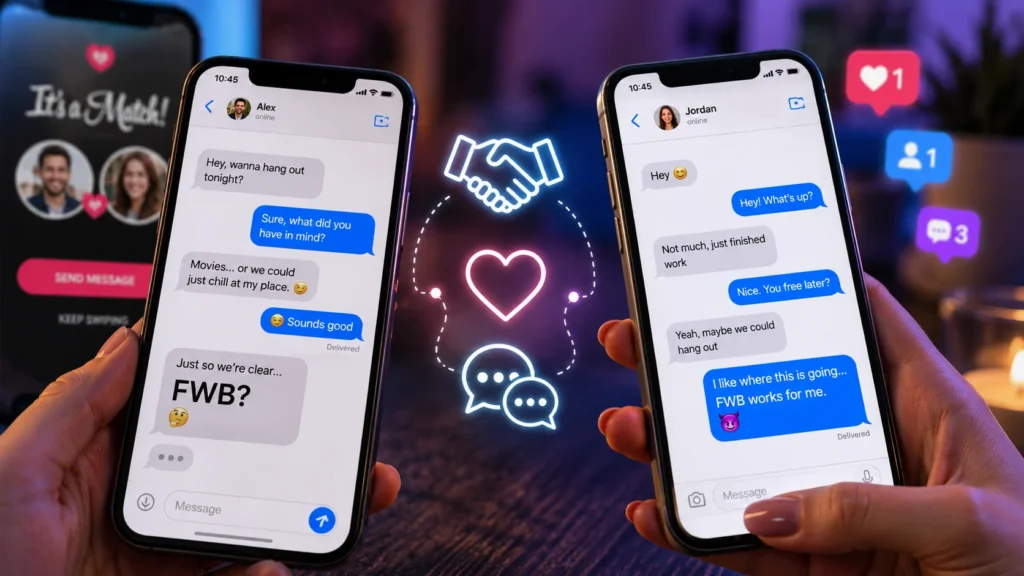
What does FWB mean in texting?
When someone texts “FWB,” they usually mean:
- “Are we friends with benefits?”
- “I see you as a casual partner”
- “This is not a serious relationship”
It helps avoid long explanations.
What does FWB mean on Snapchat?
On Snapchat, FWB often signals:
- Casual relationship interest
- Private communication
- Non-official connection
Snapchat’s disappearing messages make it popular for casual and informal dating communication.
What does FWB mean on dating apps?
On dating apps, FWB can mean:
- User is open to casual intimacy
- User does not want commitment
- User prefers flexible relationship structure
It often appears alongside terms like:
- “casual”
- “no strings attached”
- “short-term fun”
Rules of a Friends With Benefits Relationship
Why rules matter in FWB relationships
Without rules, FWB often becomes emotionally confusing. Clear boundaries help both people avoid misunderstandings.
Common FWB Rules
Here are widely accepted rules in Friends With Benefits (FWB) arrangements:
- Be honest about intentions
- Avoid romantic expectations
- Set emotional boundaries early
- Respect personal space
- Communicate regularly
- Avoid jealousy-driven behavior
- Keep it consensual at all times
Emotional Boundaries in FWB
Emotional boundaries are critical because FWB mixes:
- Friendship
- Physical intimacy
- Emotional connection risk
Without boundaries, one person may develop feelings while the other does not.
Consent and Mutual Agreement
Every FWB relationship depends on:
- Clear consent
- Mutual agreement
- Ongoing communication
Without these, the arrangement becomes unhealthy or unclear.
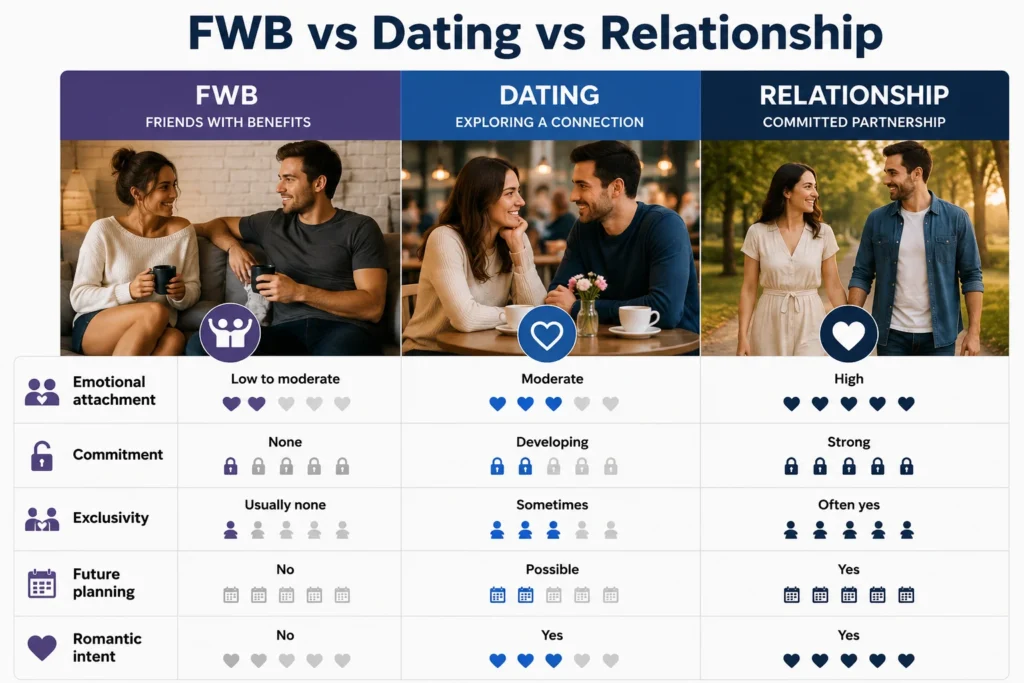
FWB vs Dating: Key Differences Explained
Is FWB the same as dating?
No. FWB is not the same as dating.
Dating involves:
- Romantic interest
- Emotional bonding
- Future potential
- Relationship progression
FWB involves:
- No romantic label
- No commitment expectation
- Physical connection focus
FWB vs Dating vs Relationship
How Long Do FWB Relationships Last?
There is no fixed timeline
FWB relationships don’t have a standard duration.
They can last:
- A few weeks
- Several months
- Occasionally years
But most follow a pattern: they change or end when emotions shift.
What usually ends FWB
FWB relationships typically end when:
- One person develops romantic feelings
- Someone starts a serious relationship elsewhere
- Emotional boundaries break down
- Communication becomes awkward
Why FWB rarely stays stable long-term
The main reason is simple:
Human emotions evolve faster than casual agreements.
Even if two people agree on “no feelings,” repeated closeness can change that.
Can FWB Turn Into a Relationship?
One of the most searched questions is:
“Can friends with benefits turn into a real relationship?”
The answer is: sometimes, but not often by design.
When FWB becomes a relationship
It usually happens when:
- Emotional connection grows naturally
- Both people start prioritizing each other
- Jealousy appears and is acknowledged
- Communication becomes deeper and more consistent
- Future plans start to matter
At that point, the label quietly shifts from FWB → dating → relationship.
When it does NOT turn into a relationship
FWB stays casual when:
- One person wants to keep things light
- Emotional imbalance exists
- Boundaries stay strict
- Neither person wants commitment
Table: FWB evolution outcomes
| Outcome | Probability | Explanation |
|---|---|---|
| Becomes relationship | Medium | Happens if emotions align |
| Ends completely | High | Most common outcome |
| Becomes friendship only | Medium | After boundaries reset |
| Continues indefinitely | Low | Rare long-term stability |
FWB vs Love: What’s the Difference?
FWB is structured around:
- Convenience
- Physical attraction
- Emotional limits
- Flexibility
Love is different
Love in a romantic relationship involves:
- Emotional investment
- Long-term commitment
- Future planning
- Exclusivity (in most cases)
- Deep attachment
Simple comparison
- FWB = “I enjoy you, but I’m not building a future with you.”
- Love = “I want you in my life long-term, emotionally and practically.”
FWB in Modern Dating Culture
Why FWB became so common today
FWB didn’t appear randomly. It grew with modern life changes:
- Rise of dating apps
- Shift away from traditional relationship timelines
- More independence in younger generations
- Normalization of casual intimacy
- Social media slang shaping communication
FWB and hookup culture
FWB sits between:
- Hookups (one-time encounters)
- Dating (romantic progression)
It offers:
- Stability of repeated connection
- Flexibility of no commitment
- Familiarity without labels
FWB and emotional independence trend
Modern dating often values:
- Personal freedom
- Career focus
- Emotional self-sufficiency
FWB fits this mindset because it reduces relationship pressure.
Pros and Cons of FWB Relationships
Pros of FWB
FWB can work well when both people are aligned.
Benefits include:
- No relationship pressure
- Physical intimacy without commitment
- Emotional freedom
- Flexibility in dating life
- Familiar partner instead of strangers
Cons of FWB
But it comes with trade-offs:
- Emotional confusion
- Risk of heartbreak
- Unclear boundaries
- Potential friendship loss
- Jealousy issues
Table: FWB Pros vs Cons
| Pros | Cons |
|---|---|
| Freedom | Emotional risk |
| Physical connection | Confusion |
| No pressure | Jealousy |
| Flexibility | Unclear future |
Healthy vs Unhealthy FWB Dynamics
Healthy FWB looks like:
- Clear communication
- Mutual understanding
- Emotional control
- Respect for boundaries
- No pressure for commitment
Unhealthy FWB looks like:
- One-sided feelings
- Hidden expectations
- Emotional dependency
- Frequent arguments
- Confusion about status
Key warning sign
If you constantly ask:
“What are we?”
Then the FWB structure may no longer be working.
Final Meaning of FWB in Real Life
So what does FWB really mean?
FWB means more than just a slang term.
It represents a modern shift in relationships where:
- People seek connection without labels
- Physical intimacy is separated from commitment
- Emotional boundaries are tested
- Communication becomes essential
Simple final definition
Friends With Benefits (FWB) is a casual relationship where two people remain friends while engaging in physical intimacy without romantic commitment or long-term expectations.
FWB vs Situationship vs NSA Relationship
What is the difference?
These terms often confuse people, but they are not the same.
FWB (Friends With Benefits)
- Friendship + physical intimacy
- No romantic commitment
Situationship
- Undefined romantic connection
- Emotional confusion
- No clear label
NSA (No Strings Attached)
- Pure physical connection
- No friendship requirement
- No emotional involvement
Table Comparison
| Term | Friendship | Romance | Physical Intimacy | Clarity |
|---|---|---|---|---|
| FWB | Yes | No | Yes | Moderate |
| Situationship | Sometimes | Yes | Yes | Low |
| NSA | No | No | Yes | High (emotionally detached) |
Common Questions About FWB
What does FWB mean from a girl or guy?
It depends on context, but usually:
- It signals casual intent
- It avoids romantic labeling
- It shows interest in non-committed connection
How long do FWB relationships last?
FWB relationships vary:
- A few weeks
- Several months
- Sometimes years
They often end when:
- Feelings develop
- Someone starts dating someone else
- Boundaries break
What are the risks of FWB?
Common risks include:
- Emotional attachment
- Miscommunication
- Jealousy
- Friendship damage
- Unequal expectations
Healthy FWB Relationship Guidelines
How to make FWB work smoothly
To maintain balance:
- Talk openly about expectations
- Check in emotionally
- Respect boundaries
- Avoid mixed signals
- Don’t assume exclusivity
Signs an FWB relationship is unhealthy
Watch for:
- One-sided emotional attachment
- Avoidance of communication
- Constant jealousy
- Confusion about status
- Pressure or manipulation
When to end an FWB arrangement
End it when:
- Feelings are no longer mutual
- Boundaries break repeatedly
- Emotional stress increases
- One person wants commitment and the other doesn’t
FWB in Modern Relationship Culture
Why FWB became popular
FWB reflects shifts in:
- Dating apps
- Social media communication
- Changing relationship expectations
- Increased independence in relationships
FWB in online dating culture
Modern dating platforms encourage:
- Fast connections
- Casual interaction
- Flexible relationship labels
FWB fits naturally into this environment.
Impact of social media slang on FWB
Social media spreads terms like FWB quickly, making them:
- Widely recognized
- Frequently misunderstood
- Common in everyday communication
Final Summary Table
| Aspect | FWB Reality |
|---|---|
| Meaning | Friends with benefits |
| Nature | Casual, non-committed |
| Focus | Physical intimacy + friendship |
| Risk | Emotional confusion |
| Success factor | Clear communication |
FAQs
What does FWB stand for?
FWB stands for Friends With Benefits. It describes a casual arrangement where two people are friends and also share physical intimacy without being in a romantic relationship.
What does FWB mean in text messages?
In texting, FWB usually means a casual, non-committed relationship. It signals that two people are friendly and physically involved but not dating in a romantic sense.
What does FWB mean on Snapchat or social media?
On Snapchat or social media, FWB refers to a private casual connection where people interact informally without labeling the relationship as serious or exclusive.
Is FWB a real relationship?
FWB is a type of relationship, but it is not a romantic one. It is better described as a casual arrangement based on friendship and physical intimacy without commitment.
What is the difference between FWB and dating?
Dating involves romantic interest, emotional bonding, and future potential. FWB focuses on casual physical connection without long-term expectations or labels.
Can friends with benefits fall in love?
Yes, it can happen. Emotional attachment may develop over time due to closeness, trust, and repeated interaction. However, it often creates complications if feelings are not mutual.
What are the rules of a friends with benefits relationship?
Common FWB rules include:
- Clear communication
- No romantic expectations
- Respect for boundaries
- Mutual consent
- Emotional honesty
- Avoiding jealousy and possessiveness
Is FWB the same as a situationship?
No. An FWB relationship is usually clear about physical intimacy and friendship, while a situationship is emotionally unclear and often romantic without definition.
How long do FWB relationships last?
FWB relationships can last from a few weeks to several months or longer. They usually end when emotions change, boundaries break, or someone starts a serious relationship.
Can FWB turn into a serious relationship?
Yes, but only if both people develop mutual romantic feelings and are willing to shift from casual to committed dating. It is not guaranteed.
What does FWB mean from a girl or guy?
It means the same regardless of gender: a mutual agreement for a casual, non-committed relationship with physical intimacy.
Conclusion
FWB, or Friends With Benefits, is more than just internet slang. It reflects how modern relationships have become more flexible, less structured, and heavily based on personal choice.
At its core, FWB combines two things that don’t always mix easily:
- Friendship
- Physical intimacy without romantic commitment
This arrangement sits between casual dating and romantic relationships. It offers freedom and flexibility, but it also requires emotional maturity and strong communication.
The biggest truth about FWB is simple: it only works when both people want the same thing at the same time. Once expectations shift, the dynamic can quickly become confusing or emotional.
In modern dating culture, FWB shows us something important relationships are no longer one-size-fits-all. People now choose connections based on comfort, timing, and emotional readiness rather than strict labels.
So when someone asks, “what does FWB mean?”, the real answer is not just a definition. It’s a reflection of how people today navigate closeness, independence, and intimacy in a fast-changing world.

Michael Anderson is a content writer specializing in word meanings, definitions and clear explanations of modern terms and phrases.