Last Updated on June 16, 2026
What does athlete’s foot look like? Athlete’s foot usually appears as a red, itchy, scaly rash that develops between the toes or on the soles of the feet. The skin may peel, crack, turn white and soggy, or become dry and flaky. Some people develop small fluid-filled blisters, while others experience thickened, rough skin that spreads across the sole in a moccasin-like pattern. The appearance varies depending on the type and stage of the fungal infection.
Athlete’s foot can look surprisingly different from one person to another. For some people, it starts as a little itching between the toes. For others, it appears as dry, flaky skin that resembles simple dryness. In severe cases, the skin cracks open, blisters form, and walking becomes painful.
That variety is exactly why many people ask: What does athlete’s foot look like?
The short answer is that athlete’s foot usually appears as a red, itchy, scaly, or peeling rash on the feet, especially between the toes. The skin may become white and soggy, crack open, develop blisters, or thicken over time. The exact appearance depends on the type of infection and how long it has been present.
Athlete’s foot, medically known as tinea pedis, is one of the most common fungal skin infections worldwide. It affects millions of people each year and thrives in warm, moist environments such as sweaty shoes, locker rooms, swimming pools, and gym showers.
At a Glance: What Does Athlete’s Foot Look Like?
| Feature | Common Appearance |
|---|---|
| Color | Red, pink, or inflamed skin |
| Texture | Scaly, flaky, peeling, or cracked |
| Location | Between toes, soles, sides of feet |
| Moisture | White, soggy skin between toes |
| Sensation | Itching, burning, stinging |
| Severe cases | Blisters, ulcers, deep cracks |
| Chronic cases | Thickened, rough skin |
Typical signs include:
- Itchy skin between the toes
- Peeling or flaking skin
- White soggy skin in toe webs
- Red rash on the feet
- Burning or stinging sensation
- Cracked skin that may bleed
- Dry, scaly soles
- Small fluid-filled blisters
The infection often begins subtly. Many people assume they simply have dry skin until the itching and peeling become impossible to ignore.
What Is Athlete’s Foot?
Athlete’s foot is a fungal infection of the skin on the feet caused primarily by fungi called dermatophytes. These fungi feed on keratin, a protein found in the outer layer of skin, hair, and nails.
Despite its name, you don’t need to be an athlete to get athlete’s foot.
Anyone can develop it, especially if they:
- Wear tight or sweaty shoes
- Walk barefoot in public showers
- Have sweaty feet
- Share towels or footwear
- Live in warm, humid climates
- Have diabetes or a weakened immune system
The fungus grows best in dark and damp environments.
Think of the inside of a sweaty sneaker as a tiny greenhouse. Warm. Moist. Poorly ventilated. That’s exactly the environment these fungi love.
What Does Athlete’s Foot Look Like Between Toes?
The most common form of athlete’s foot appears between the toes, especially between the fourth and fifth toes.
This type is called interdigital athlete’s foot.
At first glance, the skin may look:
- White or pale
- Wet and wrinkled
- Peeling around the edges
- Slightly red underneath
- Cracked or split
As the infection worsens, the skin becomes softer and soggier.
You might notice:
- A foul odor
- Burning sensations
- Tenderness when walking
- Deep fissures between toes
- Painful cracks that bleed
Early Appearance
In the early stages, the area between the toes may show:
- Mild redness
- Slight scaling
- Light itching
- Thin peeling skin
The changes are easy to overlook.
Many people mistake the infection for:
- Dry skin
- Skin irritation
- Excess moisture from sweating
- A reaction to shoes
However, unlike ordinary dry skin, athlete’s foot tends to spread gradually and become more itchy over time.
Advanced Appearance
As the fungus grows, the toe webs often become:
- Bright red
- Extremely itchy
- Moist and white
- Cracked or eroded
- Painful to touch
The skin sometimes looks as if it has been soaked in water for hours.
In severe infections, the outer layer of skin peels away completely, leaving raw and inflamed areas underneath.
What Does Athlete’s Foot Look Like on the Soles of the Feet?
Athlete’s foot doesn’t always stay between the toes.
In many people, it spreads to the soles and sides of the feet, creating a pattern known as moccasin-type athlete’s foot.
The name comes from its appearance.
The rash often covers the foot in the same shape as a moccasin shoe.
Common Visual Features
The skin may appear:
- Dry and rough
- Thickened
- Flaky or powdery
- Red or slightly pink
- Covered with fine scales
- Cracked around the heels
Unlike the moist type found between toes, this form often feels dry.
That’s why many people confuse it with:
- Dry skin
- Eczema
- Psoriasis
- Seasonal skin changes
However, athlete’s foot usually affects both feet in a similar pattern and often continues to worsen without treatment.
Skin Changes Seen in Moccasin Athlete’s Foot
You may notice:
- White flakes that shed constantly
- Thick skin on the heels
- Deep cracks around the edges of the foot
- Scaling that spreads along the sides
- Persistent itching or burning
Some people describe it as feeling like they are walking on sandpaper.
Others barely itch at all.
The appearance varies widely.
What Does Athlete’s Foot Rash Look Like?
An athlete’s foot rash doesn’t always resemble the classic ring-shaped rash people associate with fungal infections.
Instead, it can appear in several ways.
Mild Rash
A mild athlete’s foot rash often looks like:
- Small patches of redness
- Fine scaling
- Slight peeling
- Light irritation
The rash may come and go.
Itching is usually mild at this stage.
Moderate Rash
As the infection progresses, the rash becomes:
- More widespread
- Redder and more inflamed
- Noticeably itchy
- Scaly or flaky
- Accompanied by cracking
The edges may appear slightly raised.
Severe Rash
Severe athlete’s foot rashes may include:
- Open fissures
- Raw skin
- Deep cracks
- Painful inflammation
- Secondary bacterial infection
- Swelling
The affected skin can become so irritated that even wearing socks feels uncomfortable.
Athlete’s Foot Pictures and Images: What You Would Typically See
When people search for athlete’s foot pictures or athlete’s foot images, they usually encounter several recurring appearances.
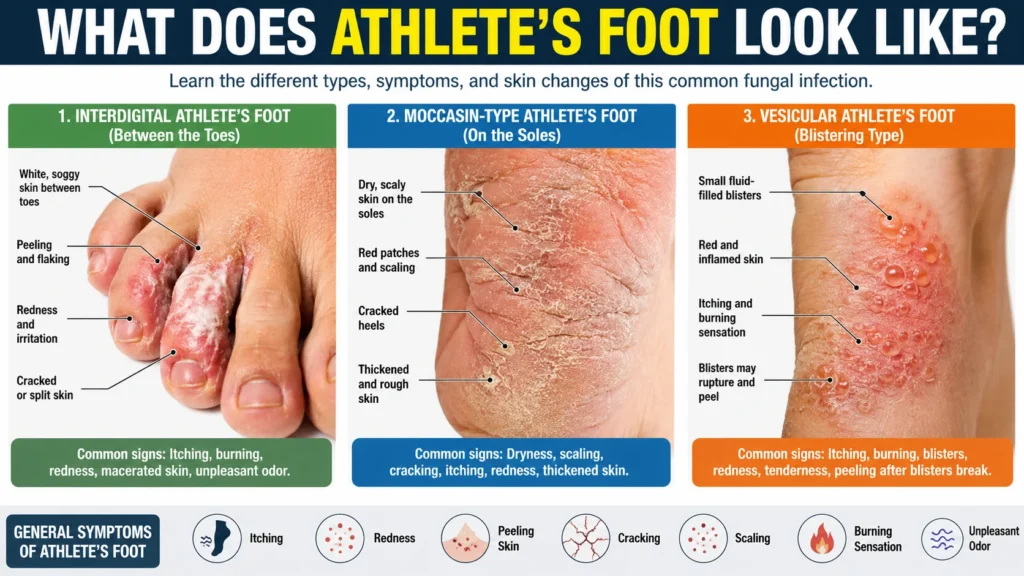
Interdigital Athlete’s Foot
Appearance:
- White soggy skin
- Peeling toe webs
- Red inflamed cracks
- Moist skin folds
Most common location:
- Between the fourth and fifth toes
Moccasin-Type Athlete’s Foot
Appearance:
- Dry scaling
- Thickened skin
- Flaking soles
- Cracked heels
Most common location:
- Bottom and sides of both feet
Vesicular Athlete’s Foot
Appearance:
- Clusters of blisters
- Red inflamed skin
- Clear fluid-filled bumps
- Swelling
Most common location:
- Arches
- Soles
- Inner sides of feet
The Three Main Types of Athlete’s Foot and Their Appearance
| Type | Appearance | Common Location | Main Symptoms |
|---|---|---|---|
| Interdigital | White, soggy, peeling skin | Between toes | Itching, cracking |
| Moccasin | Dry, scaly, thickened skin | Soles and sides | Flaking, burning |
| Vesicular | Blisters with redness | Soles and arches | Pain, itching |
Although these types look different, they all result from fungal growth in the outer layer of skin.
The infection may remain in one form or shift from one pattern to another over time.
What Does Early Athlete’s Foot Look Like?
Early athlete’s foot rarely looks dramatic.
That’s one reason so many cases go untreated.
The first signs often include:
- Mild itching between toes
- Tiny flakes of skin
- Slight redness
- Dry patches
- Small cracks
- Occasional burning
The skin changes may appear so minor that you ignore them for weeks.
However, fungi don’t disappear on their own.
Without treatment, the infection usually spreads.
Early Warning Signs to Watch For
Pay attention if you notice:
- Itching that worsens after removing shoes
- Skin peeling between toes
- Persistent moisture between toes
- White, softened skin
- Recurrent foot odor
- Scaling on the soles
Even subtle symptoms can signal the beginning of a fungal foot infection.
Athlete’s Foot Stages: How the Appearance Changes Over Time
Athlete’s foot doesn’t appear overnight.
It usually progresses through recognizable stages.
Stage One: Mild Irritation
The skin becomes:
- Slightly itchy
- Red or pink
- Mildly scaly
- Dry in small patches
At this stage, symptoms are often intermittent.
Many people mistake the infection for ordinary dry skin.
Stage Two: Peeling and Spreading
The fungus multiplies.
You may notice:
- Increased itching
- Skin peeling
- White soggy patches
- Expanding rash
- Burning sensations
The infection begins spreading to nearby skin.
Stage Three: Cracking and Inflammation
As damage increases:
- Cracks deepen
- Skin becomes painful
- Redness intensifies
- Fissures appear
- Walking may become uncomfortable
This stage often prompts people to seek treatment.
Stage Four: Chronic or Severe Athlete’s Foot
Long-standing infections may cause:
- Thickened skin
- Extensive scaling
- Chronic redness
- Recurrent cracking
- Persistent itching
- Spread to toenails
The infection can last for months or even years if left untreated.
What Does Severe Athlete’s Foot Look Like?
Severe athlete’s foot looks dramatically different from the mild, flaky rash most people imagine.
Instead of a few itchy spots, the skin may become:
- Bright red and inflamed
- Deeply cracked or split
- Painful to walk on
- Covered with thick scales
- Wet and eroded between the toes
- Swollen and tender
- Oozing fluid in some areas
In advanced cases, the skin barrier breaks down completely. The cracks become so deep that they may bleed or allow bacteria to enter the skin.
Signs of Severe Athlete’s Foot
Watch for these warning signs:
| Symptom | Appearance |
|---|---|
| Deep fissures | Large painful cracks that may bleed |
| Extensive redness | Rash spreads across the foot |
| Swelling | Skin looks puffy and inflamed |
| Thick scaling | Layers of dry, rough skin |
| Persistent itching | Severe itch that disrupts sleep |
| Secondary infection | Yellow crusting, pus, warmth |
Severe athlete’s foot can affect:
- The spaces between toes
- The entire sole
- The heels
- The sides of the feet
- Toenails
The infection may spread gradually or flare up suddenly after weeks or months of mild symptoms.
What Does Vesicular Athlete’s Foot Look Like?
One of the least recognized forms of athlete’s foot is vesicular athlete’s foot.
This type causes small fluid-filled blisters rather than dry scales.
The blisters often appear suddenly and can look alarming.
Typical Appearance
The skin may develop:
- Tiny blisters filled with clear fluid
- Red inflamed patches
- Swollen skin
- Intense itching
- Burning sensations
- Tender areas that hurt when walking
The blisters usually cluster together.
Common locations include:
- The arch of the foot
- The sole
- The inside edge of the foot
- The heel
What Happens When Blisters Break?
When the blisters rupture, they may leave:
- Raw pink skin
- Crusting
- Peeling edges
- Increased tenderness
- Temporary skin discoloration
Many people mistake vesicular athlete’s foot for:
- Allergic reactions
- Dyshidrotic eczema
- Contact dermatitis
- Friction blisters
The presence of itching, fungal exposure, and recurring outbreaks often helps distinguish it from these conditions.
What Does Chronic Athlete’s Foot Look Like?
Chronic athlete’s foot is a long-term fungal infection that persists for months or years.
Unlike sudden outbreaks, chronic infections tend to progress slowly.
The skin often appears:
- Thickened
- Dry
- Rough
- Continuously flaky
- Slightly red
- Cracked around the heels
Common Features of Chronic Athlete’s Foot
People with chronic infections often experience:
- Constant peeling
- Recurrent itching
- Persistent scaling
- Cracks that heal and reopen
- Frequent flare-ups
- Spread to toenails
The infection may seem to improve temporarily.
Then it comes back.
That cycle happens because fungi can survive deep within skin scales and contaminated footwear.
Without proper treatment and prevention, chronic athlete’s foot can become frustratingly recurrent.
Athlete’s Foot Skin Changes: How the Infection Affects the Skin
Athlete’s foot causes more than a simple rash.
The fungus changes the structure and appearance of the skin over time.
Early Skin Changes
During the first stages, you may notice:
- Mild redness
- Dry patches
- Tiny flakes
- Light itching
- Slight irritation
These changes are subtle.
Many people overlook them.
Moderate Skin Changes
As the fungal infection spreads, the skin may become:
- Scaly
- Inflamed
- White and soggy
- Cracked
- Tender
The outer layer begins to shed more rapidly.
That creates the peeling and flaking appearance commonly associated with athlete’s foot.
Advanced Skin Changes
Long-term infections can cause:
- Thickened skin
- Deep fissures
- Rough patches
- Hyperkeratosis
- Chronic inflammation
- Skin discoloration
Some areas become extremely dry.
Others remain moist and macerated.
The result is a patchwork of different textures across the foot.
Athlete’s Foot Between Toes: Why the Skin Turns White and Soggy
One of the most recognizable signs of athlete’s foot is white soggy skin between the toes.
Doctors call this process maceration.
It happens when moisture becomes trapped between toes for long periods.
The fungus thrives in these conditions.
Why Does the Skin Look White?
The outer layer of skin absorbs moisture and begins to:
- Swell
- Soften
- Turn pale or white
- Wrinkle
- Peel easily
The skin may look almost translucent.
Sometimes it resembles skin that has been submerged in water for hours.
Why Does It Crack?
As the softened skin weakens, friction from walking causes:
- Small splits
- Painful fissures
- Bleeding cracks
- Burning sensations
These openings can allow bacteria to enter.
That’s why untreated athlete’s foot sometimes develops secondary infections.
Athlete’s Foot on Toes and Toenails
Athlete’s foot doesn’t always stay on the skin.
The fungus can spread to the toenails.
When this happens, the nails may become:
- Yellow
- Thickened
- Brittle
- Crumbly
- Distorted in shape
- Difficult to trim
This condition is called onychomycosis, or fungal nail infection.
Signs the Infection Has Spread
You may notice:
- White spots on the nail
- Nail lifting from the nail bed
- Thick debris under the nail
- Discoloration that slowly worsens
- Multiple affected nails
Toenail fungal infections are harder to treat than skin infections.
They often require longer courses of medication.
Athlete’s Foot vs Dry Skin: How to Tell the Difference
Many people wonder whether their flaky feet are caused by dry skin or athlete’s foot.
At first glance, they can look very similar.
However, there are important differences.
Athlete’s Foot vs Dry Skin Comparison
| Feature | Athlete’s Foot | Dry Skin |
|---|---|---|
| Itching | Common | Mild or absent |
| Peeling | Frequent | Sometimes |
| Cracks | Common | Possible |
| White soggy skin | Often | Rare |
| Contagious | Yes | No |
| Fungal cause | Yes | No |
| Rash spreads | Usually | Rarely |
Dry skin usually improves with moisturizers.
Athlete’s foot often does not.
If scaling continues despite moisturizing, a fungal infection becomes more likely.
Athlete’s Foot vs Eczema
Athlete’s foot and eczema both cause:
- Redness
- Itching
- Dry skin
- Cracking
- Skin inflammation
That overlap makes diagnosis tricky.
Key Differences
| Feature | Athlete’s Foot | Eczema |
|---|---|---|
| Cause | Fungus | Immune reaction |
| Contagious | Yes | No |
| White soggy skin | Common | Rare |
| Between toes | Very common | Less common |
| Responds to antifungals | Yes | No |
| Responds to steroids | Sometimes worsens | Usually improves |
Eczema often appears on:
- Hands
- Ankles
- Elbows
- Knees
Athlete’s foot usually begins between the toes or on the soles.
Using steroid creams on a fungal infection can sometimes make the rash worse.
This phenomenon is sometimes called tinea incognito, where the fungus becomes less obvious but continues spreading underneath.
Athlete’s Foot vs Psoriasis
Psoriasis can also resemble athlete’s foot.
Both conditions cause:
- Thick scales
- Red patches
- Cracked skin
- Flaking
However, psoriasis is an autoimmune condition, not a fungal infection.
Visual Differences
| Feature | Athlete’s Foot | Psoriasis |
|---|---|---|
| Cause | Fungus | Immune system |
| Distribution | Feet mainly | Multiple body areas |
| Scaling | Fine or powdery | Thick and silvery |
| Itching | Common | Variable |
| Nail changes | Possible | Very common |
| Contagious | Yes | No |
Psoriasis often affects:
- Knees
- Elbows
- Scalp
- Lower back
- Fingernails
Athlete’s foot generally remains concentrated on the feet.
Athlete’s Foot vs Contact Dermatitis
Contact dermatitis develops when the skin reacts to an irritant or allergen.
The rash can resemble athlete’s foot.
Common triggers include:
- Shoe materials
- Dyes
- Rubber compounds
- Adhesives
- Fragrances
- Skin care products
Differences at a Glance
| Feature | Athlete’s Foot | Contact Dermatitis |
|---|---|---|
| Cause | Fungus | Irritant or allergy |
| Contagious | Yes | No |
| Peeling | Common | Possible |
| Itching | Common | Common |
| White soggy skin | Often | Rare |
| Rash location | Between toes and soles | Anywhere exposed |
Contact dermatitis usually appears soon after exposure to a trigger.
Athlete’s foot develops more gradually.
What Causes Athlete’s Foot?
Athlete’s foot develops when fungi grow on the skin.
The most common culprits are dermatophyte fungi that feed on keratin.
These fungi thrive in:
- Warm environments
- Moist skin
- Sweaty shoes
- Damp socks
- Public showers
- Locker rooms
- Swimming pool areas
How the Infection Spreads
The fungus spreads through:
- Skin-to-skin contact
- Walking barefoot on contaminated floors
- Sharing towels
- Sharing shoes
- Wearing contaminated socks
- Contact with infected surfaces
The organisms can survive for surprisingly long periods in shoes and moist environments.
That makes reinfection common.
Risk Factors That Increase Your Chances of Getting Athlete’s Foot
Some people are more likely to develop athlete’s foot than others.
Major Risk Factors
You have a higher risk if you:
- Sweat heavily
- Wear tight shoes daily
- Walk barefoot in public areas
- Live in humid climates
- Share footwear
- Have diabetes
- Have poor circulation
- Have a weakened immune system
- Previously had athlete’s foot
- Already have fungal nail infections
Men develop athlete’s foot slightly more often than women.
Adults are affected more frequently than children.
However, the infection can occur at any age.
Is Athlete’s Foot Contagious?
Yes.
Athlete’s foot is contagious.
The fungus spreads when skin cells carrying fungal spores come into contact with another person or surface.
Common Places Where Infection Spreads
Athlete’s foot frequently spreads in:
- Public showers
- Locker rooms
- Gym floors
- Swimming pools
- Shared bathrooms
- Hotel rooms
- Sauna facilities
The risk increases when feet remain damp for long periods.
Can You Spread It to Other Parts of Your Body?
Yes.
The fungus can spread to:
- Toenails
- Hands
- Groin area
- Other skin folds
For example, athlete’s foot and jock itch are often caused by similar fungi.
Touching infected feet and then another body area can transfer the infection.
How Do Doctors Diagnose Athlete’s Foot?
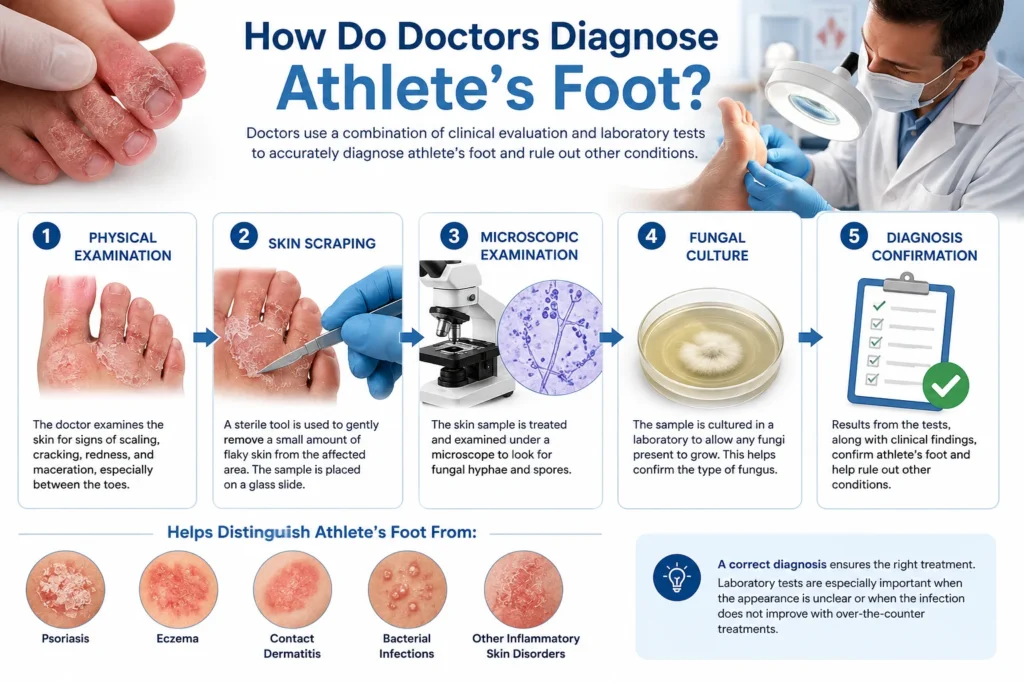
In many cases, doctors can recognize athlete’s foot simply by examining the skin.
However, appearance alone isn’t always enough.
Several conditions mimic fungal infections.
Diagnostic Methods
Doctors may use:
- Physical examination
- Skin scraping
- Microscopic examination
- Fungal culture
- Specialized laboratory tests
A skin scraping involves gently removing a small amount of flaky skin.
The sample is then examined for fungal elements.
This helps distinguish athlete’s foot from:
- Psoriasis
- Eczema
- Contact dermatitis
- Bacterial infections
- Other inflammatory skin disorders
Athlete’s Foot Treatment: What Actually Works?
The good news is that athlete’s foot is usually treatable.
Most mild to moderate infections improve with antifungal medications, especially when treatment starts early.
The challenge isn’t finding a treatment.
It’s using the right treatment consistently and continuing it long enough to kill the fungus completely.
The Main Types of Athlete’s Foot Treatment
Treatment generally falls into three categories:
- Over-the-counter antifungal creams
- Prescription antifungal medications
- Lifestyle and hygiene changes
The best option depends on:
- The severity of the infection
- How long you’ve had symptoms
- Whether the infection involves the toenails
- Your overall health
Over-the-Counter Antifungal Creams
Many cases of athlete’s foot respond well to non-prescription treatments.
Common antifungal ingredients include:
| Active Ingredient | Common Use | Treatment Length |
|---|---|---|
| Terbinafine | Most types of athlete’s foot | 1–2 weeks |
| Clotrimazole | Mild to moderate infections | 2–4 weeks |
| Miconazole | Interdigital athlete’s foot | 2–4 weeks |
| Tolnaftate | Prevention and mild infections | 2–4 weeks |
| Butenafine | Scaling and itching | 2–4 weeks |
These medications work by damaging the fungal cell membrane or stopping fungal growth.
Tips for Using Antifungal Cream Correctly
For the best results:
- Wash and dry your feet first.
- Apply the cream beyond the visible rash.
- Treat both feet if symptoms are present on both sides.
- Continue treatment for the full recommended duration.
- Keep feet dry throughout treatment.
Stopping treatment too early is one of the main reasons athlete’s foot returns.
Even when the rash disappears, small amounts of fungus may still remain in the skin.
Prescription Treatments for Severe Athlete’s Foot
Some infections don’t improve with creams alone.
Doctors may prescribe oral antifungal medications when:
- The infection is severe.
- Multiple areas of the foot are involved.
- Toenails are infected.
- Symptoms keep coming back.
- The rash spreads despite treatment.
Common Prescription Medications
Doctors may prescribe:
- Oral terbinafine
- Itraconazole
- Fluconazole
- Prescription-strength topical antifungals
Treatment may continue for:
- Several weeks for skin infections
- Several months for fungal nail infections
Toenails grow slowly.
As a result, nail infections take much longer to clear than skin infections.
Athlete’s Foot Home Remedies: Which Ones Help?
Home remedies are popular.
Some may relieve symptoms.
Others have very little evidence behind them.
Home Remedies That May Help
Certain approaches can support recovery by keeping the skin dry and reducing fungal growth.
These include:
- Keeping feet clean and dry
- Changing socks daily
- Wearing breathable shoes
- Alternating shoes to let them dry
- Using antifungal powders
- Washing socks in hot water
Remedies With Limited Evidence
People often try:
- Tea tree oil
- Vinegar soaks
- Garlic extracts
- Baking soda baths
- Coconut oil
Some laboratory studies suggest antifungal properties.
However, these remedies usually aren’t as reliable as proven antifungal medications.
If symptoms worsen, medical treatment is a better option.
Athlete’s Foot Healing Stages: What Recovery Looks Like
Healing doesn’t happen overnight.
The appearance of athlete’s foot changes gradually as the skin recovers.
Early Healing
During the first few days, you may notice:
- Less itching
- Reduced burning
- Decreased redness
- Drier skin between toes
The rash may still be visible.
That’s normal.
Intermediate Healing
After one to three weeks:
- Peeling slows down.
- Cracks begin closing.
- Scaling decreases.
- Skin texture becomes smoother.
- Inflammation fades.
The feet may still look dry while the skin repairs itself.
Late Healing
In the final stage:
- Skin color returns to normal.
- Cracks heal completely.
- Thickened skin softens.
- Flaking disappears.
- Itching stops.
For chronic infections, complete healing may take longer.
Toenail infections can require several months before healthy nails replace damaged ones.
How Long Does Athlete’s Foot Last?
The answer depends on:
- The type of athlete’s foot
- How early treatment begins
- Whether toenails are involved
- Your immune health
- Foot hygiene habits
Typical Recovery Times
| Severity | Estimated Recovery |
|---|---|
| Mild | 1–2 weeks |
| Moderate | 2–4 weeks |
| Severe | 4–8 weeks |
| Chronic infections | Several months |
| Toenail fungus | 6–18 months |
Many people start feeling better quickly.
Complete eradication of the fungus often takes longer.
That’s why continuing treatment after symptoms improve is important.
How to Prevent Athlete’s Foot From Coming Back
Athlete’s foot has a frustrating habit of returning.
Even after successful treatment, fungal spores can survive in shoes, socks, and damp environments.
Fortunately, a few habits can dramatically lower the risk of recurrence.
Daily Prevention Tips
Try to:
- Wash your feet every day.
- Dry carefully between the toes.
- Change socks daily.
- Wear moisture-wicking socks.
- Rotate shoes.
- Let shoes air dry completely.
- Wear sandals in public showers.
- Avoid sharing towels or footwear.
- Use antifungal powder if you sweat heavily.
Shoe Hygiene Matters
Shoes create the perfect environment for fungi.
Warm.
Dark.
Humid.
To reduce fungal growth:
- Alternate pairs of shoes.
- Use shoe disinfectant sprays.
- Remove insoles regularly.
- Allow shoes to dry for at least 24 hours.
- Replace heavily contaminated footwear if infections keep recurring.
Good foot hygiene is one of the most effective long-term strategies for preventing athlete’s foot.
When Should You See a Doctor?
Many cases of athlete’s foot improve at home.
However, certain symptoms require medical attention.
See a Doctor If You Notice:
- Severe pain
- Rapidly spreading redness
- Swelling
- Pus or drainage
- Fever
- Open sores
- Diabetes-related foot problems
- Recurrent infections
- Toenail involvement
- No improvement after several weeks of treatment
People with diabetes should be especially cautious.
Even small cracks in the skin can increase the risk of complications.
Frequently Asked Questions
What does athlete’s foot look like in the beginning?
Early athlete’s foot often appears as mild redness, slight peeling, or dry flaky skin between the toes. The area may itch occasionally or feel irritated after sweating. Small cracks may develop as the infection progresses.
Does athlete’s foot always itch?
No.
Although itching is one of the most common athlete’s foot symptoms, not everyone experiences it.
Some people mainly notice:
- Dry skin
- Peeling
- Scaling
- Cracks
- Burning sensations
Moccasin-type athlete’s foot can sometimes cause minimal itching despite extensive skin changes.
Can athlete’s foot look like dry skin?
Yes.
This is one of the reasons athlete’s foot often goes undiagnosed.
The infection may appear as:
- Dry patches
- Flaky skin
- Rough heels
- Fine scaling
- Mild cracking
Unlike ordinary dry skin, athlete’s foot usually spreads gradually and may not improve with moisturizers alone.
Why is the skin between my toes white?
White skin between the toes often results from maceration.
Moisture becomes trapped in the toe webs.
The skin absorbs water, softens, and turns pale or white.
Athlete’s foot commonly causes this change because fungi thrive in warm and damp areas.
Can athlete’s foot cause blisters?
Yes.
The vesicular form of athlete’s foot causes:
- Small fluid-filled blisters
- Redness
- Swelling
- Burning sensations
- Intense itching
The blisters usually appear on the arches, soles, or inner sides of the feet.
Can athlete’s foot spread to toenails?
Yes.
The fungal infection may spread from the skin to the nails.
Signs of toenail involvement include:
- Yellow discoloration
- Thickened nails
- Brittle texture
- Crumbly edges
- Nail lifting
Toenail fungal infections are often more difficult to treat and may require oral medication.
Is athlete’s foot contagious?
Yes.
Athlete’s foot spreads through contact with:
- Infected skin
- Contaminated floors
- Shared towels
- Shared footwear
- Moist environments such as locker rooms and swimming pools
Wearing sandals in public areas and keeping feet dry can help reduce the risk.
What does healed athlete’s foot look like?
As athlete’s foot heals:
- Redness fades.
- Peeling decreases.
- Cracks close.
- Itching disappears.
- Skin becomes smoother.
- The natural skin color returns.
In chronic cases, thickened skin may take longer to return to normal.
Conclusion
So, what does athlete’s foot look like?
The answer depends on the type and stage of the infection.
For some people, athlete’s foot appears as white soggy skin between the toes that peels and cracks.
For others, it looks like dry, flaky skin on the soles, a red itchy rash, or even small fluid-filled blisters.
The infection may cause:
- Redness
- Peeling skin
- Scaling
- Cracked heels
- Burning sensations
- Thickened skin
- Persistent itching
Because athlete’s foot can mimic dry skin, eczema, psoriasis, and contact dermatitis, recognizing the subtle differences matters.
The good news is that athlete’s foot is highly treatable.
Learning to identify its appearance early gives you the best chance of stopping the infection before it spreads, becomes chronic, or affects your toenails.
The next time you notice itchy toes, peeling skin, or unusual changes on your feet, you’ll know exactly what to look for.

Sophia Bennett is a professional writer focused on explaining word meanings, expressions and everyday language in a simple and engaging way.