Last Updated on June 17, 2026
What does a tick bite look like? A tick bite usually appears as a small red bump with a tiny puncture mark in the center. Some people develop mild redness or swelling around the bite, while others experience a rash that expands over several days. In certain cases, especially with Lyme disease, the rash forms a circular or bull’s-eye pattern called erythema migrans. Tick bites can look different depending on the tick species, how long the tick was attached, your skin tone, and whether an infection develops.
A tick bite often surprises people because it doesn’t always look dramatic. In fact, many tick bites are easy to miss. The bite may resemble a mosquito bite, a tiny pimple, or a small red dot. Sometimes it causes no symptoms at all.
That simplicity can be deceptive.
Ticks are tiny arachnids that feed on blood. While feeding, they inject saliva into the skin. This saliva contains substances that numb the bite area, which explains why many people never feel the bite happen.
The appearance of a tick bite depends on several factors:
- The species of tick
- How long the tick remained attached
- Your skin tone
- Whether you develop an allergic reaction
- Whether the tick transmits a disease
- Your immune response
Some bites heal within days. Others develop rashes, swelling, or symptoms that require medical attention.
Understanding what a tick bite looks like at different stages can help you recognize warning signs early and seek treatment if needed.
What Does a Tick Bite Look Like?
Most tick bites share a few common features. However, there is no single appearance that fits every case.
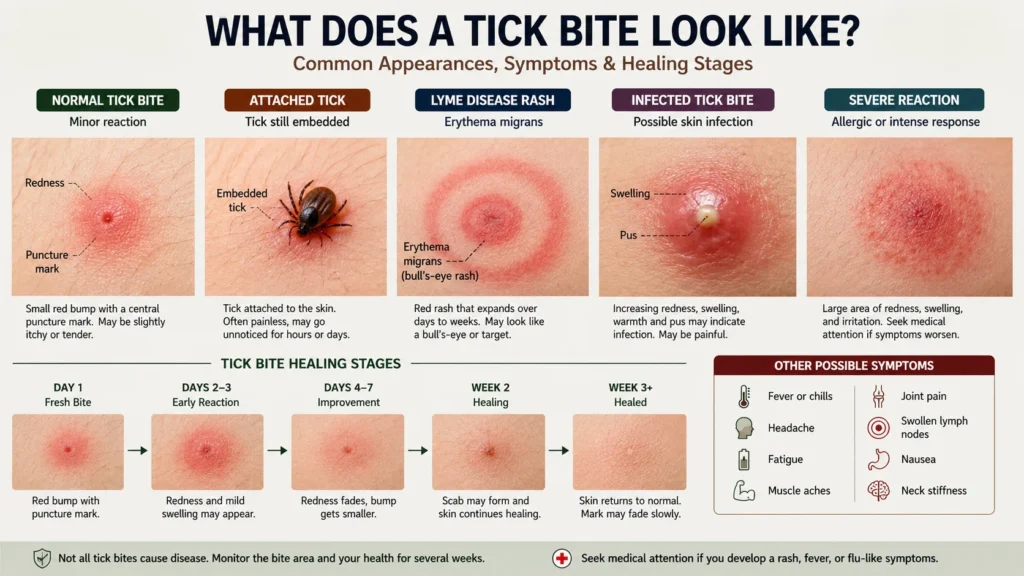
A typical tick bite often looks like:
- A small red bump
- A pinpoint puncture mark in the center
- Mild swelling
- Slight redness around the bite
- A tiny scab after the tick detaches
The bite is usually less than one inch across unless a rash develops.
Some people notice the tick still attached to the skin. Others only discover the bite after the tick falls off.
Typical Tick Bite Appearance
Imagine a mosquito bite with a tiny dark dot in the center.
That’s what many tick bites look like.
The surrounding skin may appear:
- Pink
- Red
- Slightly raised
- Warm to the touch
- Mildly itchy
In many cases, the redness fades within a few days.
However, if the redness expands or forms a ring, you should pay closer attention.
A small red bump after a tick bite is common. An expanding rash that continues to grow is not.
Tick Bite Appearance at a Glance
| Feature | Normal Tick Bite | Concerning Tick Bite |
|---|---|---|
| Size | Small, under 1 inch | Expands over time |
| Color | Pink or red | Dark red, purple, or spreading |
| Shape | Round bump | Circular rash or bull’s-eye |
| Pain | Usually painless | Increasing pain |
| Itching | Mild | Severe itching with swelling |
| Duration | A few days | More than 1 week with worsening symptoms |
Tick Bite on Light Skin
On lighter skin tones, tick bites often appear:
- Bright red
- Pink with a darker center
- Surrounded by mild inflammation
- Circular or oval
The redness usually stands out clearly against surrounding skin.
Tick Bite on Dark Skin
On darker skin tones, the bite may look different.
Instead of bright red, you may notice:
- Purple discoloration
- Dark brown spots
- Grayish or violet patches
- Raised skin with subtle color changes
Sometimes the bite feels easier to detect than to see.
You might notice:
- Tenderness
- A small lump
- Skin warmth
- Localized swelling
This difference matters because rashes such as Lyme disease can appear less obvious on dark skin.
Tick Bite Stages: How the Bite Changes Over Time
A tick bite rarely looks exactly the same from day one to day ten.
The appearance evolves as your immune system reacts and the skin heals.
Immediately After the Bite
Right after a tick detaches, you may see:
- A tiny puncture wound
- Little or no redness
- A dark spot
- Slight swelling
Many people don’t notice anything unusual at first.
That’s because tick saliva contains compounds that reduce pain and suppress immune reactions.
After 24 to 48 Hours
Over the next day or two, the bite often becomes more visible.
You may notice:
- A small red bump
- Mild itching
- Local inflammation
- A tiny scab
- Light tenderness
At this stage, the bite often resembles:
- A mosquito bite
- A flea bite
- A pimple
- A minor skin irritation
Most uncomplicated bites remain small.
What Does a Tick Bite Look Like After a Few Days?
After several days, there are two possibilities.
The bite heals normally, or a rash begins to form.
A healing bite usually:
- Shrinks in size
- Becomes less red
- Forms a small scab
- Stops itching
An abnormal bite may:
- Expand outward
- Become increasingly warm
- Develop a circular rash
- Feel painful
- Produce drainage or pus
This is the stage where Lyme disease rashes often appear.
Tick Bite Healing Stages
| Time | Appearance |
|---|---|
| Day 1 | Tiny puncture or red spot |
| Days 2-3 | Small bump with mild redness |
| Days 4-7 | Redness fades or rash begins |
| Week 2 | Healing scab or expanding rash |
| Weeks 3+ | Usually resolved unless infection develops |
Tick Bite Rash
A tick bite rash causes more anxiety than almost any other symptom.
That’s understandable.
Many people immediately think of Lyme disease whenever they see a circular rash.
However, not every rash means Lyme disease.
And not every Lyme disease rash looks like a bull’s-eye.
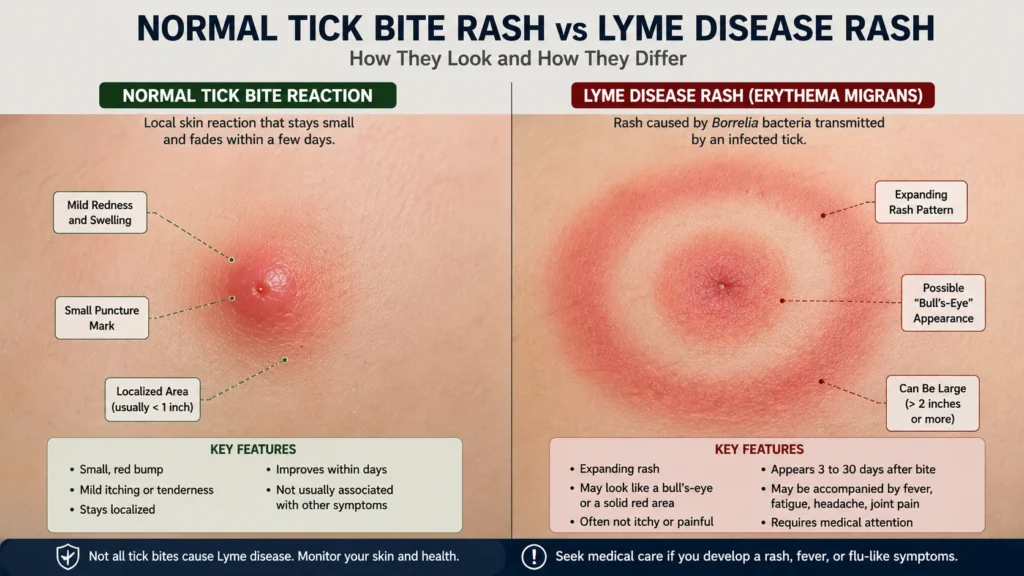
Normal Tick Bite Rash
A normal reaction may include:
- Redness around the bite
- Mild swelling
- Slight warmth
- Itching
- A raised bump
The area usually:
- Stays small
- Doesn’t continue expanding
- Improves within a few days
What Does a Tick Bite Rash Look Like?
Tick bite rashes vary widely.
They may appear as:
- A solid red patch
- A circular rash
- An oval rash
- Multiple red rings
- A bruise-like discoloration
- A target-shaped lesion
Some rashes itch.
Others don’t itch at all.
Some feel warm and tender.
Others are completely painless.
The shape and progression often matter more than the color alone.
Bull’s-Eye Rash (Erythema Migrans)
The most famous tick bite rash is the bull’s-eye rash, medically known as erythema migrans.
It is strongly associated with Lyme disease.
Characteristics include:
- Expands gradually over days
- Often exceeds 2 inches in diameter
- Circular or oval
- Red outer ring
- Clear or lighter center
- Usually not painful
- May feel warm
Surprisingly, many Lyme disease rashes do not form a classic bull’s-eye.
Some appear as:
- Uniform red patches
- Bluish-red plaques
- Oval expanding lesions
- Irregular circular rashes
Important Facts About the Bull’s-Eye Rash
| Fact | Reality |
|---|---|
| Every Lyme rash is a bull’s-eye | False |
| The rash always hurts | False |
| The rash always itches | False |
| Lyme disease always causes a rash | False |
| The rash usually expands over time | True |
Other Tick Bite Rashes
Different tick-borne illnesses produce different rashes.
Some examples include:
Rocky Mountain spotted fever
- Small pink spots
- Begins on wrists and ankles
- Spreads toward the torso
- May become purple
Southern tick-associated rash illness
- Circular rash
- Similar to Lyme disease
- Associated with lone star ticks
Allergic reactions
- Hives
- Large itchy welts
- Generalized skin redness
- Swelling beyond the bite area
Tick Bite Symptoms
The bite itself is only part of the story.
Ticks can trigger symptoms that affect your entire body.
Some symptoms appear within hours.
Others take days or even weeks.
Common Tick Bite Symptoms
Most uncomplicated tick bites cause:
- Small red bump
- Mild itching
- Redness
- Swelling
- Skin irritation
- Slight tenderness
These symptoms usually improve without treatment.
Systemic Symptoms That Require Attention
If symptoms spread beyond the bite site, pay attention.
Possible warning signs include:
- Fever
- Chills
- Fatigue
- Headache
- Muscle aches
- Joint pain
- Neck stiffness
- Swollen lymph nodes
- Night sweats
These symptoms may suggest:
- Lyme disease
- Rocky Mountain spotted fever
- Ehrlichiosis
- Anaplasmosis
- Babesiosis
- Powassan virus disease
Allergic Reactions to Tick Bites
Some people react strongly to tick saliva.
Symptoms may include:
- Severe itching
- Large swollen areas
- Hives
- Facial swelling
- Difficulty breathing
- Dizziness
In rare cases, bites from lone star ticks can trigger alpha-gal syndrome, an allergy to red meat that develops after the bite.
Symptoms may appear hours after eating:
- Hives
- Stomach pain
- Nausea
- Diarrhea
- Wheezing
- Anaphylaxis
Tick Bite vs Other Bug Bites
One reason people search “what does a tick bite look like” is because tick bites often resemble other insect bites.
At first glance, a tick bite can look almost identical to a mosquito bite or a small pimple. However, there are a few clues that make tick bite identification easier.
Tick Bite vs Mosquito Bite
Mosquito bites usually appear quickly. They become itchy within minutes and often disappear after a few days.
A tick bite behaves differently.
| Feature | Tick Bite | Mosquito Bite |
|---|---|---|
| Bite sensation | Usually not felt | Felt immediately or shortly after |
| Center mark | Often has a puncture mark | Usually absent |
| Itching | Mild or absent | Often intense |
| Rash | May expand over days | Usually stays small |
| Disease risk | Can transmit infections | Can transmit infections depending on region |
| Duration | Days to weeks | A few days |
Mosquito bites tend to itch like wild.
Tick bites often don’t.
That’s one of the reasons ticks are so sneaky.
Tick Bite vs Spider Bite
Spider bites often cause:
- Pain immediately after the bite
- Two puncture marks
- Swelling
- Burning sensation
- Localized pain
Tick bites are different.
They usually:
- Cause little pain
- Have one puncture site
- Stay unnoticed for hours or days
- May have the tick attached
If you see two fang-like marks, a spider is more likely than a tick.
Tick Bite vs Flea Bite
Flea bites love company.
They usually appear:
- In clusters
- Around ankles
- In groups of three or four
- Extremely itchy
Tick bites usually appear:
- As a single bite
- On any exposed skin
- With a central puncture mark
- Without multiple surrounding bites
Tick Bite vs Bed Bug Bite
Bed bug bites commonly appear:
- In rows
- In zig-zag patterns
- On arms, shoulders, and neck
- Very itchy
Tick bites are usually:
- Solitary
- Less itchy
- Larger
- Associated with outdoor exposure
What Does an Infected Tick Bite Look Like?
Most tick bites heal without problems.
An infected tick bite is different.
The skin starts to show signs that bacteria or inflammation are taking over.
Signs of an Infected Tick Bite
Watch for:
- Increasing redness
- Swelling that spreads
- Warm skin
- Pain that gets worse
- Yellow or green drainage
- Pus
- Red streaks moving away from the bite
- Fever
A bite that looked harmless yesterday may become inflamed several days later.
That’s why monitoring the bite is important.
Normal vs Infected Tick Bite
| Feature | Normal Bite | Infected Bite |
|---|---|---|
| Redness | Small and stable | Expanding |
| Pain | Mild or none | Increasing |
| Swelling | Slight | Significant |
| Drainage | None | Pus or fluid |
| Fever | Rare | Possible |
| Healing | Improves daily | Gets worse |
What Does an Infected Tick Bite Rash Look Like?
The rash may:
- Become darker red
- Spread outward
- Feel hot
- Develop crusting
- Form blisters
- Become tender
Sometimes the skin develops a thick scab.
Other times, the area becomes swollen and shiny.
If redness continues expanding after several days, it’s a good idea to seek medical care.
Tick Bite Identification by Tick Species
Not all ticks look the same.
And not every species causes the same bite reaction.
Knowing which tick bit you can help estimate the risk of certain diseases.
What Does a Deer Tick Bite Look Like?
The deer tick is one of the smallest ticks.
Its bite often appears as:
- Tiny red dot
- Pinpoint puncture
- Mild redness
- Minimal swelling
The bite itself is easy to miss.
The concern comes from what may happen later.
Deer ticks can transmit:
- Lyme disease
- Anaplasmosis
- Babesiosis
- Powassan virus disease
A Lyme disease rash often develops days to weeks later.
Deer Tick Bite Facts
| Feature | Description |
|---|---|
| Tick size | About poppy seed size |
| Bite pain | Usually painless |
| Rash | Possible bull’s-eye |
| Itching | Mild |
| Disease risk | High |
What Does a Lone Star Tick Bite Look Like?
Lone star tick bites tend to produce stronger skin reactions.
You may notice:
- Large red area
- Significant itching
- Raised swelling
- Circular rash
- Warm skin
Some people mistake these bites for spider bites.
Lone star ticks are also associated with:
- Alpha-gal syndrome
- Ehrlichiosis
- Southern tick-associated rash illness
The bite reaction may be surprisingly large compared to the tick’s size.
What Does an American Dog Tick Bite Look Like?
American dog tick bites often produce:
- Small red bump
- Mild swelling
- Itching
- Local irritation
Most heal normally.
However, this species can transmit:
- Rocky Mountain spotted fever
- Tularemia
If fever develops after a bite, medical evaluation is important.
Brown Dog Tick Bite Appearance
Brown dog tick bites are less common on humans.
When they occur, they may appear as:
- Tiny red papule
- Localized swelling
- Itchy patch
- Small crust or scab
These bites usually heal quickly unless irritation or infection develops.
Tick Bite Pictures Explained
Many people search for tick bite pictures hoping to compare their skin with online images.
That’s understandable.
But tick bite images can be confusing because bites vary enormously.
Tick Bite Pictures May Show:
- Tiny red dots
- Raised bumps
- Circular rashes
- Bull’s-eye lesions
- Bruise-like marks
- Swollen skin
- Embedded ticks
- Healing scabs
Two people bitten by the same tick species may develop completely different skin reactions.
Your age, immune system, skin tone, and medical history all influence how the bite appears.
Why Tick Bite Pictures Can Be Misleading
Pictures online often show:
- Classic bull’s-eye rashes
- Severe reactions
- Advanced Lyme disease
- Unusual cases
Reality is often less dramatic.
A dangerous tick bite may look surprisingly ordinary.
And a scary-looking bite may turn out to be harmless.
That’s why symptoms and rash progression matter more than appearance alone.
Tick Bite on Humans: Common Body Locations
Ticks don’t bite randomly.
They prefer warm, moist areas where skin is thin.
Common Tick Bite Locations
Ticks are often found on:
- Scalp
- Hairline
- Behind the ears
- Neck
- Armpits
- Waistline
- Groin
- Behind the knees
- Belly button
- Ankles
Children often have bites on:
- Scalp
- Neck
- Behind ears
Adults more commonly find ticks around:
- Legs
- Waist
- Armpits
- Groin
Tick Bite on the Scalp
A scalp tick bite may feel like:
- A sore bump
- A pimple
- A tender spot
- A scab hidden under hair
Signs include:
- Itching
- Local pain
- Swelling
- Enlarged lymph nodes nearby
Sometimes people discover the tick weeks later while brushing their hair.
Tick Bite on the Leg
Legs are among the most common bite locations.
You may see:
- Small red spot
- Circular rash
- Swollen bump
- Itchy patch
Ticks often attach behind the knees because the skin is thin and protected.
Tick Bite on the Groin or Armpit
Ticks love warm, hidden places.
Bites in these areas may cause:
- Tender swelling
- Red patches
- Local irritation
- Delayed discovery
Because the skin folds here are sensitive, reactions may appear more dramatic than bites elsewhere.
What Does a Tick Bite Look Like on a Child?
Tick bites on children can look different from those on adults.
Children often develop:
- Larger swelling
- More redness
- Stronger itching
- More visible allergic reactions
A bite that barely affects an adult may become swollen and bright red in a child.
Tick Bite Symptoms in Children
Watch for:
- Fever
- Fatigue
- Headache
- Rash
- Neck stiffness
- Irritability
- Loss of appetite
- Muscle aches
Young children may not describe symptoms clearly.
Instead, you might notice:
- Unusual fussiness
- Increased sleepiness
- Crying when touched
- Reduced activity
Tick Bite Safety Tips for Parents
After outdoor activities:
✓ Check behind ears
✓ Inspect the scalp
✓ Examine armpits
✓ Look around the waist
✓ Check behind knees
✓ Inspect the groin area
✓ Wash outdoor clothing
A tick found early is less likely to transmit disease.
Tick Bite Healing Stages
Most tick bites heal smoothly.
The skin goes through several predictable stages.
Stage 1: Fresh Bite
Appearance:
- Tiny puncture
- Slight redness
- Attached tick possible
Duration:
- Hours to one day
Stage 2: Early Reaction
Appearance:
- Small bump
- Mild swelling
- Slight itching
Duration:
- 1 to 3 days
Stage 3: Healing Phase
Appearance:
- Reduced redness
- Small scab
- Less swelling
Duration:
- 4 to 14 days
Stage 4: Complete Healing
Appearance:
- Skin returns to normal
- Small discoloration may remain temporarily
Duration:
- One to several weeks
What Does a Tick Bite Look Like When Healing?
A healing tick bite usually:
- Shrinks in size
- Becomes less red
- Stops itching
- Forms a small scab
- Fades gradually
You should not see:
- Expanding redness
- Increasing pain
- Pus
- Fever
- New rashes
Those signs suggest something else may be happening.
Tick Bite Scar
Most tick bites don’t leave scars.
However, scars may develop if:
- The bite becomes infected
- The area is scratched repeatedly
- The skin forms excess scar tissue
- The bite causes significant inflammation
Temporary dark spots are more common than permanent scars.
These spots often fade naturally over several months.
Tick Bite and Lyme Disease
When people ask “What does a tick bite look like?”, they’re often worried about one thing above all else: Lyme disease.
That’s understandable.
Lyme disease is the most well-known tick-borne illness. It develops when certain infected ticks transmit bacteria into the skin while feeding.
However, here’s something many people don’t realize:
Most tick bites do not lead to Lyme disease.
And not every person with Lyme disease develops the classic bull’s-eye rash.
That’s why recognizing the early signs matters.
What Does a Tick Bite Look Like With Lyme Disease?
The most famous sign of Lyme disease is the erythema migrans rash.
This rash:
- Usually appears 3 to 30 days after the bite
- Expands gradually over time
- Can reach several inches in diameter
- Often feels warm
- Usually isn’t painful
- May or may not itch
Some rashes form a classic target or bull’s-eye appearance.
Others don’t.
Common Lyme Disease Rash Patterns
A Lyme rash may appear as:
- A solid red circle
- A bull’s-eye rash
- An oval expanding patch
- A bluish-red area
- A ring-shaped rash
- Multiple expanding rashes
The rash can appear anywhere on the body.
It doesn’t always appear where the tick bit you.
Early Signs of Lyme Disease After a Tick Bite
Besides the rash, Lyme disease may cause:
- Fever
- Chills
- Headache
- Fatigue
- Muscle aches
- Joint pain
- Swollen lymph nodes
- Neck stiffness
These symptoms often resemble the flu.
That’s why Lyme disease sometimes goes unnoticed during the early stage.
Lyme Disease Symptoms by Stage
| Stage | Symptoms |
|---|---|
| Early localized | Rash, fever, headache, fatigue |
| Early disseminated | Multiple rashes, nerve symptoms, facial weakness |
| Late stage | Arthritis, chronic joint pain, neurological symptoms |
Other Tick-Borne Diseases That Cause Rashes
Lyme disease gets most of the attention.
But ticks can carry several other infections.
Each disease may produce a different rash or symptom pattern.
Rocky Mountain Spotted Fever
Despite the name, this disease occurs in many regions.
Early symptoms include:
- High fever
- Severe headache
- Muscle aches
- Nausea
- Fatigue
A rash may develop several days later.
What Does the Rash Look Like?
The rash often:
- Starts as tiny pink spots
- Appears on wrists and ankles first
- Spreads to arms and legs
- Moves toward the torso
- Can become dark red or purple
This illness can become serious quickly.
Prompt treatment is important.
Anaplasmosis
Symptoms may include:
- Fever
- Chills
- Muscle pain
- Headache
- Fatigue
- Nausea
A rash is uncommon.
Because symptoms resemble many viral illnesses, people sometimes overlook it.
Ehrlichiosis
This infection may cause:
- Fever
- Headache
- Muscle aches
- Confusion
- Rash in some cases
Children are more likely than adults to develop a rash.
Babesiosis
Babesiosis affects red blood cells.
Symptoms include:
- Fever
- Chills
- Sweating
- Fatigue
- Weakness
- Shortness of breath
Some people have no symptoms at all.
Others become seriously ill.
Alpha-Gal Syndrome
One of the strangest consequences of a tick bite is alpha-gal syndrome.
This condition causes an allergy to mammalian meat.
After being bitten by certain ticks, some people develop allergic reactions after eating:
- Beef
- Pork
- Lamb
- Venison
Symptoms include:
- Hives
- Stomach pain
- Vomiting
- Diarrhea
- Wheezing
- Facial swelling
The reaction often occurs several hours after eating, which can make the connection difficult to recognize.
Tick Removal: How to Remove a Tick Safely
Finding a tick attached to your skin can feel unsettling.
The good news?
You can remove most ticks safely at home.
What You’ll Need
Use:
- Fine-tipped tweezers
- Gloves if available
- Soap and water
- Alcohol or antiseptic
Avoid:
- Petroleum jelly
- Nail polish
- Matches
- Essential oils
- Burning the tick
These methods don’t work reliably.
In some cases, they may increase the chance of irritation.
Step-by-Step Tick Removal
Grasp the Tick Close to the Skin
Use tweezers to grab the tick as close to the skin surface as possible.
Try to grip the head or mouthparts.
Avoid squeezing the tick’s body.
Pull Upward Slowly
Pull upward with steady pressure.
Don’t:
- Twist
- Yank
- Crush the tick
A slow, even pull works best.
Clean the Area
Wash the bite thoroughly with:
- Soap and water
- Alcohol
- Antiseptic
This helps reduce irritation and lowers the risk of skin infection.
Monitor the Bite
Over the next several weeks, watch for:
- Rash
- Fever
- Fatigue
- Headache
- Expanding redness
- Joint pain
Most bites heal without complications.
What If the Tick Head Is Left in the Skin?
This happens more often than people think.
Sometimes the mouthparts remain embedded after removal.
If that happens:
- Don’t dig aggressively into the skin.
- Clean the area.
- Leave it alone if it cannot be removed easily.
- Monitor for signs of infection.
Your body often pushes small fragments out naturally.
A retained mouthpart may cause:
- Mild redness
- Small bump
- Temporary irritation
But it does not mean Lyme disease is more likely.
When Should You Worry About a Tick Bite?
Most tick bites are harmless.
Still, there are situations when medical evaluation is a good idea.
Watch for These Warning Signs
Seek medical attention if you develop:
- Expanding rash
- Bull’s-eye rash
- Fever
- Chills
- Severe headache
- Neck stiffness
- Muscle aches
- Joint swelling
- Facial weakness
- Shortness of breath
- Confusion
- Severe fatigue
These symptoms may appear:
- Days after the bite
- Weeks later
- Even after the bite itself has healed
Bite Site Warning Signs
The bite itself may become concerning if you notice:
- Increasing redness
- Pus
- Blisters
- Severe swelling
- Red streaks
- Worsening pain
- Warm skin
A bite should gradually improve.
If it keeps getting worse, it deserves attention.
When to See a Doctor for a Tick Bite
You don’t need to see a doctor after every tick bite.
However, medical advice is recommended if:
The Tick Was Attached for a Long Time
Longer attachment increases the chance of disease transmission.
Especially if:
- The tick appeared swollen
- You don’t know how long it was attached
- The tick was embedded deeply
You Develop a Rash
Seek evaluation if:
- The rash expands
- The rash resembles a target
- Multiple rashes appear
- The rash becomes painful
Flu-Like Symptoms Develop
Call a healthcare provider if you experience:
- Fever
- Fatigue
- Chills
- Headaches
- Muscle pain
- Joint aches
Especially if these symptoms appear after spending time outdoors.
Emergency Symptoms
Seek urgent medical care if you develop:
- Difficulty breathing
- Facial swelling
- Chest pain
- Severe allergic reaction
- Confusion
- Seizures
These symptoms are rare but require immediate attention.
Frequently Asked Questions
Is a Tick Bite Itchy?
Sometimes.
Many tick bites cause little or no itching.
Others become mildly itchy or irritated.
Large itchy reactions are more common with certain species, such as lone star ticks.
How Can You Tell If a Bite Is From a Tick?
Look for:
- A tiny puncture mark
- A red bump
- A circular rash
- An attached tick
- Mild swelling
- A rash that expands over time
Outdoor exposure also increases the likelihood.
What Does a Tick Bite Look Like After Removal?
After removal, the bite may appear:
- Slightly red
- Swollen
- Raised
- Like a small pimple
- With a tiny scab
This usually improves over several days.
Does Every Tick Bite Cause a Bull’s-Eye Rash?
No.
Most tick bites do not produce a bull’s-eye rash.
Even among people with Lyme disease, the rash can vary widely.
Some people never develop a rash at all.
How Long Does a Tick Bite Mark Last?
A normal bite mark often lasts:
- A few days to two weeks
Mild discoloration may remain longer.
If redness expands or symptoms worsen, seek medical advice.
Can a Tick Bite Look Like a Mosquito Bite?
Absolutely.
Early tick bites commonly resemble:
- Mosquito bites
- Pimples
- Flea bites
- Minor skin irritation
That’s one reason tick bite identification can be challenging.
What Does an Infected Tick Bite Look Like?
An infected bite may become:
- Increasingly red
- Painful
- Swollen
- Warm
- Filled with pus
- Surrounded by spreading redness
Fever may also develop.
Should I Worry About a Tick Bite?
Not every tick bite is dangerous.
However, pay attention if you develop:
- Rash
- Fever
- Headache
- Joint pain
- Fatigue
- Expanding redness
Early recognition makes treatment easier if a tick-borne illness develops.
Conclusion
So, what does a tick bite look like?
In most cases, a tick bite appears as a small red bump with a central puncture mark. The area may be slightly swollen, itchy, or tender. Some bites fade within days and never cause problems.
Others tell a different story.
An expanding rash, a bull’s-eye pattern, fever, fatigue, or worsening redness may signal something more serious.
That’s why the most important thing isn’t simply recognizing the bite itself.
It’s understanding how the bite changes over time.
A healing bite gradually improves.
A concerning bite expands, becomes inflamed, or triggers symptoms elsewhere in the body.
If you spend time outdoors, checking your skin regularly and removing ticks promptly remains one of the best ways to protect yourself.
And if you’re ever unsure whether a bite is normal, trust your instincts.
Sometimes the smallest marks deserve the closest attention.

Michael Anderson is a content writer specializing in word meanings, definitions and clear explanations of modern terms and phrases.