Last Updated on June 17, 2026
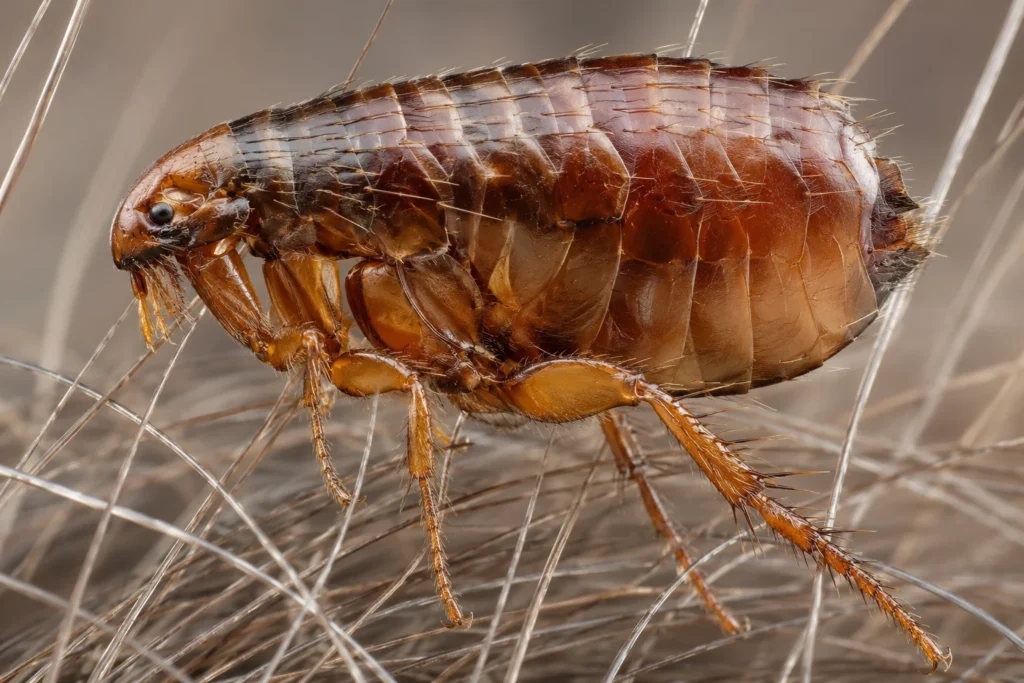
A flea is a tiny wingless insect measuring about 1.5 to 3.5 mm in length. It has a flattened reddish-brown body, six legs, and powerful hind legs built for jumping. Fleas move quickly through fur and are difficult to spot due to their small size and fast motion. They feed on blood from animals like cats and dogs and are visible to the naked eye.
If you have ever spotted a tiny speck jumping through your pet’s fur or across your couch, you have probably already met a flea. But identifying it correctly is not always easy.
So let’s answer the main question clearly:
A flea is a tiny, dark, fast-moving insect with a flat body and powerful jumping legs. It looks simple at first glance, but its body is built like a survival machine.
To truly understand what does a flea look like, you need to break it down into size, shape, color, and movement.
Flea Size: How Big Is a Flea Really?
One of the biggest challenges in flea identification is their size.
Exact flea size range
- Adult fleas measure 1.5 mm to 3.5 mm
- Most common household fleas average around 2–2.5 mm
To put that in perspective:
- A flea is smaller than a sesame seed
- Smaller than a grain of rice
- About the size of a tiny speck of dirt
Why flea size matters
Because fleas are so small, people often miss them. Many assume flea infestations are just “itchy skin” or “dust in fur.”
But once fleas multiply, even a few visible adults usually mean hundreds more in eggs and larvae.
Flea Shape: The Most Important Identification Feature
If there is one trait that defines flea appearance, it is its shape.
Flea body shape characteristics
A flea has a:
- Flattened body (side-to-side compression)
- Narrow and oval structure
- Hard outer shell
- Compact segmented design
This shape is not random. It helps fleas:
- Move through dense fur easily
- Avoid being crushed by scratching
- Hide between fibers in carpets and bedding
Simple visual description
A flea looks like a tiny flattened oval seed that moves suddenly and jumps away when disturbed.
Flea Color: What Color Are Fleas?
Fleas are usually dark, but their exact shade depends on feeding.
Common flea colors
- Reddish-brown (most common for adult fleas)
- Dark brown (unfed fleas)
- Almost black (seen on light surfaces)
Why fleas change color
When fleas feed on blood, their abdomen expands and darkens. This gives them a deeper reddish tone.
Real-life observation tip
If you see a tiny moving speck on a white surface, fleas appear darker and more visible. But on pet fur, they blend in easily.
Flea Body Structure: Built for Survival
A flea’s body is highly specialized. Every part serves a function.
Main body sections
Fleas have three key body parts:
1. Head
- Small and pointed
- Contains antennae
- Houses mouthparts for blood feeding
2. Thorax
- Middle section
- Holds all six legs
- Provides jumping power
3. Abdomen
- Largest part
- Expands after feeding
- Stores blood meal
Hard exoskeleton (armor-like body)
Fleas have a tough outer shell called an exoskeleton.
This makes them:
- Hard to crush
- Resistant to pressure
- Difficult to kill manually
If you try to squash a flea, it often slips away due to its hard shell and fast movement.
Flea Legs: The Jumping Mechanism
Fleas are not just crawling insects. They are one of nature’s best jumpers.
Flea leg structure
- Six legs total
- Front legs: stability and movement
- Middle legs: balance
- Hind legs: jumping power
Why hind legs are special
The hind legs are:
- Extremely long compared to body size
- Packed with elastic protein (resilin)
- Designed like springs
Flea jumping ability
A flea can jump:
- Up to 150–200 times its body length
- Around 13–15 inches in a single leap
That is like a human jumping across a football field.
Flea Movement: Why They Look Like “Disappearing Bugs”
One of the biggest reasons people struggle with flea identification is movement.
How fleas move
Fleas:
- Do not fly
- Do not crawl slowly
- Instead, they jump in quick bursts
What it looks like in real life
You may notice:
- A tiny black speck suddenly disappears
- A quick jump from one spot to another
- A flash-like movement in pet fur
That “vanishing effect” is classic flea behavior.
Flea Mouthparts: The Invisible Feeding Tool
Even though fleas are tiny, their feeding system is complex.
How fleas feed
Fleas use sharp, needle-like mouthparts to:
- Pierce skin
- Inject saliva
- Suck blood
Why flea saliva matters
Flea saliva:
- Prevents blood clotting
- Causes itching and allergic reactions
- Leads to red bite marks
First Real Identification Checklist
If you suspect a flea, look for these signs:
Visual signs
- Tiny dark jumping insect
- Oval flattened body
- Fast movement through fur or fabric
Behavior signs
- Sudden jumps instead of crawling
- Disappearing when exposed to light
- Clinging to pets or soft furniture
Location signs
- Pet fur (especially belly and neck)
- Carpets and rugs
- Bedding and sofas
Quick Summary of Flea Appearance (So Far)
A flea is:
- Extremely small (1.5–3.5 mm)
- Dark reddish-brown or black
- Flattened sideways like a tiny seed
- Wingless but powerful jumper
- Equipped with strong hind legs
- Hard-shelled and difficult to crush
- Fast-moving and hard to catch
Flea Anatomy Under the Microscope (Deeper Visual Breakdown)
When you zoom in on a flea under a microscope, the “tiny dark speck” turns into a highly engineered parasite. Every structure becomes visible, and suddenly, flea identification becomes much easier.
At magnified level, a flea does not just look like a bug. It looks like a biological survival machine built for jumping and feeding on blood.
Flea Head Structure: Built for Feeding and Sensing
The flea head is small, but extremely functional.
What you see under magnification
- Short, club-like antennae tucked into grooves
- Large compound eyes (in some species)
- Sharp piercing mouthparts
Key identification feature
The mouthparts look like a thin needle system designed to pierce skin and access blood vessels.
Why this matters
This structure confirms fleas are not scavengers. They are blood-feeding external parasites.
Flea Thorax: The Power Engine
The thorax is where all movement begins.
Microscope view shows
- Strong muscle attachment points
- Three pairs of legs anchored firmly
- Reinforced internal structure for jumping
Why fleas are strong despite size
The thorax is packed with elastic proteins that act like springs. This allows fleas to store and release energy instantly.
Flea Abdomen: Blood Storage System
The abdomen looks very different depending on feeding status.
Before feeding
- Flat
- Narrow
- Dark brown
After feeding
- Swollen
- Dark red or almost black
- Semi-transparent in some cases
What this tells us
A fed flea can appear twice its normal size, which is why people sometimes notice “bigger fleas” after infestations grow.
Flea Eggs: The Hidden Beginning of Infestation
Most people never see flea eggs, but they are the foundation of every infestation.
What flea eggs look like
- Tiny white oval grains
- About 0.5 mm in size
- Smooth and shiny surface
- Resemble salt or dandruff
Where flea eggs are found
Flea eggs do NOT stay on pets.
They fall into:
- Carpets
- Bedding
- Sofa cushions
- Floor cracks
Why flea eggs are dangerous
Even if you remove adult fleas, eggs can survive and restart the cycle.
One female flea can lay:
- 20 to 50 eggs per day
- Hundreds in a lifetime
Flea Larvae: Worm-Like Hidden Stage
After eggs hatch, fleas enter the larval stage.
What flea larvae look like
- Tiny worm-shaped bodies
- White or translucent color
- No legs
- Around 2–5 mm long
They avoid light and burrow deep into:
- Carpets
- Dust layers
- Pet bedding fibers
What flea larvae eat
Unlike adult fleas, larvae do NOT feed on blood.
They eat:
- Organic debris
- Skin flakes
- “Flea dirt” (digested blood waste from adults)
Why larvae matter in infestation
Larvae are often the silent growth stage, turning a small flea problem into a full infestation.
Flea Pupae: The Invisible Survival Stage
The pupal stage is the most resistant flea stage.
What flea pupae look like
- Encased in a sticky cocoon
- Covered in dust or fibers
- Almost invisible to the eye
They blend into:
- Carpets
- Upholstery
- Pet bedding
Why pupae are dangerous
Flea pupae can survive:
- Weeks
- Months
- Even chemical cleaning in some cases
They remain dormant until they sense:
- Body heat
- Movement
- Carbon dioxide
Then they emerge as adult fleas instantly.
Flea Life Cycle Visualization
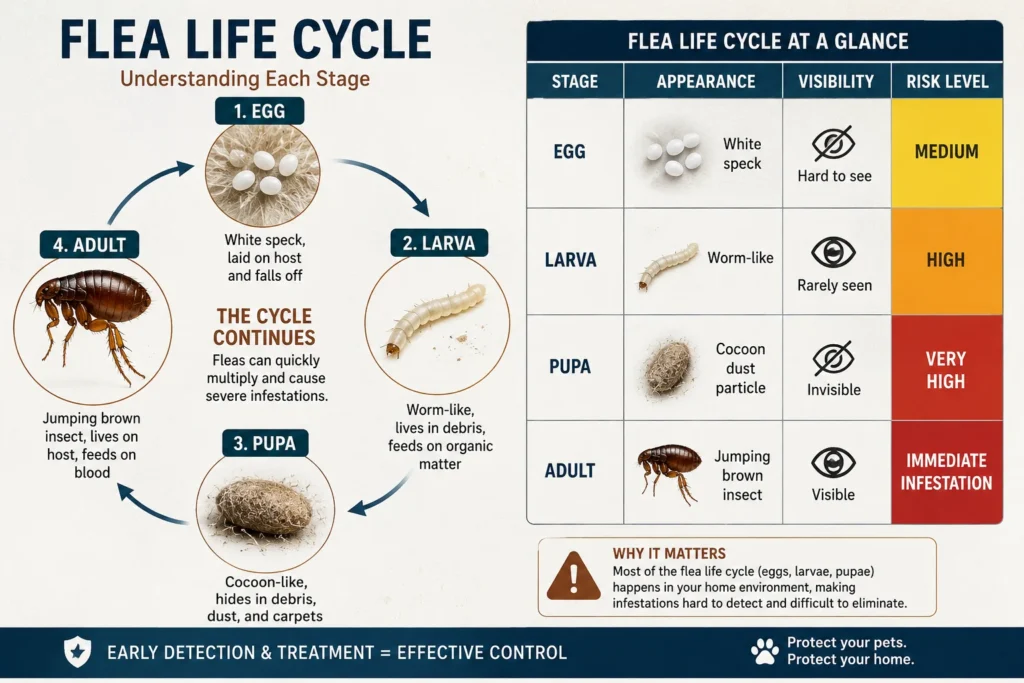
| Stage | Appearance | Visibility | Risk Level |
|---|---|---|---|
| Egg | White speck | Hard to see | Medium |
| Larva | Worm-like | Rarely seen | High |
| Pupa | Cocoon dust particle | Invisible | Very high |
| Adult | Jumping brown insect | Visible | Immediate infestation |
Flea Species Identification (What Fleas Look Like Differently)
Not all fleas look identical. Some species vary slightly in size and shape.
Cat Flea (Ctenocephalides felis)
This is the most common flea worldwide.
Appearance
- Small and dark reddish-brown
- Slightly flattened body
- Strong hind legs for jumping
Behavior
- Lives on cats and dogs
- Also bites humans
Why it dominates homes
It adapts easily to indoor environments and reproduces quickly.
Dog Flea (Ctenocephalides canis)
Less common than cat fleas but still important.
Appearance differences
- Slightly rounder body
- Marginally larger head structure
Behavior
- Prefers dogs
- Can still infest homes and furniture
Human Flea (Pulex irritans)
Rare today but historically significant.
Appearance
- Slightly larger than pet fleas
- Dark brown color
- Less adapted to animal fur
Modern presence
Found mostly in rural environments or areas with poor sanitation.
Flea Species Comparison Table
| Species | Size | Color | Common Host | Frequency |
|---|---|---|---|---|
| Cat flea | Small | Reddish-brown | Cats, dogs | Very common |
| Dog flea | Medium | Brown | Dogs | Moderate |
| Human flea | Medium-large | Dark brown | Humans | Rare |
Flea vs Other Tiny Insects (Critical Identification Guide)
Many people confuse fleas with other pests. Here is how to separate them correctly.
Flea vs Bed Bug
Bed bug appearance
- Flat oval body
- Reddish-brown
- No jumping ability
Flea appearance
- Narrow and laterally flattened
- Strong jumping legs
- Moves in sudden bursts
Key difference
If it jumps, it is NOT a bed bug.
Flea vs Tick
Tick appearance
- Round body
- Eight legs
- Slow movement
Flea appearance
- Six legs
- Flat body
- Fast jumping motion
Flea vs Lice
Lice appearance
- Small, soft-bodied
- Lives only in hair
- Cannot jump
Flea appearance
- Hard exoskeleton
- Jumps long distances
- Moves between hosts
Quick Identification Rule
If the insect:
- Jumps → Flea
- Crawls slowly → Lice or tick
- Hides in mattress seams → Bed bug
Flea Behavior That Affects Appearance
Understanding appearance alone is not enough. Behavior also changes how fleas are seen.
Flea movement patterns
Fleas:
- Move downward into fur
- Hide when exposed to light
- Jump when disturbed
What this looks like visually
A flea often appears as:
- A disappearing dot
- A quick flicker in fur
- A sudden jump and vanish effect
Flea feeding behavior
When feeding, fleas:
- Stay attached to skin
- Become darker and fuller
- Move less frequently
Flea survival instincts
Fleas are designed to:
- Avoid detection
- Reproduce quickly
- Spread between hosts instantly
Real-World Flea Identification Signs
This is where theory becomes practical.
On pets
Look for:
- Constant scratching
- Hair thinning patches
- Small black specks in fur
- Red irritated skin
On home surfaces
Look for:
- Tiny jumping dots on carpets
- Black pepper-like particles (flea dirt)
- Bites on ankles or legs
Flea dirt test (important trick)
Place black specks on wet tissue:
- If it turns reddish → flea dirt (digested blood)
- If it stays black → regular dirt
Infestation warning signals
- Multiple bites after sitting on furniture
- Pets restless at night
- Fleas visible in daylight movement
Flea Infestation: What It Actually Looks Like in Real Life
A flea infestation rarely starts in a way people notice right away. It doesn’t begin with dozens of visible insects crawling on the floor.
Instead, it begins quietly.
At first, you might only see:
- One or two tiny jumping specks
- A pet scratching slightly more than usual
- A few unexplained bites on your ankles
But underneath that, fleas are already multiplying.
How a flea infestation appears visually
When fleas spread, the scene changes quickly:
Pets
- Constant scratching and biting at fur
- Restlessness, especially at night
- Small dark specks moving through hair
- Patchy hair loss in severe cases
Furniture
- Tiny jumping dots on sofas or cushions
- Fleas appearing when someone sits down
- Sudden movement in fabric seams
On floors and carpets
- Fleas jumping when you walk across the room
- Black pepper-like debris (flea dirt)
- Increased activity in warm areas
Why infestations are hard to detect early
Fleas are experts at hiding. You usually don’t see the problem until:
- Eggs have already hatched
- Larvae have developed in carpets
- Pupae are waiting to emerge
By the time you notice adult fleas, the infestation is already established.
Flea Bites: What They Look Like on Skin
One of the clearest signs of fleas is the bite pattern they leave behind.
Flea bite appearance
Flea bites usually look like:
- Small red bumps
- Slight swelling
- Central red dot (bite point)
- Intense itching
Where flea bites usually appear
Fleas tend to bite areas that are easy to reach:
- Ankles
- Lower legs
- Feet
- Waistline
- Arms (less common)
Flea bite pattern
Unlike mosquito bites, flea bites often appear in:
- Clusters
- Lines
- Small grouped patches
This happens because fleas bite multiple times in a small area.
Flea bite reaction severity
Reactions vary depending on sensitivity:
| Reaction Type | Symptoms |
|---|---|
| Mild | Small itchy bumps |
| Moderate | Red swelling and irritation |
| Severe | Allergic reaction, rash, blistering |
Some people develop flea allergy dermatitis, which makes symptoms worse.
Where Fleas Live: Flea Habitat Explained
Understanding where fleas live is key to understanding what they look like in action.
Primary flea habitats indoors
Fleas prefer warm, dark, and undisturbed places.
Common indoor hiding spots
- Carpets and rugs
- Sofa cushions
- Pet bedding
- Bed mattresses
- Floor cracks and corners
Why these places attract fleas
Fleas choose these environments because:
- They protect eggs and larvae
- They stay close to hosts (pets or humans)
- They maintain humidity and warmth
Outdoor flea habitats
Fleas can also survive outside in:
- Grass and soil
- Shaded garden areas
- Animal resting spots
- Kennels or pet shelters
Flea hotspots in homes
If you look closely, flea activity is highest in:
- Pet sleeping areas
- Under furniture
- Carpet edges
- Behind baseboards
Flea Detection: How Professionals Identify Fleas
Professionals do not rely on spotting a single flea. They look for patterns.
Flea inspection methods
1. White sock test
Walking across carpets in white socks helps detect fleas:
- Fleas jump onto fabric
- Dark movement becomes visible
2. Flea comb inspection
Used on pets:
- Fine-tooth comb removes fleas and debris
- Flea dirt becomes visible
3. Light trap method
- Fleas are attracted to heat and light
- Sticky traps capture jumping fleas at night
4. Visual carpet check
Inspect:
- Carpet fibers
- Furniture seams
- Pet bedding folds
What professionals look for
They don’t just look for fleas. They also identify:
- Eggs (white specks)
- Larvae (tiny worms)
- Pupae (dust-like cocoons)
- Flea dirt (black specks)
Flea dirt identification test
A simple but powerful test:
- Collect black specks
- Place on damp tissue
- Observe color change
Result
- Red or rust color = flea dirt
- No change = normal dirt
Flea Behavior in Infested Areas
Understanding flea behavior helps explain why they are so hard to eliminate.
Flea activity cycle
Fleas follow a repeating cycle:
- Eggs fall into environment
- Larvae feed and grow
- Pupae hide in cocoons
- Adults emerge and bite hosts
Why infestations seem to “come back”
Even after cleaning, fleas return because:
- Pupae can remain dormant for weeks
- They hatch when they detect movement or heat
- New adults immediately search for blood
Flea movement inside homes
Fleas move in patterns:
- From carpets → pets
- From bedding → furniture
- From floor → human ankles
They always stay close to a food source.
Flea Prevention: Stopping the Appearance Before It Starts
Once you understand what a flea looks like, prevention becomes much easier.
Pet-focused prevention
To reduce flea appearance on animals:
- Use flea combs regularly
- Apply vet-approved treatments
- Wash pet bedding weekly
Home prevention methods
Inside the house:
- Vacuum carpets frequently
- Wash fabrics in hot water
- Clean hidden corners and edges
Environmental control
Fleas survive best when unnoticed. So control includes:
- Indoor cleaning routines
- Pet grooming schedules
- Outdoor yard maintenance
Prevention checklist
- Keep pets clean and treated
- Maintain dry, clean carpets
- Inspect pets regularly
- Act early at first sign
Key Identification Summary (So Far)
A flea infestation looks like:
- Tiny jumping dark specks in fur or carpet
- Black pepper-like debris (flea dirt)
- Itchy bite clusters on skin
- Constant pet scratching
- Fleas appearing in warm, hidden areas
Flea Under Extreme Magnification: What You Really See
When you place a flea under high magnification, the simple “tiny brown bug” transforms into something much more detailed and complex.
At microscope level, a flea looks like a highly armored, side-flattened jumping machine with hooked legs and needle-like mouthparts.
Microscope flea appearance breakdown
Head (zoomed view)
- Short, angled antennae tucked into grooves
- Hardened mouth structure shaped like a syringe
- Small sensory hairs for detecting movement and heat
👉 At this level, the flea clearly looks like a blood-feeding parasite, not just an insect.
Body surface (exoskeleton detail)
- Hard segmented plates
- Glossy dark brown armor-like surface
- Fine backward-facing spines
These spines help fleas:
- Grip onto fur
- Resist being pulled off
- Move easily through dense hair
Leg structure (zoomed view)
- Strong joints with spring-like proteins
- Hooked claws at the ends of legs
- Extremely long hind legs compared to body
This is the reason fleas can:
- Escape instantly when disturbed
- Jump extreme distances in milliseconds
Abdomen expansion (feeding view)
After feeding:
- Abdomen swells significantly
- Becomes darker and more reddish
- Looks semi-translucent under light
This change is one of the clearest visual indicators of a recent blood meal.
Final Flea Appearance Master Summary
If you only remember one section, remember this.
A flea is:
- A tiny insect (1.5–3.5 mm)
- Reddish-brown to dark brown in color
- Flat and narrow from side to side
- Wingless and extremely fast-moving
- Equipped with six legs and powerful hind legs for jumping
- Covered in a hard, shiny exoskeleton
- Designed as a blood-feeding external parasite
Quick “What Does a Flea Look Like” visual summary
A flea looks like:
A tiny, dark, flattened seed that suddenly jumps and disappears before you can catch it.
Complete Flea vs Other Insects Comparison (Final Reference Table)
This is the most important identification tool for real-world use.
| Feature | Flea | Bed Bug | Tick | Louse |
|---|---|---|---|---|
| Size | Very small (1.5–3.5 mm) | Small-medium | Medium (swells when fed) | Very small |
| Shape | Flat, narrow | Oval, flat | Round/oval | Flat, elongated |
| Color | Dark brown/reddish | Reddish-brown | Brown/gray | Light gray/tan |
| Legs | 6 long legs | 6 legs | 8 legs | 6 legs |
| Movement | Jumping | Crawling | Slow crawling | Crawling |
| Wings | No | No | No | No |
| Habitat | Pets, carpets | Beds, mattresses | Skin attachment | Human hair |
Advanced Flea Identification Checklist (Expert Level)
Use this checklist when you are unsure:
Visual confirmation signs
- Tiny dark jumping insect
- Fast disappearing movement
- Flat body shape under light
Environmental signs
- Flea dirt in carpets or pet bedding
- Eggs in hidden fabric areas
- Larvae in dark corners
Host behavior signs
- Pet scratching constantly
- Restlessness in animals
- Frequent biting of legs or ankles
Flea Appearance in Different Conditions
Fleas do NOT always look identical. Their appearance changes based on condition.
Before feeding
- Flat body
- Dark brown color
- Very thin appearance
After feeding
- Swollen abdomen
- Dark red tone
- Slower movement
After environmental stress
- More active jumping
- Faster escape behavior
- Increased hiding patterns
Why Fleas Are So Hard to See (Final Explanation)
Fleas remain difficult to detect because of three biological advantages:
1. Size advantage
They are small enough to disappear into:
- Fur
- Carpet fibers
- Fabric seams
2. Movement advantage
Their jumping ability allows them to:
- Escape instantly
- Avoid capture
- Move between hosts quickly
Final Flea Identification Strategy (Simple Human Method)
If you suspect fleas, follow this simple real-world method:
Step 1: Observe movement
Look for:
- Tiny jumping dots
- Sudden disappearing specks
Step 2: Inspect pets
Check:
- Neck area
- Belly region
- Tail base
Step 3: Check environment
Search:
- Carpet edges
- Bedding folds
- Sofa seams
Step 4: Confirm with flea dirt test
- Collect black specks
- Add water
- Watch for reddish color
FAQs
What does a flea look like to the human eye?
A flea looks like a tiny dark speck that moves quickly and then disappears. You may notice a reddish-brown or black dot jumping through pet fur, carpets, or bedding. Even though fleas are visible without a microscope, their speed and small size make them hard to track.
How big is a flea in real life?
An adult flea is usually 1.5 mm to 3.5 mm long. That makes it about the size of a sesame seed or a tiny grain of dirt. Most people don’t notice a flea until it moves because it blends into its surroundings so well.
What color are fleas normally?
Fleas are typically:
- Reddish-brown when they have fed
- Dark brown when unfed
- Nearly black on light surfaces
Their color helps them hide easily in pet fur and household fabrics.
Can you see fleas without a microscope?
Yes, fleas are visible to the naked eye. However, spotting them is difficult because they:
- Move extremely fast
- Jump instead of crawling
- Hide deep in fur and fabrics
You usually notice them more by movement than by still observation.
What shape is a flea?
A flea has a flattened, narrow, oval-shaped body. It is flattened from side to side, which allows it to move easily through hair and fur without getting trapped.
Why do fleas jump so much?
Fleas have extremely strong hind legs designed for jumping. They can jump up to 150–200 times their body length. This helps them:
- Move between hosts quickly
- Escape threats
- Spread through environments rapidly
What does a flea look like under a microscope?
Under a microscope, a flea looks like a heavily armored insect with:
- Segmented body plates
- Hooked claws on legs
- Needle-like mouthparts for feeding
- Strong muscle structure in the thorax
It appears more like a biological machine built for survival than a simple insect.
How can I tell if I saw a flea or another insect?
A flea is most easily identified by:
- Jumping movement (not crawling)
- Small, flat body
- Dark reddish-brown color
- Fast disappearance into fabric or fur
If it crawls slowly or does not jump, it is likely not a flea.
What do flea eggs look like?
Flea eggs are:
- Tiny white oval specks
- About 0.5 mm in size
- Smooth and shiny
- Often found in carpets, bedding, or pet areas
They are very hard to see without close inspection.
What does a flea infestation look like?
A flea infestation usually shows:
- Tiny jumping insects in carpets or fur
- Black pepper-like specks (flea dirt)
- Frequent pet scratching
- Bite marks on ankles or legs
At first, it may seem minor, but it grows quickly if untreated.
How do fleas look compared to bed bugs?
Fleas:
- Jump
- Have narrow, flattened bodies
- Are smaller and faster
Bed bugs:
- Crawl slowly
- Are oval and flat
- Do not jump
Jumping is the easiest way to tell them apart.
Conclusion
A flea is a tiny, wingless, blood-feeding insect with a flattened reddish-brown body, six strong legs, and powerful hind legs built for jumping. It hides in fur, carpets, and bedding, and is often seen only when it moves.
In real life, a flea looks like a moving speck that vanishes the moment you try to focus on it.
Understanding what a flea looks like is more than just spotting a tiny bug. It’s about recognizing a complete biological system designed for survival. Once you learn its shape, movement, and behavior, you can identify fleas quickly and prevent infestations before they spread.

Sophia Bennett is a professional writer focused on explaining word meanings, expressions and everyday language in a simple and engaging way.