Last Updated on June 16, 2026
In transit means a package, parcel, or shipment is actively moving through a carrier’s transportation network on its way to the final destination. The package may be traveling between warehouses, sorting facilities, distribution centers, airports, or delivery hubs. When tracking says in transit, it does not necessarily mean the package is on a truck headed directly to your address. Instead, it indicates that the shipment is progressing through one or more stages of the shipping process before final delivery.
If you’ve ever ordered something online, you’ve probably checked the tracking page repeatedly and seen the status “In Transit.”
At first glance, the phrase seems simple. Yet many people become confused when their package remains in transit for several days without any visible movement.
So, what is in transit?
The in transit meaning in shipping refers to a package that has already been accepted by a shipping carrier and is currently moving through the transportation network toward its destination.
In simple terms:
In transit means your package is on the way but has not yet reached its final delivery address.
The package may be:
- Traveling on a truck
- Being transferred between facilities
- Moving through an airport
- Waiting for the next transportation leg
- Passing through customs during international shipping
- Being sorted at a distribution center
As long as the carrier continues processing and transporting the shipment, the tracking system may display an in transit status.
In Transit Definition in Shipping
The official logistics definition is straightforward.
In transit definition: A shipment that is currently being transported between its origin and destination within a transportation network.
This status covers a surprisingly large portion of a package’s journey.
Many people assume that a package only enters transit when it’s physically moving. In reality, carriers often use the status for several stages within their logistics systems.
A Shipment Can Be In Transit While:
- Sitting at a sorting facility
- Waiting for a transfer truck
- Awaiting cargo loading
- Traveling between states
- Moving between countries
- Undergoing routing through distribution centers
Because of this broad usage, the status often remains unchanged for extended periods.
In Transit Meaning in Shipping Explained Simply
Imagine ordering a new laptop.
The seller ships it from California to New York.
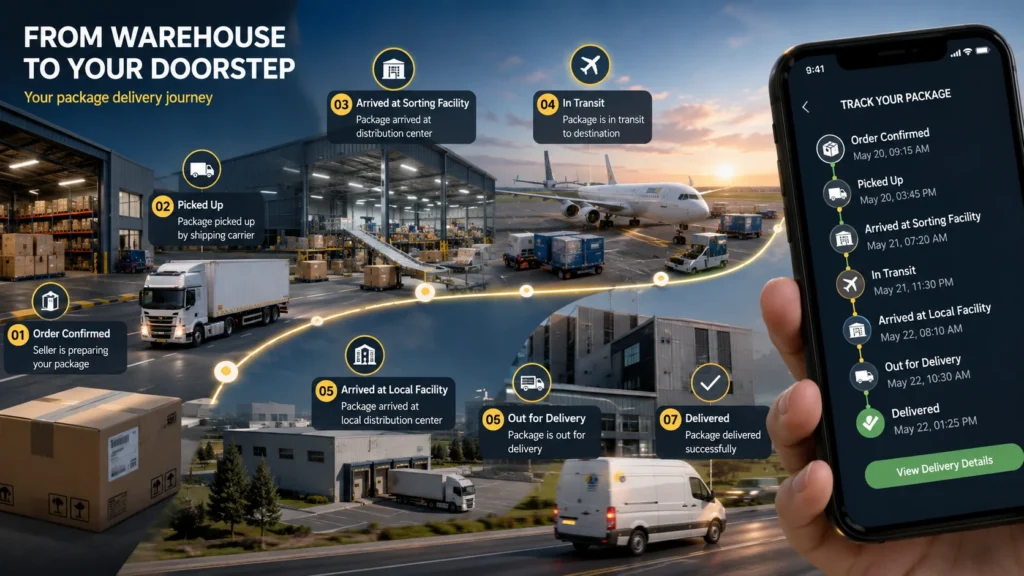
The package journey may look something like this:
| Shipping Stage | Tracking Status |
|---|---|
| Label Created | Shipment Information Received |
| Carrier Pickup | Accepted by Carrier |
| Regional Hub | In Transit |
| National Sorting Center | In Transit |
| Destination Facility | In Transit |
| Local Delivery Center | Arrived at Facility |
| Delivery Vehicle | Out for Delivery |
| Customer Address | Delivered |
Notice something important.
Several completely different locations all share the same tracking status:
In Transit
That’s why the phrase can sometimes feel vague.
The package may be 1,500 miles away or only 10 miles away. The tracking page may still show exactly the same message.
Why Shipping Companies Use the In Transit Status
Carriers handle millions of packages every day.
Providing a unique status for every movement would create enormous complexity.
Instead, shipping companies group many transportation events under one category.
Benefits for Shipping Carriers
- Simplifies tracking systems
- Reduces tracking confusion
- Makes logistics easier to manage
- Standardizes updates across networks
- Works across domestic and international routes
Major carriers use similar terminology even though their systems differ.
This includes:
- USPS
- FedEx
- DHL
- UPS
- Royal Mail
- Canada Post
- Australia Post
- Regional courier services
While wording may vary slightly, the underlying meaning remains largely the same.
Where Is Your Package When Tracking Says In Transit?
One of the most common questions customers ask is:
“Where is my package right now?”
The truth is that several answers may be correct.
The Package Could Be on a Truck
Long-distance trucking remains one of the most common transportation methods.
Packages often travel hundreds or thousands of miles between facilities before arriving near the destination.
The Package Could Be at a Sorting Facility
Sorting facilities serve as major logistics hubs.
Workers and automated systems scan, organize, and route packages according to destination.
Your package may spend several hours there.
During busy seasons, it may remain longer.
The Package Could Be on an Airplane
Many express shipments travel by air.
This is especially common for:
- Overnight shipping
- International shipments
- Priority services
- Time-sensitive deliveries
The tracking system may continue displaying in transit throughout the flight.
The Package Could Be Crossing Borders
International shipping introduces additional checkpoints.
The shipment may be:
- Leaving the origin country
- Entering the destination country
- Undergoing customs review
- Waiting for import clearance
All of these stages often appear under the same status.
Understanding the Journey of a Package in Transit
To fully understand package in transit meaning, it helps to see the complete shipping process.
Order Placed
The customer purchases an item.
Order Fulfillment
The seller prepares the package.
Label Creation
A tracking number is generated.
Carrier Pickup
The shipping company receives the parcel.
Origin Facility Processing
Initial scans enter the system.
Transportation Network
The package moves through various transit points.
Destination Processing
The shipment reaches the local region.
Last-Mile Delivery
The package moves to the delivery vehicle.
Final Delivery
The customer receives the shipment.
Most of this journey falls under one umbrella status:
In Transit
Different Stages Hidden Behind the In Transit Status
Many tracking systems hide detailed logistics information.
Behind the scenes, however, multiple events occur.
Departed Origin Facility
The package leaves the first processing center.
Arrived at Sorting Facility
The shipment reaches a distribution hub.
Processed Through Facility
Sorting systems identify the next destination.
Departed Transit Hub
The package leaves for another location.
Arrived at Destination Region
The shipment enters the final geographic area.
Arrived at Local Facility
The package reaches a center near the recipient.
Even though these are separate events, many carriers continue displaying:
In Transit
Common Tracking Updates You May See Alongside In Transit
Tracking systems often include supporting messages.
Shipment Accepted
The carrier officially receives the package.
Arrived at Facility
The package enters a processing center.
Departed Facility
The shipment leaves for the next location.
Arrived at Sorting Facility
The package enters a sorting operation.
Processed Through Hub
The shipment receives routing instructions.
Arrival at Destination Facility
The package enters the final delivery region.
Out for Delivery
A driver has the package.
Delivered
The shipment reaches its destination.
Understanding these updates helps you interpret package movement more accurately.
Package In Transit Meaning vs Parcel In Transit Meaning
People often search for both terms.
In practice, they mean exactly the same thing.
| Term | Meaning |
|---|---|
| Package In Transit | Shipment moving through carrier network |
| Parcel In Transit | Shipment moving through carrier network |
| Shipment In Transit | Goods being transported |
| Order In Transit | Purchased item currently being delivered |
Different countries simply favor different terminology.
For example:
- North America commonly uses “package.”
- The United Kingdom often uses “parcel.”
- Logistics companies frequently use “shipment.”
The underlying concept remains identical.
Why Tracking Information Sometimes Appears Stuck
This is one of the biggest causes of customer anxiety.
You see:
In Transit
Then nothing changes.
Hours pass.
A day passes.
Sometimes several days pass.
Naturally, you start wondering whether something is wrong.
In many cases, nothing is wrong at all.
Packages Are Not Scanned Constantly
Tracking updates occur when a package reaches specific checkpoints.
Between checkpoints, movement may continue without new scans.
Trucks Travel Long Distances
A truck crossing multiple states may not generate tracking events until reaching the next facility.
Weather Can Slow Updates
Snowstorms, hurricanes, flooding, and severe weather often create transportation delays.
Facilities Experience High Volume
Holiday shopping periods dramatically increase package volume.
Processing centers sometimes become congested.
Technology Delays Happen
Occasionally, tracking systems update later than the physical package movement.
The package may already have advanced while the website still displays older information.
Signs Your Shipment Is Moving Normally
Many customers assume a package is lost too quickly.
Usually, normal indicators exist.
Positive Signs
- Recent scan within the last few days
- Estimated delivery date remains active
- Package continues showing in transit
- Carrier has not issued an exception notice
- Destination remains unchanged
These signals generally indicate normal transportation activity.
Potential Warning Signs
- No updates for more than a week
- Delivery date repeatedly changes
- Shipment enters the wrong state repeatedly
- Carrier issues an exception status
- Tracking history stops completely
These situations may require further investigation.
How Long Does In Transit Usually Last?
There is no universal answer.
Transit time depends on multiple factors.
The most important factors include:
- Shipping method
- Distance
- Carrier network
- Customs processing
- Weather conditions
- Seasonal volume
The next section will examine transit times in detail and explain why some packages arrive in days while others remain in transit for weeks.
How Long Does In Transit Take?
One of the first questions people ask after seeing an in transit status is:
“How long does in transit take?”
The answer depends on several variables. A package traveling across town follows a completely different route than a package crossing continents.
The in transit status itself doesn’t reveal how much time remains. It simply indicates that the shipment continues moving through the carrier’s network.
Average Domestic Transit Times
| Shipping Service | Typical Transit Time |
|---|---|
| Same-Day Delivery | A few hours |
| Overnight Shipping | 1 business day |
| Express Shipping | 1–3 business days |
| Standard Shipping | 3–7 business days |
| Economy Shipping | 5–10 business days |
These estimates represent normal operating conditions.
Weather disruptions, transportation bottlenecks, and holiday demand can extend delivery times.
Average International Transit Times
| Shipping Type | Typical Transit Time |
|---|---|
| International Express | 2–5 business days |
| Priority International | 5–10 business days |
| Standard International | 7–21 business days |
| Economy International | 2–8 weeks |
International shipments often remain in transit longer because they pass through more checkpoints.
These checkpoints include:
- Export processing
- Airport transfers
- Customs inspections
- Import processing
- Local carrier handoffs
Each step adds time to the overall journey.
Factors That Affect Transit Time
Not all packages move at the same speed.
Several factors influence how long a shipment stays in transit.
Distance
The farther a package travels, the longer transit usually takes.
A package traveling 100 miles may arrive tomorrow.
A package traveling 3,000 miles may require several days.
Shipping Service Level
Premium shipping receives priority handling.
Economy shipping often waits for available transportation space.
Carrier Network
Every courier operates a unique logistics system.
Some carriers maintain larger transportation networks that allow faster movement.
Weather Conditions
Severe weather can disrupt:
- Air transportation
- Road transportation
- Sorting operations
- Delivery schedules
Snowstorms and hurricanes commonly cause delays.
Peak Shopping Seasons
Transit times often increase during:
- Black Friday
- Cyber Monday
- Christmas season
- Major sales events
Facilities process significantly higher package volumes during these periods.
Customs Processing
International shipments may remain in customs for hours, days, or occasionally weeks.
This stage falls outside the direct control of most carriers.
In Transit vs Out for Delivery
Many people mistakenly believe these statuses mean the same thing.
They do not.
Understanding the difference helps set realistic expectations.
What In Transit Means
When tracking says in transit:
- The package is moving through the shipping network.
- The shipment has not reached the final delivery vehicle.
- Multiple transportation steps may still remain.
What Out for Delivery Means
When tracking shows out for delivery:
- The package is on a local delivery route.
- A driver currently possesses the shipment.
- Delivery typically occurs that day.
Quick Comparison
| Status | Meaning |
|---|---|
| In Transit | Moving through transportation network |
| Out for Delivery | On delivery vehicle |
| Delivered | Successfully received |
Think of it this way:
In Transit = Traveling to your neighborhood
Out for Delivery = Traveling to your door
That distinction explains why a package may remain in transit for several days before suddenly switching to out for delivery.
In Transit vs Processing
Another common source of confusion involves processing statuses.
Processing Status
Processing usually means:
- The order exists.
- The shipping label exists.
- The carrier may not yet have the package.
Sometimes the seller creates a tracking number before physically handing over the shipment.
In Transit Status
In contrast:
- The carrier possesses the package.
- Transportation activity has begun.
- The shipment is moving toward its destination.
Comparison Table
| Tracking Status | What It Means |
|---|---|
| Processing | Preparing shipment |
| Label Created | Tracking generated |
| Accepted | Carrier received package |
| In Transit | Shipment moving |
| Out for Delivery | Final delivery stage |
| Delivered | Shipment completed |
Why Is My Package Still In Transit?
This question appears millions of times every year.
In most situations, the package is not lost.
Several common explanations exist.
Long Transportation Routes
Packages often travel through multiple hubs.
For example:
Warehouse → Regional Hub → National Hub → Destination Hub → Local Facility → Customer
Every transfer adds time.
Missed Tracking Scans
Not every movement generates a scan.
The package may continue moving even when tracking remains unchanged.
Transportation Delays
Unexpected events can slow movement:
- Mechanical issues
- Road closures
- Flight cancellations
- Labor shortages
- Weather disruptions
High Package Volume
Sorting facilities occasionally receive more packages than expected.
Backlogs can temporarily slow processing.
Delayed In Transit: What It Means
Sometimes tracking systems display messages such as:
- Delayed in transit
- Transit delayed
- Shipment exception
- Delivery delay
These messages indicate that the package encountered an unexpected obstacle.
Common Delay Causes
| Cause | Impact |
|---|---|
| Weather | Transportation interruptions |
| Customs Review | International shipment delays |
| Facility Congestion | Slower processing |
| Transportation Issues | Missed connections |
| Incorrect Address | Routing problems |
| Security Inspections | Additional screening |
A delay doesn’t automatically mean the shipment is lost.
Most delayed packages eventually arrive successfully.
What Happens When a Package Is In Transit?
Many consumers imagine a package simply riding in a truck from Point A to Point B.
The reality is far more complex.
Modern logistics networks function like giant transportation webs.
A package may pass through multiple cities before reaching its destination.
Typical Package Journey
Stage 1: Pickup
The carrier receives the shipment.
Stage 2: Origin Processing
The package enters the first sorting facility.
Stage 3: Regional Transportation
The shipment travels toward larger hubs.
Stage 4: National Sorting
Automated systems determine optimal routing.
Stage 5: Destination Transportation
The package moves toward the recipient’s region.
Stage 6: Local Processing
The shipment reaches the final delivery area.
Stage 7: Delivery
A local driver completes the delivery.
Most of these stages appear under a single status:
In Transit
USPS In Transit Meaning
For USPS tracking, in transit generally means the package continues moving between postal facilities.
Common USPS updates include:
- In Transit to Next Facility
- Arriving Late
- Departed USPS Regional Facility
- Arrived at USPS Regional Facility
USPS often updates tracking whenever the package enters or leaves major processing centers.
Sometimes USPS tracking pauses between scans for several days, especially during busy periods.
This doesn’t necessarily indicate a problem.
FedEx In Transit Status Explained
FedEx uses detailed tracking systems.
When FedEx shows in transit, the package may be:
- Traveling by truck
- Flying between airports
- Moving through sorting centers
- Waiting for transportation scheduling
FedEx frequently provides additional scan details, making shipment progress easier to follow.
Common FedEx updates include:
- Left FedEx Origin Facility
- Arrived at FedEx Location
- Departed FedEx Location
- At Local Facility
All of these typically fall under the broader in transit category.
DHL In Transit Tracking Meaning
DHL operates one of the world’s largest international logistics networks.
Because DHL specializes in international shipping, shipments often remain in transit longer than domestic deliveries.
DHL tracking may indicate:
- Shipment picked up
- Processed at facility
- Departed facility
- Customs status updated
- Arrived at destination country
International DHL packages frequently move through multiple countries before final delivery.
UPS In Transit Meaning
UPS uses the in transit status similarly to other major carriers.
The shipment may be:
- Moving between UPS facilities
- Traveling by truck or aircraft
- Awaiting transfer to another route
UPS tracking often provides estimated delivery dates alongside transportation updates.
These estimates become more accurate as the package approaches the destination.
International Shipping Tracking and In Transit Status
International shipping adds additional layers of complexity.
Domestic packages usually move within one transportation network.
International packages may pass through several systems.
Additional International Stages
- Export clearance
- International transportation
- Customs review
- Import clearance
- Local carrier transfer
- Final delivery
As a result, international shipments often display in transit for extended periods.
This is normal.
Customs Clearance Shipping Explained
Customs plays a major role in international logistics.
Government agencies inspect incoming shipments to ensure compliance with import regulations.
Customs May Review
- Package contents
- Declared value
- Import documentation
- Taxes and duties
- Restricted goods
During this review, tracking may continue displaying in transit.
In some cases, updates temporarily stop until customs processing finishes.
How Long Customs Takes
| Situation | Typical Time |
|---|---|
| Routine Clearance | A few hours |
| Standard Inspection | 1–3 days |
| Additional Review | Several days |
| Documentation Issues | Longer delays |
Most packages clear customs without major problems.
Why Tracking Sometimes Stops Updating
A lack of updates often creates unnecessary concern.
Several legitimate explanations exist.
Transportation Without Scanning
A package traveling hundreds of miles may not receive another scan until reaching its destination facility.
Carrier Handoffs
International shipments often move between carriers.
Tracking synchronization can take time.
Technology Delays
Physical movement sometimes occurs faster than tracking updates.
Weekend Processing
Some facilities reduce operations on weekends.
This can create temporary gaps in tracking history.
When Should You Contact the Carrier?
Patience usually solves most tracking concerns.
However, certain situations justify contacting customer support.
Consider Contacting the Carrier If:
- No updates appear for more than 7–10 days.
- The estimated delivery date has passed.
- Tracking shows conflicting information.
- The package appears misrouted.
- A shipment exception remains unresolved.
Before contacting support, review the entire tracking history.
Often the most recent scan provides valuable clues.
Signs a Package May Be Lost
Lost packages are relatively rare compared to total shipment volume.
Still, they occasionally occur.
Potential warning signs include:
- No scans for multiple weeks
- Repeated routing loops
- Missing delivery estimates
- Carrier confirms investigation
- Tracking history stops entirely
Most carriers have formal package tracing procedures for these situations.
Key Takeaways About In Transit Meaning
Understanding shipping terminology removes much of the anxiety associated with package tracking.
Remember these essential facts:
In transit means the shipment is moving through the carrier’s transportation network toward its destination.
It does not necessarily mean:
- The package is near you.
- Delivery will happen today.
- The package is on a delivery truck.
Instead, it indicates ongoing movement between facilities, hubs, airports, warehouses, and distribution centers.
A package can remain in transit for hours, days, or even weeks depending on:
- Distance
- Shipping method
- Carrier operations
- Customs processing
- Weather conditions
- Seasonal demand
Most importantly, seeing an in transit status is generally a positive sign. It means the shipment remains active within the logistics network and continues progressing toward final delivery.
Frequently Asked Questions
What does in transit mean on package tracking?
In transit means the carrier is currently transporting the package through its shipping network toward the final destination.
Does in transit mean my package is coming today?
No. A package in transit may still be several transportation stages away from delivery. Out for delivery usually indicates arrival that day.
How long can a package stay in transit?
Transit times vary from one day to several weeks depending on shipping service, distance, customs processing, and carrier operations.
Why is my package stuck in transit?
Most packages are not actually stuck. Common causes include long transportation routes, missed scans, facility congestion, weather delays, and customs processing.
What happens after in transit?
The next status often includes arrival at a local facility, arrival at a destination hub, or out for delivery before the package is finally delivered.
Is in transit a good sign?
Yes. In transit generally means the shipment remains active and continues moving through the delivery network.
What is the difference between in transit and delivered?
In transit means transportation is still ongoing. Delivered means the package has reached its final destination and the shipping process is complete.
Can a package be lost while in transit?
Although rare, packages can occasionally become lost, damaged, or misrouted. Most carriers provide investigation and tracing services when this occurs.
Conclusion
Understanding the in transit meaning can eliminate much of the confusion that comes with tracking a package online. When tracking says in transit, it simply means the shipment is actively moving through the carrier’s logistics network on its way to the final destination. The package may be traveling between distribution centers, sorting facilities, airports, warehouses, or local delivery hubs.
It’s important to remember that in transit status meaning does not indicate the exact location of a package or guarantee delivery on the same day. In many cases, a shipment can remain in transit for several days while it moves through different stages of the shipping process. Factors such as distance, carrier operations, weather conditions, customs clearance, and seasonal demand can all affect transit times.
Whether you’re tracking a domestic parcel or monitoring an international shipment, seeing package is in transit is generally a positive sign. It means the carrier has possession of the package and is continuing to transport it toward its destination. While occasional delays and tracking gaps can happen, most shipments reach the recipient without issues.
The next time you check your tracking page and see “In Transit,” you’ll know exactly what it means: your package is still on the journey, moving through the transportation network and getting one step closer to your doorstep.

Michael Anderson is a content writer specializing in word meanings, definitions and clear explanations of modern terms and phrases.