
Last Updated on June 15, 2026
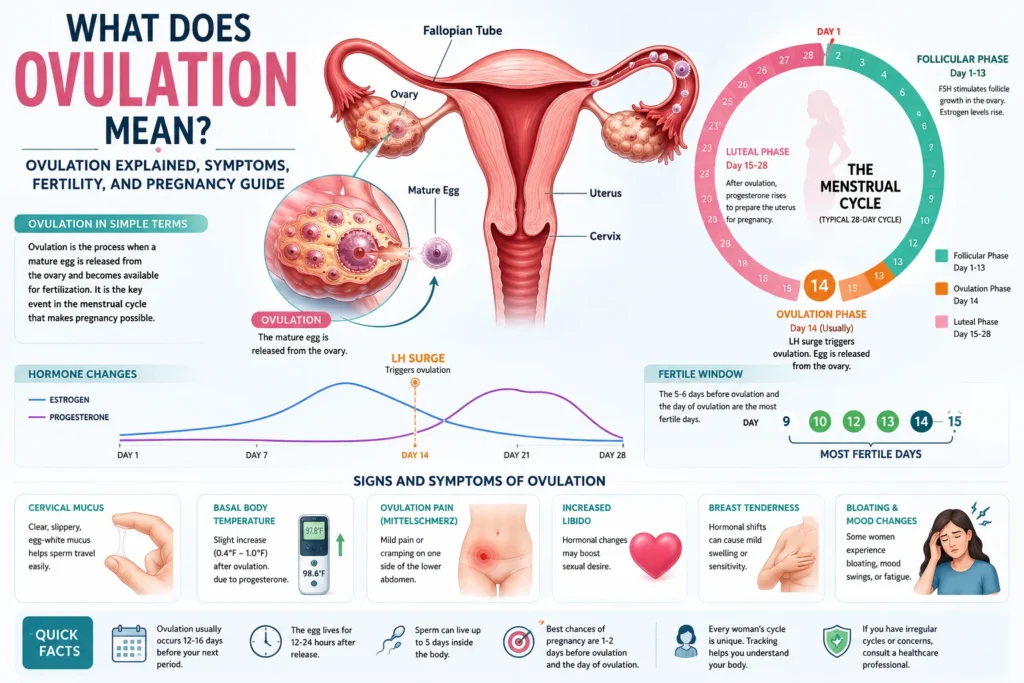
Ovulation is the process in which a mature egg is released from an ovary and travels into the fallopian tube where fertilization may occur. It usually happens once during each menstrual cycle and represents the most fertile time for pregnancy. Ovulation is controlled by hormones including luteinizing hormone (LH), follicle-stimulating hormone (FSH), estrogen, and progesterone.
If you’ve ever wondered, “What does ovulation mean?”, you’re not alone. Millions of women search for the answer every year because ovulation plays a central role in fertility, pregnancy, menstruation, and overall reproductive health.
In simple terms, ovulation is the release of a mature egg from one of the ovaries. Once released, that egg begins a journey through the fallopian tube where it may meet sperm and become fertilized.
Without ovulation, natural conception cannot occur. That’s why understanding ovulation matters whether you’re trying to become pregnant, avoiding pregnancy, tracking your menstrual cycle, or simply learning more about how your body works.
Although many people associate ovulation only with pregnancy, its importance goes much deeper. Ovulation acts as a monthly signal that the reproductive system is functioning normally. It reflects a complex interaction between the brain, hormones, ovaries, and reproductive organs.
Think of ovulation as the centerpiece of the menstrual cycle. Every stage before ovulation prepares the egg for release. Every stage afterward prepares the body for a possible pregnancy.
Understanding this process can help you make sense of cycle changes, fertility signs, hormone fluctuations, and common symptoms that occur throughout the month.
Ovulation Meaning Explained in Simple Terms
Many medical explanations make ovulation sound complicated. In reality, the concept is straightforward.
Imagine the ovary as a garden containing thousands of tiny immature eggs. During each menstrual cycle, one of those eggs usually develops and matures inside a protective structure called a follicle.
Once the egg reaches maturity, the ovary releases it.
That release is ovulation.
After ovulation:
- The egg enters the fallopian tube.
- It waits for possible fertilization.
- If sperm is present, conception may occur.
- If fertilization does not happen, the egg breaks down.
- The menstrual cycle continues toward the next period.
This monthly event represents the body’s natural reproductive rhythm.
Quick Ovulation Definition
Ovulation is the release of a mature egg from the ovary for potential fertilization.
Key Facts About Ovulation
| Fact | Explanation |
|---|---|
| Happens once per cycle | Most women release one egg per cycle |
| Triggered by hormones | Mainly LH and FSH |
| Essential for pregnancy | Fertilization requires an egg |
| Usually occurs mid-cycle | Around day 14 in a 28-day cycle |
| Egg survives briefly | About 12–24 hours |
| Creates fertile window | Highest pregnancy chances occur around ovulation |
Why Ovulation Is Important
Ovulation influences far more than fertility.
The process affects:
- Hormone production
- Menstrual regularity
- Reproductive health
- Pregnancy chances
- Overall hormonal balance
When ovulation occurs consistently, it often indicates that the reproductive system is functioning properly.
When ovulation becomes irregular or stops entirely, it can signal an underlying health issue.
Benefits of Regular Ovulation
Regular ovulation often suggests:
- Balanced estrogen levels
- Healthy progesterone production
- Predictable menstrual cycles
- Improved fertility potential
- Normal ovarian function
What Happens Without Ovulation?
When ovulation does not occur, a condition called anovulation develops.
This can lead to:
- Irregular periods
- Missed periods
- Fertility challenges
- Hormonal imbalances
- Difficulty conceiving
Because ovulation sits at the center of reproductive health, doctors often evaluate ovulation patterns when investigating fertility concerns.
Understanding the Female Reproductive System
Before learning how ovulation works, it’s helpful to understand the organs involved.
Several parts of the female reproductive system work together during ovulation.
Main Reproductive Organs
| Organ | Function |
| Ovaries | Store and release eggs |
| Fallopian Tubes | Transport eggs |
| Uterus | Supports pregnancy |
| Cervix | Connects uterus to vagina |
| Vagina | Birth canal and reproductive passage |
Each structure plays a specific role during the ovulation cycle.
The Ovaries
The ovaries are two small organs located on either side of the uterus.
They serve two major functions:
- Store egg cells
- Produce reproductive hormones
Women are born with millions of immature eggs. Over time, that number gradually declines.
During each menstrual cycle, a group of follicles begins developing inside the ovaries. Usually, only one follicle becomes dominant and releases an egg during ovulation.
The Fallopian Tubes
After ovulation, the egg enters a fallopian tube.
This is where fertilization typically occurs.
Contrary to popular belief, fertilization usually does not happen inside the uterus. It most often occurs inside the fallopian tube before the fertilized egg travels toward the uterus.
The Uterus
The uterus prepares for pregnancy throughout the cycle.
Before ovulation, hormones encourage the uterine lining to thicken.
If fertilization occurs, the embryo implants into this lining.
If pregnancy does not occur, the lining sheds during menstruation.
The Science Behind Ovulation
Ovulation may seem simple from the outside, but a sophisticated hormonal system controls the process.
The brain and reproductive organs communicate constantly.
A small disruption in this communication can affect ovulation timing or prevent ovulation entirely.
The Brain-Ovary Connection
Ovulation begins in the brain.
Specifically, the hypothalamus and pituitary gland coordinate the hormonal signals necessary for egg development and release.
These structures act like the body’s reproductive control center.
They send messages to the ovaries using hormones.
The ovaries respond by maturing and releasing an egg.
Hormones That Control Ovulation
Several hormones work together throughout the cycle.
Follicle-Stimulating Hormone (FSH)
FSH stimulates follicle growth inside the ovary.
Without FSH, eggs cannot mature properly.
Its primary role includes:
- Encouraging follicle development
- Supporting egg maturation
- Preparing the ovary for ovulation
Estrogen
As follicles grow, they produce estrogen.
Estrogen helps:
- Build the uterine lining
- Prepare the body for pregnancy
- Trigger the LH surge
Estrogen levels rise steadily before ovulation.
Luteinizing Hormone (LH)
LH is the hormone most directly responsible for ovulation.
When estrogen reaches a certain level, the brain releases a large amount of LH.
This event is known as the LH surge.
The LH surge causes:
- Final egg maturation
- Follicle rupture
- Egg release
Ovulation usually occurs within 24 to 36 hours after the LH surge begins.
Progesterone
After ovulation, progesterone becomes dominant.
This hormone:
- Stabilizes the uterine lining
- Supports implantation
- Prepares the body for pregnancy
Progesterone levels rise significantly during the second half of the menstrual cycle.
What Happens Before Ovulation?
Many people focus only on ovulation itself.
However, the body spends weeks preparing for that single event.
The phase leading up to ovulation is called the follicular phase.
Early Follicular Phase
The follicular phase begins on the first day of menstruation.
During this time:
- Estrogen is low.
- Progesterone is low.
- FSH begins rising.
- Follicles start developing.
Several follicles compete for dominance.
Eventually, one follicle becomes the strongest.
Dominant Follicle Development
As the dominant follicle grows:
- It produces more estrogen.
- Other follicles stop developing.
- The egg continues maturing.
The dominant follicle eventually reaches full maturity.
At that point, the body prepares for ovulation.
Rising Estrogen Levels
Increasing estrogen creates several noticeable changes:
- Thicker uterine lining
- Increased cervical mucus
- Improved fertility environment
- Hormonal signals that trigger LH production
This hormonal rise represents one of the most important steps in the ovulation process.
Without sufficient estrogen production, ovulation may not occur.
The Moment of Ovulation
Ovulation itself is surprisingly brief.
Months of preparation lead to a process that takes only a short time.
When the LH surge reaches its peak:
- The follicle ruptures.
- The mature egg exits the ovary.
- The egg enters the fallopian tube.
- The fertile window reaches its peak.
At this moment, the body becomes most capable of achieving pregnancy.
Although ovulation is a single event, fertility extends beyond that day because sperm can survive inside the reproductive tract for several days.
This explains why pregnancy can occur even when intercourse happens before ovulation.
How Long Does Ovulation Last?
This question causes considerable confusion.
The actual release of the egg happens quickly.
However, the egg remains viable for only a short period afterward.
Ovulation Timeline
| Event | Typical Duration |
| LH Surge | 24–36 hours |
| Egg Release | Minutes |
| Egg Survival | 12–24 hours |
| Sperm Survival | Up to 5 days |
| Fertile Window | About 6 days |
Because sperm can survive longer than the egg, fertility begins before ovulation and continues briefly afterward.
This fertile window creates the highest opportunity for conception.
When Does Ovulation Occur in the Menstrual Cycle?
One of the most common misconceptions is that every woman ovulates on day 14.
In reality, ovulation timing varies considerably.
A woman with a 28-day cycle may ovulate around day 14.
Someone with a 35-day cycle may ovulate closer to day 21.
Someone with a shorter cycle may ovulate much earlier.
The most accurate rule is this:
Ovulation usually occurs about 14 days before the next period begins.
This means cycle length influences ovulation timing.
Understanding this principle can improve fertility tracking and cycle awareness.
Typical Ovulation Timing by Cycle Length
| Cycle Length | Estimated Ovulation Day |
| 21 Days | Day 7 |
| 24 Days | Day 10 |
| 26 Days | Day 12 |
| 28 Days | Day 14 |
| 30 Days | Day 16 |
| 32 Days | Day 18 |
| 35 Days | Day 21 |
These estimates vary from person to person, but they provide a useful starting point for understanding the ovulation cycle.
Ovulation Symptoms: How to Tell If You Are Ovulating
Many women wonder whether they can actually feel ovulation happening.
The answer is yes, sometimes.
While some women experience obvious ovulation symptoms every month, others notice very few signs. Both situations are completely normal.
Ovulation symptoms occur because hormone levels shift rapidly before, during, and after egg release. These hormonal changes affect the reproductive system, body temperature, cervical mucus, and even mood.
Learning to recognize these signs can help you understand your cycle and identify your most fertile days.
Common Ovulation Symptoms
The most frequently reported ovulation symptoms include:
- Clear, stretchy cervical mucus
- Mild pelvic pain
- Increased sex drive
- Breast tenderness
- Bloating
- Heightened sense of smell
- Increased energy
- Light spotting
- Changes in basal body temperature
Not every woman experiences all of these symptoms. Some notice only one or two signs while others experience several.
Ovulation Symptoms at a Glance
| Symptom | Why It Happens |
|---|---|
| Clear cervical mucus | Rising estrogen levels |
| Pelvic discomfort | Egg release from ovary |
| Higher libido | Hormonal changes |
| Breast sensitivity | Estrogen and progesterone fluctuations |
| Slight bloating | Hormonal effects on fluid balance |
| Light spotting | Follicle rupture |
| Temperature increase | Progesterone rise after ovulation |
Cervical Mucus Changes During Ovulation
One of the most reliable natural fertility signs involves cervical mucus.
As ovulation approaches, estrogen levels rise dramatically.
This causes the cervix to produce mucus that becomes:
- Clear
- Slippery
- Stretchy
- Elastic
Many women compare it to raw egg whites.
This type of mucus helps sperm survive longer and travel more easily through the reproductive tract.
Why Cervical Mucus Matters
Sperm face a difficult journey.
Without fertile cervical mucus, many sperm die before reaching the egg.
During ovulation, cervical mucus creates a more welcoming environment by:
- Protecting sperm
- Providing moisture
- Reducing acidity
- Supporting sperm movement
Because of these benefits, egg-white cervical mucus often signals peak fertility.
Cervical Mucus Throughout the Cycle
| Cycle Stage | Mucus Appearance |
|---|---|
| After period | Dry or minimal |
| Early follicular phase | Sticky |
| Before ovulation | Creamy |
| Ovulation | Clear and stretchy |
| After ovulation | Thick and sticky |
Women who practice fertility awareness often track these changes every day.
Ovulation Pain (Mittelschmerz)
Some women experience discomfort when ovulation occurs.
Doctors call this pain Mittelschmerz, a German term meaning “middle pain.
The discomfort typically appears:
- On one side of the lower abdomen
- Near the active ovary
- Around the middle of the cycle
What Ovulation Pain Feels Like
Women describe it differently.
Some report:
- Sharp pain
- Dull ache
- Mild cramping
- Brief stabbing sensation
The pain may last:
- A few minutes
- Several hours
- Occasionally one to two days
Most cases are harmless and simply reflect normal egg release.
Why Ovulation Pain Happens
Experts believe several factors contribute:
- Follicle expansion before rupture
- Release of fluid from the follicle
- Mild irritation of nearby tissues
- Small amounts of bleeding
Although the pain can feel alarming, it usually resolves on its own.
Increased Libido During Ovulation
Nature has an interesting way of encouraging reproduction.
Many women notice an increase in sexual desire around ovulation.
Research has shown that hormonal changes can influence attraction, libido, and sexual interest during the fertile window.
Several factors contribute:
- Higher estrogen levels
- Increased testosterone activity
- Brain responses to reproductive hormones
This rise in libido often occurs naturally during peak fertility.
Breast Tenderness and Ovulation
Hormonal fluctuations can affect breast tissue.
Some women notice:
- Tenderness
- Fullness
- Increased sensitivity
- Mild discomfort
These symptoms often begin around ovulation and continue into the luteal phase.
Progesterone is usually responsible for these changes after the egg has been released.
Light Spotting During Ovulation
A small percentage of women notice light spotting around ovulation.
This spotting typically appears:
- Pink
- Light red
- Brown
Unlike a menstrual period, ovulation spotting is usually:
- Very light
- Short-lived
- Lasting one or two days
The spotting may result from rapid hormone changes or follicle rupture.
Changes in Energy and Mood
Hormones affect much more than fertility.
They also influence:
- Mood
- Energy
- Concentration
- Confidence
Some women report feeling:
- More energetic
- More social
- More motivated
- Mentally sharper
Others notice subtle emotional changes.
These variations occur because reproductive hormones interact with brain chemistry throughout the menstrual cycle.
What Is the Fertile Window?
The fertile window refers to the days during a menstrual cycle when pregnancy is most likely.
Many people mistakenly assume fertility exists only on the day of ovulation.
In reality, fertility spans several days.
Why the Fertile Window Exists
The answer lies in sperm survival.
While the egg survives only about 12–24 hours, sperm can remain alive inside the female reproductive tract for up to five days.
Because sperm can wait for the egg, intercourse before ovulation may still result in pregnancy.
Fertile Window Timeline
| Day Relative to Ovulation | Fertility Level |
|---|---|
| 5 days before | Moderate |
| 4 days before | Moderate |
| 3 days before | High |
| 2 days before | Very High |
| 1 day before | Peak |
| Ovulation day | Peak |
| 1 day after | Low |
This six-day period represents the highest chance of conception.
Can You Get Pregnant During Ovulation?
Yes.
Ovulation is the most fertile time of the menstrual cycle.
Pregnancy occurs when:
- Ovulation releases an egg.
- Sperm reaches the egg.
- Fertilization takes place.
- The embryo implants successfully.
Without ovulation, natural conception cannot occur.
Pregnancy Chances Around Ovulation
Although exact percentages vary, conception is most likely when intercourse occurs:
- One to two days before ovulation
- On ovulation day
This timing allows sperm to be present when the egg arrives.
Why Timing Matters
The egg’s lifespan is surprisingly short.
Once released, it remains viable for approximately:
- 12 hours
- 24 hours at most
If fertilization does not occur during that period, the egg breaks down.
This is why understanding ovulation timing is so important for fertility planning.
Ovulation and Conception Explained
Many people use the terms ovulation and conception interchangeably.
However, they are different events.
Ovulation
Ovulation means:
- Egg matures
- Egg releases from ovary
- Egg enters fallopian tube
Conception
Conception occurs when:
- Sperm penetrates the egg
- Genetic material combines
- A fertilized egg forms
Ovulation creates the opportunity for conception.
Conception occurs only if sperm successfully fertilizes the egg.
Step-by-Step Fertilization Process
The journey from ovulation to pregnancy involves several stages.
Step 1: Egg Release
Ovulation releases a mature egg from the ovary.
Step 2: Sperm Travel
Millions of sperm begin moving through the reproductive tract.
Only a tiny fraction reach the fallopian tube.
Step 3: Fertilization
One sperm successfully enters the egg.
Genetic material combines.
A fertilized egg forms.
Step 4: Cell Division
The fertilized egg begins dividing rapidly.
Step 5: Travel to the Uterus
The developing embryo travels toward the uterus.
Step 6: Implantation
The embryo attaches to the uterine lining.
Pregnancy officially begins after successful implantation.
How Ovulation Affects Pregnancy Chances
Ovulation directly determines fertility.
Without an egg, sperm has nothing to fertilize.
The quality of ovulation can also influence pregnancy success.
Factors That Affect Fertility Around Ovulation
Several factors impact conception chances:
- Age
- Egg quality
- Hormone balance
- Sperm quality
- Timing of intercourse
- Overall reproductive health
Understanding ovulation helps couples maximize fertility opportunities.
How Long Does the Egg Survive After Ovulation?
One of the most important fertility facts involves egg lifespan.
A mature egg survives for only a short period after release.
Egg Survival Timeline
| Time After Ovulation | Fertilization Potential |
|---|---|
| 0–12 hours | Highest |
| 12–24 hours | Possible |
| Beyond 24 hours | Unlikely |
Because the fertile window is brief, identifying ovulation accurately can significantly improve pregnancy planning.
Why Some Women Do Not Notice Ovulation Symptoms
Not everyone experiences noticeable signs.
This is completely normal.
Some women ovulate regularly without:
- Pain
- Spotting
- Mood changes
- Obvious mucus changes
Others experience strong symptoms every month.
Both patterns can occur in healthy cycles.
The absence of symptoms does not necessarily mean ovulation is absent.
Tracking methods such as ovulation predictor kits, cycle charting, and basal body temperature monitoring often provide a clearer picture than symptoms alone.
Fertility Awareness and Ovulation
Fertility awareness involves understanding the body’s natural signs of fertility.
Many women use fertility awareness methods to:
- Track ovulation
- Plan pregnancy
- Understand cycle patterns
- Monitor reproductive health
These methods often combine:
- Cervical mucus observations
- Basal body temperature tracking
- Calendar calculations
- Ovulation predictor kits
When used consistently, fertility awareness can provide valuable insight into the ovulation cycle and overall reproductive health.
How to Know If You Are Ovulating
One of the most common fertility questions is:
“How can I tell if I am ovulating?”
The answer depends on how closely you monitor your body and cycle.
Some women recognize ovulation through physical symptoms. Others rely on fertility tracking tools to identify their fertile days more accurately.
The most reliable approach combines multiple methods rather than depending on a single sign.
Common Ways to Detect Ovulation
Women often identify ovulation through:
- Cervical mucus changes
- Basal body temperature tracking
- Ovulation predictor kits
- Menstrual cycle tracking
- Fertility monitors
- Blood hormone testing
- Ultrasound monitoring
Each method offers advantages and limitations.
Using several together generally improves accuracy.
Ovulation Tracking Explained
Ovulation tracking helps predict when the egg is likely to be released.
Many women track ovulation to:
- Increase pregnancy chances
- Understand their menstrual cycle
- Monitor reproductive health
- Identify irregular cycles
- Support fertility treatment
Modern technology has made fertility tracking easier than ever.
Apps, wearable devices, and hormone tests can now provide detailed cycle insights.
Calendar Tracking Method
Calendar tracking is one of the simplest fertility awareness methods.
This approach involves:
- Recording cycle lengths.
- Identifying patterns.
- Estimating future ovulation dates.
For example:
| Cycle Length | Estimated Ovulation |
|---|---|
| 28 days | Day 14 |
| 30 days | Day 16 |
| 32 days | Day 18 |
| 35 days | Day 21 |
While useful, calendar tracking has limitations.
Ovulation does not always occur on the same day every month.
Stress, illness, travel, and hormonal fluctuations can shift timing.
Because of this, calendar tracking works best when combined with other fertility signs.
Basal Body Temperature Tracking
Basal body temperature (BBT) tracking remains one of the oldest fertility awareness methods.
Basal body temperature refers to your body’s resting temperature immediately after waking.
How Ovulation Affects Body Temperature
Before ovulation:
- Progesterone remains low.
- Body temperature stays relatively stable.
After ovulation:
- Progesterone rises.
- Body temperature increases slightly.
The increase is usually:
- 0.4°F to 1.0°F
- Approximately 0.2°C to 0.5°C
Although the change is small, consistent tracking often reveals a clear pattern.
Typical BBT Pattern
| Cycle Phase | Temperature Trend |
|---|---|
| Menstruation | Lower |
| Follicular Phase | Stable |
| Ovulation | Slight dip possible |
| Luteal Phase | Higher |
A sustained temperature increase often confirms that ovulation has already occurred.
Advantages of BBT Tracking
- Low cost
- Natural method
- Helpful for cycle analysis
- Useful for fertility awareness
Limitations
Temperature readings can be affected by:
- Poor sleep
- Illness
- Alcohol consumption
- Travel
- Stress
Because of these factors, BBT works best when combined with other ovulation indicators.
Ovulation Predictor Kits (OPKs)
Ovulation predictor kits have become one of the most popular fertility tools.
These tests detect luteinizing hormone (LH) in urine.
Since ovulation typically occurs within 24–36 hours of the LH surge, OPKs can help identify the most fertile days.
How OPKs Work
The process is simple:
- Test urine daily.
- Watch for rising LH levels.
- Detect the LH surge.
- Predict ovulation.
Many women begin testing several days before expected ovulation.
Benefits of OPKs
- Easy to use
- Widely available
- Non-invasive
- Good accuracy
- Helps identify fertile days
Limitations of OPKs
Certain conditions may affect results.
These include:
- Polycystic Ovary Syndrome (PCOS)
- Hormonal disorders
- Some fertility medications
For this reason, OPKs should be interpreted alongside other fertility signs.
Fertility Monitors and Digital Tracking Devices
Technology continues to transform fertility awareness.
Modern fertility monitors can track:
- LH levels
- Estrogen changes
- Temperature shifts
- Cycle trends
Many devices connect directly to smartphone applications.
These tools analyze large amounts of cycle data and generate fertility predictions.
Although they can be useful, no technology can guarantee pregnancy or predict ovulation with perfect accuracy.
What Happens After Ovulation?
The menstrual cycle does not end after the egg is released.
In many ways, ovulation marks the beginning of a completely new phase.
This stage is known as the luteal phase.
The Luteal Phase Explained
After ovulation:
- The empty follicle transforms into the corpus luteum.
- Progesterone production increases.
- The uterine lining becomes more receptive.
- The body prepares for possible implantation.
The luteal phase usually lasts:
- About 12–14 days
- Fairly consistent from cycle to cycle
Unlike ovulation timing, luteal phase length tends to remain stable.
What Is the Corpus Luteum?
The corpus luteum is a temporary structure that forms after ovulation.
Its primary role is producing progesterone.
Progesterone helps:
- Maintain the uterine lining
- Support early pregnancy
- Prevent premature shedding of the endometrium
If pregnancy occurs, the corpus luteum continues functioning until the placenta takes over hormone production.
If pregnancy does not occur, it gradually breaks down.
What Happens If Fertilization Occurs?
When sperm successfully fertilizes the egg, a remarkable process begins.
Early Pregnancy Timeline
| Event | Approximate Timing |
|---|---|
| Ovulation | Day 0 |
| Fertilization | Within 24 hours |
| Cell division begins | Day 1–3 |
| Embryo reaches uterus | Day 5–6 |
| Implantation begins | Day 6–10 |
| Pregnancy hormone rises | After implantation |
This sequence occurs long before most women realize they are pregnant.
Implantation Explained
Implantation occurs when the developing embryo attaches to the uterine lining.
This process allows:
- Nutrient exchange
- Oxygen delivery
- Pregnancy progression
Successful implantation represents one of the most critical steps in human reproduction.
Even when fertilization occurs, implantation must also happen for pregnancy to continue.
What Happens If Fertilization Does Not Occur?
If the egg is not fertilized, pregnancy does not develop.
The body then begins preparing for menstruation.
Events After an Unfertilized Egg
- Egg breaks down.
- Progesterone decreases.
- Estrogen decreases.
- Uterine lining sheds.
- Menstruation begins.
A new menstrual cycle then starts.
This process repeats throughout the reproductive years.
Irregular Ovulation
Not every woman ovulates consistently every month.
Irregular ovulation occurs when:
- Ovulation timing changes significantly
- Ovulation occurs infrequently
- Ovulation becomes unpredictable
Signs of Irregular Ovulation
Common signs include:
- Irregular periods
- Missed periods
- Unusually long cycles
- Very short cycles
- Difficulty conceiving
Occasional variation is normal.
Frequent irregularity may indicate an underlying issue.
What Is Anovulation?
Anovulation means ovulation does not occur.
Without egg release, natural conception becomes impossible during that cycle.
Common Causes of Anovulation
Several factors can interfere with normal ovulation.
Hormonal Imbalances
Hormones must remain carefully balanced.
Disruptions can prevent ovulation entirely.
Polycystic Ovary Syndrome (PCOS)
PCOS is one of the most common causes of ovulatory dysfunction.
Women with PCOS may experience:
- Irregular cycles
- Missed periods
- Elevated androgen levels
- Difficulty conceiving
Thyroid Disorders
Both overactive and underactive thyroid conditions can affect reproductive hormones.
Significant Weight Changes
Rapid weight gain or loss can disrupt hormone production.
Excessive Exercise
Extreme physical activity sometimes suppresses ovulation.
Chronic Stress
Stress hormones can interfere with reproductive hormone signaling.
Polycystic Ovary Syndrome (PCOS) and Ovulation
PCOS affects millions of women worldwide.
It is one of the leading causes of infertility associated with ovulation disorders.
How PCOS Affects Ovulation
Women with PCOS often experience:
- Delayed ovulation
- Infrequent ovulation
- Absent ovulation
- Hormonal imbalance
The ovaries may develop multiple small follicles that fail to mature properly.
As a result, regular egg release becomes difficult.
Common Symptoms of PCOS
- Irregular periods
- Acne
- Excess facial hair
- Weight gain
- Fertility challenges
Early diagnosis and management can significantly improve reproductive outcomes.
Other Conditions That Affect Ovulation
Ovulation depends on many body systems working together.
Several health conditions can interfere with this process.
Conditions Linked to Ovulation Problems
- Thyroid disease
- Hyperprolactinemia
- Premature ovarian insufficiency
- Hypothalamic dysfunction
- Diabetes
- Severe obesity
- Eating disorders
Addressing the underlying condition often improves ovulatory function.
Can Ovulation Occur Without a Period?
Surprisingly, yes.
Ovulation can occasionally occur before a menstrual period returns.
This situation commonly occurs:
- After childbirth
- During breastfeeding
- After discontinuing hormonal birth control
Because ovulation happens before menstruation, pregnancy may occur even before the first postpartum period arrives.
This fact often surprises many women.
Can You Have a Period Without Ovulating?
Yes.
Not all bleeding represents a true ovulatory menstrual cycle.
Some women experience bleeding caused by:
- Hormonal fluctuations
- Breakthrough bleeding
- Anovulatory cycles
In these situations, bleeding occurs even though egg release never happened.
This distinction becomes important when evaluating fertility.
Ovulation and Age
Age significantly affects fertility and ovulation quality.
Women are born with a finite number of eggs.
Over time:
- Egg quantity declines.
- Egg quality declines.
- Fertility gradually decreases.
General Fertility Trends
| Age Group | Fertility Trend |
|---|---|
| 20s | Highest |
| Early 30s | Slight decline |
| Mid-30s | Noticeable decline |
| Late 30s | Significant decline |
| 40+ | Reduced fertility |
Ovulation may continue for many years, but egg quality often becomes a more important factor than ovulation itself.
Why Understanding Ovulation Matters
Understanding ovulation provides valuable insight into reproductive health.
It helps women:
- Recognize fertility patterns
- Track menstrual health
- Identify potential disorders
- Improve pregnancy planning
- Understand hormonal changes
Knowledge of ovulation transforms fertility from a mystery into a process that can be observed, monitored, and understood.
Common Myths About Ovulation
Ovulation is one of the most misunderstood aspects of reproductive health. Many myths continue to circulate online, causing confusion about fertility, pregnancy, and menstrual cycles.
Let’s separate fact from fiction.
Myth: Every Woman Ovulates on Day 14
This is perhaps the most widespread misconception.
While ovulation often occurs around day 14 in a 28-day cycle, not every woman has a 28-day cycle.
Cycle length varies significantly.
Some women ovulate:
- Earlier than day 14
- Later than day 14
- On different days each month
Ovulation timing depends on individual hormone patterns rather than a fixed calendar date.
Myth: You Can Only Get Pregnant on Ovulation Day
Pregnancy can occur even if intercourse happens several days before ovulation.
This is because sperm can survive inside the reproductive tract for up to five days.
As a result, the fertile window extends beyond the exact day of ovulation.
Myth: Ovulation Always Causes Pain
Many women never experience ovulation pain.
Others notice mild discomfort every month.
Neither experience automatically indicates a problem.
Pain is simply one possible symptom of egg release.
Myth: Regular Periods Guarantee Ovulation
Although regular cycles often suggest ovulation is occurring, they do not guarantee it.
Some women experience anovulatory cycles while still having monthly bleeding.
Only proper fertility tracking or medical evaluation can confirm ovulation consistently.
Myth: You Cannot Get Pregnant If You Miss a Period
Ovulation may occur before menstruation returns.
This is especially true:
- After childbirth
- During breastfeeding
- After stopping hormonal birth control
Pregnancy can happen before the first postpartum period appears.
Lifestyle Factors That Affect Ovulation
Ovulation depends on a delicate hormonal balance.
Several lifestyle factors can influence this balance and affect fertility.
Nutrition and Ovulation
The body requires adequate nutrients to support reproductive function.
A balanced diet helps maintain:
- Hormone production
- Egg development
- Metabolic health
- Reproductive wellness
Important nutrients include:
- Protein
- Iron
- Zinc
- Folate
- Vitamin D
- Omega-3 fatty acids
While no single food causes ovulation, overall nutrition plays an important role in reproductive health.
Body Weight and Fertility
Both underweight and heavier person conditions can affect ovulation.
Low body fat may reduce hormone production.
Excess body fat can increase hormonal disruption.
Maintaining a healthy weight often supports:
- More regular cycles
- Improved hormone balance
- Better ovulation patterns
The relationship between weight and fertility is complex, but it remains an important factor.
Exercise and Ovulation
Moderate exercise benefits reproductive health.
Potential benefits include:
- Improved circulation
- Better insulin sensitivity
- Stress reduction
- Hormone support
However, excessive exercise may interfere with ovulation in some women.
High-intensity training combined with insufficient calorie intake can suppress reproductive hormones.
Balance is key.
Stress and Hormonal Changes
The body prioritizes survival over reproduction.
When stress becomes chronic, hormone signaling may be disrupted.
Stress can influence:
- LH production
- FSH secretion
- Menstrual cycle timing
- Ovulation consistency
This does not mean everyday stress automatically stops ovulation.
However, severe or prolonged stress may contribute to cycle irregularities in some individuals.
Ovulation and Birth Control
Many women wonder how birth control affects ovulation.
Most hormonal contraceptives work by preventing ovulation.
How Hormonal Birth Control Prevents Ovulation
Hormonal contraceptives may:
- Suppress LH release
- Prevent the LH surge
- Stop egg maturation
- Thicken cervical mucus
- Alter the uterine lining
Without the LH surge, ovulation cannot occur.
Does Ovulation Return After Stopping Birth Control?
In many cases, ovulation resumes relatively quickly.
However, timing varies.
Some women ovulate within weeks.
Others may need several months before cycles become predictable again.
Factors influencing recovery include:
- Age
- Hormonal health
- Type of contraception
- Individual physiology
Ovulation and Fertility Treatments
For women experiencing ovulation disorders, fertility treatments may help stimulate egg release.
Common Fertility Approaches
Treatment options depend on the underlying cause.
Examples include:
- Lifestyle modifications
- Hormonal medications
- Ovulation induction therapies
- Assisted reproductive technologies
The goal is often to restore or support normal ovulation.
In Vitro Fertilization (IVF) and Ovulation
In Vitro Fertilization (IVF) is one of the most widely known fertility treatments.
During IVF:
- Multiple eggs are stimulated to mature.
- Eggs are retrieved from the ovaries.
- Fertilization occurs in a laboratory.
- Embryos are transferred to the uterus.
Although IVF bypasses some natural reproductive steps, ovulation biology still plays a major role in treatment success.
Understanding the Complete Ovulation Cycle
Ovulation is not a single isolated event.
Instead, it represents one stage within a larger reproductive cycle.
Complete Cycle Overview
| Stage | Primary Activity |
|---|---|
| Menstruation | Uterine lining sheds |
| Follicular Phase | Egg develops |
| Ovulation | Egg releases |
| Luteal Phase | Body prepares for pregnancy |
Each phase depends on precise hormonal coordination.
A disruption in one stage can affect the entire cycle.
Ovulation Timeline From Start to Finish
The following timeline summarizes the entire process.
Menstrual Days
- Previous cycle ends
- New cycle begins
- Hormone levels remain low
Follicular Development
- FSH stimulates follicles
- One follicle becomes dominant
- Estrogen increases
Ovulation Preparation
- Estrogen peaks
- LH surge begins
- Egg reaches maturity
Ovulation
- Egg releases from ovary
- Fertile window reaches peak
Luteal Phase
- Progesterone rises
- Uterine lining stabilizes
- Pregnancy preparation occurs
Cycle Completion
If fertilization does not occur:
- Hormones decline
- Menstruation begins
- New cycle starts
Quick Facts About Ovulation
Essential Ovulation Facts
- Most women release one egg per cycle.
- Ovulation usually occurs once each month.
- The egg survives approximately 12–24 hours.
- Sperm may survive up to five days.
- Ovulation is required for natural conception.
- LH triggers egg release.
- Estrogen rises before ovulation.
- Progesterone rises after ovulation.
- The fertile window lasts about six days.
- Ovulation timing varies among individuals.
Frequently Asked Questions
What Does Ovulation Mean in Simple Terms?
Ovulation means a mature egg is released from an ovary and becomes available for fertilization.
What Is Ovulation and Why Is It Important?
Ovulation is the process of egg release. It is essential because pregnancy cannot occur without an egg available for fertilization.
When Do Women Ovulate?
Most women ovulate about 12–16 days before their next menstrual period begins.
How Long Does Ovulation Last?
The egg survives approximately 12–24 hours after release, although the fertile window lasts several days.
What Causes Ovulation?
Ovulation is triggered primarily by a surge in luteinizing hormone (LH), which signals the ovary to release a mature egg.
How Can I Tell If I Am Ovulating?
Possible signs include:
- Clear cervical mucus
- Ovulation pain
- Increased libido
- Basal body temperature changes
- Positive ovulation predictor test
Can You Get Pregnant During Ovulation?
Yes. Ovulation represents the most fertile period of the menstrual cycle.
What Happens After Ovulation?
Progesterone levels rise, the uterine lining prepares for pregnancy, and the body enters the luteal phase.
Can Ovulation Occur Without a Period?
Yes. Ovulation may occur before menstruation returns in some situations, particularly after childbirth or when cycles are irregular.
What Is Anovulation?
Anovulation is the absence of ovulation. Without ovulation, natural conception cannot occur.
What Hormones Control Ovulation?
The primary hormones include:
- Follicle-stimulating hormone (FSH)
- Luteinizing hormone (LH)
- Estrogen
- Progesterone
Does Ovulation Mean Pregnancy?
No. Ovulation creates the opportunity for pregnancy, but fertilization and implantation must also occur.
Conclusion
So, what does ovulation mean?
Ovulation is the natural biological process in which a mature egg is released from an ovary and becomes available for fertilization. It serves as the central event of the menstrual cycle and plays a critical role in fertility, conception, and reproductive health.
The ovulation process involves complex hormonal signals, including follicle-stimulating hormone (FSH), luteinizing hormone (LH), estrogen, and progesterone. Together, these hormones regulate egg development, release, and preparation for potential pregnancy.
Whether your goal is pregnancy planning, fertility awareness, cycle tracking, or simply understanding your body better, learning how ovulation works provides a strong foundation for reproductive health knowledge.
By understanding ovulation meaning, ovulation symptoms, fertile windows, hormone changes, and fertility patterns, you can make more informed decisions about your reproductive health and overall well-being.
Ovulation is more than just egg release. It is one of the most important biological processes in the female reproductive system and a key indicator of reproductive wellness.

Sophia Bennett is a professional writer focused on explaining word meanings, expressions and everyday language in a simple and engaging way.