
Last Updated on June 15, 2026
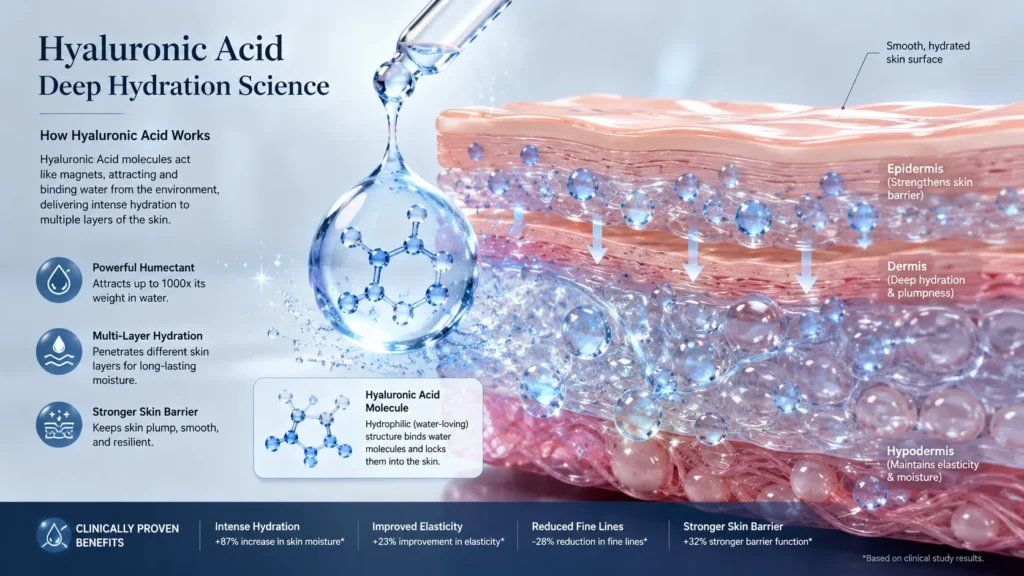
What does hyaluronic acid do? Hyaluronic acid is a naturally occurring glycosaminoglycan that attracts and retains water throughout the body. In skincare, it acts as a powerful humectant that improves skin hydration, supports the skin barrier, creates a plumping effect, and reduces the appearance of fine lines caused by dehydration. Beyond the skin, hyaluronic acid helps lubricate joints, maintain eye moisture, and support wound healing. It is commonly found in serums, moisturizers, supplements, dermal fillers, and medical injections.
Walk down any skincare aisle and you’ll see hyaluronic acid everywhere.
It’s in serums. It’s in moisturizers. Dermatologists recommend it. Beauty influencers talk about it daily. Yet many people still ask the same question:
What does hyaluronic acid do?
The simple answer is that hyaluronic acid helps your body hold onto water.
That might sound ordinary. In reality, it’s one of the most important hydration molecules found in human tissue. Without it, your skin would lose moisture faster, your joints would experience more friction, and many tissues throughout your body wouldn’t function as efficiently.
Think of hyaluronic acid as a microscopic sponge. Instead of soaking up water and releasing it immediately, it helps retain moisture exactly where your body needs it.
This remarkable substance exists naturally in your:
- Skin
- Connective tissues
- Eyes
- Cartilage
- Joint fluid
- Blood vessels
Its primary role revolves around hydration, lubrication, and tissue support.
As people age, natural hyaluronic acid levels gradually decline. That decline contributes to several visible changes including:
- Increased skin dryness
- Reduced skin elasticity
- More noticeable fine lines
- Loss of plumpness
- Less efficient wound healing
These age-related changes explain why hyaluronic acid skincare products have become a cornerstone of modern skincare routines.
What Is Hyaluronic Acid?
Before exploring hyaluronic acid benefits, it helps to understand exactly what this ingredient is.
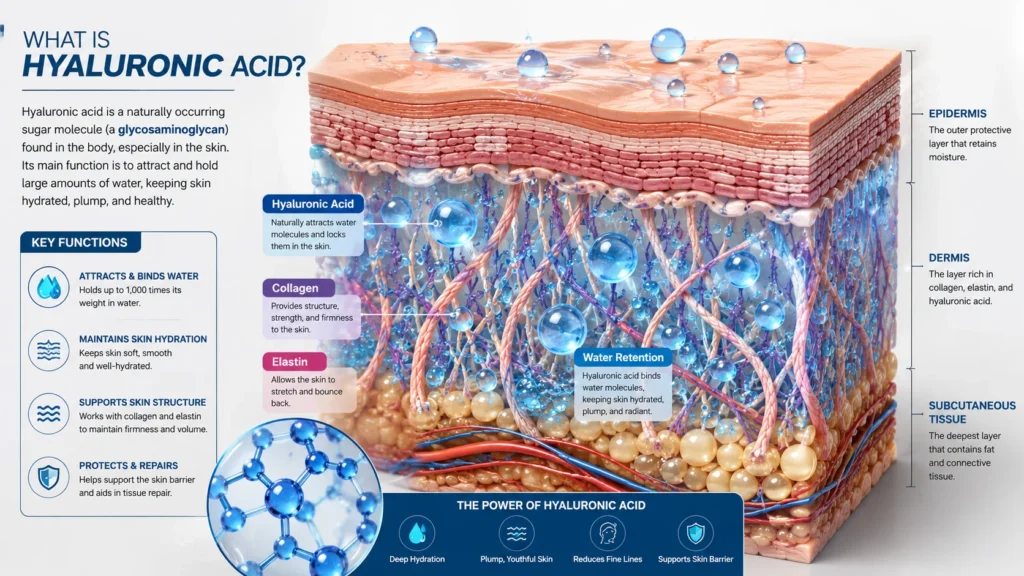
Hyaluronic acid is a naturally occurring sugar molecule classified as a glycosaminoglycan.
Although the word “acid” sounds harsh, hyaluronic acid isn’t an exfoliating acid like:
- Glycolic acid
- Salicylic acid
- Lactic acid
Instead, it serves an entirely different purpose.
Its job is hydration.
Scientists first identified hyaluronic acid in the 1930s. Since then, researchers have discovered that it plays a vital role throughout the body.
Hyaluronic Acid in Human Skin
Nearly half of the body’s hyaluronic acid resides within the skin.
Inside the skin, it helps:
- Maintain moisture levels
- Support skin structure
- Improve flexibility
- Enhance softness
- Reduce dehydration
The highest concentrations appear in the dermis, which sits beneath the outer epidermis.
The dermis contains:
| Skin Component | Function |
|---|---|
| Collagen | Provides structure and firmness |
| Elastin | Allows stretching and flexibility |
| Hyaluronic Acid | Maintains hydration and volume |
Together, these components help skin appear youthful and healthy.
Understanding the Hyaluronic Acid Function
The true power of hyaluronic acid comes from its unique ability to bind water.
Many skincare ingredients moisturize the skin.
Few can compete with hyaluronic acid’s water-retention capabilities.
A Water-Binding Molecule
Hyaluronic acid acts as a humectant skincare ingredient.
Humectants attract water.
Once hyaluronic acid encounters moisture, it helps hold that moisture within tissues.
This process supports:
- Hydration
- Skin volume
- Tissue lubrication
- Elasticity
- Barrier function
Imagine placing a sponge inside a dry container.
Now imagine that sponge continuously pulling water from the environment and storing it.
That’s similar to how hyaluronic acid behaves inside tissues.
Why Water Retention Matters
Hydration affects much more than appearance.
When skin remains properly hydrated:
- Cells function more effectively
- Skin feels smoother
- Barrier defenses remain stronger
- Irritation occurs less frequently
- Texture improves
Without adequate hydration, skin often appears:
- Dull
- Tight
- Rough
- Flaky
- Aged
This is why hyaluronic acid for skin has become one of the most researched cosmetic dermatology ingredients.
Hyaluronic Acid for Skin: The Science Behind Healthy Hydration
The popularity of hyaluronic acid skincare products isn’t based on hype alone.
The ingredient delivers several measurable benefits.
Skin Hydration and Moisture Retention
The most important benefit is hydration.
When applied topically, hyaluronic acid helps attract water to the skin’s surface layers.
As hydration increases, skin typically feels:
- Softer
- Smoother
- More comfortable
Many people notice improvement within hours of application.
Unlike heavy creams that simply sit on the surface, hyaluronic acid works by increasing water content within the upper layers of skin.
Why Dehydrated Skin Looks Older
Dehydrated skin often exaggerates imperfections.
Fine lines become more noticeable.
Texture appears uneven.
The complexion loses radiance.
When moisture levels improve, skin becomes fuller and smoother.
This explains why many people mistake hydration benefits for anti-aging effects.
In reality, hydrated skin simply functions and appears healthier.
Hyaluronic Acid Benefits for Fine Lines and Wrinkles
One of the most common claims surrounding hyaluronic acid involves wrinkle reduction.
The truth requires a little nuance.
Can Hyaluronic Acid Remove Wrinkles?
No.
Hyaluronic acid cannot permanently eliminate wrinkles.
However, it can reduce the appearance of certain lines.
Here’s why.
Many visible facial lines become more noticeable when skin lacks moisture.
Hydration fills tiny gaps between skin cells.
As those cells swell slightly with water, the skin surface appears smoother.
This creates what skincare professionals call a plumping effect on skin.
The result may include:
- Less visible dehydration lines
- Improved smoothness
- Better skin texture
- More youthful appearance
Temporary vs Permanent Changes
It’s important to understand the difference.
| Effect | Hyaluronic Acid |
|---|---|
| Hydration | Yes |
| Plumping | Yes |
| Reduced appearance of fine lines | Yes |
| Permanent wrinkle removal | No |
| Increased skin moisture | Yes |
| Instant facelift effect | No |
Proper expectations lead to better results.
Hyaluronic acid works exceptionally well when viewed as a hydration ingredient rather than a miracle anti-aging treatment.
How Hyaluronic Acid Improves Skin Elasticity
Elasticity refers to the skin’s ability to stretch and return to its original shape.
Young skin generally rebounds quickly.
Aging skin responds more slowly.
Several factors influence elasticity:
- Collagen levels
- Elastin fibers
- Hydration status
- Sun exposure
- Environmental damage
Although hyaluronic acid doesn’t replace collagen, it helps create conditions that support healthier skin function.
Collagen Support in Skin
Many people assume hyaluronic acid directly creates collagen.
The reality is more complex.
Hyaluronic acid supports the environment surrounding collagen fibers.
Well-hydrated skin often allows structural proteins to function more effectively.
Because hydration and collagen work together, skin frequently appears:
- Firmer
- More resilient
- More supple
This indirect relationship explains why hyaluronic acid often appears alongside ingredients such as:
- Retinol
- Peptides
- Vitamin C
- Ceramides
These combinations target multiple aspects of skin aging simultaneously.
Skin Barrier Support: An Overlooked Benefit
Most discussions about hyaluronic acid focus on hydration.
Yet one of its most valuable functions involves supporting the skin barrier.
What Is the Skin Barrier?
The skin barrier serves as your body’s frontline defense.
It helps prevent:
- Water loss
- Irritant penetration
- Environmental damage
- Excess dryness
When the barrier becomes compromised, symptoms often include:
- Redness
- Sensitivity
- Tightness
- Flaking
- Increased irritation
Proper hydration helps the barrier function more effectively.
Hyaluronic Acid and Barrier Function
By improving moisture levels, hyaluronic acid contributes to healthier barrier performance.
A stronger barrier can:
- Retain hydration longer
- Reduce discomfort
- Improve resilience
- Support recovery from dryness
This benefit makes hyaluronic acid useful for many skin types, including sensitive skin.
Why Natural Hyaluronic Acid Declines With Age
One reason hyaluronic acid products remain so popular is that natural levels decrease over time.
This decline starts gradually during adulthood.
Several factors contribute:
- Aging
- UV exposure
- Pollution
- Smoking
- Chronic inflammation
- Environmental stressors
As natural stores diminish, skin may experience:
- Reduced hydration
- Lower elasticity
- Increased roughness
- More visible lines
The decline doesn’t happen overnight.
Instead, it develops slowly over decades.
That gradual change explains why many people notice increasing dryness as they age.
Signs Your Skin May Benefit From Hyaluronic Acid
Not everyone experiences dehydration in the same way.
Some signs appear obvious.
Others develop subtly.
Common indicators include:
- Tight skin after cleansing
- Rough texture
- Dull appearance
- Makeup settling into lines
- Increased sensitivity
- Flaky patches
- Loss of skin bounce
Even oily skin can become dehydrated.
This surprises many people.
Oil and hydration are not the same thing.
A person may produce excess oil while still lacking adequate water content within the skin.
That distinction helps explain why hyaluronic acid works for nearly every skin type.
Quick Facts About Hyaluronic Acid
Hyaluronic acid naturally exists throughout the human body and plays a critical role in hydration, lubrication, and tissue support.
Key Facts
- Nearly 50% of the body’s hyaluronic acid resides in the skin.
- It functions primarily as a water-binding molecule.
- It supports skin hydration and moisture retention.
- It helps create a temporary plumping effect on skin.
- It contributes to skin barrier support.
- It assists with joint lubrication.
- It helps maintain eye moisture.
- It participates in wound healing processes.
- Natural levels decrease with age.
- It appears in serums, moisturizers, fillers, and injections.
Hyaluronic Acid Uses Beyond Skincare
Most people associate hyaluronic acid with facial serums and moisturizers. However, the body uses this remarkable molecule in many other ways.
Its role extends far beyond cosmetic skincare.
From helping joints move smoothly to keeping the eyes comfortable, hyaluronic acid performs several essential biological functions every day.
Hyaluronic Acid and Joint Lubrication
Healthy joints depend on smooth movement.
Every time you walk, bend, run, or climb stairs, cartilage and joint fluid work together to reduce friction.
Hyaluronic acid serves as one of the primary components of synovial fluid, which is the thick liquid found inside joints.
This fluid acts like a natural shock absorber.
Without adequate lubrication, joints experience:
- Increased friction
- Reduced flexibility
- Greater wear and tear
- More discomfort during movement
Think of synovial fluid as engine oil for your joints. When lubrication remains adequate, movement feels smooth and efficient.
When lubrication decreases, motion becomes less comfortable.
Hyaluronic Acid Injection for Joint Health
Medical professionals sometimes use hyaluronic acid injections to support people with joint problems, especially those experiencing osteoarthritis.
In these treatments, doctors inject hyaluronic acid directly into the affected joint.
The goal is to:
- Improve lubrication
- Reduce friction
- Enhance mobility
- Increase comfort during movement
Results vary from person to person.
Some individuals notice significant improvement while others experience more modest benefits.
The effectiveness often depends on:
- Severity of joint damage
- Overall joint health
- Age
- Activity level
Hyaluronic Acid and Eye Moisture
Your eyes contain naturally occurring hyaluronic acid.
This molecule helps maintain proper moisture levels across the eye surface.
Healthy tear films rely on balanced hydration.
When moisture decreases, symptoms may include:
- Burning sensations
- Itching
- Redness
- Eye fatigue
- Blurred vision
Because of its water-binding properties, hyaluronic acid frequently appears in lubricating eye drops.
These products help provide temporary relief for individuals dealing with dry eye symptoms.
Wound Healing Properties
One of the lesser-known hyaluronic acid benefits involves tissue repair.
Researchers have observed that hyaluronic acid participates in several stages of wound healing.
Its functions may include:
- Supporting cell migration
- Maintaining moisture within healing tissue
- Helping regulate inflammation
- Assisting tissue regeneration
Hydration plays a critical role during recovery.
When damaged tissue remains properly hydrated, healing processes often function more efficiently.
This relationship explains why hyaluronic acid appears in some advanced wound-care products.
Different Types of Hyaluronic Acid in Skincare Products
Not all hyaluronic acid ingredients are identical.
Manufacturers often use different forms depending on the product’s goals.
Understanding these variations helps explain why some formulas perform differently than others.
High Molecular Weight Hyaluronic Acid
High molecular weight hyaluronic acid contains larger molecules.
Because these molecules are relatively large, they primarily remain near the skin’s surface.
Benefits include:
- Immediate hydration
- Improved softness
- Surface moisture retention
- Barrier support
Many users notice quick improvements in comfort and smoothness.
Low Molecular Weight Hyaluronic Acid
Low molecular weight hyaluronic acid consists of smaller molecules.
These smaller particles interact differently with the skin.
Potential advantages include:
- Enhanced hydration support
- Longer-lasting moisture effects
- Improved skin suppleness
Many premium products combine multiple molecular weights rather than relying on a single form.
Hydrolyzed Hyaluronic Acid
Hydrolyzed hyaluronic acid undergoes processing that breaks larger molecules into smaller fragments.
This modification can improve product performance and skin interaction.
Benefits may include:
- Lightweight feel
- Better product spreadability
- Improved moisture distribution
Sodium Hyaluronate
Sodium hyaluronate is one of the most common forms found in skincare products.
Technically, it is a salt derivative of hyaluronic acid.
Manufacturers favor it because it offers:
- Excellent stability
- Effective hydration
- Good compatibility with skincare formulas
When reading ingredient labels, you’ll often find sodium hyaluronate instead of the full hyaluronic acid name.
Hyaluronic Acid Molecular Weight Explained
Many skincare enthusiasts encounter the term “molecular weight” and wonder why it matters.
In simple terms, molecular weight refers to molecule size.
Different sizes influence how hyaluronic acid behaves on the skin.
Comparison of Molecular Weights
| Type | Molecule Size | Primary Benefit |
|---|---|---|
| High Molecular Weight | Large | Surface hydration |
| Medium Molecular Weight | Moderate | Balanced hydration |
| Low Molecular Weight | Smaller | Enhanced moisture support |
| Hydrolyzed HA | Very Small | Lightweight hydration |
Modern formulations frequently blend several molecular weights to provide comprehensive hydration.
This approach allows products to support moisture at multiple levels simultaneously.
Topical vs Injectable Hyaluronic Acid
People often assume all hyaluronic acid products work the same way.
They don’t.
The delivery method dramatically affects the outcome.
Topical Hyaluronic Acid
Topical products include:
- Serums
- Moisturizers
- Creams
- Gels
- Masks
These products focus primarily on skin hydration.
Benefits typically include:
- Improved moisture levels
- Softer skin
- Reduced tightness
- Enhanced plumpness
Results often appear quickly but require continued use.
Injectable Hyaluronic Acid
Injectable products serve different purposes.
Doctors and cosmetic professionals use them to:
- Restore facial volume
- Fill wrinkles
- Improve contour definition
- Enhance specific facial features
Unlike skincare products applied to the surface, injectable fillers physically add volume beneath the skin.
Topical vs Injectable Hyaluronic Acid Comparison
| Feature | Topical HA | Injectable HA |
|---|---|---|
| Application | Surface of skin | Beneath skin |
| Main Purpose | Hydration | Volume restoration |
| Results | Temporary hydration | Longer-lasting volume |
| Availability | Over-the-counter | Professional treatment |
| Recovery Time | None | Varies |
Understanding this distinction prevents unrealistic expectations.
A serum cannot replace a filler.
Likewise, a filler doesn’t replace a daily skincare routine.
Hyaluronic Acid Serum vs Hyaluronic Acid Moisturizer
Many consumers wonder whether they need both products.
The answer depends on how each product functions.
What Does a Hyaluronic Acid Serum Do?
Serums contain concentrated active ingredients.
A hyaluronic acid serum primarily focuses on delivering hydration.
Advantages include:
- Lightweight texture
- Fast absorption
- Layering compatibility
- Intensive moisture support
Because serums typically contain fewer occlusive ingredients, they often require a moisturizer afterward.
What Does a Hyaluronic Acid Moisturizer Do?
Moisturizers serve a broader purpose.
In addition to hydration, they help reduce moisture loss.
Many formulas contain:
- Ceramides
- Emollients
- Fatty acids
- Humectants
These ingredients work together to support the skin barrier.
Which One Should You Choose?
For many people, the ideal routine includes both.
A simple sequence looks like this:
- Cleanser
- Hyaluronic acid serum
- Moisturizer
- Sunscreen (morning)
The serum attracts hydration.
The moisturizer helps keep that hydration in place.
How to Use Hyaluronic Acid Correctly
Even excellent ingredients can underperform when used incorrectly.
Proper application maximizes results.
Apply to Slightly Damp Skin
One of the most common mistakes involves applying hyaluronic acid to completely dry skin.
Because hyaluronic acid attracts water, applying it to damp skin provides moisture for the ingredient to bind.
After cleansing:
- Pat skin gently
- Leave it slightly damp
- Apply serum immediately
This simple step often improves results significantly.
Follow With a Moisturizer
Hyaluronic acid attracts moisture.
A moisturizer helps seal it in.
Without this step, hydration benefits may not last as long.
Think of hyaluronic acid as filling a bucket with water.
The moisturizer acts as the lid.
Use Morning and Night
Most people tolerate hyaluronic acid well.
Daily use is generally appropriate.
Many individuals apply it:
- In the morning
- Before bed
Consistency usually produces the best long-term improvements.
Who Should Use Hyaluronic Acid?
One reason hyaluronic acid skincare remains so popular is its versatility.
It works for nearly every skin type.
Dry Skin
Dry skin often benefits significantly from additional hydration support.
Potential improvements include:
- Reduced flaking
- Improved softness
- Greater comfort
Oily Skin
Many oily-skinned individuals avoid hydrating products unnecessarily.
That’s a mistake.
Oil production and hydration levels are separate issues.
Hyaluronic acid provides water without adding heaviness.
Sensitive Skin
Because hyaluronic acid naturally exists in the body, most people tolerate it well.
Many sensitive skin users appreciate its gentle nature.
Aging Skin
As natural hyaluronic acid levels decline, mature skin often benefits from supplementation through skincare products.
Benefits may include:
- Improved plumpness
- Better hydration
- Enhanced softness
- Reduced appearance of dehydration lines
Combination Skin
Combination skin frequently experiences both oily and dry areas.
Lightweight hydration can help create better balance across the face.
What Results Can You Realistically Expect?
Marketing claims sometimes create unrealistic expectations.
Let’s focus on actual outcomes.
Common Short-Term Effects
Within hours or days, many users notice:
- Softer skin
- Improved hydration
- Reduced tightness
- Better comfort
- Smoother texture
Common Long-Term Effects
With consistent use, potential benefits include:
- Improved moisture retention
- Stronger skin barrier support
- Enhanced skin appearance
- Better skin resilience
- Healthier overall texture
What Hyaluronic Acid Cannot Do
It’s important to separate facts from marketing.
Hyaluronic acid cannot:
- Permanently stop aging
- Replace collagen entirely
- Erase deep wrinkles
- Tighten loose skin dramatically
- Produce surgical-level results
Its strength lies in hydration.
Fortunately, hydration alone can make a noticeable difference in skin appearance.
Signs a Hyaluronic Acid Product Is Working
People often wonder how to evaluate results.
Common indicators include:
- Skin feels less tight
- Reduced roughness
- Improved smoothness
- More comfortable skin throughout the day
- Increased glow
- Better makeup application
These improvements typically appear before more visible changes.
Hydration often improves first.
Appearance follows.
The Relationship Between Hyaluronic Acid and Anti-Aging Skincare
Although hyaluronic acid is frequently called an anti-aging skincare ingredient, hydration remains its primary function.
Its anti-aging reputation comes from the visible effects hydration creates.
Well-hydrated skin often appears:
- Fuller
- Smoother
- Healthier
- More radiant
These changes help soften the appearance of aging.
However, hydration works best alongside a complete skincare strategy that includes:
- Sunscreen
- Retinoids
- Antioxidants
- Healthy lifestyle habits
No single ingredient can address every aspect of skin aging.
Hyaluronic acid excels because it tackles one of the most important foundations: moisture.
Hyaluronic Acid Side Effects and Safety
One reason hyaluronic acid remains a staple in skincare and medicine is its excellent safety profile.
Since the body naturally produces hyaluronic acid, most people tolerate it extremely well.
That said, no ingredient is perfect for every person.
Understanding potential side effects helps you use products more effectively and set realistic expectations.
Is Hyaluronic Acid Safe?
For the vast majority of users, yes.
Topical hyaluronic acid products are generally considered safe for:
- Daily use
- Long-term use
- Sensitive skin
- Mature skin
- Oily skin
- Dry skin
- Combination skin
Unlike many active skincare ingredients, hyaluronic acid typically doesn’t cause:
- Peeling
- Significant irritation
- Increased sun sensitivity
- Skin purging
This gentle nature explains why dermatologists frequently recommend it as a foundational skincare ingredient.
Potential Side Effects
Although uncommon, some people may experience:
- Mild redness
- Temporary irritation
- Itching
- Product-specific reactions
In many cases, the reaction isn’t caused by hyaluronic acid itself.
Instead, it stems from other ingredients in the formula such as:
- Fragrance
- Preservatives
- Essential oils
- Alcohol-based ingredients
If irritation occurs, discontinue use and evaluate the entire ingredient list.
Can Hyaluronic Acid Cause Dryness?
Surprisingly, yes.
This often confuses skincare users.
Here’s why it happens.
Hyaluronic acid attracts water.
In extremely dry environments, there may be limited moisture available in the surrounding air.
Without adequate moisture and an accompanying moisturizer, skin can sometimes feel tighter rather than more hydrated.
To avoid this problem:
- Apply to damp skin
- Follow with moisturizer
- Maintain consistent hydration habits
This simple approach maximizes benefits.
Common Myths About Hyaluronic Acid
The popularity of hyaluronic acid has created several misconceptions.
Let’s separate facts from fiction.
Myth: Hyaluronic Acid Is an Exfoliating Acid
This myth appears frequently because of the word “acid.”
Reality:
Hyaluronic acid is not an exfoliant.
It does not function like:
- Glycolic acid
- Lactic acid
- Salicylic acid
Its primary role involves hydration and moisture retention.
Myth: More Hyaluronic Acid Means Better Results
Consumers often assume higher concentrations automatically produce superior outcomes.
That’s not always true.
Formula quality matters more than concentration alone.
A well-designed product containing supportive ingredients may outperform a product that simply contains more hyaluronic acid.
Myth: Only Dry Skin Needs Hyaluronic Acid
Many oily-skinned individuals avoid hydrating products unnecessarily.
In reality, oily skin can become dehydrated.
Hydration and oil production are separate concerns.
Oily skin frequently benefits from lightweight humectants such as hyaluronic acid.
Myth: Hyaluronic Acid Replaces Moisturizer
A hyaluronic acid serum and a moisturizer serve different functions.
Hyaluronic acid attracts moisture.
Moisturizers help lock moisture into the skin.
Most routines benefit from using both.
Myth: Hyaluronic Acid Permanently Removes Wrinkles
Hydration improves appearance.
It does not permanently eliminate wrinkles.
The ingredient helps reduce the appearance of dehydration-related lines through improved moisture retention and plumping effects.
How to Choose the Best Hyaluronic Acid Product
The skincare market contains thousands of products.
Not all formulas deliver the same experience.
Knowing what to look for makes shopping much easier.
Look for Multiple Molecular Weights
Products that combine different molecular weights often provide more comprehensive hydration.
Benefits may include:
- Surface moisture support
- Improved skin comfort
- Longer-lasting hydration
Many advanced formulations now use a blend of molecular sizes rather than relying on a single form.
Consider Supporting Ingredients
Hyaluronic acid performs even better when paired with complementary ingredients.
Excellent companions include:
| Ingredient | Primary Benefit |
|---|---|
| Ceramides | Skin barrier support |
| Glycerin | Additional hydration |
| Panthenol | Soothing properties |
| Squalane | Moisture retention |
| Niacinamide | Barrier improvement |
| Peptides | Skin support |
These combinations create a more complete skincare experience.
Avoid Unnecessary Irritants
If you have sensitive skin, consider limiting products containing:
- Heavy fragrance
- Excessive essential oils
- Harsh alcohols
A simple formula often performs exceptionally well.
Choose Texture Based on Skin Type
Different skin types prefer different textures.
Dry Skin
Consider:
- Rich serums
- Cream-based formulas
- Hyaluronic acid moisturizers
Oily Skin
Consider:
- Lightweight serums
- Gel formulations
- Fast-absorbing textures
Combination Skin
A balanced serum often works best.
Hyaluronic Acid vs Other Popular Hydrating Ingredients
Many skincare ingredients improve hydration.
Each offers unique advantages.
Understanding the differences helps you build a smarter routine.
Hyaluronic Acid vs Glycerin
Both ingredients function as humectants.
Both attract water.
However, they behave somewhat differently.
| Feature | Hyaluronic Acid | Glycerin |
|---|---|---|
| Water Binding | Excellent | Excellent |
| Skin Feel | Lightweight | Slightly richer |
| Popularity | Extremely high | Extremely high |
| Cost | Higher | Lower |
| Compatibility | Excellent | Excellent |
Many effective products contain both ingredients.
Hyaluronic Acid vs Urea
Urea offers benefits beyond hydration.
It can help soften rough skin and improve moisture retention.
| Feature | Hyaluronic Acid | Urea |
|---|---|---|
| Hydration | Excellent | Excellent |
| Barrier Support | Strong | Strong |
| Skin Softening | Moderate | High |
| Rough Skin Treatment | Moderate | Excellent |
People with severely dry skin often benefit from formulations containing both.
Hyaluronic Acid vs Aloe Vera
Aloe vera provides soothing properties alongside hydration.
| Feature | Hyaluronic Acid | Aloe Vera |
|---|---|---|
| Hydration | Excellent | Good |
| Soothing Effect | Moderate | Strong |
| Water Retention | Excellent | Moderate |
| Irritation Relief | Good | Excellent |
The two ingredients frequently appear together in calming skincare products.
Why Hyaluronic Acid Remains a Skincare Essential
Trends come and go.
Certain ingredients remain relevant for decades.
Hyaluronic acid belongs to that category.
Several factors explain its staying power.
It Solves a Universal Problem
Almost everyone experiences dehydration at some point.
Environmental factors contribute daily.
Examples include:
- Air conditioning
- Cold weather
- Indoor heating
- Air travel
- Sun exposure
- Aging
Because dehydration affects nearly everyone, hydration-focused ingredients maintain broad appeal.
It Works With Other Ingredients
Some skincare actives conflict with one another.
Hyaluronic acid rarely causes these issues.
It pairs effectively with:
- Retinol
- Vitamin C
- Niacinamide
- Ceramides
- Peptides
- Sunscreen
This versatility makes it easy to incorporate into existing routines.
It Delivers Noticeable Results
Users often feel improvements quickly.
Hydrated skin generally feels:
- Softer
- Smoother
- More comfortable
Those immediate benefits encourage continued use.
Frequently Asked Questions
What Does Hyaluronic Acid Do for Skin?
Hyaluronic acid attracts and retains water within the skin.
This improves hydration, supports the skin barrier, enhances softness, and creates a temporary plumping effect that reduces the appearance of dehydration-related fine lines.
What Are the Main Hyaluronic Acid Benefits?
The primary hyaluronic acid benefits include:
- Skin hydration and moisture retention
- Skin barrier support
- Improved softness
- Temporary plumping effects
- Reduced appearance of fine lines
- Joint lubrication support
- Eye moisture support
- Participation in wound healing
Is Hyaluronic Acid Good for Oily Skin?
Yes.
Oily skin can still become dehydrated.
Hyaluronic acid provides hydration without adding heavy oils, making it suitable for oily skin types.
Can I Use Hyaluronic Acid Every Day?
Most people can safely use hyaluronic acid daily.
Many users apply it both morning and night.
Does Hyaluronic Acid Help Wrinkles?
Hyaluronic acid helps reduce the appearance of certain wrinkles caused by dehydration.
It does not permanently eliminate wrinkles or reverse aging.
Is Hyaluronic Acid Better Than Moisturizer?
Neither is better.
They perform different functions.
Hyaluronic acid attracts moisture.
Moisturizers help lock that moisture into the skin.
Using both often provides the best results.
Can Hyaluronic Acid Be Used With Retinol?
Yes.
Many skincare routines combine hyaluronic acid with retinol.
The hydration support from hyaluronic acid can help improve comfort when using retinoids.
How Long Does It Take to See Results?
Many people notice improved hydration within hours.
More noticeable improvements in skin texture and moisture retention often develop over several weeks of consistent use.
Does Hyaluronic Acid Increase Collagen?
Hyaluronic acid does not directly replace collagen.
However, it supports a hydrated environment that helps skin function more effectively.
What Is the Best Age to Start Using Hyaluronic Acid?
There is no specific age requirement.
Anyone experiencing dehydration, dryness, or moisture loss may benefit from incorporating hyaluronic acid into a skincare routine.
Final Thoughts
So, what does hyaluronic acid do?
At its core, hyaluronic acid acts as one of the body’s most effective water-binding molecules.
Its primary mission is simple yet incredibly important: retain moisture where the body needs it most.
In the skin, it supports hydration, softness, barrier function, and a healthy appearance.
In joints, it contributes to lubrication and smooth movement.
In the eyes, it helps maintain moisture and comfort.
In healing tissues, it participates in repair and recovery processes.
The reason hyaluronic acid remains one of the most trusted ingredients in modern skincare is straightforward.
It addresses a fundamental biological need.
Every healthy tissue depends on hydration.
When moisture levels improve, skin generally looks better, feels better, and functions better.
While hyaluronic acid isn’t a miracle cure for aging, it is one of the most effective and versatile hydration ingredients available today.
For anyone seeking healthier, more comfortable, and better-hydrated skin, hyaluronic acid continues to earn its place as a skincare essential.

Michael Anderson is a content writer specializing in word meanings, definitions and clear explanations of modern terms and phrases.