
Last Updated on June 16, 2026
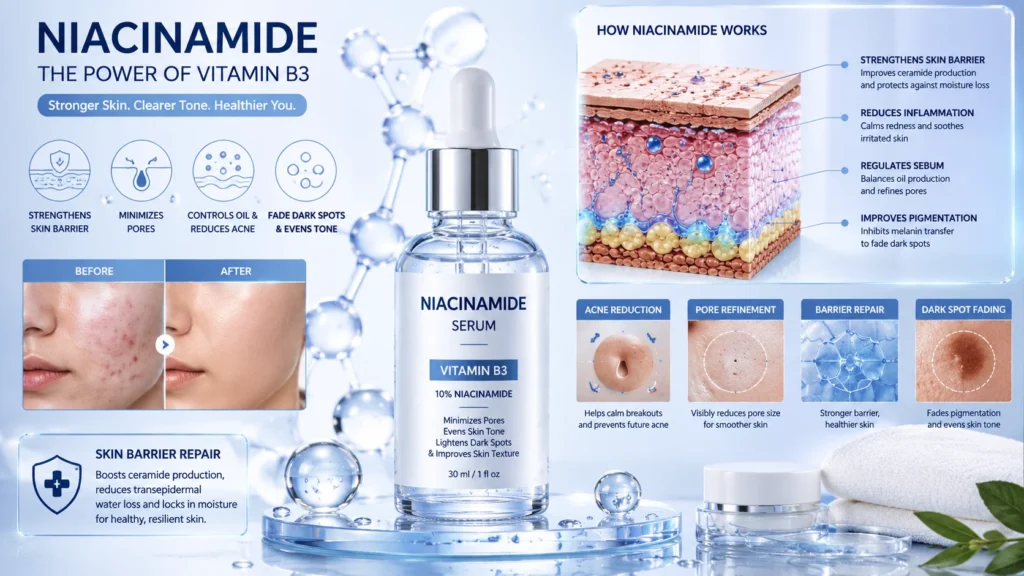
What does niacinamide do? Niacinamide is a form of vitamin B3 that helps strengthen the skin barrier, reduce oil production, fade dark spots, calm redness, improve skin texture, and minimize the appearance of pores. It also supports hydration and may reduce fine lines and wrinkles. Most people can use niacinamide daily because it works well with many other skincare ingredients and causes minimal irritation.
If there were a skincare hall of fame, niacinamide would almost certainly earn a front-row seat.
This versatile ingredient appears in serums, moisturizers, toners, creams, masks, and even supplements. Dermatologists recommend it. Beauty enthusiasts swear by it. Meanwhile, researchers continue to uncover new ways this form of vitamin B3 supports healthy skin.
So, what does niacinamide do exactly?
In simple terms, niacinamide helps your skin perform better. It strengthens the skin barrier, regulates oil production, reduces inflammation, improves uneven skin tone, and softens signs of aging. Unlike many active ingredients that target just one concern, niacinamide tackles multiple problems at the same time.
That versatility explains why you’ll find it in products designed for:
- Acne-prone skin
- Oily skin
- Dry skin
- Sensitive skin
- Rosacea-prone skin
- Hyperpigmentation
- Mature skin
- Combination skin
Even better, niacinamide works quietly in the background. It doesn’t usually sting like acids. It doesn’t make your skin peel aggressively like some retinoids. Instead, it strengthens your skin’s natural defenses and helps restore balance over time.
Whether you’re curious about what does niacinamide do for acne, what does niacinamide do for dark spots, or what does niacinamide do for wrinkles, this guide covers everything you need to know.
What Is Niacinamide?
Before diving into the many niacinamide benefits, it helps to understand what this ingredient actually is and why it plays such a major role in skincare.
What Exactly Is Niacinamide?
Niacinamide, also called nicotinamide, is a water-soluble form of vitamin B3.
Vitamin B3 is one of the essential nutrients your body needs to convert food into energy, maintain healthy cells, and support hundreds of biological processes. Niacinamide is one of the two major forms of vitamin B3, while the other is niacin, also known as nicotinic acid.
Although they belong to the same vitamin family, they behave differently.
| Type of Vitamin B3 | Common Name | Main Uses | Causes Flushing? |
|---|---|---|---|
| Niacinamide | Nicotinamide | Skincare, supplements | No |
| Niacin | Nicotinic Acid | Cholesterol management, supplements | Yes |
Many people confuse niacinamide with niacin, yet the two aren’t interchangeable.
High doses of niacin may cause:
- Skin flushing
- Tingling sensations
- Warmth
- Temporary redness
Niacinamide doesn’t produce these effects. That’s one reason why skincare companies use it extensively in topical formulations.
Another reason is its impressive stability.
Unlike some active ingredients that degrade quickly when exposed to light or air, niacinamide remains relatively stable. It also pairs well with many other skincare ingredients, making it easy to incorporate into daily routines.
You’ll commonly find niacinamide in:
- Face serums
- Moisturizers
- Creams
- Sunscreens
- Cleansers
- Eye creams
- Sheet masks
- Acne treatments
Some supplements also contain niacinamide because vitamin B3 supports overall health, including energy metabolism and cellular repair.
However, when people ask “What is niacinamide?”, they’re usually referring to its role as a skincare ingredient.
And that’s where things get interesting.
How Does Niacinamide Work in the Skin?
Niacinamide doesn’t simply sit on the surface of your skin.
Once absorbed, it becomes involved in several essential biological processes that influence how your skin repairs itself, retains moisture, and responds to stress.
At the cellular level, niacinamide contributes to the production of NAD+, short for nicotinamide adenine dinucleotide.
NAD+ is a molecule found in every living cell. Think of it as a rechargeable battery that powers many cellular activities.
NAD+ helps cells:
- Produce energy
- Repair DNA damage
- Defend against oxidative stress
- Maintain healthy cell function
- Support skin regeneration
As people age, NAD+ levels naturally decline.
Lower NAD+ levels can contribute to:
- Reduced skin elasticity
- Increased dryness
- Slower repair processes
- More visible wrinkles
- Greater susceptibility to environmental damage
By supplying the skin with niacinamide, you help support these important cellular functions.
But energy production is only part of the story.
Niacinamide also stimulates the production of lipids that form the skin barrier, including:
- Ceramides
- Free fatty acids
- Cholesterol
These lipids act like mortar between bricks.
Imagine your skin cells as bricks in a wall.
Ceramides and lipids are the mortar that keeps everything sealed together.
When the mortar weakens:
- Moisture escapes.
- Irritants enter more easily.
- Skin becomes dry.
- Redness increases.
- Sensitivity rises.
Niacinamide helps rebuild that mortar.
As a result, skin becomes stronger, more resilient, and better able to retain moisture.
Researchers have also found that niacinamide offers:
- Anti-inflammatory properties
- Antioxidant activity
- Sebum-regulating effects
- Pigment-balancing effects
- Support for skin elasticity
This broad range of actions explains why niacinamide appears in products targeting everything from acne to wrinkles.
Why Is Niacinamide So Popular in Skincare?
Few ingredients check as many boxes as niacinamide.
Some ingredients focus solely on exfoliation.
Others only increase hydration.
Some target wrinkles but irritate sensitive skin.
Niacinamide sits in a unique category because it addresses multiple concerns simultaneously while remaining gentle enough for most skin types.
Here are some of the most widely recognized niacinamide benefits:
| Benefit | How Niacinamide Helps |
|---|---|
| Skin barrier repair | Boosts ceramide production |
| Hydration | Reduces water loss |
| Oil control | Helps regulate sebum |
| Acne | Reduces inflammation and redness |
| Dark spots | Interferes with pigment transfer |
| Pores | Minimizes their appearance |
| Anti-aging | Improves elasticity and texture |
| Sensitive skin | Strengthens barrier and calms irritation |
This versatility makes niacinamide one of the most researched skincare ingredients available today.
Whether your skin is oily, dry, acne-prone, or sensitive, there’s a good chance niacinamide can help.
What Does Niacinamide Do for Skin?
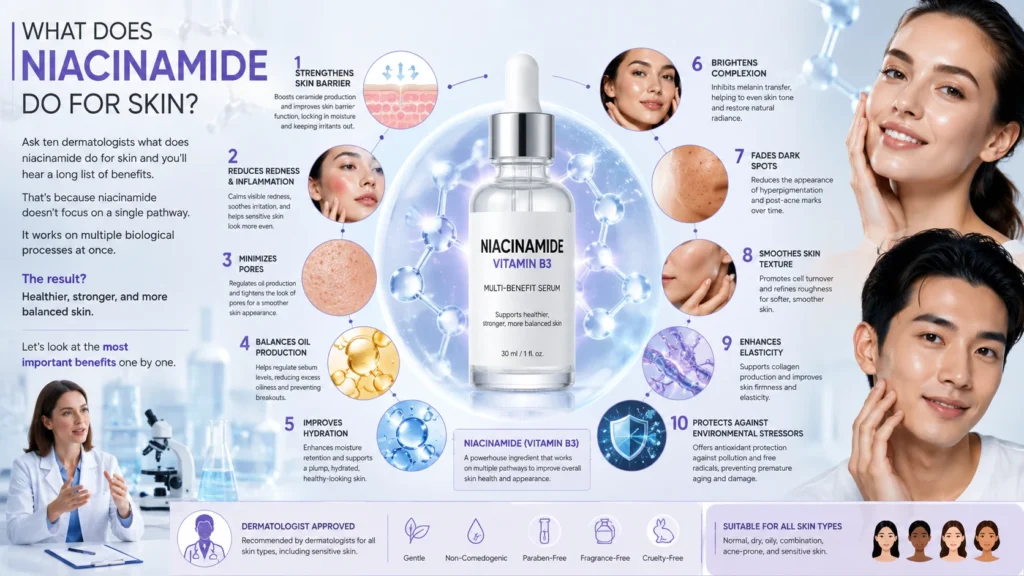
Ask ten dermatologists what does niacinamide do for skin and you’ll hear a long list of benefits.
That’s because niacinamide doesn’t focus on a single pathway.
It works on multiple biological processes at once.
The result?
Healthier, stronger, and more balanced skin.
Let’s look at the most important benefits one by one.
Niacinamide Strengthens the Skin Barrier
Your skin barrier is your body’s first line of defense.
It protects against:
- Pollution
- Allergens
- Bacteria
- UV damage
- Irritants
- Moisture loss
When the barrier weakens, your skin often feels:
- Dry
- Tight
- Red
- Sensitive
- Rough
- Easily irritated
This condition is surprisingly common.
Over-exfoliation, harsh cleansers, sun exposure, and aging can all damage the skin barrier.
Niacinamide helps repair it.
One of its biggest strengths is its ability to increase the production of:
- Ceramides
- Free fatty acids
- Cholesterol
Together, these lipids strengthen the outermost layer of skin.
A stronger barrier means:
- Better moisture retention
- Reduced irritation
- Increased resilience
- Improved hydration
- Less sensitivity
Many people notice their skin feels softer and less reactive after adding niacinamide to their routine.
In fact, this barrier-supporting effect is one reason dermatologists frequently recommend niacinamide for:
- Sensitive skin
- Rosacea-prone skin
- Eczema-prone skin
- Dry skin
- Skin damaged by harsh treatments
Signs Niacinamide Is Improving Your Skin Barrier
You may notice:
✓ Less tightness after cleansing
✓ Reduced redness
✓ Fewer dry patches
✓ Improved hydration
✓ Softer texture
✓ Less irritation from other skincare products
Healthy skin starts with a healthy barrier.
Niacinamide helps build that foundation.
Niacinamide Reduces Excess Oil Production
If shiny skin feels like a daily battle, niacinamide may help.
One of the most talked-about niacinamide benefits is its ability to regulate sebum, the oily substance produced by sebaceous glands.
Sebum isn’t inherently bad.
Your skin needs it because it:
- Protects against dehydration
- Lubricates the skin
- Supports the skin barrier
- Helps defend against microbes
The problem begins when the skin produces too much.
Excess sebum can contribute to:
- Greasy skin
- Enlarged pores
- Blackheads
- Whiteheads
- Acne breakouts
Niacinamide appears to help normalize oil production.
It doesn’t completely stop sebum production.
Instead, it encourages balance.
That distinction matters.
Your skin still needs oil.
Niacinamide simply helps prevent the overproduction that often leads to congestion.
What Does Niacinamide Do for Oily Skin?
People with oily or combination skin often notice:
- Less shine throughout the day
- Reduced greasiness around the T-zone
- Smaller-looking pores
- Fewer clogged pores
- More balanced skin texture
Because niacinamide controls oil gently, it usually causes far less irritation than aggressive drying products.
This makes it especially appealing for people whose skin becomes oily and sensitive at the same time.
Niacinamide Helps Reduce Acne and Breakouts
Acne isn’t caused by one thing.
Instead, several factors work together:
- Excess oil production
- Clogged pores
- Inflammation
- Bacteria
- Hormonal changes
- Impaired skin barrier function
Niacinamide targets several of these factors simultaneously.
That’s why many acne-focused products include it.
What Does Niacinamide Do for Acne?
Niacinamide may help acne in several ways.
It reduces inflammation.
Inflammation plays a major role in acne.
Inflamed pimples often appear:
- Red
- Swollen
- Painful
- Tender
Niacinamide has anti-inflammatory properties that help calm irritated skin.
As inflammation decreases, pimples may appear less angry and redness may fade faster.
It regulates oil production.
Less excess oil means fewer clogged pores.
That can reduce the formation of:
- Blackheads
- Whiteheads
- Mild breakouts
- Congested pores
It strengthens the skin barrier.
Many acne treatments can dry out the skin.
A weakened barrier often leads to:
- Increased redness
- Flaking
- Irritation
- More sensitivity
Niacinamide helps counteract these issues by supporting barrier repair.
Niacinamide vs Other Acne Ingredients
Niacinamide isn’t necessarily the strongest acne treatment available.
However, it offers one major advantage.
It’s gentle.
Here’s how it compares to other common acne ingredients.
| Ingredient | Main Function | Irritation Risk | Best For |
|---|---|---|---|
| Niacinamide | Oil control, redness, barrier support | Low | Sensitive acne-prone skin |
| Salicylic Acid | Unclogs pores | Moderate | Blackheads and oily skin |
| Benzoyl Peroxide | Reduces acne bacteria | Moderate to high | Inflammatory acne |
| Retinoids | Increase cell turnover | Moderate to high | Acne and aging |
| Azelaic Acid | Acne and pigmentation | Low to moderate | Sensitive skin |
Many people actually combine niacinamide with these ingredients.
For example:
- Niacinamide + retinol for acne and anti-aging
- Niacinamide + salicylic acid for oily skin
- Niacinamide + benzoyl peroxide to reduce irritation
- Niacinamide + azelaic acid for acne and pigmentation
This compatibility makes niacinamide one of the easiest ingredients to add to an acne skincare routine.
What Does Niacinamide Do for Hyperpigmentation, Dark Spots, and Uneven Skin Tone?
Dark spots can feel stubborn.
You finally clear a breakout and then a brown mark sticks around for months. Sun exposure leaves patches of discoloration. Sometimes, your complexion simply looks uneven no matter how many products you try.
This is where niacinamide shines.
One of the most studied niacinamide benefits is its ability to improve hyperpigmentation and brighten uneven skin tone without aggressively exfoliating the skin.
What Causes Hyperpigmentation?
Hyperpigmentation occurs when certain areas of the skin produce or retain excess melanin, the pigment responsible for skin color.
Common causes include:
- Acne scars
- Sun damage
- Hormonal changes
- Melasma
- Skin injuries
- Inflammation
- Aging
The result may appear as:
- Brown spots
- Age spots
- Post-inflammatory hyperpigmentation (PIH)
- Uneven patches
- Lingering acne marks
Many people search for what does niacinamide do for dark spots because they want a gentler alternative to harsh brightening treatments.
Fortunately, niacinamide offers exactly that.
How Does Niacinamide Help Hyperpigmentation?
Niacinamide doesn’t bleach the skin.
It doesn’t remove your natural skin tone.
Instead, it works by interfering with melanin transfer.
Here’s what happens.
Melanin forms inside cells called melanocytes.
Those cells package pigment and transfer it to surrounding skin cells.
Niacinamide slows down that transfer process.
As less pigment moves upward, dark spots gradually become less noticeable.
This mechanism offers several advantages:
- It works gradually and evenly.
- It doesn’t make skin thinner.
- It doesn’t increase sun sensitivity as dramatically as some acids.
- It suits many skin types.
Over time, many users notice:
✓ Brighter skin
✓ Reduced acne marks
✓ More even skin tone
✓ Faded sun spots
✓ Improved radiance
What Does Niacinamide Do for Dark Spots?
Dark spots often fade slowly on their own.
Niacinamide may help accelerate that process.
It works especially well for:
- Acne scars
- Post-inflammatory hyperpigmentation
- Mild sun damage
- Uneven tone
- Residual redness
However, very deep pigmentation such as stubborn melasma often requires a combination approach involving:
- Sunscreen
- Retinoids
- Azelaic acid
- Prescription treatments
- Professional procedures
Niacinamide still plays an important supporting role because it calms inflammation and strengthens the skin barrier.
How Long Does Niacinamide Take to Fade Dark Spots?
Results vary.
Factors that influence progress include:
- Severity of pigmentation
- Concentration of niacinamide
- Consistency of use
- Sun protection habits
- Individual skin biology
Most people notice:
| Timeline | Possible Results |
|---|---|
| 2-4 weeks | Improved brightness |
| 4-8 weeks | More even skin tone |
| 8-12 weeks | Visible fading of dark spots |
| 3-6 months | Significant improvement in pigmentation |
Consistency matters.
Dark spots rarely disappear overnight.
Think of niacinamide as a marathon runner rather than a sprinter.
It works steadily and often delivers long-lasting improvements.
What Does Niacinamide Do for Enlarged Pores?
Enlarged pores frustrate many people.
They’re among the most searched skincare concerns in the world.
Which leads to another common question:
Can niacinamide shrink pores?
The short answer:
No.
At least not permanently.
Pore size is largely determined by:
- Genetics
- Oil production
- Age
- Sun damage
- Skin elasticity
You can’t physically shrink pores forever.
However, niacinamide can make them appear smaller.
And that’s an important distinction.
Why Do Pores Look Enlarged?
Pores often appear larger when:
- Excess oil stretches them.
- Dead skin cells accumulate.
- Collagen declines with age.
- Skin loses elasticity.
- Blackheads fill the pore opening.
When these issues improve, pores become less noticeable.
Niacinamide helps address several of these causes simultaneously.
What Does Niacinamide Do for Pores?
Niacinamide may improve pore appearance by:
- Regulating oil production
- Improving skin elasticity
- Reducing congestion
- Smoothing skin texture
- Supporting collagen production indirectly
As the skin becomes firmer and less oily, pores often look tighter and more refined.
This effect is cosmetic rather than structural.
Still, for many people, the difference can be impressive.
Niacinamide for Pores: Expectations vs Reality
| Claim | Reality |
|---|---|
| Shrinks pores permanently | No |
| Reduces oil production | Yes |
| Improves pore appearance | Yes |
| Helps prevent clogged pores | Yes |
| Smooths surrounding skin | Yes |
The goal isn’t to erase pores.
Healthy skin has pores.
The goal is to make them less noticeable while keeping your skin balanced.
What Does Niacinamide Do for Redness and Sensitive Skin?
Some skincare ingredients act like fireworks.
They deliver dramatic effects but often leave irritation behind.
Niacinamide takes a different approach.
It’s more like a steady builder.
One of the reasons dermatologists frequently recommend niacinamide is its ability to calm inflammation and support sensitive skin.
Why Does Skin Become Red and Irritated?
Redness may develop due to:
- Damaged skin barrier
- Over-exfoliation
- Environmental stress
- Acne
- Rosacea
- Dryness
- Harsh skincare products
- Allergic reactions
When the skin barrier weakens, irritants penetrate more easily.
This often triggers inflammation.
Niacinamide helps interrupt this cycle.
What Does Niacinamide Do for Redness?
Niacinamide possesses anti-inflammatory properties.
That means it helps reduce the inflammatory signals that contribute to:
- Redness
- Irritation
- Swelling
- Skin sensitivity
At the same time, it strengthens the skin barrier.
This dual action creates a powerful calming effect.
Many people report:
- Less flushing
- Reduced irritation
- Lower sensitivity
- More balanced skin
- Improved comfort
Is Niacinamide Good for Sensitive Skin?
In many cases, yes.
Sensitive skin often struggles with:
- Weak barrier function
- Increased water loss
- Frequent irritation
- Reactivity to products
Niacinamide addresses each of these issues.
That’s why you’ll often find it in products marketed toward:
- Sensitive skin
- Dry skin
- Rosacea-prone skin
- Barrier repair
- Post-procedure skincare
Can Niacinamide Help Rosacea?
Rosacea is a chronic inflammatory skin condition.
Common symptoms include:
- Persistent redness
- Flushing
- Visible blood vessels
- Burning sensations
- Sensitive skin
Niacinamide isn’t a cure.
However, its anti-inflammatory and barrier-repair properties may help reduce:
- Irritation
- Redness
- Sensitivity
- Dryness associated with rosacea
Because rosacea varies widely, people should introduce new products slowly and consult a dermatologist if symptoms worsen.
What Does Niacinamide Do for Fine Lines and Wrinkles?
When people hear “anti-aging,” they often think of retinol.
Retinol deserves its reputation.
Yet niacinamide has quietly become one of the most respected anti-aging ingredients in modern skincare.
And for good reason.
Why Does Skin Age?
Aging affects skin in many ways.
Over time:
- Collagen declines.
- Elastin fibers weaken.
- Skin loses moisture.
- Cell turnover slows.
- Sun damage accumulates.
- Oxidative stress increases.
These changes contribute to:
- Fine lines
- Wrinkles
- Sagging
- Rough texture
- Dullness
- Uneven tone
No topical ingredient can stop aging.
But some can help slow visible changes.
Niacinamide is one of them.
What Does Niacinamide Do for Wrinkles?
Niacinamide fights several contributors to aging simultaneously.
It helps:
- Improve skin barrier function
- Reduce moisture loss
- Support collagen production indirectly
- Enhance elasticity
- Reduce oxidative stress
- Improve skin texture
The result is often:
✓ Smoother skin
✓ Softer fine lines
✓ Improved firmness
✓ Better hydration
✓ Healthier texture
Niacinamide and Antioxidant Protection
Every day, your skin faces attacks from:
- UV rays
- Pollution
- Smoke
- Environmental toxins
- Natural metabolic processes
These stressors generate unstable molecules called free radicals.
Free radicals contribute to:
- Premature aging
- Collagen breakdown
- Wrinkles
- Hyperpigmentation
- Inflammation
Niacinamide helps strengthen the skin’s natural antioxidant defenses.
Think of antioxidants as bodyguards.
They neutralize damaging molecules before they wreak havoc.
The stronger your defenses, the better your skin may age.
Niacinamide vs Retinol
Both ingredients offer anti-aging benefits.
However, they work differently.
| Feature | Niacinamide | Retinol |
|---|---|---|
| Irritation risk | Low | Moderate to high |
| Improves barrier function | Yes | Sometimes weakens temporarily |
| Reduces oil | Yes | Mildly |
| Improves wrinkles | Yes | Strongly |
| Improves dark spots | Yes | Yes |
| Suitable for sensitive skin | Usually | Not always |
| Daily use | Yes | Often introduced slowly |
Many skincare enthusiasts use both.
Why?
Because they complement each other.
Retinol accelerates skin renewal.
Niacinamide helps soothe irritation and strengthen the barrier.
Together, they create one of the most effective anti-aging combinations available.
Niacinamide Benefits by Skin Type
One reason niacinamide has become a superstar ingredient is its versatility.
Few ingredients work across as many skin types.
Let’s break it down.
Niacinamide for Oily Skin
If your skin becomes shiny shortly after washing, niacinamide may help.
Benefits for oily skin include:
- Reduced oil production
- Less shine
- Smaller-looking pores
- Fewer clogged pores
- Improved skin texture
Unlike harsh drying products, niacinamide regulates oil gently.
Your skin stays balanced rather than stripped.
Niacinamide for Dry Skin
Dry skin often suffers from:
- Weak barrier function
- Moisture loss
- Rough texture
- Tightness
Niacinamide supports:
- Ceramide production
- Moisture retention
- Barrier repair
- Smoother texture
Over time, dry skin may feel:
- Softer
- More hydrated
- Less irritated
- More resilient
Niacinamide for Sensitive Skin
Sensitive skin can be unpredictable.
A product works one day and causes redness the next.
Because niacinamide strengthens the skin barrier and calms inflammation, it often works well for:
- Reactive skin
- Easily irritated skin
- Rosacea-prone skin
- Post-treatment skin
- Over-exfoliated skin
Still, patch testing remains a smart idea.
Even gentle ingredients can irritate a small percentage of users.
Niacinamide for Mature Skin
Mature skin faces several challenges at once.
These include:
- Wrinkles
- Fine lines
- Dullness
- Hyperpigmentation
- Reduced elasticity
- Dryness
Niacinamide addresses many of these concerns simultaneously.
That’s why you’ll often find it in:
- Anti-aging serums
- Firming creams
- Barrier repair moisturizers
- Brightening treatments
- Eye creams
Its ability to multitask makes it one of the most valuable ingredients in an anti-aging skincare routine.
Niacinamide Before and After: What Results Can You Expect?
One of the biggest reasons people stick with niacinamide is that the results tend to build over time.
You probably won’t wake up one morning and suddenly see flawless skin.
Instead, improvements usually happen gradually.
Your skin becomes calmer.
It feels stronger.
The texture improves.
Then, weeks later, you realize your complexion looks healthier overall.
That’s the magic of niacinamide.
It works behind the scenes.
Results After 2 to 4 Weeks
The earliest improvements often involve hydration and skin comfort.
Many users notice:
- Reduced redness
- Less irritation
- Improved hydration
- Softer skin texture
- Less oiliness
- More balanced skin
If your skin barrier was damaged before using niacinamide, these changes may feel dramatic.
Even subtle improvements can make the skin appear healthier and more radiant.
Results After 4 to 8 Weeks
After a month or two of consistent use, additional benefits often become visible.
You may notice:
- Fewer breakouts
- Reduced shine
- Brighter skin tone
- Improved texture
- Less visible pores
- Smoother complexion
Dark spots may begin fading during this stage, especially if you’re using sunscreen regularly.
Results After 8 to 12 Weeks
By this point, niacinamide has had enough time to influence several skin processes.
Common improvements include:
- More even skin tone
- Reduced hyperpigmentation
- Softer fine lines
- Better elasticity
- Smoother texture
- Healthier-looking skin overall
People with acne scars or persistent pigmentation may need longer.
Patience pays off.
Niacinamide rewards consistency more than intensity.
Niacinamide Before and After Timeline
| Time | What You May Notice |
|---|---|
| 1-2 weeks | Improved hydration and less irritation |
| 2-4 weeks | Reduced redness and oiliness |
| 4-8 weeks | Smoother texture and fewer breakouts |
| 8-12 weeks | Faded dark spots and more even skin tone |
| 3-6 months | Long-term improvements in texture and appearance |
What Percentage of Niacinamide Is Best?
A quick search for niacinamide products reveals a confusing range of concentrations.
Some products contain:
- 2%
- 5%
- 10%
- 15%
- Even 20%
Naturally, many people assume:
Higher percentage = better results.
Not necessarily.
In skincare, more isn’t always better.
Sometimes it’s simply more irritating.
2% Niacinamide
Lower concentrations may seem underwhelming.
They’re not.
Even at around 2%, niacinamide can support:
- Skin barrier repair
- Hydration
- Reduced water loss
- Improved sensitivity
- Overall skin health
This concentration often appears in moisturizers and gentle skincare products.
Best for:
- Sensitive skin
- Beginners
- Dry skin
- Barrier repair
4% to 5% Niacinamide
This range is often considered the sweet spot.
Many clinical studies investigating niacinamide benefits use concentrations around 4% or 5%.
Benefits include:
- Oil control
- Improved texture
- Reduced pigmentation
- Better barrier function
- Fewer visible pores
- Less redness
For most people, this concentration provides excellent results with minimal irritation.
Best for:
- Oily skin
- Combination skin
- Acne-prone skin
- Hyperpigmentation
- Everyday use
10% Niacinamide
Ten percent niacinamide has become extremely popular.
Many serums feature this concentration because it sounds powerful.
And for some people, it works very well.
Potential benefits include:
- Strong oil control
- Enhanced brightening
- Reduced pore appearance
- More visible improvements in acne marks
However, higher concentrations can sometimes increase:
- Redness
- Stinging
- Irritation
- Temporary flushing
This doesn’t happen to everyone.
Still, people with sensitive skin may prefer lower concentrations.
Is Higher Niacinamide Always Better?
Not really.
Imagine watering a plant.
Giving it enough water helps it thrive.
Pouring an entire bucket on it doesn’t necessarily make it grow faster.
The same principle often applies to skincare.
Higher concentrations may not dramatically outperform moderate ones.
Instead, they sometimes increase the risk of irritation.
Niacinamide Concentration Guide
| Concentration | Best For | Benefits |
|---|---|---|
| 2% | Sensitive skin | Barrier support and hydration |
| 4-5% | Most skin types | Balanced benefits with low irritation |
| 10% | Oily or acne-prone skin | Oil control and brightening |
| 15-20% | Advanced users | Strong formulations with higher irritation risk |
For most people, 5% niacinamide offers an excellent balance between effectiveness and comfort.
How to Use Niacinamide Correctly
One reason niacinamide has become a skincare favorite is its simplicity.
Unlike some ingredients that require complicated schedules, niacinamide fits easily into most routines.
Still, using it correctly helps maximize results.
Morning Niacinamide Skincare Routine
Morning application focuses on protection and balance.
A typical routine looks like this:
- Gentle cleanser
- Niacinamide serum
- Moisturizer
- Sunscreen
Why use niacinamide in the morning?
Because it helps:
- Strengthen the skin barrier
- Reduce oxidative stress
- Control oil production
- Improve hydration
- Support skin throughout the day
Combined with sunscreen, niacinamide creates a strong defense against environmental stressors.
Evening Niacinamide Skincare Routine
Nighttime is when the skin repairs itself.
This makes evening another excellent time to apply niacinamide.
A simple nighttime routine:
- Cleanser
- Niacinamide serum
- Treatment product if needed
- Moisturizer
You can use niacinamide before:
- Retinol
- Hyaluronic acid
- Peptides
- Moisturizers
Because niacinamide is gentle, many people use it both morning and night.
Should I Use Niacinamide Every Day?
In most cases, yes.
Daily use is generally safe.
In fact, consistency produces the best results.
Many people use niacinamide:
- Once daily
- Twice daily
- Year-round
Because it supports the skin barrier rather than aggressively exfoliating, niacinamide usually integrates well into long-term routines.
Signs You Should Reduce Frequency
Although niacinamide is well tolerated, overdoing skincare isn’t always beneficial.
Consider reducing usage if you notice:
- Persistent redness
- Burning sensations
- Increased sensitivity
- Itching
- Irritation
Sometimes the problem isn’t niacinamide itself.
Instead, it’s the combination of multiple active ingredients.
More isn’t always better.
Healthy skin often prefers balance.
What Ingredients Can You Use With Niacinamide?
Another reason niacinamide dominates the skincare world?
It gets along with almost everyone.
Unlike ingredients that clash with other actives, niacinamide pairs beautifully with many popular skincare ingredients.
Let’s explore the most common combinations.
Niacinamide and Hyaluronic Acid
This duo focuses on hydration.
Hyaluronic acid attracts water.
Niacinamide helps keep that water inside the skin by strengthening the barrier.
Together, they can:
- Improve hydration
- Reduce dryness
- Smooth texture
- Increase skin comfort
- Strengthen moisture retention
Think of hyaluronic acid as filling a water tank.
Niacinamide helps seal the tank so moisture stays where it belongs.
Niacinamide and Retinol
This combination has become a skincare powerhouse.
Retinol helps:
- Increase cell turnover
- Improve wrinkles
- Reduce acne
- Fade pigmentation
However, retinol may also cause:
- Dryness
- Redness
- Peeling
- Irritation
That’s where niacinamide helps.
It supports the skin barrier and reduces irritation.
Benefits of combining them include:
- Better anti-aging results
- Improved acne control
- Less dryness
- Reduced redness
- Better skin tolerance
Many dermatologists recommend using them together.
Niacinamide and Salicylic Acid
People with acne often love this pairing.
Why?
Because each ingredient targets a different issue.
Salicylic acid:
- Exfoliates pores
- Removes excess oil
- Helps blackheads
- Reduces congestion
Niacinamide:
- Calms inflammation
- Supports the barrier
- Reduces redness
- Controls oil production
Together they can improve:
- Acne
- Oily skin
- Enlarged pores
- Breakouts
- Skin texture
Niacinamide and Vitamin C
This combination used to be controversial.
Years ago, people believed vitamin C and niacinamide should never be used together.
That advice came from outdated studies performed under unrealistic laboratory conditions.
Modern research tells a different story.
Today, skincare experts widely agree:
You can use niacinamide and vitamin C together.
In fact, they may complement one another.
Benefits of combining them include:
- Brighter skin
- Antioxidant protection
- Improved skin tone
- Reduced hyperpigmentation
- Better protection against environmental stress
Niacinamide and AHAs or BHAs
AHAs and BHAs are exfoliating acids.
Examples include:
- Glycolic acid
- Lactic acid
- Mandelic acid
- Salicylic acid
These ingredients help:
- Remove dead skin cells
- Improve texture
- Fade pigmentation
- Unclog pores
However, over-exfoliation may irritate the skin.
Niacinamide can help reduce:
- Redness
- Barrier damage
- Dryness
- Sensitivity
This makes it an excellent companion to exfoliating acids.
Niacinamide vs Vitamin C
These two ingredients dominate brightening skincare.
Which one is better?
The answer depends on your goals.
| Feature | Niacinamide | Vitamin C |
|---|---|---|
| Reduces dark spots | Yes | Yes |
| Brightens skin | Yes | Yes |
| Controls oil | Yes | No |
| Strengthens barrier | Yes | Mildly |
| Antioxidant protection | Yes | Strong |
| Reduces redness | Yes | Sometimes |
| Suitable for sensitive skin | Usually | Depends on formulation |
Choose niacinamide if you want:
- Oil control
- Barrier repair
- Reduced redness
- Gentle brightening
Choose vitamin C if you want:
- Strong antioxidant protection
- Brightening
- Environmental defense
Many people use both.
You don’t always need to choose.
Niacinamide vs Hyaluronic Acid
This comparison is surprisingly common.
The truth?
They do completely different jobs.
| Feature | Niacinamide | Hyaluronic Acid |
|---|---|---|
| Controls oil | Yes | No |
| Reduces redness | Yes | No |
| Hydrates | Yes | Yes |
| Supports barrier | Yes | Mildly |
| Fades dark spots | Yes | No |
| Improves acne | Yes | No |
Hyaluronic acid focuses mainly on hydration.
Niacinamide does much more.
That’s why many serums combine both ingredients.
Frequently Asked Questions
What Does Niacinamide Do?
Niacinamide is a form of vitamin B3 that improves multiple aspects of skin health. It strengthens the skin barrier, reduces oil production, fades dark spots, calms redness, improves hydration, and helps soften fine lines and wrinkles.
Unlike many active ingredients that focus on one concern, niacinamide works on several skin processes at the same time.
Its most important benefits include:
- Improving skin barrier function
- Reducing transepidermal water loss
- Controlling excess oil
- Calming inflammation
- Fading hyperpigmentation
- Improving skin texture
- Supporting healthy aging
That’s why niacinamide has become one of the most widely used ingredients in modern skincare.
What Does Niacinamide Do for Your Skin?
Niacinamide helps your skin become healthier and more resilient.
It supports the production of important lipids such as:
- Ceramides
- Cholesterol
- Fatty acids
These lipids strengthen the skin barrier and help the skin retain moisture.
At the same time, niacinamide may:
- Reduce redness
- Improve uneven skin tone
- Minimize the appearance of pores
- Control oil production
- Reduce acne-related inflammation
- Improve skin elasticity
Most skin types can benefit from niacinamide, including oily, dry, sensitive, and mature skin.
What Does Niacinamide Serum Do?
A niacinamide serum delivers concentrated vitamin B3 directly to the skin.
Depending on the formula and concentration, a niacinamide serum may help:
- Reduce excess oil
- Fade acne marks
- Improve skin texture
- Minimize visible pores
- Calm irritation
- Brighten dull skin
- Strengthen the skin barrier
Serums often absorb quickly and fit easily into morning or evening skincare routines.
What Does Niacinamide Do for Acne?
Niacinamide helps acne in several ways.
It may:
- Reduce inflammation
- Regulate oil production
- Calm redness
- Strengthen the skin barrier
- Improve post-acne marks
Because it is generally gentle, niacinamide is often combined with:
- Retinol
- Salicylic acid
- Benzoyl peroxide
- Azelaic acid
While it isn’t a replacement for prescription acne treatments in severe cases, it can be an effective addition to acne-prone skincare routines.
What Does Niacinamide Do for Pores?
Niacinamide does not permanently shrink pores.
However, it can make them appear smaller.
It does this by:
- Reducing oil production
- Improving skin texture
- Supporting elasticity
- Reducing pore congestion
As the skin becomes smoother and less oily, pores often appear more refined and less noticeable.
What Does Niacinamide Do for Dark Spots?
Niacinamide helps fade dark spots by slowing the transfer of melanin to skin cells.
This may improve:
- Acne scars
- Post-inflammatory hyperpigmentation
- Sun spots
- Uneven skin tone
- Mild pigmentation
Most people begin noticing improvements after several weeks of consistent use, especially when they also use sunscreen daily.
Does Niacinamide Brighten Skin?
Yes.
Niacinamide can brighten the skin by improving uneven tone and reducing excess pigmentation.
Importantly, it doesn’t bleach the skin or change your natural complexion.
Instead, it helps:
- Fade discoloration
- Improve radiance
- Reduce dullness
- Create a more even-looking complexion
The result is brighter, healthier-looking skin that still looks natural.
Is Niacinamide Good for Sensitive Skin?
For many people, yes.
Niacinamide is considered one of the gentlest active skincare ingredients.
It may help sensitive skin by:
- Strengthening the skin barrier
- Reducing irritation
- Improving moisture retention
- Calming redness
- Supporting skin recovery
That said, reactions are still possible.
People with highly reactive skin should patch test new products before applying them to the entire face.
Can You Use Niacinamide Every Day?
Yes.
Most people can safely use niacinamide every day.
Many skincare routines include niacinamide:
- Once daily
- Twice daily
- Morning and evening
Because it supports skin health rather than aggressively exfoliating, niacinamide usually works well as a long-term ingredient.
Consistency often produces better results than using high concentrations infrequently.
What Percentage of Niacinamide Is Best?
For most people, 4% to 5% niacinamide provides an excellent balance of effectiveness and comfort.
Here’s a quick overview:
| Concentration | Best For |
|---|---|
| 2% | Sensitive and dry skin |
| 4-5% | Most skin types |
| 10% | Oily and acne-prone skin |
| 15-20% | Experienced users |
Higher percentages aren’t always more effective.
In some cases, they simply increase the likelihood of irritation.
Can Niacinamide Be Used With Retinol?
Yes.
Niacinamide and retinol work exceptionally well together.
Retinol helps:
- Increase cell turnover
- Improve wrinkles
- Fade dark spots
- Reduce acne
Niacinamide helps:
- Calm irritation
- Strengthen the barrier
- Improve hydration
- Reduce redness
Together, they create one of the most effective anti-aging and acne-fighting combinations in skincare.
Can Niacinamide Be Used With Vitamin C?
Yes.
The old belief that niacinamide and vitamin C shouldn’t be combined is based on outdated research.
Modern formulations allow both ingredients to work together effectively.
Using niacinamide with vitamin C may help:
- Brighten skin
- Improve uneven tone
- Increase antioxidant protection
- Reduce pigmentation
- Protect against environmental damage
Many skincare products now include both ingredients in the same formula.
How Long Does Niacinamide Take to Work?
Results vary depending on your skin concerns and the product you use.
Generally:
| Time | Possible Improvements |
|---|---|
| 2-4 weeks | Better hydration and less redness |
| 4-8 weeks | Improved texture and oil control |
| 8-12 weeks | Reduced dark spots and smoother skin |
| 3-6 months | Long-term improvements in tone and texture |
Patience is important.
Niacinamide works gradually, yet its benefits often continue building with consistent use.
What Are the Side Effects of Niacinamide?
Niacinamide is generally well tolerated.
However, some people may experience:
- Temporary redness
- Mild itching
- Burning sensations
- Skin irritation
- Flushing from high concentrations
These reactions are uncommon and often related to:
- Using very high percentages
- Combining too many active ingredients
- Individual sensitivity
Starting with a lower concentration may reduce the risk of irritation.
Conclusion
After looking at the science and the real-world results, one thing becomes clear:
Niacinamide is one of the most versatile skincare ingredients available today.
It isn’t trendy because of marketing hype.
It’s popular because it works.
Whether your goal is reducing acne, fading dark spots, improving hydration, minimizing pores, or softening fine lines, niacinamide offers benefits backed by decades of research and everyday experience.
Its greatest strengths include:
- Strengthening the skin barrier
- Reducing oil production
- Calming inflammation
- Improving hyperpigmentation
- Supporting hydration
- Enhancing skin texture
- Helping reduce signs of aging
- Working well with many other skincare ingredients
Perhaps the best thing about niacinamide is its balance.
Some ingredients deliver dramatic results but irritate the skin.
Others are gentle but offer limited benefits.
Niacinamide sits comfortably in the middle.
It’s effective.
It’s versatile.
And for most people, it’s easy to use every day.
If you’ve ever wondered “What does niacinamide do?”, the answer is surprisingly simple:
Niacinamide helps your skin function at its best.
It strengthens what protects you, calms what irritates you, and gradually improves the concerns that matter most.
That’s a rare combination in skincare.
And it’s exactly why niacinamide continues to earn its place as one of the most trusted ingredients in modern skin care.

Michael Anderson is a content writer specializing in word meanings, definitions and clear explanations of modern terms and phrases.