
Last Updated on June 17, 2026
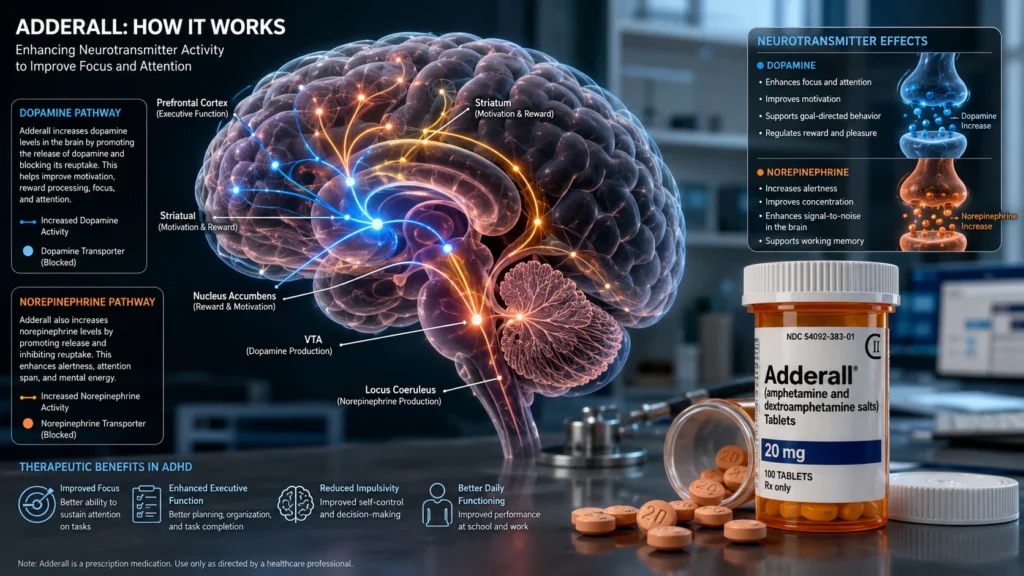
What does Adderall do? Adderall is a prescription stimulant medication that contains amphetamine and dextroamphetamine. Doctors primarily prescribe it to treat Attention-Deficit/Hyperactivity Disorder (ADHD) and narcolepsy. Adderall works by increasing dopamine and norepinephrine activity in the brain, which can improve focus, attention span, impulse control, alertness, and task completion. While Adderall can be highly effective when used as prescribed, it may also cause side effects such as insomnia, appetite suppression, increased heart rate, and anxiety. Because it is a Schedule II controlled substance, Adderall carries a risk of misuse, dependence, and addiction.
Millions of people receive an Adderall prescription every year. Yet one question continues to dominate search engines:
What does Adderall do?
The short answer is simple. Adderall increases activity in specific brain chemicals that help regulate attention, focus, alertness, and self-control.
The complete answer, however, involves brain chemistry, ADHD symptom management, stimulant therapy, medical safety, and treatment outcomes.
For people with ADHD, Adderall can dramatically improve concentration and reduce impulsive behavior. For people with narcolepsy, it can help promote wakefulness throughout the day. At the same time, the medication can produce side effects and carries risks when misused.
Understanding exactly how Adderall works helps patients make informed decisions alongside their healthcare providers.
Adderall does not create intelligence. Instead, it helps certain individuals manage symptoms that interfere with attention, organization, and daily functioning.
This guide explains everything you need to know about Adderall medication, including how it affects the brain, why doctors prescribe it, what benefits it may provide, and what risks patients should understand.
What Is Adderall?
Adderall is a prescription stimulant medication composed of mixed amphetamine salts.
The medication contains two active ingredients:
- Amphetamine
- Dextroamphetamine
Together, these compounds act as central nervous system stimulants.
Doctors most commonly prescribe Adderall for:
- Attention-Deficit/Hyperactivity Disorder (ADHD)
- Narcolepsy
Adderall belongs to a class of medications known as stimulant drugs. Although the word “stimulant” often sounds alarming, these medications have decades of clinical research supporting their use for specific medical conditions.
What Is Adderall Made Of?
Adderall contains a combination of amphetamine salts designed to provide balanced therapeutic effects.
The formulation includes:
| Component | Purpose |
|---|---|
| Dextroamphetamine saccharate | Increases stimulant activity |
| Amphetamine aspartate | Supports therapeutic effect |
| Dextroamphetamine sulfate | Enhances focus and alertness |
| Amphetamine sulfate | Contributes to overall effectiveness |
These ingredients work together to influence neurotransmitter activity within the brain.
Is Adderall a Stimulant?
Yes.
Adderall is classified as a central nervous system stimulant.
Stimulants increase activity within specific areas of the brain that regulate:
- Attention
- Focus
- Alertness
- Executive functioning
- Behavioral control
- Impulse regulation
This classification often surprises people because ADHD itself may appear hyperactive on the surface.
Many assume stimulants would worsen hyperactivity. In reality, properly prescribed stimulant medication often helps reduce hyperactivity symptoms in individuals with ADHD.
Why Is Adderall a Controlled Substance?
Adderall is classified as a Schedule II controlled substance in the United States.
This designation exists because the medication has:
- Legitimate medical uses
- Potential for misuse
- Risk of dependence
- Potential for addiction
Healthcare providers carefully monitor prescriptions to reduce misuse while ensuring patients receive appropriate treatment.
What Is Adderall Used For?
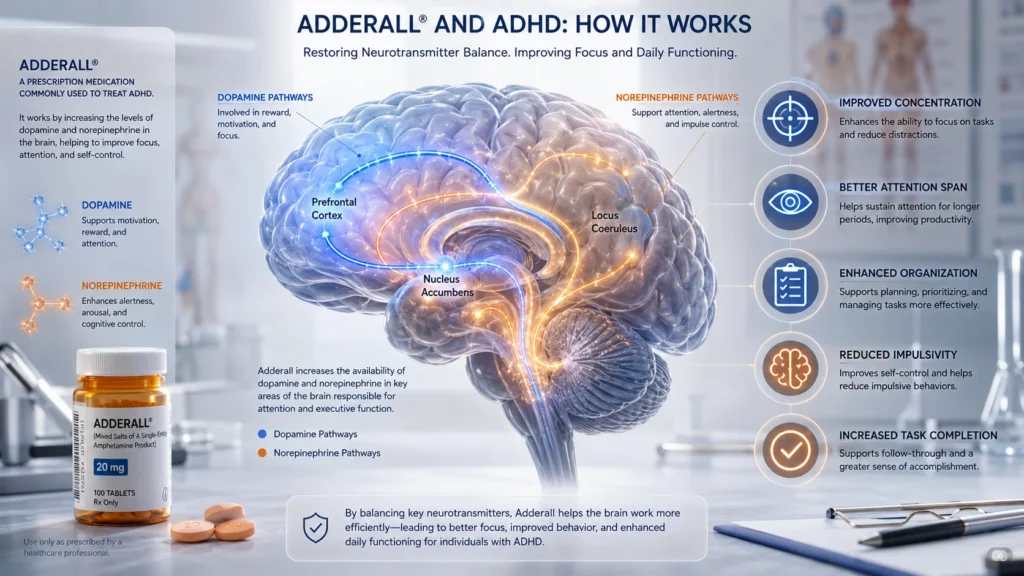
When people ask what Adderall is used for, the answer usually begins with ADHD.
However, ADHD is not the only condition treated with this medication.
Adderall for ADHD
The most common use of Adderall is ADHD treatment.
ADHD affects both children and adults. The condition influences attention regulation, executive functioning, organization, impulse control, and sustained concentration.
Common ADHD symptoms include:
- Difficulty focusing
- Frequent distraction
- Forgetfulness
- Poor organization
- Restlessness
- Impulsive behavior
- Trouble completing tasks
For many patients, Adderall helps reduce these symptoms significantly.
Improvements may include:
- Better concentration
- Increased attention span
- Improved task completion
- Reduced impulsivity
- Better academic performance
- Improved workplace productivity
Adderall for Adults With ADHD
Many people mistakenly believe ADHD only affects children.
In reality, ADHD often continues into adulthood.
Adults with ADHD may struggle with:
- Time management
- Project completion
- Meeting deadlines
- Maintaining attention during meetings
- Following conversations
- Organization
Adderall treatment may help adults manage these challenges more effectively.
Adderall for Children With ADHD
Healthcare providers sometimes prescribe Adderall for children diagnosed with ADHD.
Treatment goals often include:
- Better classroom behavior
- Improved learning outcomes
- Enhanced attention
- Reduced disruptive behavior
- Improved social functioning
Parents and healthcare providers typically monitor children closely to ensure treatment remains effective and safe.
Adderall for Narcolepsy
Narcolepsy is a neurological sleep disorder characterized by excessive daytime sleepiness.
Individuals with narcolepsy may experience:
- Sudden sleep episodes
- Extreme fatigue
- Difficulty staying awake
- Reduced alertness
Adderall promotes wakefulness and helps patients remain alert throughout the day.
For some patients, this improvement can significantly enhance quality of life.
What Does Adderall Do to Your Brain?
To understand how Adderall works, you first need to understand brain neurotransmitters.
These chemical messengers allow nerve cells to communicate with one another.
Two neurotransmitters play a particularly important role:
- Dopamine
- Norepinephrine
Dopamine and Adderall
Dopamine influences:
- Motivation
- Reward processing
- Attention
- Focus
- Learning
- Goal-directed behavior
Research suggests many individuals with ADHD experience differences in dopamine signaling.
Adderall increases dopamine availability within certain brain regions.
As dopamine activity improves, many patients experience:
- Better concentration
- Enhanced motivation
- Greater mental engagement
- Improved task persistence
This effect helps explain why Adderall can improve attention regulation.
Norepinephrine and Adderall
Norepinephrine affects:
- Alertness
- Attention
- Wakefulness
- Reaction speed
- Mental energy
Adderall increases norepinephrine activity alongside dopamine.
As a result, patients often experience:
- Improved alertness
- Better sustained attention
- Enhanced focus
- Reduced mental fatigue
These effects contribute significantly to medication effectiveness.
Does Adderall Increase Dopamine?
Yes.
One of Adderall’s primary actions involves increasing dopamine activity.
The medication affects dopamine release and dopamine reuptake processes.
As dopamine remains available longer, communication between nerve cells becomes more efficient.
This mechanism helps explain many therapeutic effects associated with ADHD symptom improvement.
Does Adderall Change Brain Chemistry?
Temporarily, yes.
Every dose influences neurotransmitter activity while the medication remains active.
The goal is not to permanently alter the brain.
Instead, Adderall provides temporary support for attention regulation and executive functioning during the period in which the medication is working.
How Does Adderall Work?
Many people understand that Adderall improves focus.
Fewer understand how it actually accomplishes that goal.
How Adderall Affects Neurotransmitters
The medication increases the availability of dopamine and norepinephrine within the central nervous system.
This process helps strengthen communication pathways involved in:
- Attention regulation
- Behavioral control
- Working memory
- Executive functioning
- Sustained concentration
Think of these pathways as roads carrying information.
In ADHD, some of those roads may function less efficiently.
Adderall helps improve traffic flow so information travels more effectively.
How Adderall Helps With Concentration
Focus requires multiple brain systems working together.
You must:
- Filter distractions
- Maintain attention
- Shift focus appropriately
- Complete tasks
Individuals with ADHD often struggle with one or more of these functions.
Adderall can improve concentration by strengthening neural systems responsible for these processes.
Patients frequently report:
- Less mental wandering
- Improved attention to detail
- Greater productivity
- Better follow-through
How Adderall Affects Executive Functioning
Executive functions act as the brain’s management system.
They help you:
- Plan ahead
- Organize information
- Prioritize tasks
- Manage time
- Control impulses
ADHD often disrupts these abilities.
By improving neurotransmitter activity, Adderall may help strengthen executive functioning skills.
How Quickly Does Adderall Work?
Onset depends on formulation.
| Formulation | Typical Onset |
|---|---|
| Immediate-release Adderall | 30–60 minutes |
| Adderall XR | Approximately 1–2 hours |
Some patients notice improvements quickly.
Others may require dosage adjustments before experiencing optimal results.
How Long Do Adderall Effects Last?
Duration varies depending on formulation and individual metabolism.
| Type | Typical Duration |
|---|---|
| Immediate-release | 4–6 hours |
| Extended-release (Adderall XR) | 8–12 hours |
Healthcare providers choose formulations based on treatment goals and patient needs.
What Does Adderall Do for ADHD?
For individuals diagnosed with ADHD, Adderall can influence several symptom areas simultaneously.
The medication does not cure ADHD.
However, it can substantially reduce symptom severity.
Improved Focus and Concentration
One of the most recognized Adderall effects involves improved concentration.
Patients often report:
- Better sustained attention
- Less distraction
- Improved reading focus
- Better listening skills
- Enhanced productivity
Tasks that once felt overwhelming may become easier to manage.
Reduced Impulsivity
Impulsivity can affect:
- Decision-making
- Relationships
- Workplace performance
- Academic outcomes
Adderall may help patients pause and think before acting.
That extra moment of self-control can have significant real-world benefits.
Better Attention Span
Many individuals with ADHD struggle to maintain attention for extended periods.
Adderall can help improve:
- Meeting participation
- Classroom focus
- Task completion
- Long-term project management
This improvement often contributes to better performance at school and work.
Reduced Hyperactivity Symptoms
Hyperactivity does not always involve obvious physical movement.
In adults, it may appear as:
- Internal restlessness
- Constant mental activity
- Difficulty relaxing
- Excessive talking
Adderall can help regulate these symptoms and improve overall functioning.
Improved Task Completion
Starting tasks is one challenge.
Finishing them is another.
Many patients find that Adderall helps bridge the gap between intention and execution.
As a result, they often complete more tasks and experience greater satisfaction with their productivity.
What Does Adderall Feel Like?
When someone takes Adderall as prescribed, the experience can vary widely. It depends on dosage, individual brain chemistry, and whether the person has ADHD.
For many people with ADHD, the effect feels surprisingly subtle at first. Instead of a sudden “high,” they notice a quiet shift in mental clarity.
Commonly Reported Feelings (Therapeutic Use)
People prescribed Adderall often describe:
- A calmer, more organized mind
- Easier task initiation
- Less mental clutter
- Improved focus without forcing it
- Reduced emotional overwhelm
- A sense of “mental alignment”
One patient description often repeated in clinical settings is:
“It feels like my brain finally stops arguing with itself.”
That’s not magic. It reflects improved dopamine and norepinephrine signaling in attention circuits.
When Adderall Feels Too Strong
If the dose is too high or taken without medical need, the experience can shift:
- Jittery energy
- Racing thoughts
- Increased heart awareness
- Anxiety or irritability
- Over-focus on small tasks
- Difficulty relaxing
This is one reason medical supervision matters. The goal is balance, not overstimulation.
Emotional Effects
Adderall can also influence mood.
Some people experience:
- Increased motivation
- Emotional steadiness
- Reduced frustration tolerance issues
Others may feel:
- Emotional flattening
- Irritability as it wears off
- Mood swings during rebound periods
The emotional response often depends on how well the dose matches the individual’s needs.
What Happens If You Take Adderall Without ADHD?
This is one of the most searched questions, and for good reason.
Adderall affects everyone’s brain chemistry, not just those diagnosed with ADHD.
However, the outcome differs.
Effects in People Without ADHD
Without ADHD-related neurotransmitter differences, Adderall may produce:
- Increased energy
- Heightened alertness
- Reduced fatigue
- Short-term productivity boost
- Stronger focus on tasks
At first glance, this might sound beneficial.
But the downside often shows up quickly.
The Hidden Cost of Misuse
People without ADHD may experience:
- Over-focusing on irrelevant tasks
- Anxiety and nervousness
- Reduced creative thinking
- Sleep disruption
- Irritability as it wears off
Instead of improving overall performance, it can narrow attention too much.
Think of it like zooming a camera lens too far. You see details clearly, but you lose the full picture.
Risk of Dependence
Repeated non-medical use increases risk of:
- Psychological dependence
- Tolerance buildup
- Sleep cycle disruption
- Mood instability
Because Adderall increases dopamine activity, the brain may start associating productivity or pleasure with the drug itself.
That’s where misuse becomes dangerous.
Adderall Effects: Benefits and Risks
Adderall is not a “good” or “bad” medication. It’s a powerful neurological tool.
Its impact depends on how it is used.
Positive Therapeutic Effects
When prescribed correctly, Adderall may support:
- Improved focus and attention span
- Reduced impulsivity
- Better executive functioning
- Increased wakefulness in narcolepsy
- Enhanced task completion
- Improved academic and work performance
These effects directly target core ADHD symptoms.
Physical and Cognitive Side Effects
Adderall also produces measurable physiological changes.
Common side effects include:
- Reduced appetite
- Increased heart rate
- Elevated blood pressure
- Dry mouth
- Headaches
- Sleep disturbances
These occur because stimulant medications activate the central nervous system.
Psychological Side Effects
Some users experience:
- Anxiety
- Irritability
- Mood swings
- Overstimulation
- Emotional sensitivity
These effects are more likely when dosage is too high or when sleep and nutrition are poor.
Short-Term vs Long-Term Effects
| Type | Effects |
|---|---|
| Short-term | Focus boost, alertness, appetite suppression |
| Long-term | Tolerance, dependence risk, possible cardiovascular strain in susceptible individuals |
Long-term outcomes depend heavily on monitoring, dosage, and medical supervision.
Adderall Side Effects Explained in Detail
Side effects are one of the most important aspects of understanding Adderall.
They vary in intensity and frequency.
Most Common Side Effects
These appear in many users:
- Insomnia
- Appetite suppression
- Dry mouth
- Increased heart rate
- Mild anxiety
These are generally manageable under medical supervision.
Less Common but Important Effects
- Mood swings
- Irritability
- Head pressure or headaches
- Stomach discomfort
- Dizziness
These may signal dosage adjustment needs.
Serious Side Effects (Require Medical Attention)
Although rare, some effects require immediate evaluation:
- Chest pain
- Severe anxiety or panic attacks
- Hallucinations
- Extreme agitation
- Significant blood pressure spikes
These symptoms should never be ignored.
Adderall XR vs Immediate Release
Not all Adderall works the same way.
There are two main formulations:
Immediate-Release (IR) Adderall
- Works quickly (30–60 minutes)
- Lasts 4–6 hours
- Often taken multiple times per day
Best suited for:
- Flexible dosing schedules
- Short-term focus needs
- Fine-tuning treatment response
Extended-Release (Adderall XR)
- Gradual release over time
- Lasts 8–12 hours
- Usually taken once daily
Best suited for:
- School or full workday coverage
- Stable symptom control
- Reduced dosing frequency
Key Differences
| Feature | IR | XR |
|---|---|---|
| Onset | Faster | Slower |
| Duration | Short | Long |
| Dosing | Multiple per day | Once daily |
| Stability | Peaks and drops | Smoother effect |
Choosing between them depends on lifestyle and symptom patterns.
Long-Term Adderall Use
Many people use Adderall for years under medical supervision.
Long-term use is common in ADHD treatment, but it requires monitoring.
What Happens Over Time?
Some patients experience:
- Stable symptom control
- Consistent focus improvements
- Improved life functioning
Others may notice:
- Tolerance development
- Need for dosage adjustments
- Changes in sleep or appetite patterns
Does Adderall Lose Effectiveness?
Sometimes.
This is usually due to:
- Natural tolerance
- Changing ADHD symptoms
- Lifestyle changes
- Sleep or stress issues
Doctors often adjust treatment rather than discontinuing it.
Long-Term Health Considerations
Healthcare providers monitor:
- Heart rate
- Blood pressure
- Sleep quality
- Weight changes
- Mental health status
This helps ensure safe ongoing use.
Adderall Dependence, Tolerance, and Withdrawal
Because Adderall affects dopamine pathways, it carries a risk of dependence.
This does not mean everyone becomes addicted. But the risk exists.
Tolerance
Tolerance means the body adapts over time.
Signs may include:
- Reduced effectiveness at the same dose
- Shorter duration of benefits
- Increased need for adjustments
Dependence
Dependence can be:
- Physical
- Psychological
People may feel they “need” the medication to function normally.
Withdrawal Symptoms
Stopping suddenly may cause:
- Fatigue
- Depression-like symptoms
- Increased sleep
- Low motivation
- Brain fog
These effects are usually temporary but can feel intense.
Adderall Misuse and Addiction Risk
Adderall is a Schedule II controlled substance for a reason.
It has real medical value but also misuse potential.
Why Misuse Happens
Common reasons include:
- Academic pressure
- Work performance demands
- Cognitive enhancement attempts
- Recreational use
What Misuse Does to the Brain
Non-medical use can overstimulate dopamine systems.
This may lead to:
- Reduced natural motivation
- Emotional instability
- Increased risk of addiction
- Sleep cycle disruption
Warning Signs of Misuse
- Taking more than prescribed
- Using without prescription
- Craving the medication
- Using it for euphoria rather than focus
- Difficulty stopping
Early awareness helps prevent long-term harm.
Key Facts About Adderall (Quick Reference Table)
| Topic | Fact |
|---|---|
| Drug class | CNS stimulant |
| Active ingredients | Amphetamine + dextroamphetamine |
| Main uses | ADHD, narcolepsy |
| Controlled status | Schedule II |
| Onset | 30–60 minutes (IR) |
| Duration | 4–12 hours depending on type |
| Main neurotransmitters affected | Dopamine, norepinephrine |
| Common effects | Focus, alertness, reduced impulsivity |
| Main risks | Dependence, insomnia, appetite loss |
Adderall and Cognitive Enhancement: Myth vs Reality
One of the biggest misconceptions around Adderall is that it acts as a “smart drug” for everyone.
That idea spreads fast online. However, the science paints a more nuanced picture.
Does Adderall Improve Cognitive Performance?
For individuals with ADHD, yes, Adderall often improves:
- Attention regulation
- Working memory performance
- Task completion consistency
- Executive functioning efficiency
But for people without ADHD, the effects are different.
Instead of enhancing cognition broadly, Adderall tends to:
- Narrow attention
- Increase fixation on tasks
- Boost alertness temporarily
- Reduce fatigue perception
That doesn’t always translate into better thinking or creativity.
The “Study Drug” Myth
Some students use Adderall during exams expecting improved academic performance.
What often actually happens:
- Short bursts of intense focus
- Reduced awareness of fatigue
- Overconfidence in task completion
- Sleep loss afterward
Sleep disruption alone can erase any short-term cognitive gains.
So while Adderall can increase attention, it does not guarantee smarter thinking or better learning.
Adderall vs Other ADHD Medications
Adderall is not the only stimulant used for ADHD treatment.
Doctors often choose between several options based on patient response.
Adderall vs Vyvanse
Vyvanse is a prodrug, meaning it becomes active after metabolism.
| Feature | Adderall | Vyvanse |
|---|---|---|
| Onset | Faster | Slower |
| Duration | 4–12 hours | 10–14 hours |
| Abuse potential | Higher | Lower |
| Effect smoothness | More peaks | More stable |
Vyvanse is often preferred for smoother, longer-lasting symptom control.
Adderall vs Ritalin
Ritalin works differently by targeting dopamine reuptake more directly.
| Feature | Adderall | Ritalin |
|---|---|---|
| Drug type | Amphetamine-based | Methylphenidate-based |
| Duration | Longer | Shorter |
| Mood effect | More stimulating | More neutral |
Some patients respond better to one than the other due to brain chemistry differences.
Adderall vs Concerta
Concerta provides extended symptom control with once-daily dosing.
Concerta tends to deliver:
- More stable coverage
- Fewer rebound effects
- Longer duration than standard Ritalin
But Adderall may feel stronger for certain patients due to amphetamine activity.
Who Should Take Adderall?
Adderall is not a universal solution.
It is designed for specific medical conditions.
Approved Uses
Doctors prescribe Adderall for:
- Attention-Deficit/Hyperactivity Disorder (ADHD)
- Narcolepsy
These are evidence-based indications supported by decades of clinical research.
Candidates for ADHD Treatment
People who may benefit include those with:
- Persistent inattention
- Chronic disorganization
- Impulsivity affecting daily life
- Difficulty sustaining mental effort
- Academic or work impairment
Diagnosis must come from a qualified healthcare provider.
Who Should Be Careful or Avoid It
Adderall may not be appropriate for individuals with:
- Severe heart conditions
- Uncontrolled anxiety disorders
- History of stimulant misuse
- Certain psychiatric conditions
Medical evaluation is essential before starting treatment.
Adderall Dosage Overview (General Information Only)
Dosage is highly individualized.
It depends on:
- Age
- Symptom severity
- Medical history
- Response to treatment
Typical Clinical Approach
Doctors often start with:
- Low dose
- Gradual adjustment
- Careful monitoring
This reduces side effects and improves tolerance.
Important Safety Note
Adderall is not a self-adjustable medication.
Changes in dosage without medical guidance can lead to:
- Increased side effects
- Reduced effectiveness
- Higher risk of dependence
How Adderall Affects ADHD Diagnosis Outcomes
Adderall is not used to diagnose ADHD.
Instead, it supports symptom management after diagnosis.
ADHD Diagnosis Process
A proper evaluation often includes:
- Behavioral assessments
- Symptom history review
- Academic or occupational impact analysis
- Psychological testing when needed
Medication response alone is not a diagnostic tool.
Role of Adderall in Treatment Plans
Once diagnosed, Adderall may be part of a broader plan that includes:
- Behavioral therapy
- Lifestyle adjustments
- Sleep regulation strategies
- Skills training for organization and focus
Medication works best when combined with these supports.
What Does Adderall Do? (Simple Breakdown)
To summarize the core idea clearly:
Adderall increases dopamine and norepinephrine activity in the brain, which helps improve attention, focus, impulse control, and wakefulness, especially in individuals with ADHD or narcolepsy.
FAQs
What does Adderall do to your brain?
Adderall increases dopamine and norepinephrine levels, improving attention, focus, and behavioral control.
How does Adderall help with ADHD?
It reduces core symptoms like inattention, impulsivity, and hyperactivity by improving neurotransmitter signaling.
How quickly does Adderall work?
Immediate-release forms start within 30–60 minutes, while extended-release versions take 1–2 hours.
How long do Adderall effects last?
Effects last about 4–6 hours for IR and 8–12 hours for XR formulations.
What happens if someone without ADHD takes Adderall?
They may experience increased alertness and focus but also higher risk of anxiety, insomnia, and overstimulation.
Is Adderall addictive?
Yes, it carries a risk of dependence and misuse because it affects dopamine pathways in the brain.
What are common side effects of Adderall?
Common side effects include appetite loss, insomnia, dry mouth, increased heart rate, and anxiety.
Does Adderall improve productivity?
It can improve task focus and completion, but productivity gains depend on proper medical use and individual response.
What is the difference between Adderall and Adderall XR?
Adderall XR is extended-release and lasts longer, while immediate-release works faster but wears off sooner.
Is Adderall safe long-term?
It can be safe under medical supervision with regular monitoring of heart health, sleep, and mental well-being.
Final Summary
Adderall is a prescription stimulant that directly affects brain chemistry linked to attention and alertness.
It helps many people with ADHD regain control over focus, behavior, and task management. For narcolepsy, it supports wakefulness and daytime functioning.
At the same time, it is not a casual performance enhancer. It carries real risks, especially when misused or taken without medical supervision.
The key takeaway is simple:
Adderall is effective when used correctly, but it demands respect, oversight, and responsible medical guidance.

Sophia Bennett is a professional writer focused on explaining word meanings, expressions and everyday language in a simple and engaging way.