
Last Updated on June 15, 2026
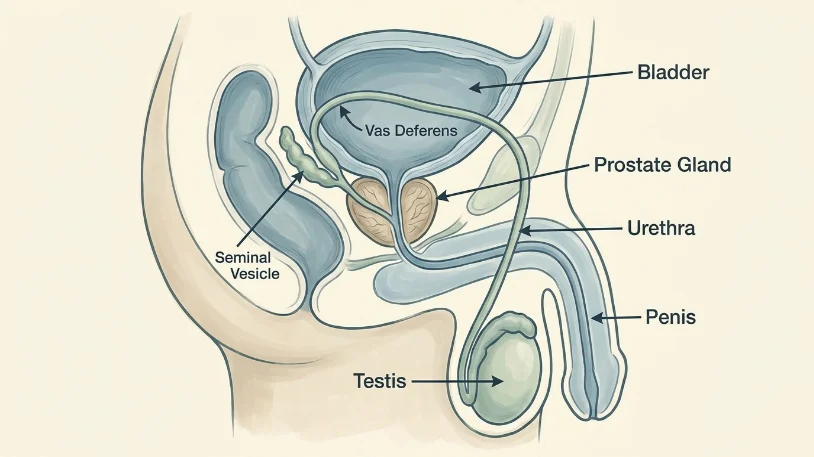
The prostate is a small gland in the male reproductive system located below the bladder and surrounding the urethra. Its main function is to produce prostatic fluid, a key component of semen that supports sperm survival, mobility, and fertility. During ejaculation, the prostate contracts to help push semen through the urethra. It also plays a role in urinary control because it sits around the urinary tube. As men age, the prostate can enlarge, affecting urine flow and overall reproductive health.
Understanding Prostate Function, Purpose and Role in the Male Body
The prostate often stays in the background of male health conversations. You don’t think about it daily. You probably don’t even notice it working. Yet it plays a quiet but powerful role in reproduction and urination.
So let’s break it down simply.
The prostate is not just “another gland.” It is a biological support system for semen production, sperm survival, and urinary flow control. Without it, male fertility would not function the same way.
To really understand what does the prostate do, you need to look at anatomy, function, and how it behaves during key body processes like ejaculation and urination.
What Is the Prostate? Basic Structure and Meaning
The prostate is a small, walnut-shaped gland in the male reproductive system. It sits deep inside the pelvis and connects closely with both the urinary and reproductive systems.
It belongs to a group of organs known as accessory reproductive glands. That means it doesn’t produce sperm itself, but it supports sperm function.
Core characteristics of the prostate
- Size: about 20 grams in a healthy adult
- Shape: walnut-like, slightly rounded
- Composition: glandular and muscular tissue
- Function type: secretory + muscular support organ
The prostate is not static. It changes across life stages, especially after puberty and during aging.
Prostate Location in the Body (Why It Matters So Much)
Understanding prostate location in the body is key to understanding its function.
The prostate sits:
- Directly below the bladder
- In front of the rectum
- Surrounding the urethra
This positioning is critical.
Because the prostate wraps around the urethra, even small changes in size can affect urine flow. That’s why urinary symptoms often appear when the prostate enlarges.
Simple spatial breakdown
Think of it like this:
- Bladder = water tank
- Urethra = exit pipe
- Prostate = ring around the pipe
If the ring tightens, flow slows down.
What Does the Prostate Do? Core Prostate Function Explained
The prostate function is mainly about supporting reproduction and assisting fluid movement in the male reproductive system.
It has three major biological roles:
- Producing fluid that supports sperm
- Helping form semen
- Assisting ejaculation through muscular contractions
Let’s go deeper.
Prostate Fluid Production and Semen Formation
One of the most important answers to what does the prostate do is this:
It produces prostatic fluid, a key part of semen.
What is prostatic fluid?
It is a slightly alkaline, milky fluid containing:
- Enzymes
- Zinc
- Citric acid
- Proteins
This fluid makes up about 20–30% of semen volume.
The rest comes from:
- Seminal vesicles (~60–70%)
- Testes (sperm cells)
Why prostatic fluid matters for sperm
Sperm cells are sensitive. Outside the body, they struggle to survive.
Prostatic fluid helps by:
- Neutralizing acidity in the female reproductive tract
- Providing enzymes that help semen stay fluid
- Supporting sperm motility
- Increasing survival time of sperm cells
Without this fluid, sperm would lose efficiency quickly.
Semen composition (clear breakdown)
| Component | Source | Function |
|---|---|---|
| Sperm cells | Testes | Genetic material delivery |
| Prostatic fluid | Prostate gland | Protection and activation |
| Seminal fluid | Seminal vesicles | Energy and transport support |
Role of the Prostate Gland in Ejaculation
Another key part of prostate function in ejaculation is mechanical.
The prostate is not passive during ejaculation. It actively contracts.
What happens during ejaculation
- Nerve signals activate reproductive organs
- The prostate contracts rhythmically
- Seminal fluid is pushed into the urethra
- Semen exits the body through muscular force
This process is fast, coordinated, and highly controlled.
Why prostate contraction matters
Without contraction:
- Semen would not be properly propelled
- Ejaculation would be weaker or incomplete
- Sperm delivery efficiency would drop
So the prostate acts like a pump assisting fluid movement.
Testosterone Influence on Prostate Function
The prostate is highly dependent on hormones.
The main hormone involved is testosterone, which is converted into dihydrotestosterone (DHT) inside the prostate.
What DHT does
- Stimulates prostate growth
- Maintains gland function
- Supports fluid production
Life stage hormone effects
| Life stage | Hormonal activity | Prostate behavior |
|---|---|---|
| Childhood | Low testosterone | Small, inactive |
| Puberty | Rising testosterone | Rapid growth |
| Adulthood | Stable hormones | Full function |
| Aging | Hormonal shifts | Enlargement risk |
Prostate and Fertility: Why It’s Important
When discussing prostate and fertility, the connection is direct and essential.
The prostate does not create sperm, but it creates the environment sperm need to function.
How the prostate supports fertility
- Improves sperm motility
- Protects sperm from acidic environments
- Helps semen stay fluid for movement
- Supports enzymatic activity for sperm release
If prostate function is impaired, fertility can decline even if sperm production is normal.
Urinary System and Prostate Connection
The prostate is part of both the reproductive and urinary systems.
This dual role is what makes it medically important.
How it affects urination
Because it surrounds the urethra:
- It regulates urine flow indirectly
- It can compress the urethra if enlarged
- It influences bladder emptying efficiency
Normal function
A healthy prostate:
- Does not block urine flow
- Maintains smooth bladder emptying
- Keeps urinary pressure stable
Why is the Prostate Important? Biological Perspective
The purpose of the prostate goes beyond reproduction.
It supports two critical functions:
Reproductive support
- Semen formation
- Sperm activation
- Ejaculatory coordination
Urinary regulation
- Structural support around urethra
- Bladder outlet control
Without it, male reproductive efficiency would be significantly reduced.
Prostate Gland Anatomy Explained Clearly
Understanding prostate gland anatomy helps connect structure to function.
Internal structure
The prostate contains:
- Glandular tissue (fluid production)
- Muscular fibers (ejaculation control)
- Ducts (fluid transport pathways)
Zones of the prostate
| Zone | Function |
|---|---|
| Peripheral zone | Main site of prostate cancer origin |
| Central zone | Surrounds ejaculatory ducts |
| Transitional zone | Surrounds urethra, linked to enlargement |
Ejaculatory Process and Prostate Function
The prostate plays a timed role in ejaculation.
Step-by-step process
- Sexual stimulation activates nerves
- Seminal vesicles release fluid
- Prostate contracts
- Semen mixes in urethra
- Ejaculation occurs
Everything is synchronized.
A delay or disruption in prostate contraction can affect ejaculation quality.
Semen Liquefaction Process (Prostate Role)
Right after ejaculation, semen is thick. It must liquefy for sperm to move.
The prostate releases enzymes such as:
- Prostate-specific antigen (PSA)
These enzymes break down semen proteins.
Why liquefaction matters
- Allows sperm movement
- Supports fertilization
- Prevents semen from staying gel-like
Without this process, fertility efficiency drops.
Common Prostate Conditions That Affect Function
Even though this article focuses on normal function, understanding dysfunction helps complete the picture.
Benign Prostatic Hyperplasia (BPH)
- Non-cancerous enlargement
- Common after age 50
- Affects urine flow
Prostatitis
- Inflammation or infection
- Can cause pain and urinary discomfort
- Can affect ejaculation
Prostate cancer
- Often slow-growing
- Can remain silent in early stages
- May affect urinary and reproductive systems later
Warning Signs of Prostate Dysfunction
You should pay attention to:
- Weak urine stream
- Frequent nighttime urination
- Pain during urination or ejaculation
- Blood in urine or semen
- Difficulty starting urination
These signs do not confirm disease, but they signal a need for evaluation.
How Doctors Evaluate Prostate Function
Doctors use several methods:
- Physical examination (digital rectal exam)
- Blood test measuring PSA levels
- Imaging tests when needed
- Biopsy for detailed analysis
These tools help assess both structure and function.
Prostate Health Function and Lifestyle Factors
The prostate responds to lifestyle over time.
Supporting factors
- Regular physical activity
- Balanced diet rich in vegetables
- Healthy body weight
- Adequate hydration
Risk factors
- Sedentary lifestyle
- High-fat diets
- Aging (natural factor)
- Hormonal changes
Myths About Prostate Function
Myth: The prostate only matters in old age
Truth: It functions actively from puberty onward.
Myth: Prostate enlargement always means cancer
Truth: Most enlargement is benign.
Myth: The prostate is only for reproduction
Truth: It also affects urinary flow.
Conclusion
The prostate is a small gland with a big job.
It:
- Produces fluid that supports sperm
- Helps form semen
- Assists ejaculation
- Influences urinary flow
If you strip it down, the answer to what does the prostate do is simple:
It helps sperm survive, travel, and get released efficiently while also shaping how urine exits the body.

Michael Anderson is a content writer specializing in word meanings, definitions and clear explanations of modern terms and phrases.