Last Updated on June 17, 2026
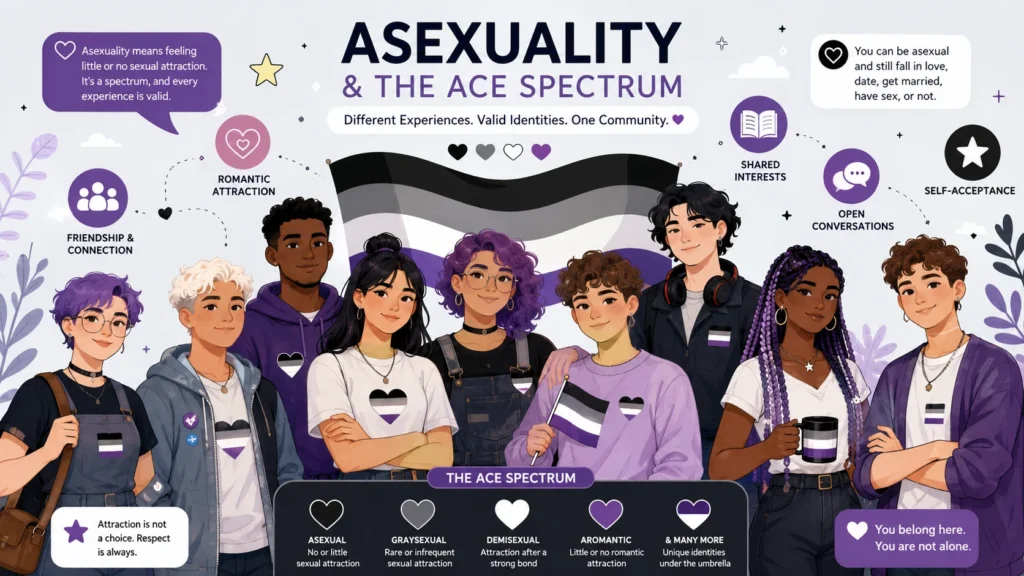
What does asexual mean? Asexual means experiencing little or no sexual attraction to other people. Asexuality is a sexual orientation and exists on a spectrum, often called the ace spectrum. Some asexual people fall in love, date, get married, or have children. Others identify as aromantic and experience little or no romantic attraction. Being asexual is different from celibacy, abstinence, or having a low sex drive because it describes how a person experiences sexual attraction rather than their behavior or choices.
Sexuality isn’t as simple as people once believed. For decades, society assumed everyone experiences sexual attraction in roughly the same way. Yet human experiences are far more diverse.
That’s where many people start asking an important question:
What does asexual mean?
If you’ve heard someone identify as asexual, call themselves “ace,” or mention the ace spectrum, you might wonder what these terms actually mean. Perhaps you’re questioning your own identity. Maybe you want to understand a friend, partner, or family member better.
The short answer is simple.
Asexual means experiencing little or no sexual attraction to others.
The longer answer is more fascinating.
Asexuality isn’t about hating sex. It isn’t celibacy. It isn’t a medical condition. It doesn’t automatically mean someone avoids relationships or never falls in love.
In fact, asexuality exists on a broad spectrum. Some asexual people date and marry. Some enjoy sex while others don’t. Some experience romantic attraction while others identify as aromantic.
Understanding asexuality means understanding that attraction itself isn’t one single feeling. It’s a collection of experiences that don’t always overlap.
This guide explores:
- The meaning of asexual and asexuality
- Different forms of attraction
- The asexual spectrum and ace identities
- Romantic relationships and dating
- Myths and misconceptions
- Signs of asexuality
- Questions people commonly ask about being ace
By the end, you’ll have a clear understanding of what does being asexual mean and why millions of people around the world identify somewhere on the ace spectrum.
What Does Asexual Mean?
The Simple Definition of Asexual
The meaning of asexual is straightforward.
An asexual person experiences little or no sexual attraction toward other people.
Sexual attraction refers to the feeling of wanting sexual contact with a particular person. Many people experience this naturally and frequently. Asexual individuals either experience it very rarely, under specific conditions, or not at all.
This is why asexuality is considered a sexual orientation.
It describes how someone experiences sexual attraction, not:
- Their personality
- Their moral beliefs
- Their relationship status
- Their sexual history
- Their physical ability to have sex
An asexual person can be outgoing or shy.
They can be single or married.
They can have children or remain child-free.
Their orientation simply describes one aspect of how they experience attraction.
Asexual Definition in Simple Words
If someone asks you to define asexual, here’s an easy explanation:
Asexuality is a sexual orientation in which a person experiences little or no sexual attraction to others.
That’s it.
However, many people mistakenly assume that means:
- They never date.
- They hate intimacy.
- They dislike physical affection.
- They can’t fall in love.
- They have a hormone problem.
None of these assumptions are automatically true.
Asexuality is more nuanced than that.
What Does Being Asexual Mean in Everyday Life?
Being asexual means different things to different people.
For one person, it might mean:
- Never experiencing sexual attraction.
- Enjoying romantic relationships.
- Wanting marriage and children.
For another person, it might mean:
- Rarely feeling sexual attraction.
- Not being interested in dating.
- Preferring deep friendships.
For someone else:
- They might enjoy sex for emotional closeness.
- They may identify as sex-favorable.
- They may still consider themselves completely asexual.
This diversity is why experts often talk about the asexual spectrum rather than treating asexuality as one universal experience.
What Is an Asexual Person?
An asexual person is often called an ace.
The word “ace” is a shortened form of asexual and is widely used within the ace community.
Someone who is ace may:
- Experience no sexual attraction.
- Experience sexual attraction rarely.
- Experience attraction only in certain situations.
- Desire romantic relationships.
- Prefer friendships over romance.
- Enjoy physical intimacy like hugging or kissing.
- Feel indifferent toward sex.
There is no single way to be asexual.
Two ace individuals may have completely different experiences and still both identify as asexual.
Asexual Meaning vs Other Sexual Orientations
One reason people struggle to understand asexuality is that most discussions about sexuality focus on who people are attracted to.
For example:
- Heterosexual people experience attraction to another gender.
- Homosexual people experience attraction to the same gender.
- Bisexual people experience attraction to multiple genders.
- Pansexual people experience attraction regardless of gender.
Asexuality asks a different question.
Instead of:
“Who are you attracted to?”
The question becomes:
“Do you experience sexual attraction at all?”
For many ace people, the answer is:
- Rarely
- Under specific circumstances
- Not at all
Quick Table: Asexual Meaning Explained
| Term | Meaning |
|---|---|
| Asexual | Experiences little or no sexual attraction |
| Sexual Attraction | Desire for sexual activity with a specific person |
| Libido | General physical sex drive |
| Celibacy | Choosing not to have sex |
| Abstinence | Temporarily avoiding sexual activity |
| Allosexual | Someone who experiences sexual attraction regularly |
What Is Sexual Attraction?
Before understanding what is asexuality, it helps to understand sexual attraction itself.
Many people assume attraction is a single emotion.
It isn’t.
Human attraction resembles a set of overlapping circles rather than one universal feeling.
You might feel:
- Romantic attraction without sexual attraction.
- Sexual attraction without romance.
- Emotional closeness without either.
- Physical affection without sexual desire.
This distinction forms the foundation of modern discussions about asexuality.
Sexual Attraction Explained
Sexual attraction means feeling sexually drawn to a specific person.
It’s the feeling that makes someone think:
- “I’d like to have sex with them.”
- “I’m sexually interested in this person.”
- “I feel sexual chemistry with them.”
For many people, sexual attraction appears naturally.
For asexual people, this experience may be:
- Completely absent
- Rare
- Situational
- Difficult to recognize
This doesn’t mean they can’t admire someone’s appearance.
It doesn’t mean they can’t think someone is beautiful.
It simply means they don’t experience the sexual pull others often describe.
Romantic Attraction
Romantic attraction differs from sexual attraction.
It involves wanting:
- Emotional closeness
- Romantic partnership
- Dating
- Love
- Commitment
Someone can experience romantic attraction without sexual attraction.
For example:
An asexual person may think:
“I want to spend my life with this person.”
without thinking:
“I want to have sex with this person.”
This separation surprises many people.
Yet it’s one of the most important concepts for understanding the ace spectrum.
Emotional Attraction
Emotional attraction involves wanting a deep emotional bond.
You may feel:
- Safe around someone.
- Understood by them.
- Drawn to their personality.
- Connected through shared values.
This attraction often forms the basis of:
- Close friendships
- Romantic relationships
- Long-term partnerships
Many asexual people experience emotional attraction strongly.
Aesthetic Attraction
Aesthetic attraction means appreciating someone’s appearance.
You may think:
- “They’re beautiful.”
- “They’re handsome.”
- “I love their style.”
- “They’re incredibly attractive.”
This doesn’t automatically include sexual desire.
Think about admiring:
- A painting
- A sunset
- A celebrity
- A fashion model
You appreciate beauty.
You aren’t necessarily sexually attracted.
Many ace individuals experience aesthetic attraction frequently.
Sensual Attraction
Sensual attraction refers to wanting physical closeness that isn’t sexual.
Examples include:
- Hugging
- Holding hands
- Cuddling
- Resting on someone’s shoulder
- Gentle touching
Some asexual people love physical affection.
Others dislike it.
Experiences vary greatly.
The Split Attraction Model
One of the most useful concepts in understanding asexuality is the Split Attraction Model.
It suggests that attraction can be divided into separate categories.
A person might be:
| Sexual Orientation | Romantic Orientation |
|---|---|
| Asexual | Heteroromantic |
| Asexual | Homoromantic |
| Asexual | Biromantic |
| Asexual | Panromantic |
| Asexual | Aromantic |
This explains why someone can say:
“I’m asexual, but I’m romantically attracted to women.”
or:
“I’m asexual and aromantic.”
Both are valid experiences.
Why Understanding Attraction Matters
Many people spend years confused about their identity because they assume:
Sexual attraction = Romantic attraction.
But they aren’t the same.
Imagine loving romance novels.
Wanting companionship.
Dreaming about marriage.
Feeling butterflies around someone.
Yet never experiencing sexual attraction.
That experience is common among many asexual individuals.
Understanding this distinction often brings enormous relief.
People suddenly realize:
“There’s nothing wrong with me. I just experience attraction differently.”
Is Asexuality a Sexual Orientation?
The short answer is:
Yes.
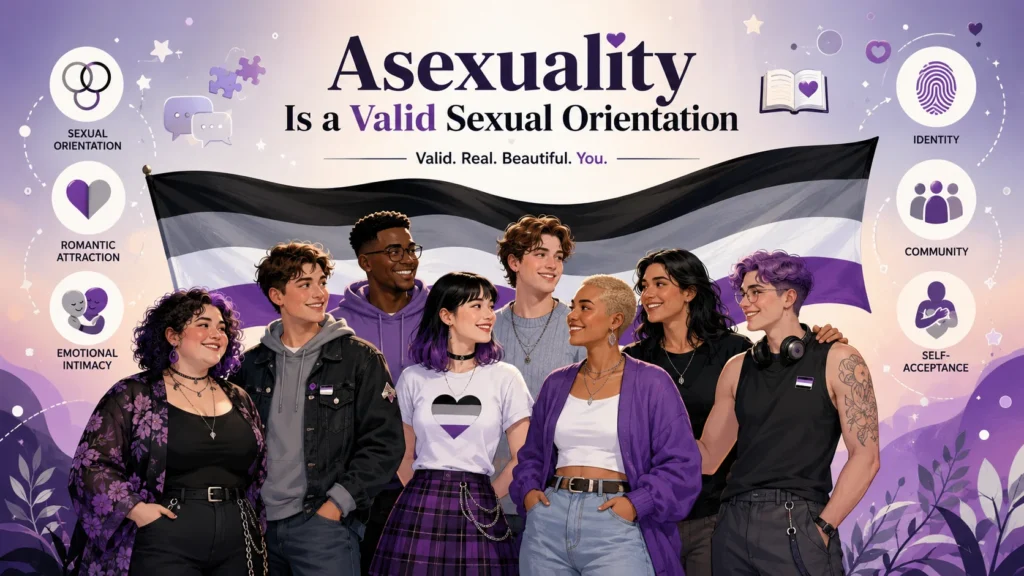
Most researchers, mental health professionals, and LGBTQIA+ communities recognize asexuality as a legitimate sexual orientation.
Why Asexuality Is Considered a Sexual Orientation
Sexual orientations describe patterns of attraction.
For example:
- Heterosexuality describes attraction to another gender.
- Homosexuality describes attraction to the same gender.
- Bisexuality describes attraction to multiple genders.
- Asexuality describes little or no sexual attraction.
The key factor isn’t behavior.
It’s attraction.
This distinction matters because many people mistakenly believe:
“If someone doesn’t have sex, they’re asexual.”
Not necessarily.
Someone may avoid sex because of:
- Personal values
- Religious beliefs
- Trauma
- Medical conditions
- Lack of opportunity
These experiences are different from asexuality.
Asexuality describes how attraction works, not whether someone chooses to have sex.
Is Asexuality a Choice?
One of the most common questions is:
Is asexuality a choice?
The answer is generally no.
Asexual people don’t decide one day to stop experiencing attraction.
Instead, many report:
- Never experiencing sexual attraction.
- Experiencing it differently from peers.
- Feeling confused before discovering the term.
- Feeling relief after understanding their identity.
Like other orientations, asexuality isn’t widely viewed as something people consciously choose.
Is Asexuality a Medical Condition?
No.
Asexuality is not automatically:
- A disease
- A disorder
- A hormonal imbalance
- A mental illness
This distinction is important.
Some medical conditions affect sexual desire.
Examples include:
- Hormonal disorders
- Depression
- Certain medications
- Chronic illness
However, these conditions often involve:
- Distress
- Sudden changes
- Loss of previously experienced attraction
Asexuality differs because:
- It is an orientation.
- Many ace people feel healthy and fulfilled.
- Their lack of sexual attraction doesn’t necessarily cause distress.
Can Someone Become Asexual Later in Life?
Sexual identity can be complicated.
Some people know they are ace from adolescence.
Others discover the term in their twenties, thirties, or even later.
Several factors influence this:
- Increased awareness.
- Better language for describing experiences.
- Personal reflection.
- Learning about the ace spectrum.
Sometimes people don’t change.
Instead:
They finally find a word that describes how they’ve always felt.
That moment can feel transformative.
Like finding the missing piece of a puzzle.
The Asexual Spectrum Explained
Asexuality isn’t one experience.
It exists on what many people call the ace spectrum or asexual spectrum.
This spectrum includes people who experience:
- No sexual attraction.
- Rare sexual attraction.
- Conditional attraction.
- Attraction under specific emotional circumstances.
Understanding the spectrum helps explain why two ace people may have completely different experiences.
Yet both identities remain equally valid.
What Is the Ace Spectrum?
The ace spectrum is an umbrella term that includes a range of identities related to experiencing little, rare, or conditional sexual attraction.
Think of it like a color gradient.
There isn’t always a sharp dividing line.
Experiences can vary widely.
Some people identify simply as:
- Asexual
- Ace
Others prefer more specific labels.
These labels help people describe experiences more precisely.
Asexual
Asexual people experience:
- Little sexual attraction
- No sexual attraction
- Rare attraction
Some may:
- Date
- Marry
- Have children
- Enjoy sex
- Avoid sex
The orientation doesn’t dictate behavior.
It describes attraction.
Graysexual Meaning
Graysexual or gray-asexual falls between asexuality and allosexuality.
Graysexual individuals may experience:
- Sexual attraction very rarely
- Attraction only in unusual situations
- Attraction with very low intensity
- Attraction so infrequently that it feels outside the norm
A graysexual person might think:
“I’ve felt sexual attraction only once or twice in my life.”
or
“I experience attraction, but it’s extremely uncommon.”
This identity helps people describe experiences that don’t fit neatly into traditional categories.
Demisexual Meaning
Demisexuality is one of the most widely discussed identities on the ace spectrum.
A demisexual person experiences sexual attraction:
Only after developing a strong emotional bond.
This doesn’t mean:
- They are shy.
- They are waiting for marriage.
- They simply prefer emotional intimacy.
Instead:
Without emotional closeness, sexual attraction doesn’t occur.
With emotional closeness, it may develop.
This makes demisexuality distinct from both allosexuality and complete asexuality.
Aromantic Asexual
An aromantic asexual experiences:
- Little or no sexual attraction.
- Little or no romantic attraction.
This doesn’t mean they cannot:
- Love people.
- Build close relationships.
- Experience emotional intimacy.
Many aromantic asexual people value:
- Deep friendships.
- Family relationships.
- Queerplatonic partnerships.
- Community connections.
Love exists in many forms.
Romantic love is only one of them.
Romantic Asexual Identities
Not every asexual person is aromantic.
Many experience romantic attraction.
Common romantic orientations include:
- Heteroromantic romantic attraction to another gender.
- Homoromantic romantic attraction to the same gender.
- Biromantic romantic attraction to multiple genders.
- Panromantic romantic attraction regardless of gender.
- Demiromantic romantic attraction only after emotional closeness.
- Grayromantic romantic attraction that occurs rarely or under limited circumstances.
These labels help explain the rich diversity within the ace community.
Table: Common Asexual Spectrum Identities
| Identity | Description |
|---|---|
| Asexual | Little or no sexual attraction |
| Graysexual | Rare or situational sexual attraction |
| Demisexual | Sexual attraction after emotional bonding |
| Aromantic | Little or no romantic attraction |
| Demiromantic | Romantic attraction after emotional closeness |
| Grayromantic | Rare romantic attraction |
| Allosexual | Regular sexual attraction |
Sex-Favorable, Sex-Indifferent, and Sex-Repulsed Asexual
Another important distinction involves attitudes toward sex itself.
Not all asexual people feel the same way about sexual activity.
Some are:
Sex-Favorable Asexual
These individuals:
- May enjoy sex.
- May seek sexual experiences.
- May value sex for intimacy or pleasure.
- Still experience little or no sexual attraction.
Sex-Indifferent Asexual
They may:
- Feel neutral about sex.
- Participate or avoid it.
- Have no strong positive or negative feelings.
Sex-Repulsed Asexual
These individuals may:
- Feel uncomfortable with sexual activity.
- Dislike sexual discussions.
- Avoid sexual experiences entirely.
All three experiences are valid.
None makes a person “more” or “less” asexual.
Asexuality isn’t defined by whether someone has sex. It’s defined by how they experience sexual attraction.
The ace spectrum reminds us of something important:
Human sexuality isn’t a straight line.
It’s a landscape.
People experience attraction in countless ways and asexuality is one of those natural variations.
Can Asexual People Fall in Love?
One of the biggest myths about asexuality is that asexual people cannot fall in love.
That simply isn’t true.
The answer depends on the individual because sexual attraction and romantic attraction are not the same thing.
Many asexual people experience powerful romantic feelings. They develop crushes, dream about relationships, and build lifelong partnerships. Others identify as aromantic and experience little or no romantic attraction.
Both experiences are real.
Both are valid.
Understanding this difference helps answer many common questions about the meaning of asexual, especially questions like:
- Can asexual people date?
- Can asexual people get married?
- Can asexual people have children?
- Can you be asexual and in love?
The answer to all of these questions can be yes.
Romantic Attraction and Asexuality
Romantic attraction refers to the desire to form a romantic relationship with someone.
You might want to:
- Date them.
- Hold hands.
- Share your life together.
- Go on trips.
- Build a family.
- Express affection and commitment.
None of these feelings require sexual attraction.
This surprises many people because society often treats romance and sex as inseparable.
Yet countless ace people experience:
- Deep love
- Emotional intimacy
- Romantic commitment
- Strong relationships
without experiencing sexual attraction.
Different Romantic Orientations Among Asexual People
Asexuality only describes sexual attraction.
Romantic orientation describes romantic attraction.
This means an asexual person may identify as:
| Romantic Orientation | Meaning |
|---|---|
| Heteroromantic | Romantically attracted to another gender |
| Homoromantic | Romantically attracted to the same gender |
| Biromantic | Romantically attracted to multiple genders |
| Panromantic | Romantically attracted regardless of gender |
| Aromantic | Experiences little or no romantic attraction |
| Demiromantic | Romantic attraction develops after emotional closeness |
| Grayromantic | Romantic attraction occurs rarely |
This is why two asexual people can have very different lives.
One might happily marry.
Another may never desire a romantic relationship.
Neither experience is more authentic.
Can Asexual People Have Crushes?
Yes.
Many ace people have crushes.
However, their crushes may feel different from what others describe.
An asexual crush may involve:
- Wanting emotional closeness
- Thinking about someone constantly
- Feeling butterflies
- Wanting affection
- Wanting to spend time together
without wanting sexual intimacy.
Some people call these:
- Romantic crushes
- Emotional crushes
- Squishes
A squish is a term often used in the ace community to describe a strong desire for friendship or emotional closeness that isn’t romantic or sexual.
Can Asexual People Get Married?
Absolutely.
Many asexual people marry and build fulfilling relationships.
Marriage for ace individuals may include:
- Romance
- Emotional intimacy
- Shared goals
- Affection
- Partnership
- Parenting
The role of sex varies from couple to couple.
Some marriages include:
- Regular sexual activity
- Occasional sex
- No sex at all
Every relationship defines intimacy differently.
Communication matters far more than following a social script.
Can Asexual People Have Children?
Yes.
Asexual people can have children in many ways.
Some choose:
- Biological parenthood
- Adoption
- Surrogacy
- Co-parenting
- Foster care
Being asexual doesn’t affect a person’s ability to become a parent.
It only affects how they experience sexual attraction.
Asexual Relationships and Dating
When people first learn the asexual orientation meaning, they often ask:
“How do asexual relationships work?”
The truth is:
There isn’t one answer.
Asexual relationships vary just as much as any other relationships.
Some involve sex.
Some don’t.
Some are romantic.
Others are queerplatonic.
Some include partners with different sexual orientations.
Can Asexual People Date?
Yes.
Many ace people enjoy dating.
They may seek:
- Romantic companionship
- Emotional intimacy
- Long-term commitment
- Shared life experiences
- Marriage
Dating as an asexual person may involve extra communication.
This is especially true when:
- One partner is asexual.
- The other partner is allosexual.
- Partners have different expectations around intimacy.
Open conversations often help couples create relationships that satisfy both people.
What Is a Queerplatonic Relationship?
A queerplatonic relationship, often shortened to QPR, is a close partnership that doesn’t fit traditional categories.
A QPR may include:
- Lifelong commitment
- Living together
- Emotional intimacy
- Shared finances
- Raising children
- Physical affection
Yet the relationship may not be:
- Romantic
- Sexual
- Traditionally platonic
The boundaries depend entirely on the people involved.
Queerplatonic relationships challenge the idea that love must always be romantic or sexual.
Mixed-Orientation Relationships
A mixed-orientation relationship involves partners with different sexual orientations.
For example:
- Asexual + heterosexual
- Asexual + bisexual
- Asexual + pansexual
- Asexual + demisexual
These relationships can succeed.
Like any partnership, they require:
- Honest communication
- Respect
- Boundaries
- Compromise
- Understanding
Successful couples often discuss:
- Physical intimacy
- Emotional needs
- Sexual expectations
- Relationship goals
There isn’t a universal formula.
Every couple creates their own.
Emotional Intimacy Often Takes Center Stage
For many ace individuals, emotional intimacy becomes the heart of a relationship.
This may include:
- Deep conversations
- Shared hobbies
- Physical affection
- Mutual support
- Quality time
- Acts of kindness
Some describe relationships this way:
“I may not experience sexual attraction, but I love deeply.”
That statement captures something important.
Love doesn’t depend on sexual attraction.
Human connection takes many forms.
Can Asexual People Have Sex?
This question appears in nearly every discussion about what does being asexual mean.
The answer is:
Yes, some asexual people have sex.
Others don’t.
Asexuality describes attraction.
It does not dictate behavior.
Why Would an Asexual Person Have Sex?
People have sex for many reasons besides sexual attraction.
Some ace individuals choose to have sex because of:
- Emotional intimacy
- Physical pleasure
- Curiosity
- Desire to have children
- Partner compatibility
- Enjoyment of physical closeness
Others don’t enjoy sex and avoid it entirely.
Both experiences are valid.
Sexual Attraction vs Sexual Behavior
This distinction often confuses people.
Think about it this way:
A person can:
- Enjoy dancing without loving music.
- Love food without enjoying cooking.
- Enjoy kissing without feeling sexual attraction.
Likewise:
An asexual person may participate in sex without experiencing sexual attraction.
Behavior and attraction aren’t always the same thing.
Libido vs Sexual Attraction
One of the biggest misconceptions about asexuality involves libido.
People often assume:
No sexual attraction = No sex drive.
This isn’t necessarily true.
Libido is the body’s general desire for sexual release.
Sexual attraction is the desire for sexual activity with a particular person.
These are separate experiences.
Table: Libido vs Sexual Attraction
| Libido | Sexual Attraction |
|---|---|
| General physical urge | Attraction toward a specific person |
| Can exist without attraction | May exist with low libido |
| Influenced by hormones | Related to orientation |
| Not directed at anyone | Directed toward someone |
Can Asexual People Enjoy Sex?
Some do.
Some don’t.
Some enjoy:
- Physical sensations
- Emotional closeness
- Shared intimacy
Others feel:
- Indifferent
- Uncomfortable
- Repulsed
There is no “correct” way to be asexual.
Sex-Favorable, Sex-Indifferent, and Sex-Repulsed
The ace community often uses these terms:
| Identity | Meaning |
|---|---|
| Sex-Favorable | Enjoys or is open to sex |
| Sex-Indifferent | Neutral about sex |
| Sex-Repulsed | Dislikes or avoids sex |
These attitudes don’t determine whether someone is asexual.
They simply describe feelings toward sexual activity.
Asexual vs Celibate vs Abstinence vs Low Libido
People often confuse these concepts.
Yet they describe very different experiences.
Understanding the differences helps answer:
“What is the difference between asexual and celibate?”
Asexual vs Celibate
Asexuality is an orientation.
Celibacy is a choice.
Someone who is celibate:
- Chooses not to have sex.
- May still experience sexual attraction.
- May want sex but avoid it.
Someone who is asexual:
- Experiences little or no sexual attraction.
- May or may not have sex.
- Doesn’t become asexual through choice.
Asexual vs Abstinence
Abstinence refers to behavior.
People may abstain because of:
- Religion
- Personal values
- Health concerns
- Temporary life circumstances
Asexuality refers to attraction.
The two are completely different concepts.
Asexual vs Low Libido
Low libido means:
- Reduced sex drive.
- Lower physical desire for sexual activity.
It may result from:
- Stress
- Medication
- Hormones
- Depression
- Chronic illness
Asexuality isn’t automatically connected to any of these.
Someone can have:
- High libido and be asexual.
- Low libido and not be asexual.
- High libido and be allosexual.
The experiences are separate.
Comparison Table
| Characteristic | Asexuality | Celibacy | Abstinence | Low Libido |
|---|---|---|---|---|
| Sexual orientation | Yes | No | No | No |
| Choice | No | Usually | Usually | No |
| Related to attraction | Yes | No | No | Not necessarily |
| Can involve sexual desire | Sometimes | Yes | Yes | Usually reduced |
| Medical condition | No | No | No | Sometimes |
Common Myths About Asexuality
Asexuality remains misunderstood.
Many myths persist because society often assumes everyone experiences sexual attraction in similar ways.
Let’s clear up the most common misconceptions.
Myth: Asexual People Hate Sex
Reality:
Some asexual people dislike sex.
Others enjoy it.
Many feel neutral.
Sexual attraction and attitudes toward sex are different things.
Myth: Asexuality Is a Medical Problem
Reality:
Asexuality is a recognized sexual orientation.
Most ace individuals are healthy.
A doctor doesn’t diagnose someone as asexual.
People identify as asexual because it accurately describes their experiences.
Myth: They Just Haven’t Met the Right Person
Reality:
This statement often invalidates ace identities.
Many asexual people have:
- Dated.
- Fallen in love.
- Married.
- Had long relationships.
Their orientation remains valid regardless of who they meet.
Myth: Asexual People Cannot Fall in Love
Reality:
Many ace individuals experience:
- Romantic attraction
- Deep love
- Commitment
- Emotional intimacy
Others are aromantic.
Both experiences are equally real.
Myth: Asexuality Is Rare and New
Reality:
Asexual people have always existed.
The language surrounding asexuality has become more visible in recent decades which helps more people understand and describe their experiences.
Greater visibility doesn’t create asexuality.
It simply gives people words for feelings they’ve had all along.
Myth: All Asexual People Are the Same
Reality:
The ace spectrum includes:
- Asexual
- Graysexual
- Demisexual
- Aromantic asexual
- Sex-favorable ace
- Sex-indifferent ace
- Sex-repulsed ace
Experiences differ widely.
That’s one reason the ace community often says:
“There is no one right way to be asexual.”
Understanding these myths matters because misconceptions can make people feel isolated.
For many individuals, discovering the asexual identity brings clarity.
They realize:
- They aren’t broken.
- They aren’t alone.
- Their experiences are real.
- Their way of experiencing attraction is simply one part of the rich diversity of human sexuality.
And for countless people, that realization changes everything.
How Do I Know If I Am Asexual?
Many people discover the word asexual after years of feeling different.
They may hear friends talk about crushes, celebrity fantasies, or sexual attraction and quietly wonder:
“Why don’t I feel that way?”
Others assume they are simply late bloomers.
Some think they haven’t met the right person yet.
Many spend years searching for answers before learning the meaning of asexual and realizing:
“This describes me.”
There isn’t a medical test or a checklist that can tell someone with certainty whether they are asexual.
Asexuality is a personal identity.
Only you can decide whether the label fits.
Still, there are common experiences many ace people share.
Common Signs of Asexuality
Not every asexual person experiences these signs.
However, many relate to some of them.
You may be asexual if you:
- Rarely or never experience sexual attraction.
- Feel confused when people describe sexual desire.
- Enjoy romance but don’t desire sex.
- Have crushes that focus on emotional closeness rather than sexual attraction.
- Feel indifferent toward sex.
- Prefer emotional or intellectual intimacy.
- Enjoy relationships without wanting sexual activity.
- Realize your experiences differ from those of your peers.
Some ace people say:
“I thought everyone was exaggerating about sexual attraction.”
Others say:
“I kept waiting for sexual attraction to appear, but it never did.”
Experiences vary.
There isn’t one universal story.
What Sexual Attraction Feels Like Can Be Hard to Define
One challenge in discovering asexuality is this:
Many people struggle to define sexual attraction.
Ask ten people what it feels like and you’ll get ten different answers.
Because of this, many questioning individuals wonder:
- Am I asexual?
- Am I graysexual?
- Am I demisexual?
- Am I simply inexperienced?
- Am I confusing attraction with admiration?
These questions are common.
Exploring them takes time.
Questions People Often Ask Themselves
People exploring the ace spectrum often ask:
- Have I ever felt sexually attracted to someone?
- Do I enjoy romance more than sex?
- Do I admire people aesthetically rather than sexually?
- Am I interested in emotional intimacy but not physical intimacy?
- Do sexual relationships feel important to me?
- Does the asexual label make me feel understood?
There are no right or wrong answers.
Self-discovery rarely follows a straight line.
Is It Okay to Question Your Identity?
Absolutely.
Questioning doesn’t make your experiences less real.
Some people:
- Identify as asexual immediately.
- Explore labels for years.
- Change labels later.
- Avoid labels entirely.
Identity isn’t an exam.
It’s a process of understanding yourself.
If a label helps you explain your experiences, it can be useful.
If it doesn’t, that’s okay too.
Discovering Asexuality and Self-Identification
Many ace people describe discovering asexuality as a moment of relief.
For years they may have felt:
- Different
- Broken
- Confused
- Out of place
Then they encounter the term ace sexuality or asexual orientation.
Suddenly things make sense.
Why So Many People Discover Asexuality Later
Unlike other sexual orientations, asexuality often involves the absence of a feeling.
That can be difficult to notice.
Imagine asking yourself:
“How do I know I don’t experience something I’ve never experienced?”
Many ace people grow up assuming:
- Attraction will appear eventually.
- Everyone feels uncertain.
- They are simply shy.
- They are focused on school or work.
Years later, learning about the ace spectrum changes their perspective.
They realize:
“Maybe this isn’t a phase. Maybe this is who I am.”
The Importance of Language
Language shapes understanding.
Before learning terms like:
- Asexual
- Graysexual
- Demisexual
- Aromantic
- Ace spectrum
many people struggle to explain their experiences.
Labels don’t create identities.
They provide words for experiences that already exist.
For many people, finding those words feels empowering.
Coming Out as Asexual
Some ace individuals choose to come out.
Others don’t.
Coming out is a personal decision.
People may tell:
- Friends
- Family members
- Romantic partners
- Coworkers
- Online communities
Or they may keep their identity private.
There is no obligation to come out.
There is no timeline.
Everyone deserves to share their identity on their own terms.
Can Asexuality Change Over Time?
Another common question is:
Can someone become asexual later in life?
Or:
Can asexuality change?
The answer is nuanced.
Human sexuality is complex.
Sexual Identity Can Evolve
For some people:
- Their orientation remains stable throughout life.
For others:
- Their understanding changes.
- Their experiences evolve.
- New labels feel more accurate.
Neither experience is unusual.
People sometimes move between identities such as:
- Questioning
- Graysexual
- Demisexual
- Asexual
- Aromantic
This doesn’t mean their previous identity was fake.
It means they gained a better understanding of themselves.
Discovering vs Changing
Many people don’t become asexual.
Instead, they discover they have always been ace.
Think of it like learning a new language.
The experience existed before.
Now there are words to describe it.
That distinction matters.
Identity isn’t always about changing.
Sometimes it’s about understanding.
Is It Okay to Change Labels?
Yes.
Labels exist to help people.
People don’t exist to fit labels.
You might identify as:
- Asexual today.
- Graysexual next year.
- Questioning later.
Or you might keep the same identity forever.
What matters most is:
Does this label help you understand yourself?
If the answer is yes, it has value.
Asexuality and Mental Health
One of the most harmful misconceptions about asexuality is the idea that something must be wrong with an asexual person.
That assumption is outdated.
Modern understanding of human sexuality recognizes that people experience attraction in different ways.
Asexuality is one of those variations.
Is Asexuality a Disorder?
No.
Asexuality is not considered a mental illness.
It is not:
- Depression
- Anxiety
- Hormonal imbalance
- Sexual dysfunction
- Personality disorder
Most asexual people are healthy individuals whose experiences simply differ from the majority.
Asexuality vs Hypoactive Sexual Desire Disorder (HSDD)
People sometimes confuse asexuality with Hypoactive Sexual Desire Disorder, often abbreviated as HSDD.
The two are not the same.
HSDD involves:
- Reduced sexual desire.
- Personal distress.
- Emotional suffering because of the change.
Asexuality differs because:
- It is an orientation.
- Many ace people feel comfortable with their identity.
- Lack of sexual attraction doesn’t automatically cause distress.
Comparison Table
| Asexuality | HSDD |
|---|---|
| Sexual orientation | Medical diagnosis |
| Little or no sexual attraction | Reduced sexual desire |
| Usually not distressing | Often causes distress |
| Not considered an illness | Can require treatment |
| Identity-based | Health-related |
Mental Health Challenges Often Come From Social Pressure
Although asexuality itself isn’t a disorder, some ace people experience mental health challenges because of:
- Social misunderstanding
- Pressure to date or have sex
- Feeling isolated
- Lack of representation
- Family expectations
Imagine hearing:
- “You’ll change your mind.”
- “You just haven’t met the right person.”
- “That’s impossible.”
- “Something must be wrong.”
Repeated invalidation can be exhausting.
This is why community and visibility matter so much.
Is Asexuality Caused by Trauma?
This question appears frequently.
The short answer is:
No. Trauma does not define asexuality.
Trauma and Orientation Are Different Things
Some people experience trauma.
Some people are asexual.
Some people experience both.
The existence of one does not automatically explain the other.
Researchers and mental health professionals generally view asexuality as:
- A natural variation of human sexuality.
- An orientation.
- A valid identity.
Assuming all ace people are traumatized can be harmful because it:
- Invalidates their experiences.
- Treats their identity as a problem.
- Encourages unwanted attempts to “fix” them.
Every Person Has Their Own Story
Human sexuality develops through:
- Biology
- Psychology
- Social experiences
- Culture
- Personal identity
No single factor explains everyone’s experiences.
There isn’t one cause of asexuality.
And there doesn’t need to be.
Challenges Asexual People May Face
Living in a society that often assumes everyone experiences sexual attraction can create challenges for ace individuals.
Many people grow up hearing:
- “Everyone wants sex.”
- “Romance must include sex.”
- “You’ll understand when you’re older.”
These assumptions can make ace people feel invisible.
Social Pressure
One common challenge is social expectation.
People may feel pressure to:
- Date.
- Marry.
- Have sex.
- Follow traditional relationship paths.
When someone’s experiences differ, they may feel:
- Confused
- Isolated
- Misunderstood
This pressure is sometimes called allonormativity.
It refers to the assumption that everyone experiences sexual attraction in typical ways.
Lack of Representation
For many years, asexual characters rarely appeared in movies, books, or television.
When they did appear, they were often portrayed as:
- Emotionless
- Broken
- Socially awkward
- Unable to love
These stereotypes don’t reflect reality.
Asexual people are:
- Romantic and aromantic
- Introverted and extroverted
- Married and single
- Parents and non-parents
- Passionate and affectionate
Greater representation helps challenge outdated ideas.
Relationship Challenges
Relationships can also present challenges.
An ace person may worry:
- Will someone understand me?
- Can I find a compatible partner?
- Will people accept my boundaries?
Partners may have different expectations regarding:
- Sex
- Affection
- Romance
- Physical intimacy
Healthy communication often helps couples navigate these differences.
Asexual Awareness, Ace Pride, and Community
No one should have to figure everything out alone.
That’s one reason the asexual community has become such an important source of support.
What Does Ace Mean?
The word ace is a shortened version of asexual.
Many people proudly use it as an identity.
You might hear phrases such as:
- Ace community
- Ace pride
- Ace spectrum
- Ace identity
These terms refer to people who identify somewhere on the asexual spectrum.
The Ace Pride Flag
The asexual pride flag contains four horizontal stripes:
| Color | Meaning |
|---|---|
| Black | Asexuality |
| Gray | Graysexuality and gray area identities |
| White | Allies and partners |
| Purple | Community |
The flag symbolizes the diversity of ace experiences.
It has become an important symbol during:
- Pride Month
- Asexual Awareness Week
- Community events
- Online spaces
Asexual Awareness and Visibility
In recent years, awareness of asexuality has grown significantly.
More people now recognize:
- Asexuality is real.
- It is a sexual orientation.
- It exists on a spectrum.
- Romantic and sexual attraction are separate experiences.
- Ace people live diverse and fulfilling lives.
Greater visibility helps people understand themselves.
It also helps challenge myths and stereotypes.
Why Community Matters
Discovering asexuality can feel overwhelming.
Community offers:
- Education
- Support
- Friendship
- Shared experiences
- Validation
Many ace people describe their first interaction with the community as transformative.
For the first time, they hear stories that sound familiar.
They realize:
“I’m not alone.”
And sometimes that’s the most powerful discovery of all.
Asexuality isn’t a flaw.
It isn’t a failure to experience life correctly.
It’s simply one of the many ways human beings experience attraction, intimacy, and connection.
Understanding that truth allows people to embrace themselves exactly as they are.
Famous Asexual and Ace-Spectrum Public Figures
As awareness of asexuality grows, more public figures have spoken openly about identifying as asexual or somewhere on the ace spectrum. Their visibility helps others understand that asexuality is a normal part of human diversity.
Here are several well-known examples.
Yasmin Benoit
Yasmin Benoit is a British model, writer, and activist who openly identifies as asexual and aromantic.
She has become one of the most recognizable voices for:
- Asexual awareness
- Aromantic visibility
- LGBTQIA+ education
- Ace representation in media
Benoit frequently discusses misconceptions about asexuality and advocates for better understanding of ace identities.
David Jay
David Jay is an American activist and founder of the Asexual Visibility and Education Network (AVEN).
AVEN played a major role in:
- Increasing awareness of asexuality
- Creating educational resources
- Building online communities
- Supporting ace individuals around the world
For many people, AVEN became their first introduction to the concept of asexuality.
Alice Oseman
Alice Oseman, the creator of Heartstopper, identifies on the asexual and aromantic spectrums.
Through novels and graphic novels, Oseman has helped increase:
- Ace representation
- Aromantic visibility
- Awareness of queer identities
- Understanding of diverse relationships
Her work introduced many readers to identities that rarely appeared in mainstream media.
Representation Matters
Public representation helps people realize:
- They aren’t alone.
- Their identity is valid.
- Others share similar experiences.
- Human sexuality is diverse.
For someone questioning their identity, seeing an openly ace person in public life can be incredibly meaningful.
Frequently Asked Questions
What Does Asexual Mean?
Asexual means experiencing little or no sexual attraction to other people.
Asexuality is a sexual orientation.
Some asexual people:
- Date
- Fall in love
- Get married
- Have children
- Enjoy sex
Others do not.
Experiences vary across the ace spectrum.
What Is Asexuality?
Asexuality is a sexual orientation characterized by experiencing little or no sexual attraction.
It exists on a broad spectrum that includes identities such as:
- Asexual
- Graysexual
- Demisexual
- Aromantic asexual
There is no single way to experience asexuality.
What Is an Asexual Person?
An asexual person is someone who experiences little or no sexual attraction.
They may also be:
- Heteroromantic
- Homoromantic
- Biromantic
- Panromantic
- Aromantic
Asexuality describes sexual attraction, not personality or relationship preferences.
Can Asexual People Fall in Love?
Yes.
Many asexual people experience romantic attraction and deeply meaningful relationships.
They may:
- Have crushes
- Date
- Get married
- Build families
- Form lifelong partnerships
Others identify as aromantic and experience little or no romantic attraction.
Can Asexual People Have Sex?
Yes.
Some asexual people have sex.
Others don’t.
Some are:
- Sex-favorable
- Sex-indifferent
- Sex-repulsed
Asexuality describes sexual attraction, not sexual behavior.
Are Asexual People Attracted to Anyone?
Some are.
Some aren’t.
Many ace people experience:
- Romantic attraction
- Emotional attraction
- Aesthetic attraction
- Sensual attraction
- Platonic attraction
Others experience sexual attraction rarely or only under specific circumstances.
Is Asexuality Part of LGBTQIA+?
Yes.
Asexuality is widely included within the LGBTQIA+ community.
The “A” in LGBTQIA+ commonly stands for:
- Asexual
- Aromantic
- Agender
Ace individuals are an important part of queer communities worldwide.
What Does Ace Mean?
Ace is a shortened form of asexual.
People who identify as ace may be:
- Asexual
- Graysexual
- Demisexual
- Aromantic asexual
The term is widely used throughout the ace community.
What Is the Ace Spectrum?
The ace spectrum refers to identities involving:
- Little sexual attraction
- Rare sexual attraction
- Situational attraction
- Conditional attraction
Common identities include:
- Asexual
- Graysexual
- Demisexual
- Aromantic
- Grayromantic
- Demiromantic
What Does Graysexual Mean?
Graysexual people experience sexual attraction:
- Rarely
- Infrequently
- Under limited circumstances
- With lower intensity than most people
Graysexuality exists between allosexuality and complete asexuality.
What Does Demisexual Mean?
Demisexual people experience sexual attraction only after developing a strong emotional bond.
This doesn’t mean they are shy or conservative.
It means:
Without emotional closeness, sexual attraction doesn’t occur.
Is Asexuality the Same as Celibacy?
No.
Asexuality is a sexual orientation.
Celibacy is a choice to avoid sexual activity.
A celibate person may still experience sexual attraction.
An asexual person may or may not choose to have sex.
What Is the Difference Between Asexual and Aromantic?
Asexuality relates to sexual attraction.
Aromanticism relates to romantic attraction.
Someone may be:
- Asexual but romantic.
- Aromantic but sexual.
- Aromantic and asexual.
The two identities are related but distinct.
What Does Asexual Mean for a Girl?
For a girl, being asexual means the same thing it means for anyone else:
Experiencing little or no sexual attraction.
An asexual woman may:
- Date
- Fall in love
- Marry
- Enjoy romance
- Have children
- Identify as aromantic
Gender does not change the definition of asexuality.
What Does Asexual Mean for a Guy?
For a guy, being asexual means experiencing little or no sexual attraction.
An asexual man can be:
- Romantic or aromantic
- Single or married
- Sex-favorable or sex-repulsed
- Introverted or outgoing
Asexuality isn’t determined by gender stereotypes.
What Does Asexual Mean in a Relationship?
In a relationship, asexuality means a person experiences little or no sexual attraction.
Relationships may still include:
- Love
- Romance
- Affection
- Emotional intimacy
- Physical closeness
- Shared goals
Every couple defines intimacy differently.
Can Asexual People Date?
Yes.
Many asexual people date and form successful relationships.
Some seek:
- Romance
- Emotional intimacy
- Marriage
- Long-term partnerships
Others prefer friendships or queerplatonic relationships.
Can Asexual People Get Married?
Absolutely.
Many ace individuals marry.
Their marriages may include:
- Romance
- Emotional closeness
- Physical affection
- Sexual activity
- No sexual activity
Marriage looks different for every couple.
Can Asexual People Have Children?
Yes.
Asexual people can become parents through:
- Biological parenthood
- Adoption
- Foster care
- Surrogacy
- Co-parenting
Asexuality does not prevent someone from raising a family.
How Common Is Asexuality?
Research estimates vary.
However, many studies suggest that approximately 1% of the population may identify as asexual or somewhere on the ace spectrum.
The actual number may be higher because:
- Many people don’t know the term.
- Some don’t publicly identify as ace.
- Sexual identities can be difficult to measure.
As awareness increases, more people feel comfortable exploring and discussing asexuality.
Is Asexuality Rare?
Asexuality is less common than many other sexual orientations.
However, it isn’t extraordinarily rare.
Millions of people worldwide likely identify as:
- Asexual
- Graysexual
- Demisexual
- Aromantic
- Ace-spectrum
Growing awareness has helped more people understand and embrace these identities.
Are Asexual People Born That Way?
There isn’t one universal explanation for sexual orientation.
Researchers generally believe sexuality develops through a combination of:
- Biological influences
- Psychological factors
- Social experiences
- Personal identity
For many ace people, their orientation feels like a natural and enduring part of who they are.
Final Thoughts
So, what does asexual mean?
At its core, asexual means experiencing little or no sexual attraction to others.
Yet that simple definition only tells part of the story.
Asexuality exists on a spectrum.
Some ace people:
- Fall deeply in love.
- Enjoy romance.
- Get married.
- Have children.
- Enjoy sex.
Others:
- Prefer friendship.
- Identify as aromantic.
- Avoid sexual relationships.
- Focus on emotional intimacy.
There isn’t a single ace experience.
There are countless ways to be asexual.
Understanding the asexual meaning begins with understanding that attraction itself is complex.
Sexual attraction.
Romantic attraction.
Emotional attraction.
Aesthetic attraction.
These experiences don’t always overlap.
And that’s perfectly normal.
The ace spectrum reminds us that human sexuality isn’t a rigid set of boxes.
It’s a diverse landscape of experiences, identities, and relationships.
For people who identify as asexual, discovering that truth can be life-changing.
For everyone else, understanding it offers something equally valuable:
A deeper appreciation for the many ways people experience love, intimacy, and connection.
And perhaps that’s the most important definition of all.
Asexuality isn’t about what’s missing.
It’s one of the many authentic ways human beings experience the world.

Sophia Bennett is a professional writer focused on explaining word meanings, expressions and everyday language in a simple and engaging way.