
Last Updated on June 16, 2026
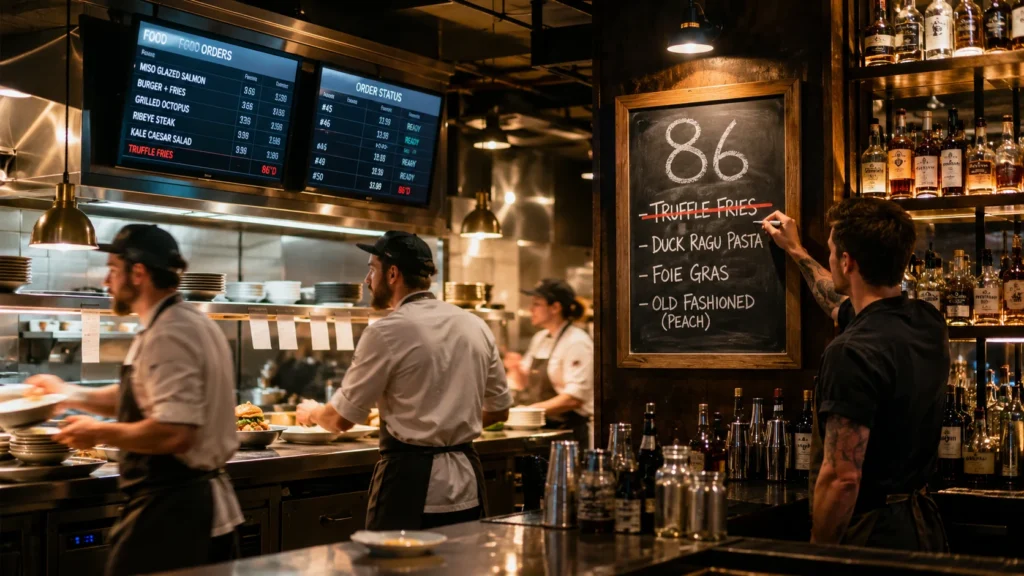
What does 86 mean? The term 86 means to remove, reject, refuse, cancel, get rid of, or deny something. In restaurants, it usually means an item is unavailable or out of stock. When referring to a person, being 86’d means being kicked out, banned, refused service, or removed from a location. The expression originated in American slang and later became common in restaurants, bars, hospitality businesses, and everyday conversations.
You’ve probably heard someone say:
“We’re 86 on the chicken special.”
Or maybe:
“That customer got 86’d from the bar.”
At first glance, the number 86 seems random. Unlike many slang expressions that clearly hint at their meaning, this one leaves most people scratching their heads.
Yet the phrase has become deeply rooted in American English. Restaurant staff use it daily. Bartenders rely on it during busy shifts. Managers use it when discussing inventory shortages. Outside the hospitality industry, people use it casually to mean canceling, removing, rejecting, or getting rid of something.
The fascinating part is that 86 doesn’t have just one meaning. Its meaning changes slightly depending on the situation.
In a restaurant kitchen, it may signal that a menu item has run out.
At a bar, it could mean a patron has been banned.
In casual conversation, someone might use it to mean scrapping an idea entirely.
Understanding how and why people use the term requires looking at its practical uses, industry applications, and cultural evolution.
What Is the Meaning of 86?

Define 86 in Simple Terms
The simplest 86 definition is:
To remove, reject, cancel, refuse, eliminate, or make unavailable.
Although the exact meaning varies by context, the core idea remains the same.
Something is being taken away, denied, discontinued, or removed from use.
Quick Reference Table of 86 Meaning
| Context | Meaning of 86 |
|---|---|
| Restaurant | Item is unavailable |
| Kitchen | Out of stock ingredient |
| Bar | Refuse service or remove customer |
| Hospitality | Remove from service |
| Business | Cancel or discontinue |
| Everyday Slang | Get rid of something |
| Social Media | Reject or remove |
| Person | Ban, eject, or exclude |
The common thread connecting every use is removal or denial.
What Does 86 Mean in a Restaurant?
Among all uses of the phrase, the restaurant industry popularized it more than any other field.
When people search for “what does 86 mean in a restaurant”, they’re usually referring to menu items.
86 Restaurant Meaning
In restaurant terminology, 86 means an item is no longer available.
The kitchen cannot prepare it because ingredients have run out or management has temporarily removed it from service.
For example:
- 86 salmon
- 86 cheesecake
- 86 onion rings
- 86 today’s soup special
The phrase allows staff members to communicate quickly without lengthy explanations.
Instead of saying:
“We have completely run out of salmon and can no longer serve it tonight.”
A chef simply says:
“86 salmon.”
Everyone immediately understands.
Why Restaurants Use the Term 86
Restaurants operate in fast-moving environments.
During lunch and dinner rushes, employees need short and efficient communication.
The term offers several advantages:
- Quick communication
- Fewer misunderstandings
- Faster kitchen operations
- Better inventory management
- Easier coordination between servers and cooks
A single phrase instantly informs the entire team.
That’s why the term survived decades of industry changes.
What Does 86 Menu Item Mean?
An 86 menu item refers to any dish that can no longer be sold.
Reasons may include:
- Inventory shortages
- Ingredient spoilage
- Equipment failures
- Temporary menu changes
- Product recalls
- Unexpected demand
For example:
| Menu Item | Reason for Being 86’d |
|---|---|
| Steak | Ran out of inventory |
| Cheesecake | Sold out |
| Wings | Supplier shortage |
| Fish Special | Fresh stock depleted |
| Milkshake | Ice cream unavailable |
When servers learn that a menu item has been 86’d, they stop offering it to customers.
How Chefs Use 86 in Kitchens
Professional kitchens depend on concise language.
A chef may call out:
“86 shrimp.”
Or:
“86 garlic bread until the next prep batch.”
The kitchen staff immediately adjusts production.
No discussion is needed.
This shorthand improves speed during busy service periods.
In many kitchens, the phrase appears on:
- Whiteboards
- Kitchen display systems
- Order screens
- Prep sheets
- Inventory lists
Because of its efficiency, 86 has become one of the most recognizable pieces of kitchen terminology.
Real Restaurant Examples of 86
Here are examples you might hear during a dinner shift:
Chef:
“We’re 86 on the lobster.”
Server:
“Got it. I’ll stop selling it.”
Kitchen Manager:
“86 the chocolate cake.”
Waiter:
“Understood.”
Line Cook:
“We’re almost out of fries.”
Chef:
“If they run out, 86 fries.”
These examples show how naturally the phrase fits into food service communication.
What Does 86 Mean in Food Service?
The meaning extends beyond restaurants.
The entire food service industry uses the expression.
86 in Food Service Operations
Food service businesses include:
- Restaurants
- Cafeterias
- Hotels
- Resorts
- Catering companies
- Stadium vendors
- Cruise ships
- Food trucks
Across all these operations, 86 generally means:
Unavailable, discontinued, removed, or no longer offered.
The phrase helps maintain consistency between departments.
For example:
A catering manager may tell staff:
“86 the seafood platter from today’s event menu.”
That instruction immediately affects ordering, preparation, and customer communication.
Inventory Management and the Meaning of 86
Inventory shortages happen every day.
Restaurants constantly track:
- Meat
- Produce
- Dairy
- Beverages
- Condiments
- Desserts
When stock reaches zero, employees often mark the item as 86.
This simple code helps prevent:
- Customer disappointment
- Ordering mistakes
- Waste
- Communication errors
As a result, the term remains valuable even in modern digital inventory systems.
What Does 86 Mean in Hospitality?
The hospitality industry adopted the term from restaurant culture.
Hotels, resorts, event venues, and entertainment facilities all use similar language.
86 in Hospitality Industry Terminology
In hospitality settings, 86 often means:
- Remove from service
- Discontinue temporarily
- Make unavailable
- Deny access
Examples include:
- 86 a room category
- 86 a service option
- 86 an event package
- 86 a maintenance area
The phrase continues to communicate the same underlying concept:
Something is no longer available.
Why Hospitality Workers Use the Phrase
Hospitality environments require rapid communication between departments.
Teams must coordinate:
- Front desk operations
- Food service
- Housekeeping
- Security
- Event management
A short expression like 86 saves time.
Instead of long explanations, staff can quickly communicate operational changes.
What Does 86 Mean in Bars?
Bars use the term differently than restaurants.
Although it can still refer to unavailable products, it often applies to people.
86 Meaning in Bars
At a bar, to 86 someone usually means:
- Refuse service
- Remove them from the premises
- Ban them temporarily
- Ban them permanently
This meaning became extremely common in nightlife settings.
For example:
“The bartender had to 86 that customer.”
This doesn’t mean the customer ran out.
It means the customer was removed or denied service.
Why Customers Get 86’d
Bars may 86 patrons for several reasons.
Common causes include:
- Intoxication
- Aggressive behavior
- Harassment
- Fighting
- Property damage
- Rule violations
- Threatening staff
Managers and bartenders use the phrase as a professional shorthand.
Instead of announcing:
“This person is no longer welcome here.”
They simply say:
“He’s been 86’d.”
Everyone understands.
What Does Getting 86’d Mean?
When someone asks:
“What does getting 86’d mean?”
The answer depends on the setting.
Most commonly, it means:
Being removed, banned, excluded, rejected, or denied service.
Examples:
- Getting kicked out of a bar
- Being banned from a restaurant
- Losing access to a venue
- Being removed from an event
The phrase carries a negative implication because it involves exclusion.
However, it doesn’t always imply wrongdoing.
In some situations, someone may be 86’d simply because a business chooses not to serve them.
Temporary vs Permanent 86
Not every 86 is permanent.
Some bans last:
- One night
- One week
- One month
Others remain indefinitely.
Here’s the difference:
| Type | Meaning |
|---|---|
| Temporary 86 | Short-term removal |
| Permanent 86 | Long-term ban |
| Service 86 | Refusal of service |
| Venue 86 | Removal from location |
Policies vary between establishments.
What Does It Mean to 86 Someone?
The phrase eventually expanded beyond bars and restaurants.
Today, many people use it casually.
86 Someone Meaning
To 86 someone generally means:
- Remove them
- Exclude them
- Reject them
- Get rid of them
- Cut them out
Examples:
“The company 86’d the old policy.”
“We should 86 that idea.”
“They 86’d him from the project.”
The exact meaning depends on context.
Yet the central idea remains removal.
Everyday Examples of Using 86
People often use 86 in informal speech.
Examples include:
- 86 the old plan.
- 86 that proposal.
- Let’s 86 the meeting.
- Management 86’d the project.
- They 86’d the outdated software.
In these examples, nobody is being kicked out.
Instead, something is being canceled or eliminated.
How the Meaning of 86 Expanded Beyond Restaurants
Many industry terms never leave the workplace.
The term 86 followed a different path.
Several factors helped it spread:
- Restaurant culture in popular media
- Movies and television
- Bartender slang
- Workplace jargon
- Everyday conversations
Over time, Americans began using the phrase in broader contexts.
Today, you can hear it in:
- Offices
- Schools
- Sports teams
- Social media
- Online forums
- Business meetings
The meaning remains surprisingly consistent despite its wider use.
Whenever someone says “86,” they usually mean one thing:
Remove it. Reject it. Get rid of it.
Where Did 86 Come From? The Origin of 86 Slang
The origin of 86 slang meaning feels a bit like a mystery that refuses to settle down. Ask ten people and you’ll hear ten different stories. Some sound believable. Others feel like urban legends passed around a diner counter at 2 a.m.
Still, a few theories stand out because they show up repeatedly in historical records, restaurant culture, and early slang dictionaries.
Let’s break them down in a clear, no-nonsense way.
The “Chumley’s Bar” Theory
One of the most popular explanations ties 86 meaning in slang to a famous New York bar called Chumley’s.
In this story, staff used “86” as shorthand for removing unruly patrons through the back exit located at 86 Bedford Street.
So when someone caused trouble, bartenders would say:
“He’s 86.”
Meaning the person would be escorted out the back door.
This explanation sounds neat. It connects a number to a physical location. It also fits how bar slang often evolves.
However, historians debate its accuracy. While Chumley’s did exist and did use coded language, solid evidence linking this exact origin remains limited.
The Restaurant Code Theory
Another strong explanation comes from early American diners and restaurants.
In busy kitchens, staff developed restaurant code words to speed up communication.
In this theory:
- “86” meant an item was out of stock
- “86 it” meant remove it from the order
- “We’re 86 on that” meant it was unavailable
This version feels practical. It matches how food service industry language works today.
Fast kitchens need fast communication. Long explanations slow everything down. So short numeric codes made sense.
Many industry veterans argue this is the most realistic origin because it still matches modern usage almost perfectly.
The Rhyming Slang and Journalism Theory
Another explanation connects 86 to early 20th-century journalism and printing culture.
Some workers believe “86” came from shorthand used in newspaper editing rooms where numbers represented instructions like:
- 30 = end of story
- 12 = delete
- 86 = throw it out
This theory suggests workplace slang terminology spread from journalism into food service.
It’s plausible but not strongly documented. Still, it shows how professional shorthand can migrate across industries.
The Military and Police Slang Theory
Some researchers point toward military slang meaning and police code culture.
In this version:
- “86” may have meant “to eliminate” or “cancel the mission”
- It could also refer to “denied access” or “removed from service”
Law enforcement sometimes uses numeric codes for quick communication, so this theory fits structurally.
However, official police code systems do not consistently list 86 with that meaning across departments.
So while it influences modern interpretations, it is not confirmed as the original source.
The Prohibition-Era Theory
During Prohibition, bars operated illegally in hidden ways.
Some historians suggest “86” emerged from speakeasy culture where staff used coded language to:
- Remove drunk customers
- Alert others to police presence
- Shut down service quickly
In this environment, saying something directly could be risky.
So coded slang like “86 him” would have helped workers communicate discreetly.
Again, this theory fits the culture but lacks definitive documentation.
Why Do People Say 86?
Even without a single confirmed origin, the phrase survived because it solved a real problem.
People use 86 slang meaning because it is:
- Fast
- Clear
- Flexible
- Easy to remember
- Useful in high-pressure environments
In restaurants, bars, and hospitality settings, speed matters more than formality.
Instead of long explanations, staff use one short code.
That efficiency alone explains why the term stuck around for decades.
What Does 86 Mean in Slang Today?
Modern usage has expanded far beyond kitchens and bars.
Today, what does 86 mean in slang usually depends on context, but it still revolves around removal or rejection.
Core Modern Meanings
- Remove something
- Cancel something
- Reject something
- Stop something
- Get rid of something
Example in casual speech
“Let’s 86 that plan.”
This means the idea is no longer useful or needed.
Social and Cultural Usage
On social media, people often use 86 in informal ways:
- “86 this drama”
- “86 the negativity”
- “86 that app update”
It carries a slightly sharp tone, but not always aggressive.
What Does 86 Mean in Text Messages?
In texting, 86 meaning in texting follows the same general idea.
People use it when they want to sound quick and decisive.
Text examples:
- “86 the meeting”
- “We 86’d the trip”
- “They 86’d my request”
- “Let’s 86 it and start over”
It works like shorthand for “cancel” or “remove.”
It’s especially common in group chats where people want fast decisions.
What Does 86 Mean at a Bar?
In nightlife settings, 86 meaning in bars becomes more serious.
Here, it usually refers to a person, not an item.
Bar usage:
- Refusing service
- Removing a guest
- Banning a customer
- Ejecting someone from the venue
Example:
“The bartender had to 86 him after the fight.”
This signals a safety or behavior issue.
Why Bars 86 People
Bars prioritize safety and legal compliance. A customer may get 86’d for:
- Fighting or aggression
- Excessive intoxication
- Harassing others
- Refusing to follow rules
- Damaging property
Staff use the term because it is discreet and professional.
It avoids confrontation while still communicating urgency.
What Does 86 Mean in Business?
Outside hospitality, 86 meaning in business often refers to eliminating something from operations.
Business usage:
- Cancel a project
- Remove a policy
- Stop a product line
- Discontinue a service
- Reject a proposal
Example:
“Management 86’d the old marketing strategy.”
This reflects a decision to move on quickly.
It works well in corporate slang because it is short and decisive.
What Does 86 Mean in Military Slang?
In military slang, interpretations vary by unit and context.
Common informal uses include:
- Cancel a mission
- Remove equipment
- Eliminate a target from consideration
- Discontinue an order
Example:
“Command 86’d the operation.”
However, it is important to note:
- It is not an official standardized military code
- It is more informal or conversational slang
Still, the meaning aligns with removal or cancellation.
What Does 86 Mean in Police Slang?
In police slang, usage also varies by region.
Common meanings include:
- Deny entry
- Remove a person from an area
- Refuse service or access
- Eject someone from a location
Example:
“We had to 86 him from the premises.”
It functions as shorthand during operations where quick communication matters.
Why the Meaning of 86 Stays Consistent
Even across industries, the meaning doesn’t drift too far.
That’s rare in slang.
Here’s why it stays stable:
- It always implies removal
- It always signals a decision
- It always communicates finality
- It is short and efficient
- It fits high-speed environments
So whether you hear it in a kitchen or office, the core idea remains the same:
Something is being cut out or shut down.
Evolution of 86 in Modern Language
Language changes fast, but 86 has held its ground.
It moved from:
- Restaurant shorthand
→ Bar slang
→ General slang
→ Internet usage
→ Workplace communication
Now it appears in everyday conversation without confusion.
People don’t even think about its origin anymore. They just understand it.
That’s what makes it powerful.
Real Examples of 86 in Everyday Sentences
Understanding what does 86 mean becomes much easier when you see it in real conversations. The term shifts slightly depending on tone and setting, but the core idea always stays the same: removal, rejection, or cancellation.
Here are practical examples you would actually hear or read.
Restaurant and Kitchen Examples
- “We just ran out of steak, so 86 it for tonight.”
- “Chef said to 86 the soup special after the lunch rush.”
- “We’re 86 on fries until the next delivery arrives.”
- “Can you 86 the dessert menu item? It’s not available anymore.”
In these cases, staff use 86 as a fast communication tool. Nobody wastes time explaining shortages during service.
Bar and Hospitality Examples
- “The bartender 86’d that customer for causing trouble.”
- “Security had to 86 a guest after repeated warnings.”
- “He got 86’d from the club last night.”
- “They 86 people who don’t follow the rules here.”
Here, the meaning becomes stricter. It signals removal or refusal of service.
Business and Workplace Examples
- “Management 86’d the outdated policy.”
- “They 86’d the entire project after budget cuts.”
- “We should 86 that idea and rethink the strategy.”
- “The company 86’d the old software system.”
In workplaces, it often means cancellation or elimination of something structural.
Casual and Internet Examples
- “Let’s 86 this drama.”
- “86 that app. It’s not worth it.”
- “They 86’d my suggestion in the group chat.”
- “We should 86 the whole plan and start over.”
Online, the term becomes flexible and conversational.
Table: How 86 Meaning Changes by Context
| Context | Meaning of 86 | Tone | Example |
|---|---|---|---|
| Restaurant | Item unavailable | Neutral | “86 the chicken special” |
| Kitchen | Out of stock | Operational | “86 burgers” |
| Bar | Remove customer | Strict | “He got 86’d” |
| Hospitality | Refuse service | Formal | “86 the guest” |
| Business | Cancel project | Strategic | “86 the proposal” |
| Text/Social | Stop or remove something | Casual | “86 that idea” |
Even though the tone shifts, the core meaning stays tightly connected.
Is 86 a Negative Term?
Yes, but only sometimes.
The meaning depends on what is being 86’d.
Neutral Uses
- “86 the item” (neutral operational update)
- “86 the dish” (simple inventory issue)
Negative Uses
- “He got 86’d from the bar”
- “She was 86’d from the venue”
When applied to people, it often carries a negative emotional weight because it implies rejection or exclusion.
What Does Getting 86’d Mean?
When someone asks what does getting 86’d mean, the answer is straightforward:
It means being removed, banned, or refused service.
Common Scenarios
- Kicked out of a bar or club
- Banned from a restaurant
- Removed from a venue or event
- Denied access to a service
Example in Real Life
Imagine someone causing a disturbance in a bar. After warnings fail, security steps in.
The manager might say:
“He’s 86’d. Don’t let him back in.”
That single phrase replaces a long explanation.
What Does 86 Mean in Texting and Social Media?
In modern digital communication, 86 meaning in texting has become more casual and flexible.
How People Use It Online
- To cancel plans
- To reject ideas
- To remove content
- To shut down negativity
Example Messages
- “86 the meeting, nobody’s free.”
- “86 this thread, it’s getting toxic.”
- “We 86’d the group project idea.”
- “Let’s 86 this and try something else.”
It works like a sharper version of “cancel” or “drop it.”
What Does 86 Mean in American Slang?
In American slang, 86 is part of a larger system of informal language used in workplaces and daily life.
Core Slang Meaning
- Remove
- Reject
- Get rid of
- Cancel
- Discard
Why Americans Use It
- It’s fast
- It’s efficient
- It sounds professional in work environments
- It avoids long explanations
It fits perfectly into service-based industries where communication speed matters.
Why Is It Called 86?
Even after decades, the exact origin remains debated.
However, most explanations agree on one thing:
It started as shorthand used in fast-paced work environments.
Whether it came from restaurants, bars, journalism, or Prohibition-era slang, the purpose stayed consistent.
It helped workers communicate quickly without confusion.
Cultural Impact of 86
The phrase didn’t stay locked inside kitchens or bars. It spread into everyday speech because it fills a useful gap in language.
Why It Spread
- Easy to remember
- Works in many contexts
- Sounds sharp and decisive
- Shows up in movies and TV
- Used by service workers everywhere
Modern Cultural Presence
Today, you’ll hear 86 in:
- Office meetings
- Group chats
- Social media posts
- Customer service conversations
- Pop culture references
It has become part of modern informal English.
Common Misunderstandings About 86
People often misinterpret the term because it looks like a random number.
Misunderstanding 1: It Has a Fixed Official Meaning
It doesn’t. Meaning depends on context.
Misunderstanding 2: It Always Refers to People
No. It often refers to items, plans, or ideas.
Misunderstanding 3: It Is New Slang
Actually, it has been around for decades in American English.
FAQs
What does 86 mean in slang?
It means to remove, reject, cancel, or get rid of something.
What does 86 mean in a restaurant?
It means a menu item is unavailable or out of stock.
What does 86 mean at a bar?
It means to remove or ban a customer from the venue.
What does it mean to 86 someone?
It means to exclude, eject, or refuse service to that person.
What does getting 86’d mean?
It means being banned or removed from a place or service.
What does 86 mean in texting?
It means to cancel or remove something in a conversation.
Where did 86 come from?
Its exact origin is unclear, but it likely started in American service industry slang.
Final Summary
At its core, what does 86 mean comes down to one simple idea:
Something is no longer allowed, available, or accepted.
It can describe:
- A missing menu item
- A canceled plan
- A rejected idea
- A removed customer
- A discontinued service
That flexibility is why it survived so long in American slang.
It adapts to kitchens, bars, offices, and online conversations without losing meaning.
Short. Sharp. Useful.
That’s why people still say it today.

Michael Anderson is a content writer specializing in word meanings, definitions and clear explanations of modern terms and phrases.