
Last Updated on June 13, 2026
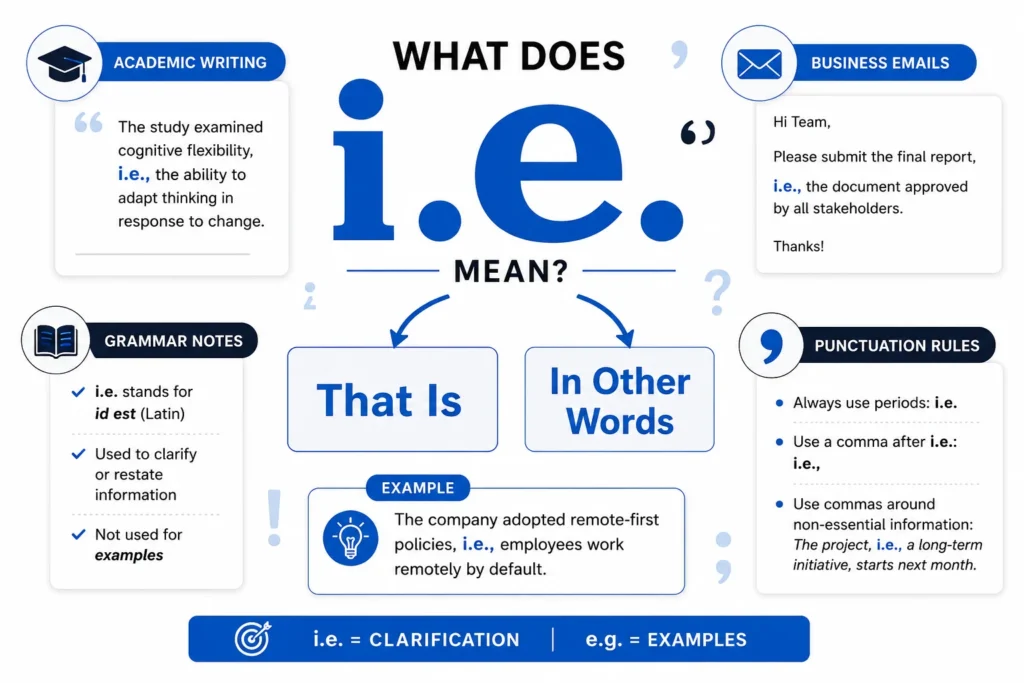
The abbreviation i.e. stands for the Latin phrase id est, which means “that is” or “in other words.” Writers use i.e. to clarify, restate, or explain a statement more precisely. Unlike e.g., which introduces examples, i.e. introduces an exact explanation. It is commonly used in academic writing, business communication, legal documents, and formal English.
If you’ve ever stopped in the middle of a sentence and wondered, “What does i.e. mean?”, you’re not alone.
Many people encounter this abbreviation in books, academic papers, emails, reports, and online articles. Although it appears frequently, it often causes confusion because many writers mistakenly use it interchangeably with another abbreviation: e.g.
The truth is that i.e. has a very specific meaning.
It isn’t used to provide examples.
It isn’t used to introduce a list of possibilities.
Instead, it serves one important purpose:
It clarifies exactly what the writer means.
Understanding this small abbreviation can dramatically improve your writing. It helps you communicate ideas with greater precision and avoid misunderstandings.
In simple terms:
i.e. = “that is”
or
i.e. = “in other words”
Whenever you want to restate something in a clearer or more specific way, i.e. is often the right choice.
Consider this sentence:
I prefer asynchronous communication, i.e., communication that does not require an immediate response.
The second part explains the first part. That’s the core function of i.e.
Once you understand this principle, the abbreviation becomes much easier to use correctly.
i.e. Meaning Explained in Plain English
Most grammar explanations make i.e. sound more complicated than it really is.
Let’s simplify it.
Imagine you’re talking to a friend.
You say something.
Then you immediately realize they may not fully understand what you mean.
So you add a quick clarification.
That’s exactly what i.e. does.
Example
The conference was postponed indefinitely, i.e., no new date has been scheduled.
Notice what happens here.
The phrase after i.e. doesn’t provide an example.
Instead, it explains precisely what “postponed indefinitely” means.
Here’s another example:
She practices minimalism, i.e., she owns only essential items.
Again, the second phrase clarifies the first one.
Think of i.e. as a bridge between an idea and its explanation.
Whenever readers might need extra clarity, i.e. steps in and removes ambiguity.
i.e. Full Form and Origin
Understanding the origin of i.e. makes it easier to remember.
The abbreviation comes from the Latin phrase:
id est
The translation is:
“that is”
or
“it is”
Over time, English writers adopted the abbreviation because it provides a concise way to clarify information.
Many commonly used English abbreviations have Latin origins.
Here are a few examples:
| Abbreviation | Latin Phrase | Meaning |
|---|---|---|
| i.e. | id est | that is |
| e.g. | exempli gratia | for example |
| etc. | et cetera | and so on |
| cf. | confer | compare |
| vs. | versus | against |
Although most people don’t speak Latin today, these abbreviations remain common in modern English.
Academic writing, legal writing, technical documentation, and business communication still rely on them heavily.
Why Writers Use i.e.
Strong writing values clarity.
Readers shouldn’t have to guess what a sentence means.
Whenever a statement could be interpreted in different ways, writers often use i.e. to narrow the meaning.
Benefits of Using i.e.
- Improves clarity
- Reduces ambiguity
- Prevents misunderstandings
- Makes technical writing easier to understand
- Helps define unfamiliar terms
- Improves precision
Consider this sentence:
Employees may work remotely, i.e., from a location outside the office.
Without the clarification, different readers might interpret “remote work” differently.
The phrase after i.e. eliminates that confusion.
This is why i.e. appears frequently in:
- Academic papers
- Research studies
- Business reports
- Contracts
- Policies
- Technical manuals
- Educational content
Whenever precision matters, i.e. becomes useful.
i.e. Meaning in Writing
In writing, every word serves a purpose.
The role of i.e. is straightforward:
It introduces an explanation that restates the preceding information more precisely.
Think of it as a zoom lens.
You start with a broader statement.
Then you zoom in to explain exactly what you mean.
Example
The company adopted a hybrid work model, i.e., employees split their time between home and the office.
The phrase after i.e. clarifies what “hybrid work model” means.
This distinction matters because not everyone may understand the term in the same way.
By using i.e., the writer removes uncertainty.
What Does i.e. Stand For in English?
One of the most searched questions online is:
What does i.e. stand for in English?
The answer remains the same:
i.e. stands for id est.
However, most native English speakers never translate the Latin phrase directly.
Instead, they mentally replace it with:
- that is
- in other words
- namely
- specifically
For example:
The package contains perishable goods, i.e., products that can spoil quickly.
You could rewrite the sentence as:
The package contains perishable goods, that is, products that can spoil quickly.
The meaning stays exactly the same.
This substitution technique is one of the easiest ways to determine whether you’re using i.e. correctly.
If “that is” fits naturally, i.e. probably works too.
Common Situations Where i.e. Appears
You probably encounter i.e. more often than you realize.
Here are the most common situations where writers use it.
Academic Writing
Researchers frequently use i.e. when defining terms.
Example:
The study focused on adolescents, i.e., individuals between the ages of 13 and 19.
Academic writing values precision above almost everything else.
As a result, i.e. appears frequently in journals, textbooks, and scholarly articles.
Business Communication
Professionals often use i.e. to clarify expectations.
Example:
All expense reports must be submitted immediately, i.e., within 24 hours of travel completion.
This reduces confusion and improves compliance.
Technical Documentation
Technical writers rely heavily on precise language.
Example:
Install the software locally, i.e., on the device itself rather than a remote server.
Technical documents often contain specialized terminology.
Using i.e. helps explain those terms quickly.
Legal Documents
Legal writing must eliminate ambiguity.
Example:
The tenant shall maintain common areas, i.e., hallways, entrances, and shared facilities.
Because legal disputes often arise from unclear wording, precision becomes critical.
That’s one reason legal professionals frequently use i.e.
Educational Content
Teachers and instructors use i.e. to explain concepts.
Example:
Photosynthesis requires chlorophyll, i.e., the pigment that gives plants their green color.
This helps students understand unfamiliar terms without interrupting the flow of the lesson.
Quick Test: Are You Using i.e. Correctly?
Ask yourself this simple question:
If you’re explaining the idea, use i.e.
If you’re providing examples, use e.g.
Correct
The company adopted a four-day workweek, i.e., employees now work four days instead of five.
Explanation provided.
Incorrect
The company offers several benefits, i.e., health insurance and retirement plans.
These are examples, not explanations.
The correct abbreviation would be e.g.
This distinction may seem small, but it significantly affects writing accuracy.
Why So Many People Misunderstand i.e.
The confusion usually comes from one source:
People often see i.e. and e.g. used in similar positions within sentences.
Because both abbreviations introduce additional information, many assume they mean the same thing.
They don’t.
One explains.
One exemplifies.
That’s the entire difference.
Unfortunately, many websites, emails, and social media posts misuse these abbreviations, which spreads the confusion further.
Learning the distinction immediately improves your grammar and makes your writing appear more polished and professional.
i.e. vs e.g. Understanding the Difference Once and for All
If there is one grammar mistake that appears everywhere, it is the confusion between i.e. and e.g.
Even experienced writers occasionally use the wrong abbreviation.
The reason is simple. Both abbreviations introduce extra information. At first glance, they seem interchangeable.
They are not.
Understanding the difference is essential if you want your writing to appear professional, accurate, and polished.
The Simplest Explanation
Think of it this way:
- i.e. = that is
- e.g. = for example
That’s the easiest rule to remember.
When you use i.e., you’re explaining exactly what something means.
When you use e.g., you’re providing examples of something.
Comparison Table
| Abbreviation | Full Form | Meaning | Purpose |
|---|---|---|---|
| i.e. | id est | that is | Clarification |
| e.g. | exempli gratia | for example | Examples |
Example Using i.e.
She specializes in pediatric medicine, i.e., healthcare for children.
The phrase after i.e. defines and clarifies pediatric medicine.
Example Using e.g.
She specializes in several medical fields, e.g., pediatrics and dermatology.
The phrase after e.g. provides examples.
Notice the difference.
One narrows meaning.
The other broadens meaning.
Side-by-Side Examples
Correct Use of i.e.
The project is delayed indefinitely, i.e., no completion date exists.
Correct Use of e.g.
The project faces several challenges, e.g., staffing shortages and budget constraints.
Common Errors
Incorrect
I enjoy outdoor activities, i.e., hiking and kayaking.
This is incorrect because hiking and kayaking are examples.
Correct
I enjoy outdoor activities, e.g., hiking and kayaking.
Incorrect
The software is incompatible, e.g., it cannot run on this operating system.
This explains incompatibility rather than providing examples.
Correct
The software is incompatible, i.e., it cannot run on this operating system.
A Simple Memory Trick
Many writers use these memory devices:
For i.e.
Think:
“In Essence”
While not the actual Latin meaning, it helps you remember that i.e. explains the essence of something.
For e.g.
Think:
“Example Given”
Again, this is not the literal translation, but it helps reinforce proper usage.
These memory shortcuts have helped countless students and professionals avoid confusion.
How to Use i.e. Correctly in a Sentence
Using i.e. correctly becomes easy once you understand its purpose.
The abbreviation generally appears immediately after a statement that needs clarification.
Basic Structure
Main statement + i.e. + explanation
Example
The company adopted a decentralized structure, i.e., decision-making occurs across multiple departments.
The explanation follows directly after the statement.
Readers immediately understand what the writer means.
Pattern One: Clarifying a Term
Many writers use i.e. to explain specialized vocabulary.
Example
The patient exhibited tachycardia, i.e., an unusually rapid heart rate.
Medical professionals use this structure frequently.
The same pattern appears in science, technology, law, and education.
Pattern Two: Clarifying a Process
Example
The files were archived, i.e., moved into long-term storage.
Here, the writer explains what “archived” means in practical terms.
Pattern Three: Clarifying a Category
Example
The event targets young professionals, i.e., individuals between 22 and 35 years old.
The explanation defines the category more precisely.
Pattern Four: Clarifying a Requirement
Example
Applicants must provide identification, i.e., a government-issued photo ID.
The requirement becomes clearer because the writer specifies exactly what qualifies.
i.e. Meaning in Formal Writing
Formal writing depends on clarity and precision.
For that reason, i.e. appears frequently in:
- Academic papers
- Legal contracts
- Government reports
- Research publications
- Corporate documents
- Policy manuals
Writers in these fields often deal with complex information.
A small misunderstanding can create significant problems.
That’s why i.e. remains a valuable writing tool.
Example from Formal Writing
The survey targeted urban residents, i.e., individuals living within designated metropolitan areas.
The explanation prevents readers from interpreting “urban residents” differently.
Why Formal Writers Prefer i.e.
Formal writers value:
- Accuracy
- Precision
- Consistency
- Clarity
The abbreviation supports all four goals.
Instead of creating a lengthy explanation, a writer can clarify a statement quickly and efficiently.
i.e. Meaning in Academic Writing
Academic writing often introduces specialized terminology.
Students, researchers, and professors frequently rely on i.e. to define concepts.
Example
The study examined cognitive flexibility, i.e., the ability to adapt thinking in response to changing circumstances.
Without clarification, some readers might interpret the term differently.
The explanation ensures everyone understands the concept in the same way.
Common Academic Uses
Researchers often use i.e. when:
- Defining variables
- Explaining terminology
- Clarifying methodology
- Describing participant groups
- Explaining research findings
Example
Participants completed the intervention remotely, i.e., from their homes rather than a laboratory setting.
This type of sentence appears frequently in scholarly literature.
Why Academics Value Precision
Academic communication aims to reduce ambiguity.
Researchers need readers around the world to interpret findings consistently.
Even small misunderstandings can affect how research gets applied or cited.
As a result, abbreviations like i.e. remain important in academic writing.
i.e. Meaning in Business Communication
Business communication often involves instructions, deadlines, policies, and expectations.
Ambiguous language can create costly misunderstandings.
That’s why professionals frequently use i.e.
Example
The report requires immediate attention, i.e., completion before close of business today.
The clarification leaves no room for confusion.
Common Business Applications
Emails
Please provide supporting documentation, i.e., invoices and payment receipts.
Internal Policies
Employees must follow security procedures, i.e., multi-factor authentication requirements.
Project Management
The milestone has been completed, i.e., all deliverables have been approved.
Human Resources
Benefits become available after probation, i.e., after 90 days of employment.
Benefits in Professional Communication
Using i.e. correctly can:
- Improve understanding
- Reduce mistakes
- Minimize follow-up questions
- Increase efficiency
- Clarify expectations
When everyone interprets instructions the same way, operations run more smoothly.
i.e. Meaning in Emails
Emails often contain instructions that need clarification.
This makes i.e. particularly useful.
Example
Please submit the finalized version, i.e., the document containing all approved revisions.
The recipient immediately understands what version is required.
More Email Examples
We need immediate feedback, i.e., responses before noon.
Please use secure credentials, i.e., passwords that meet company requirements.
Schedule the meeting with decision-makers, i.e., department heads and executives.
Each example reduces uncertainty.
Should You Use i.e. in Every Email?
Not necessarily.
Sometimes plain English sounds more natural.
Compare these examples:
Formal
Please submit the final draft, i.e., the version approved by management.
Simpler
Please submit the version approved by management.
The second sentence is often easier to read.
Good writers use i.e. when it adds clarity, not merely because it sounds formal.
i.e. Meaning in Text Messages
Many people wonder:
What does i.e. mean in text messages?
The answer remains exactly the same.
It still means:
- that is
- in other words
Example
I’m taking a digital detox, i.e., staying off social media for a few days.
Another Example
Today is recovery day, i.e., no gym workout.
Although texting tends to be casual, some people still use i.e. when they want to be precise.
However, most texters prefer simpler alternatives such as:
- in other words
- basically
- meaning
- I mean
For example:
I’m taking a digital detox, meaning no social media for a few days.
This sounds more conversational while delivering the same message.
i.e. Meaning in Everyday English
Outside formal writing, i.e. still appears regularly.
You’ll find it in:
- Newspapers
- Magazines
- Blog articles
- Educational content
- Professional websites
- Instructional materials
The purpose never changes.
It always introduces clarification.
Everyday Examples
We moved to a rural area, i.e., a location far from major cities.
The machine requires maintenance, i.e., routine servicing to ensure proper operation.
The package contains fragile items, i.e., products that can break easily.
Notice how each sentence becomes clearer because of the explanation.
That’s exactly why i.e. continues to survive in modern English despite being a Latin abbreviation centuries old.
Quick Rule to Remember Forever
If you can replace i.e. with:
“that is”
or
“in other words”
and the sentence still makes sense, you’ve probably used it correctly.
Example
The meeting was postponed indefinitely, i.e., no future date has been announced.
Replace it:
The meeting was postponed indefinitely, that is, no future date has been announced.
The meaning remains unchanged.
That’s a strong sign the abbreviation is being used correctly.
i.e. Punctuation Rules Every Writer Should Know
Understanding i.e. punctuation rules is just as important as understanding its meaning.
Many writers know what i.e. means but still make punctuation mistakes. These errors can make otherwise professional writing look careless.
The good news is that the rules are straightforward.
Once you learn them, you’ll be able to use i.e. confidently in any situation.
Always Include the Periods
The abbreviation comes from two Latin words:
- id
- est
Because it is an abbreviation, each letter traditionally takes a period.
Correct:
i.e.
Incorrect:
ie
While some informal messages omit the periods, standard English writing generally keeps them.
Use a Comma After i.e.
In American English, a comma typically follows i.e.
Correct:
The proposal was rejected, i.e., it did not receive approval.
Incorrect:
The proposal was rejected, i.e. it did not receive approval.
The comma signals that a clarification follows.
Many professional style guides recommend this format because it improves readability.
Use Commas Around Parenthetical Information
Often, i.e. introduces information that interrupts the flow of a sentence.
When that happens, commas help separate the explanatory phrase.
Example:
The conference, i.e., the annual leadership summit, was postponed.
The commas show that the phrase is explanatory rather than essential.
Using i.e. Inside Parentheses
Many writers place i.e. inside parentheses.
This approach works especially well when the clarification is secondary information.
Example:
The company expanded into new markets (i.e., regions where it previously had no operations).
Parentheses help keep the sentence concise while still providing context.
Using i.e. in Lists
Although possible, using i.e. inside lists often creates awkward wording.
Consider this example:
Less Effective
Required items:
- Identification
- Proof of address
- Supporting documents, i.e., bank statements
A clearer version would simply specify the required documents directly.
Good writing values simplicity.
If i.e. makes a sentence harder to read, rewrite the sentence.
i.e. Grammar Rules Explained
Many people search for i.e. meaning in grammar because they want to understand where the abbreviation fits within sentence structure.
Interestingly, i.e. isn’t a grammatical component like a noun or verb.
Instead, it functions as a clarifying abbreviation.
Its job is to connect an idea with a more precise explanation.
Rule: Clarification Must Match the Original Statement
The explanation after i.e. should accurately reflect the statement before it.
Correct
The workshop focuses on cybersecurity, i.e., protecting systems and data from digital threats.
The clarification matches the original concept.
Incorrect
The workshop focuses on cybersecurity, i.e., accounting software.
The explanation does not logically relate to the original statement.
Rule: The Explanation Should Narrow Meaning
The information after i.e. should become more specific.
Think of the sentence as moving from broad to narrow.
Example
The company adopted sustainable practices, i.e., methods that reduce environmental impact.
The explanation narrows the broader concept of sustainability.
Rule: Avoid Redundancy
Many writers accidentally repeat the exact same information.
Weak Example
The event was canceled, i.e., the event was canceled.
This adds nothing.
Better Example
The event was canceled, i.e., attendees will not need to travel.
The clarification provides useful context.
Common Mistakes People Make with i.e.
Even experienced writers occasionally misuse i.e.
Let’s examine the most common mistakes.
Confusing i.e. and e.g.
This remains the biggest error.
Incorrect
I enjoy winter sports, i.e., skiing and snowboarding.
Skiing and snowboarding are examples.
Correct
I enjoy winter sports, e.g., skiing and snowboarding.
Overusing i.e.
Some writers insert i.e. into nearly every paragraph.
This creates repetitive, mechanical writing.
Overused
The project succeeded, i.e., it met objectives. The team performed well, i.e., productivity increased. Customer satisfaction improved, i.e., complaints decreased.
The repetition quickly becomes distracting.
Good writing varies sentence structure.
Using i.e. in Casual Conversation
Technically, there’s nothing wrong with using i.e. in casual contexts.
However, it can sound overly formal.
Instead of:
I’m staying in tonight, i.e., not going anywhere.
Many people would simply write:
I’m staying in tonight. In other words, I’m not going anywhere.
The second version feels more natural.
Forgetting the Clarification
Sometimes writers use i.e. without actually clarifying anything.
Weak Example
The project requires optimization, i.e., optimization.
This provides no new information.
Every clarification should help the reader understand something more clearly.
When Should You Use i.e.?
One of the most common questions is:
When should you use i.e.?
The answer is simple.
Use it whenever readers might benefit from a more precise explanation.
Use i.e. When Defining Terms
Example
The company uses SaaS software, i.e., applications delivered through the internet.
Not everyone understands technical terminology.
A brief explanation improves accessibility.
Use i.e. When Clarifying Policies
Example
Employees must maintain confidentiality, i.e., they may not share proprietary information.
Policies often require precise wording.
Use i.e. When Explaining Industry Jargon
Many industries use specialized language.
Example
The patient experienced arrhythmia, i.e., an irregular heartbeat.
The explanation helps non-experts understand the term.
Use i.e. When Eliminating Ambiguity
Ambiguous language can create misunderstandings.
Example
The agreement terminates automatically, i.e., no further action is required.
The clarification removes uncertainty.
When You Should NOT Use i.e.
Knowing when not to use i.e. is equally important.
Sometimes a sentence works better without it.
Don’t Use It for Examples
Remember:
- i.e. explains
- e.g. exemplifies
Incorrect
Popular streaming services include i.e., Netflix and Hulu.
Correct
Popular streaming services include e.g., Netflix and Hulu.
Don’t Use It to Sound Smarter
Some writers insert Latin abbreviations to appear more sophisticated.
This usually backfires.
Clear communication matters more than complicated wording.
Don’t Use It When Plain English Works Better
Compare these sentences.
Version One
The device requires calibration, i.e., adjustment to ensure accuracy.
Version Two
The device requires calibration, or adjustment to ensure accuracy.
Both are correct.
Sometimes the second version reads more naturally.
Advanced i.e. Examples in Professional Writing
Understanding advanced usage helps you write with confidence.
Scientific Writing Example
The experiment measured osmotic pressure, i.e., the force required to prevent solvent movement across a membrane.
Scientific writing often relies on precise definitions.
Technology Example
The system uses edge computing, i.e., processing data closer to where it is generated.
Technology topics frequently involve unfamiliar terminology.
Finance Example
The company improved liquidity, i.e., its ability to meet short-term obligations.
Financial documents often use i.e. to explain technical concepts.
Healthcare Example
The treatment targets inflammation, i.e., the body’s response to injury or infection.
Healthcare communication benefits greatly from clear explanations.
Education Example
Students demonstrated metacognition, i.e., awareness of their own thinking processes.
Educational content often introduces specialized concepts that require clarification.
Professional Writing Tips for Using i.e.
Strong writers don’t use i.e. automatically.
They use it strategically.
Prioritize Clarity
Always ask:
Will this explanation help the reader?
If the answer is yes, i.e. may be appropriate.
Keep Explanations Brief
The clarification should usually be concise.
Strong Example
The system operates autonomously, i.e., without human intervention.
The explanation is direct and easy to understand.
Avoid Repetition
Repeated use of i.e. can weaken writing rhythm.
Instead, alternate with phrases such as:
- in other words
- specifically
- namely
- that is
- meaning
- put differently
This creates greater variety and improves readability.
Consider Your Audience
Technical audiences may appreciate abbreviations like i.e.
General audiences often prefer simpler language.
For example:
Technical Audience
The application uses containerization, i.e., packaging software with its dependencies.
General Audience
The application packages software together with everything it needs to run.
Both communicate the same idea.
The best choice depends on who is reading.
Quick Reference Table
| Question | Answer |
|---|---|
| What does i.e. mean? | That is; in other words |
| What does i.e. stand for? | Id est |
| Is i.e. used for examples? | No |
| Which abbreviation is used for examples? | e.g. |
| Should i.e. have periods? | Yes |
| Should a comma follow i.e.? | Yes in standard US English |
| Is i.e. formal? | Mostly formal and professional |
| Can i.e. be used in emails? | Yes |
| Can i.e. appear in academic writing? | Yes |
| Does i.e. clarify meaning? | Yes |
By mastering these grammar and punctuation rules, you’ll avoid one of the most common writing mistakes in English and communicate your ideas with greater accuracy and confidence.
Extensive i.e. Examples in Real-World Writing
The fastest way to master i.e. meaning and usage is to see it in action.
Once you understand how professional writers use i.e., you’ll begin recognizing the pattern everywhere.
Remember the core rule:
The information after i.e. explains or clarifies what came before it.
Let’s look at examples from different situations.
Everyday Conversation Examples
Although i.e. appears more often in formal writing, it still shows up in everyday communication.
Examples:
- I’m taking a staycation, i.e., a vacation spent at home.
- He’s an early riser, i.e., someone who wakes up before sunrise.
- We’re downsizing, i.e., moving into a smaller house.
- She follows a vegetarian diet, i.e., she does not eat meat.
Each example restates the original idea in clearer terms.
Examples for Students
Students frequently encounter i.e. in textbooks and assignments.
Examples:
- The essay requires primary sources, i.e., original documents created during the period being studied.
- The experiment used a control group, i.e., participants who did not receive the treatment.
- The professor emphasized critical thinking, i.e., analyzing information rather than memorizing facts.
- The assignment focuses on symbolism, i.e., the use of objects or images to represent deeper meanings.
Examples in Academic Papers
Academic writing relies heavily on precision.
Examples:
- The sample consisted of adolescents, i.e., individuals between 13 and 19 years old.
- The study examined bilingual participants, i.e., individuals fluent in two languages.
- Researchers evaluated cognitive performance, i.e., memory, attention, and reasoning ability.
- Data were collected longitudinally, i.e., over an extended period rather than at a single point in time.
Examples in Business Writing
Business professionals often use i.e. to avoid ambiguity.
Examples:
- Employees must complete onboarding requirements, i.e., all mandatory training modules.
- The budget requires optimization, i.e., reducing unnecessary expenses.
- The company adopted remote-first policies, i.e., employees work remotely by default.
- Managers must approve expenditures, i.e., any purchase exceeding authorized limits.
Examples in Emails
Emails often require precise instructions.
Examples:
- Please submit the final version, i.e., the document approved by all stakeholders.
- We need immediate feedback, i.e., responses before 5 p.m.
- The meeting includes decision-makers, i.e., department directors and senior executives.
- Please update the shared file, i.e., the master document stored in the project folder.
Examples in Technical Writing
Technical documentation frequently uses i.e. to explain specialized concepts.
Examples:
- The software uses encryption, i.e., converting data into a coded format.
- The application supports virtualization, i.e., running multiple operating systems on one machine.
- The database uses indexing, i.e., structures that improve search performance.
- The network requires redundancy, i.e., backup systems that prevent downtime.
Alternatives to i.e.
While i.e. is useful, you don’t have to use it constantly.
In many situations, alternative phrases sound more natural.
Common Alternatives
- that is
- in other words
- specifically
- namely
- meaning
- to put it differently
- put another way
- more precisely
- to clarify
- stated differently
Example Comparisons
Using i.e.
The team adopted agile methodology, i.e., a flexible approach to project management.
Using “in other words”
The team adopted agile methodology. In other words, they use a flexible approach to project management.
Using “specifically”
The company targets enterprise customers, specifically large organizations with complex operational needs.
Using “to clarify”
The deadline has been extended. To clarify, submissions are now due next Friday.
These alternatives create variety and improve readability.
Professional writers often alternate between them instead of repeating i.e. throughout an article.
Other Meanings of IE
Most people searching “what does ie mean” are asking about the abbreviation i.e. (id est).
However, the letters “IE” can represent other terms depending on context.
This is a classic example of lexical ambiguity.
The meaning changes based on the subject being discussed.
Internet Explorer (IE)
For many years, IE commonly referred to Internet Explorer.
Internet Explorer was a web browser developed by Microsoft.
Example:
The legacy application only works in IE.
In this context, IE refers to the browser rather than the Latin abbreviation.
Ireland Country Code (IE)
IE is also the international country code for the country of Ireland.
Examples include:
- Website domains ending in .ie
- International shipping labels
- ISO country codes
Industrial Engineering (IE)
In education and engineering fields, IE often means Industrial Engineering.
Example:
She earned a degree in IE and now works in manufacturing optimization.
Information Engineering (IE)
Technology and computing programs sometimes use IE as shorthand for Information Engineering.
Why Context Matters
Language relies heavily on context.
Consider these sentences:
- I studied IE at university.
- The website only works in IE.
- The package is being shipped to IE.
- The article uses i.e. several times.
Each sentence uses the same letters.
Each means something completely different.
This is why context remains one of the most important principles in communication.
Expert Tips for Using i.e. Like a Professional Writer
Small details often separate average writing from excellent writing.
These tips can help you use i.e. more effectively.
Focus on Reader Understanding
Always prioritize clarity.
Ask yourself:
Will this explanation make the sentence easier to understand?
If yes, i.e. may be appropriate.
Avoid Using i.e. Excessively
Too many abbreviations can make writing feel dense.
Mix in alternative phrases when possible.
Keep Clarifications Concise
The explanation after i.e. should usually be brief.
Readers appreciate concise communication.
Use It Where Precision Matters
The best places for i.e. include:
- Definitions
- Policies
- Instructions
- Technical explanations
- Academic discussions
- Business communication
Read the Sentence Aloud
A simple test works surprisingly well.
Replace i.e. with:
“that is”
or
“in other words”
If the sentence still sounds natural, your usage is likely correct.
Quick Summary Table
| Topic | Key Takeaway |
|---|---|
| i.e. meaning | That is; in other words |
| i.e. full form | Id est |
| Language origin | Latin |
| Primary purpose | Clarification |
| Used for examples? | No |
| Alternative abbreviation for examples | e.g. |
| Common writing contexts | Academic, business, legal, technical |
| Standard punctuation | i.e., |
| Formality level | Mostly formal |
| Main benefit | Improves clarity |
Frequently Asked Questions
What Does i.e. Stand For?
i.e. stands for id est, a Latin phrase meaning “that is” or “in other words.”
What Is the Meaning of i.e.?
The meaning of i.e. is:
“that is”
or
“in other words”
Writers use it to clarify or restate information.
Is i.e. an Acronym?
No.
It is an abbreviation.
An acronym forms a pronounceable word from initial letters.
Examples include:
- NASA
- UNESCO
- NATO
By contrast, i.e. is a shortened form of a Latin phrase.
Is i.e. Formal or Informal?
It is generally considered formal.
You’ll frequently find it in:
- Academic papers
- Research articles
- Business reports
- Professional emails
- Legal documents
However, it can also appear in informal writing when clarity is needed.
Can I Use i.e. in an Email?
Yes.
Professional emails often use i.e. to clarify instructions or expectations.
Example:
Please submit supporting documentation, i.e., receipts and invoices.
Can I Use i.e. in Essays?
Absolutely.
Many academic style guides permit and encourage i.e. when it improves clarity.
Should i.e. Be Italicized?
Generally, no.
Modern English style guides treat i.e. as a standard abbreviation.
Italic formatting is usually unnecessary.
Should I Use Capital Letters?
Typically, no.
Standard usage is:
i.e.
Not:
I.E.
Can I Start a Sentence with i.e.?
Although possible, it is usually awkward.
Instead, rewrite the sentence.
Less Natural
i.e., the proposal was rejected due to budget concerns.
Better
In other words, the proposal was rejected due to budget concerns.
Is i.e. Still Relevant Today?
Yes.
Despite its ancient Latin origins, i.e. remains one of the most widely used abbreviations in English writing.
Professionals across industries still rely on it because it communicates clarification efficiently.
Final Thoughts
Understanding what does i.e. mean is simpler than many people think.
At its heart, i.e. serves one purpose:
It helps writers explain exactly what they mean.
The abbreviation comes from the Latin phrase id est, which translates to “that is” or “in other words.” Whenever you need to clarify a statement, define a term, or narrow the meaning of an idea, i.e. can help.
The most important rule to remember is the distinction between i.e. and e.g.
- i.e. explains
- e.g. provides examples
Master that difference and you’ll avoid one of the most common mistakes in English writing.
Whether you’re drafting an academic paper, composing a business email, creating technical documentation, or simply improving your grammar skills, understanding i.e. meaning, i.e. grammar rules, and i.e. usage will make your communication clearer, more precise, and more professional.
The next time you encounter i.e. in a sentence, you’ll know exactly what it means and more importantly, you’ll know how to use it correctly yourself.

Sophia Bennett is a professional writer focused on explaining word meanings, expressions and everyday language in a simple and engaging way.