Last Updated on June 15, 2026
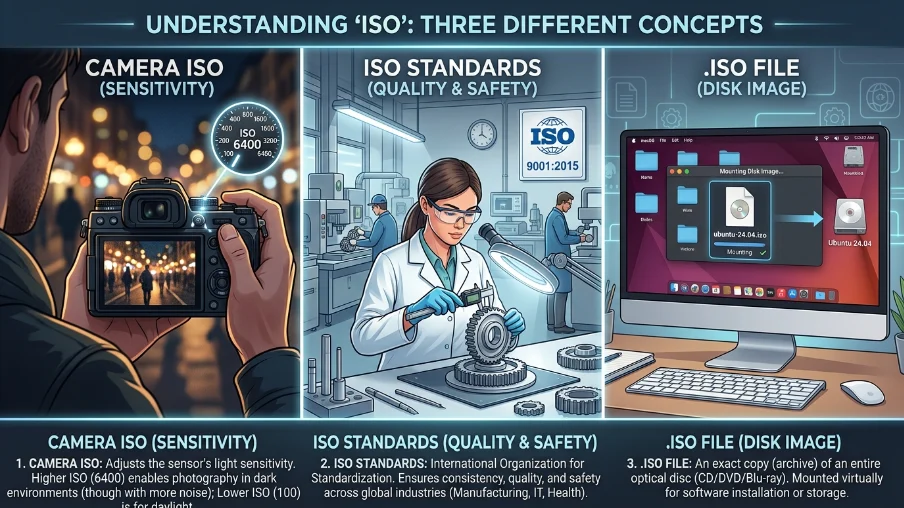
ISO is an abbreviation with multiple meanings depending on context. In photography, ISO refers to a camera setting that controls light sensitivity. In business and manufacturing, ISO stands for the International Organization for Standardization, which creates global quality and safety standards like ISO 9001. In computing, ISO refers to a disk image file format used to store exact copies of CDs or DVDs. The meaning depends entirely on the industry or situation, making ISO a highly context-dependent term.
Why ISO Confuses So Many People
You search for “ISO meaning” and suddenly you get three different answers. One talks about cameras. Another mentions business certification. A third refers to computer files. It feels messy at first, but there’s a simple reason for it.
ISO is not a single concept. It’s a shared abbreviation used across completely different fields.
Once you understand the context, everything clicks into place. You stop guessing and start recognizing what people actually mean when they say ISO.
Let’s break it down in a clear, practical way so you never feel confused again.
ISO Meaning Explained in Simple Terms
ISO has three major meanings that dominate most real-world usage:
- Photography: Camera sensitivity to light
- Business & manufacturing: Global quality and safety standards
- Computing: Disk image file format (.iso)
Each meaning operates independently. They don’t overlap technically, but they often confuse beginners because they share the same name.
Think of ISO like the word “bank.” It can mean a financial institution or the side of a river. Context decides everything.
ISO in Photography: What It Really Means
When someone says “increase your ISO,” they are talking about your camera settings.
ISO controls how sensitive your camera sensor is to light.
In simple terms:
- Low ISO = less light sensitivity, cleaner image
- High ISO = more light sensitivity, brighter image but more noise
It is one of the three pillars of photography exposure, along with shutter speed and aperture.
ISO and the Exposure Triangle
Photography exposure depends on three elements:
- Aperture: Controls light entering through the lens
- Shutter Speed: Controls how long light hits the sensor
- ISO: Controls sensitivity to that light
You can think of ISO as the “boost button.” It doesn’t add light physically. Instead, it amplifies the signal your camera captures.
Here’s a simple analogy:
Imagine whispering in a quiet room.
- Low ISO is like hearing the whisper clearly in silence
- High ISO is like turning up the volume on a recording of that whisper
The louder you amplify, the more background noise you hear.
Common ISO Values in Cameras
Most cameras use standard ISO increments.
| ISO Value | Lighting Condition | Image Quality |
|---|---|---|
| 100 | Bright sunlight | Very clean, sharp |
| 200–400 | Daylight / indoors | Clean |
| 800 | Indoor lighting | Slight noise |
| 1600 | Low light | Noticeable noise |
| 3200+ | Night / dark scenes | Heavy noise |
The pattern is simple: as ISO increases, brightness increases but image quality decreases.
How ISO Affects Image Quality
ISO doesn’t just brighten an image. It changes how the camera processes light.
When ISO is too high:
- Grain or “noise” appears in photos
- Colors may look less accurate
- Fine details can get softened
When ISO is too low:
- Image stays clean and sharp
- But photos may appear too dark in low light
The trick is balance. Good photographers don’t chase high ISO. They use it only when necessary.
Real-Life Example of ISO in Photography
Imagine you’re at a concert.
The lighting is dark, but you want to capture the moment.
You have two options:
- Keep ISO low → image is dark but clean
- Increase ISO → image is bright enough but slightly grainy
Most photographers choose the second option because capturing the moment matters more than perfection.
That’s ISO in action. It’s a trade-off tool, not a magic fix.
ISO in Cameras: Practical Tips for Beginners
If you’re just starting out, these rules help a lot:
- Use ISO 100–200 in daylight
- Use ISO 400–800 indoors
- Use ISO 1600+ only when necessary
- Always try lowering ISO first before raising it
A good habit is to think:
“Can I fix this with light or shutter speed first?”
ISO should be your last adjustment, not your first.
ISO in Photography vs Film Photography History
ISO replaced older film speed ratings.
Before digital cameras:
- Film had “ASA” or “DIN” ratings
- Higher numbers meant more sensitivity to light
ISO unified those systems into one global standard for consistency.
That’s why photographers still use ISO today—it’s a legacy system that carried into digital photography.
ISO in Business: International Organization for Standardization
Now let’s shift completely.
In business, ISO stands for the International Organization for Standardization.
This is a global body that develops standards to ensure quality, safety, and efficiency across industries.
What ISO Standards Actually Do
ISO standards create rules for:
- Product quality
- Manufacturing processes
- Safety systems
- Environmental practices
- Information security
They don’t enforce laws, but companies follow them to prove reliability.
Common ISO Standards You Should Know
Here are some widely used ISO standards:
| ISO Standard | Purpose |
|---|---|
| ISO 9001 | Quality management systems |
| ISO 14001 | Environmental management |
| ISO 27001 | Information security |
| ISO 45001 | Occupational health & safety |
These standards help companies operate consistently and safely across countries.
What ISO Certification Means for a Company
When a company says it is ISO certified, it means:
- It meets international quality standards
- Its processes are audited regularly
- It follows documented procedures
- It aims for consistent output
For customers, this builds trust.
For businesses, it improves reputation and efficiency.
Why ISO Standards Matter in Real Life
You may not notice ISO directly, but it affects everyday life.
For example:
- Food packaging safety
- Medical equipment reliability
- Software security systems
- Manufacturing consistency
Without ISO standards, global trade would be chaotic and inconsistent.
ISO in Computing: What Is an ISO File?
Now let’s move into technology.
An ISO file is a complete digital copy of a disc.
It stores everything:
- Files
- Folder structure
- Boot information
It is often used for:
- Software installation
- Operating systems
- Backup systems
How ISO Files Work
An ISO file acts like a virtual CD or DVD.
Instead of inserting a physical disc, you:
- Download the ISO file
- Mount it on your system
- Access it like a real disc
It behaves exactly like the original media.
Example of ISO File Usage
Imagine installing an operating system.
Instead of a DVD:
- You download a Windows or Linux ISO file
- You mount or boot it
- You install the system directly
This method is faster, cleaner, and more modern.
ISO File Advantages
ISO files offer several benefits:
- Easy to store and share
- No physical damage risk
- Faster installation processes
- Perfect digital backups
- Works across platforms
They are now standard in software distribution.
ISO Meaning Comparison Across Fields
Let’s put everything side by side.
| Context | ISO Meaning | Purpose |
|---|---|---|
| Photography | Light sensitivity setting | Controls exposure |
| Business | International standards body | Ensures quality and safety |
| Computing | Disk image file format | Stores complete digital copies |
Same acronym. Completely different worlds.
Common Misconceptions About ISO
People often misunderstand ISO in several ways:
ISO is not brightness
In photography, ISO does not create light. It amplifies sensitivity.
ISO is not a single standard
ISO in business refers to thousands of different standards.
ISO files are not images
Despite the name, they are not pictures. They are disk containers.
How to Choose the Right ISO in Photography
Choosing ISO depends on lighting conditions and creative goals.
Here’s a simple decision guide:
- Bright daylight → ISO 100
- Cloudy outdoor → ISO 200–400
- Indoor lighting → ISO 800–1600
- Night scenes → ISO 1600+
But always remember:
Try lowering ISO first before increasing it.
Pro Photography Insight: ISO and Noise Balance
Every camera handles ISO differently.
High-end cameras:
- Handle high ISO better
- Produce less noise
Lower-end cameras:
- Show noise earlier
- Require more careful ISO control
So ISO performance also depends on hardware quality.
Real-World Scenarios Where ISO Matters
Let’s make it practical.
Scenario: Wedding Photography
- Lighting changes constantly
- ISO must adjust quickly
- Balance between motion and clarity matters
Scenario: Sports Photography
- Fast shutter speeds needed
- Higher ISO often required
- Noise is acceptable to freeze motion
Scenario: Product Photography
- Controlled lighting
- Always low ISO
- Maximum sharpness required
Frequently Asked Questions
What does ISO stand for in simple words?
ISO can mean different things depending on context. It often refers to camera sensitivity, international quality standards, or disk image files.
Why is ISO important in photography?
ISO helps you control brightness in different lighting conditions. It allows you to shoot in dark environments without extra lighting.
Is higher ISO always better?
No. Higher ISO increases brightness but also increases noise. You should only raise it when necessary.
What is ISO certification in business?
It is proof that a company follows international quality and safety standards set by the International Organization for Standardization.
What is an ISO file used for?
It stores an exact digital copy of a disc and is used for software installation and backups.
Conclusion
ISO is not just a technical term. It’s a bridge concept used across photography, business, and computing.
Once you understand its different meanings, you start seeing it everywhere with clarity instead of confusion.
In photography, it shapes how you capture light.
In business, it defines global trust and quality.
In computing, it powers modern software delivery.
That’s what makes ISO interesting. It adapts to the world it lives in.
And now, when you see it again, you won’t guess. You’ll know exactly what it means.

Michael Anderson is a content writer specializing in word meanings, definitions and clear explanations of modern terms and phrases.