
Last Updated on June 14, 2026
What does queer mean? The word queer is an umbrella term used to describe people whose sexual orientation or gender identity falls outside traditional heterosexual or cisgender norms. Today, the queer meaning represents inclusivity, identity flexibility, and a broad spectrum of LGBTQ+ experiences.
Let’s not overcomplicate it.
The queer definition in English today refers to anyone who doesn’t fit into traditional ideas of gender or sexuality. That includes people who aren’t strictly straight. It also includes those who don’t identify strictly as male or female.
However, the meaning of queer isn’t locked into one rigid box.
It shifts. It adapts. It leaves room for individuality.
Think of it like an open door instead of a labeled container.
A Clear and Practical Queer Explanation
If you’re trying to understand what is queer, here’s a straightforward way to see it:
- It’s a broad identity term
- It includes sexual orientation and gender identity
- It avoids strict definitions
- It allows personal interpretation
That flexibility is the whole point.
Some people feel boxed in by labels like “gay” or “bisexual.” Others feel those labels don’t fully describe their experience. So instead, they choose queer.
It’s not vague by accident.
It’s intentionally open.
The Real Meaning of Queer in Everyday Language
Queer Word Meaning in Simple Terms
At its core, the queer word meaning today comes down to one idea:
Different from traditional norms of identity.
But don’t confuse “different” with unclear.
People who identify as queer often have a strong sense of who they are. They simply don’t feel the need to explain it using narrow categories.
Why the Word Feels Powerful
Language shapes identity.
And sometimes, a single word carries years of emotion, history, and meaning.
For many people, “queer” offers:
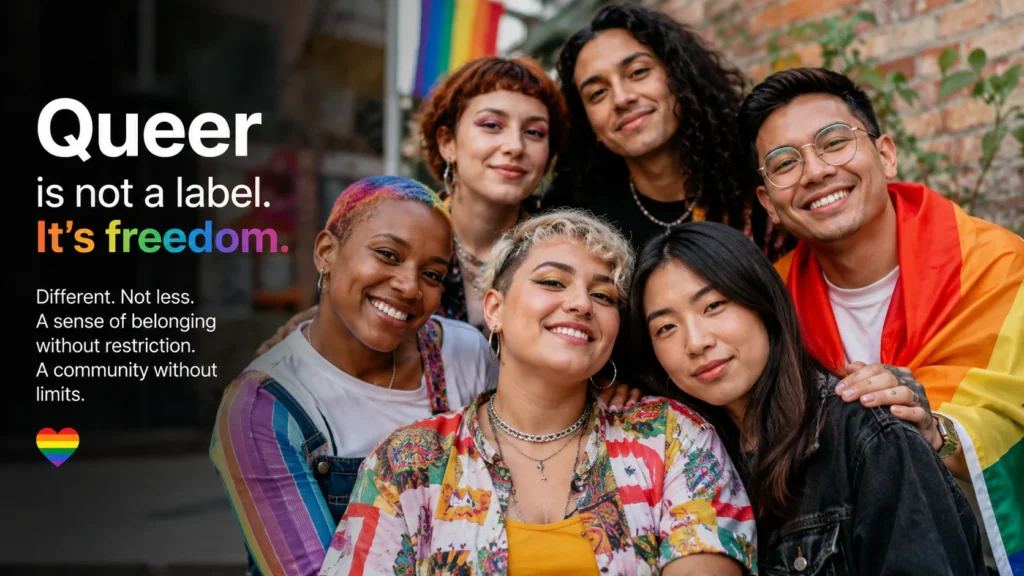
- A sense of belonging without restriction
- A label that doesn’t feel limiting
- A connection to a wider community
It’s not just a definition.
It’s a choice.
The History Behind the Queer Meaning
Where the Word Queer Started
Long before it became part of LGBTQ+ terminology, the word queer had a completely different meaning.
It meant:
- Strange
- Odd
- Unusual
People used it casually. No connection to identity. No deeper implications.
Then everything changed.
How Queer Became a Negative Term
During the late 1800s and early 1900s, society began using “queer” as an insult.
It targeted people who didn’t follow traditional gender or sexuality norms. Over time, it became a slur.
That shift wasn’t small.
It carried real harm. Real stigma. Real exclusion.
Understanding this history matters because it explains why the word still feels sensitive in some situations.
Reclaiming the Word Queer
Here’s where things take a powerful turn.
Instead of abandoning the word, LGBTQ+ communities began reclaiming it. They flipped its meaning.
This wasn’t random. It was intentional.
Reclaiming “queer” meant:
- Taking control of language
- Removing its power as an insult
- Turning it into a symbol of pride
You’ll often hear this idea described as “reclaiming the word queer.”
It transformed something negative into something empowering.
A Short Timeline of Queer History Meaning
| Time Period | Meaning of Queer |
|---|---|
| Pre-1900s | Strange or unusual |
| Early 1900s | Used as a slur |
| Late 1900s | Reclaimed by activists |
| Today | Identity and umbrella term |
That journey explains why the word carries so much weight today.
Queer Identity Meaning in Depth
Understanding Queer as an Identity
When people ask about queer identity meaning, they’re really asking how the word functions in real life.
Here’s the key idea:
Queer is not one identity. It’s many identities under one term.
That makes it different from most labels.
Queer Sexual Orientation Meaning
Sexual orientation refers to who someone is attracted to.
The queer sexual orientation meaning often includes:
- Attraction to multiple genders
- Attraction that changes over time
- Attraction that doesn’t fit standard categories
Unlike fixed labels, queer allows movement.
It reflects how real human attraction can evolve.
Queer Gender Identity Explanation
The word also connects strongly to gender.
Some people don’t identify as strictly male or female. Others feel their gender shifts or exists outside traditional definitions.
In those cases, queer becomes a way to describe that experience.
Examples include:
- Nonbinary identities
- Genderfluid identities
- Gender-nonconforming expressions
Instead of choosing one label, people may simply say, “I’m queer.”
Why “Queer” Feels More Honest for Some People
Here’s something important.
Not everyone wants a precise label.
And that’s okay.
For many, queer feels more honest because:
- It reflects complex identity
- It avoids constant explanation
- It allows change over time
It’s like saying, “This is who I am,” without needing to define every detail.
What Does Queer Stand For in LGBTQ+ Context
Does Queer Represent Something Specific
You might wonder:
What does queer stand for exactly?
Unlike acronyms, it doesn’t stand for a list of words. Instead, it represents a concept.
That concept is inclusivity.
Queer as an Umbrella Term
The phrase queer umbrella term meaning comes up often.
Here’s what it means in practice.
Queer can include:
- Gay individuals
- Lesbian individuals
- Bisexual and pansexual people
- Nonbinary and gender-diverse individuals
But it doesn’t replace those identities.
It simply offers a broader category.
Why Umbrella Terms Matter
Umbrella terms serve a purpose.
They:
- Simplify complex identity groups
- Create unity
- Provide flexibility
Instead of listing multiple labels, someone can use one word that covers their experience.
That’s where queer fits perfectly.
Queer vs Gay Meaning: Key Differences Explained
Why People Confuse the Two
It’s easy to see why people mix them up.
Both relate to identity. Both appear in LGBTQ+ discussions. Both describe non-heterosexual experiences.
But they are not the same.
Side-by-Side Comparison
| Aspect | Queer | Gay |
|---|---|---|
| Scope | Broad umbrella term | Specific orientation |
| Flexibility | High | Low |
| Includes gender identity | Yes | No |
| Definition clarity | Open | Fixed |
A Simple Way to Understand It
Think of it like this.
- “Gay” is a clear label
- “Queer” is a flexible concept
One gives precision. The other gives freedom.
Neither is better.
They just serve different needs.
Common Misunderstandings About Queer Meaning
“Queer Means the Same as Gay”
This idea spreads quickly but misses the point.
Queer includes more than just same-gender attraction. It can involve gender identity, fluid attraction, or nontraditional identity structures.
“Queer Is Just Modern Slang”
Not even close.
The queer slang meaning exists in casual conversation, but the word has deep historical and academic roots.
It appears in activism, research, and cultural studies.
“Queer Has No Clear Meaning”
It does have meaning.
It’s just not narrow.
And that’s intentional.
“Queer Is Always Offensive”
This depends on context.
Used respectfully, it’s empowering. Used carelessly, it can feel harmful.
That’s why awareness matters.
How the Word Queer Is Used in Real Life Today
Queer in Everyday Conversations
Step into any modern conversation about identity and you’ll likely hear the word queer. It shows up in casual chats, online bios, and community spaces. Yet the way people use it often depends on context.
Some people use it as a direct identity label.
Others use it more loosely to describe a general sense of not fitting traditional norms.
Here are a few natural examples of queer used in a sentence:
- “I identify as queer because I don’t feel limited by one label.”
- “This event is open to queer individuals and allies.”
- “They’ve been exploring their queer identity for a few years.”
Notice something important.
The word adapts. It fits the person, not the other way around.
Queer in Online Spaces and Social Media
Scroll through social platforms and you’ll see the word everywhere.
People include it in:
- Profile bios
- Hashtags
- Community descriptions
Why does it work so well online?
Because it’s short, inclusive, and instantly recognizable.
It signals identity without needing a long explanation. In a fast-moving digital world, that simplicity matters.
Queer-Friendly Spaces and What That Means
You might come across the phrase “queer-friendly” or “queer-inclusive.”
These terms signal something specific.
They mean the space:
- Welcomes diverse identities
- Respects different expressions of gender and sexuality
- Promotes safety and acceptance
It’s not just a label. It’s a promise of behavior.
Queer Relationships Meaning in Real Life
What Defines a Queer Relationship
When people ask about queer relationships meaning, they’re often expecting a single answer.
But there isn’t one.
A queer relationship simply involves one or more people who identify as queer. Beyond that, it can take many forms.
That’s what makes it unique.
How Queer Relationships Differ from Traditional Models
Traditional relationship models often assume:
- One man and one woman
- Fixed gender roles
- Clear expectations
Queer relationships don’t always follow those patterns.
They may:
- Challenge traditional gender roles
- Allow more flexibility in identity and expression
- Focus more on mutual understanding than predefined rules
Examples of Queer Relationship Dynamics
Here are a few ways queer relationships might look:
- A nonbinary person dating someone of any gender
- A couple where both partners identify as queer but not the same way
- A relationship that doesn’t rely on traditional gender expectations
Each one is valid. Each one reflects real human experience.
Why Flexibility Matters in Relationships
Flexibility isn’t confusion.
It’s awareness.
Queer relationships often prioritize:
- Open communication
- Respect for identity
- Emotional honesty
Instead of fitting into a mold, they create their own structure.
Queer Terminology in LGBTQ+ Language
Understanding Queer Terminology LGBTQ+
Language evolves quickly, especially in identity spaces.
The phrase queer terminology LGBTQ+ refers to the broader system of words people use to describe identity, attraction, and experience.
Queer plays a central role in that system.
Common Terms Connected to Queer Identity
Here are some key terms often linked with queer identity:
- Nonbinary – Not identifying strictly as male or female
- Genderfluid – Gender identity that changes over time
- Pansexual – Attraction regardless of gender
- Asexual – Little or no sexual attraction
Each term has its own meaning. However, some people prefer “queer” instead of choosing one specific label.
Why Inclusive Language Matters
Words shape how people feel.
Inclusive language:
- Reduces misunderstanding
- Creates safer spaces
- Allows people to express themselves honestly
When you use terms thoughtfully, you show respect. That respect builds trust.
Queer Studies Definition and Academic Perspective
What Is Queer Studies
Beyond everyday language, the word also holds weight in academia.
Queer studies is a field that examines identity, gender, sexuality, and social norms.
It goes deeper than simple definitions.
It asks questions like:
- How does society define “normal”?
- Who decides what identities are valid?
- How do power structures shape identity?
Why Queer Studies Matters
This field isn’t just theoretical.
It influences:
- Education systems
- Cultural discussions
- Media representation
It helps people understand identity beyond stereotypes.
Key Areas of Focus in Queer Studies
| Area | What It Explores |
|---|---|
| Identity | How people define themselves |
| Culture | Representation in media and art |
| History | Evolution of LGBTQ+ experiences |
| Society | Norms and expectations |
This academic approach adds depth to the queer explanation. It shows that the word isn’t just casual language. It’s part of serious intellectual study.
Is Queer a Slur or Identity Today
Understanding the Dual Nature of the Word
This question comes up often:
Is queer a slur or an identity?
The answer depends on how the word is used.
That might feel complicated, but it’s actually straightforward when you break it down.
When Queer Functions as a Slur
The word becomes harmful when:
- It’s used to insult
- It’s directed with negative intent
- It ignores someone’s identity preferences
In those cases, it carries the weight of its past.
When Queer Functions as an Identity
The word becomes empowering when:
- People choose it for themselves
- It’s used in respectful contexts
- It expresses pride or belonging
A Simple Rule to Follow
If you’re unsure, follow this guideline:
Let people define themselves.
If someone identifies as queer, respect that. If they don’t, use the terms they prefer.
That approach keeps communication clear and respectful.
Modern Meaning of Queer in Culture
Queer Culture Explanation
The modern meaning of queer extends beyond identity. It influences culture in visible and subtle ways.
Queer culture shows up in:
- Film and television
- Music and art
- Fashion and design
It often challenges traditional ideas. It asks bold questions. It invites new perspectives.
How Queer Culture Shapes Society
Cultural influence works quietly but powerfully.
Queer culture:
- Expands representation
- Breaks stereotypes
- Encourages acceptance
Over time, these changes shape how society understands identity.
The Role of Visibility
Visibility matters.
When people see diverse identities represented openly, it normalizes those experiences.
That visibility:
- Reduces stigma
- Builds confidence
- Creates connection
Queer culture plays a major role in that shift.
Queer Pride Meaning and Its Importance
What Queer Pride Represents
Queer pride is about more than celebration.
It’s about recognition.
It says:
- Your identity is valid
- You deserve respect
- You belong
Why Pride Still Matters Today
Some people assume pride is no longer necessary.
That assumption misses reality.
Even today, many individuals face misunderstanding or discrimination. Pride creates a space where identity is affirmed.
Key Elements of Queer Pride
- Visibility
- Acceptance
- Community
- Empowerment
Each one contributes to a stronger sense of belonging.
Practical Guidelines for Using the Word Queer
When It’s Appropriate to Use
You can use the word comfortably when:
- Someone identifies themselves that way
- You’re speaking in an inclusive context
- You’re discussing LGBTQ+ topics respectfully
When to Be Careful
You should pause when:
- You don’t know someone’s preference
- The context is unfamiliar
- The tone could be misunderstood
Best Practices for Respectful Communication
- Listen first
- Use the terms people prefer
- Avoid assumptions
These small actions make a big difference.
Advanced Understanding of Queer Identity in Modern Society
Queer as a Reflection of Social Change
Language never stands still. It moves with people. It evolves with culture. The modern meaning of queer reflects that shift clearly.
Decades ago, identity often followed strict categories. You were expected to fit into a defined role. Today, those boundaries feel less rigid.
Queer represents that shift.
It shows that identity can be:
- Fluid
- Personal
- Complex
Instead of forcing people into categories, it allows them to exist outside them.
Why More People Are Using the Word Queer Today
You might notice something.
More people are choosing the word queer now than ever before.
That’s not random.
Here’s why:
- Greater awareness of identity diversity
- Less pressure to conform to traditional labels
- More visibility of LGBTQ+ voices
- Growing acceptance in many parts of the world
As society opens up, language follows.
Queer becomes a natural choice for those who don’t want limits.
The Role of Identity Freedom
Freedom sits at the center of this conversation.
People want the ability to define themselves. Not according to rules. Not according to expectations.
Just honestly.
Queer supports that freedom.
It doesn’t demand explanation, precision and simply allows expression.
Deep Dive: Queer as an Umbrella Term Meaning
What Makes an Umbrella Term Effective
The phrase queer umbrella term meaning comes up often in discussions about identity.
But what actually makes an umbrella term useful?
It should:
- Include a wide range of identities
- Avoid unnecessary complexity
- Create a sense of unity
Queer checks all those boxes.
Identities That May Fall Under Queer
While not everyone uses the word, it can include:
- People attracted to multiple genders
- Individuals with fluid sexual orientation
- Those with nonbinary or evolving gender identities
- Anyone who feels outside traditional norms
That doesn’t mean everyone in these groups identifies as queer.
It simply means the term can apply.
Why Some People Avoid Specific Labels
Not everyone wants a detailed identity label.
Here’s why:
- Labels can feel restrictive
- Identity may change over time
- Personal understanding evolves
Instead of updating labels constantly, some people prefer one flexible term.
That’s where queer fits naturally.
Queer Explanation Through Real-Life Scenarios
Scenario-Based Understanding
Sometimes definitions aren’t enough.
Real-life scenarios make things clearer.
Scenario One
A person feels attraction to different genders at different times. They don’t feel comfortable calling themselves bisexual or pansexual.
They choose the word queer.
Why?
Because it reflects change without forcing precision.
Scenario Two
Someone doesn’t identify as male or female. They feel their gender exists outside traditional categories.
They describe themselves as queer.
Again, it fits better than rigid labels.
Scenario Three
An individual feels connected to LGBTQ+ culture but doesn’t want to explain their identity in detail.
They simply say, “I’m queer.”
That’s enough.
What These Examples Show
Each example highlights something important.
Queer isn’t about confusion.
It’s about alignment.
It gives people language that matches their experience.
Frequently Asked Questions
What Does Queer Mean Today
The meaning of queer today refers to an umbrella identity for people whose gender or sexual orientation does not follow traditional norms. It emphasizes flexibility, inclusivity, and self-expression.
What Does Queer Stand For
Queer does not stand for a specific phrase or acronym. Instead, it represents a concept of identity that includes diverse experiences outside heterosexual and cisgender norms.
Is Queer the Same as LGBTQ+
No.
Queer is part of the broader LGBTQ+ spectrum. It can overlap with other identities, but it does not replace them.
Is Queer a Slur or Identity
It can be both depending on context.
- As a slur: when used disrespectfully
- As an identity: when self-chosen and used positively
What Is the Difference Between Queer and Gay
- Gay refers specifically to attraction to the same gender
- Queer is broader and can include multiple identities and experiences
Can Straight People Use the Word Queer
Generally, straight individuals do not use queer as a personal identity label. However, they may use the term in respectful discussions or academic contexts.
What Does Queer Mean in Slang
In casual language, queer slang meaning often refers to someone who is not heterosexual or cisgender. However, it still carries deeper identity significance beyond slang.
What Is Queer Identity Meaning
Queer identity refers to a flexible, inclusive way of describing one’s gender or sexual orientation without strict labels.
What Is Queer Culture
Queer culture includes the creative, social, and expressive aspects of LGBTQ+ communities. It appears in art, media, activism, and everyday life.
Final Thoughts:
So, what does queer mean in the end?
It means possibility.
It means stepping outside narrow definitions and choosing something that fits better. It means recognizing that identity doesn’t always follow a straight line.
Sometimes it bends, shifts and refuses to be labeled at all.
And that’s okay.
The strength of the queer meaning lies in its openness. It doesn’t force answers. It invites understanding.
If there’s one thing to take away, it’s this:
You don’t need a perfect label to understand identity. You just need one that feels true.

Michael Anderson is a content writer specializing in word meanings, definitions and clear explanations of modern terms and phrases.