
Last Updated on June 11, 2026
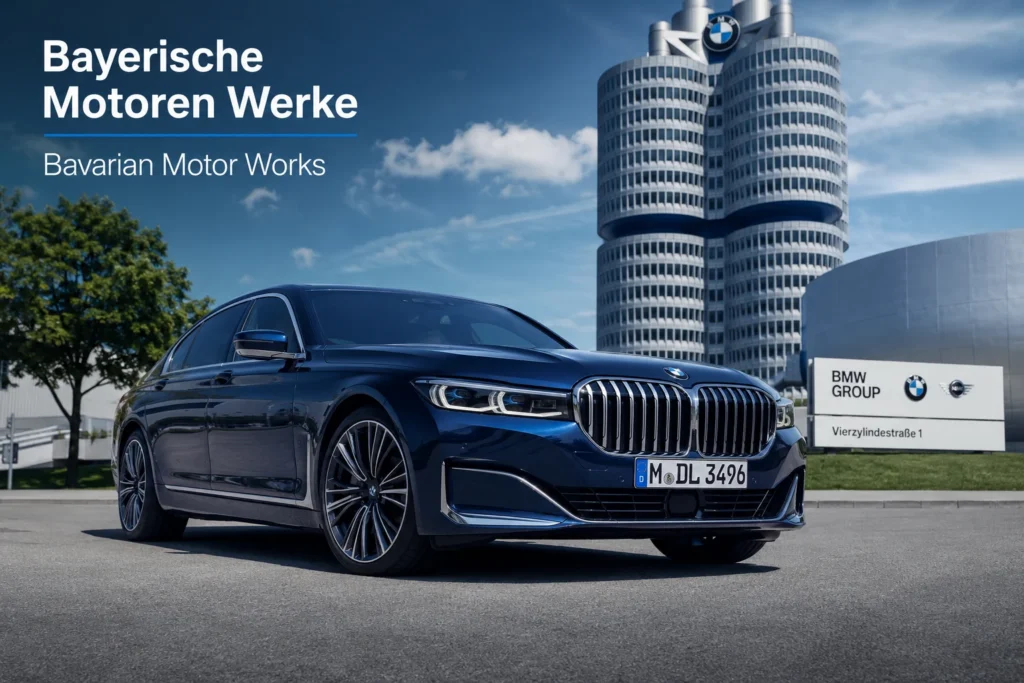
BMW stands for Bayerische Motoren Werke, which translates to Bavarian Motor Works in English. The company was founded in 1916 in Munich, Bavaria, Germany. Originally known for manufacturing aircraft engines, BMW later expanded into motorcycles and automobiles. Today, BMW is one of the world’s leading luxury vehicle manufacturers and owns brands including MINI and Rolls-Royce Motor Cars.
BMW is one of the most recognizable automotive brands on the planet. From luxury sedans and high-performance sports cars to cutting-edge electric vehicles, the company has built a reputation that stretches across more than a century.
Yet many people still ask a simple question:
What does BMW stand for?
The answer is straightforward. However, the story behind the name reveals a fascinating journey through aviation, engineering, innovation, and German industrial history.
BMW’s name is much more than an acronym. It reflects the company’s birthplace, its heritage, and the engineering principles that continue to define the brand today.
In this guide, you’ll discover the complete BMW meaning, the BMW full form, the origin of the company name, its history, and the reasons why BMW has become one of the most respected automotive manufacturers in the world.
What Does BMW Stand For?
The BMW acronym stands for:
Bayerische Motoren Werke
In English, this translates to:
Bavarian Motor Works
This is the official BMW full name and the origin of the famous BMW abbreviation used worldwide.
BMW Full Form
| Abbreviation | Full Form |
|---|---|
| BMW | Bayerische Motoren Werke |
The company adopted this name because it was founded in the German state of Bavaria and originally specialized in manufacturing engines.
Even today, despite producing millions of vehicles and motorcycles globally, BMW continues to use its original German corporate name.
BMW Meaning in English
The English translation of Bayerische Motoren Werke is:
Bavarian Motor Works
Let’s break that down:
| German Word | English Translation |
|---|---|
| Bayerische | Bavarian |
| Motoren | Motors or Engines |
| Werke | Works or Factory |
When combined, the phrase essentially means:
“Bavarian Engine Works” or “Bavarian Motor Works.”
Both translations are commonly accepted, although Bavarian Motor Works is the most widely used version.
What Does BMW Stand For in German?
In German, BMW stands for:
Bayerische Motoren Werke AG
The letters “AG” stand for:
Aktiengesellschaft
This is a German term for a publicly traded corporation.
So the company’s official legal name is:
Bayerische Motoren Werke AG
Most people simply know it as BMW.
Quick Answer Table
| Question | Answer |
|---|---|
| What does BMW stand for? | Bayerische Motoren Werke |
| BMW full form | Bayerische Motoren Werke |
| BMW meaning in English | Bavarian Motor Works |
| BMW origin | Bavaria, Germany |
| BMW founded | 1916 |
| BMW headquarters | Munich, Germany |
| BMW industry | Automotive and motorcycles |
BMW stands for Bayerische Motoren Werke, which translates to Bavarian Motor Works in English.
That short answer satisfies most people. However, understanding why the company chose that name requires a closer look at its roots.
BMW Name Meaning and Origin
A company name often tells a story.
In BMW’s case, the name captures both its geographical roots and its engineering focus.
The BMW company name wasn’t created as a marketing slogan. Instead, it reflected exactly what the company did and where it came from.
What Does Bayerische Motoren Werke Mean?
The phrase Bayerische Motoren Werke directly references Bavaria, the southern German region where the company was established.
At the time of BMW’s formation, manufacturers often incorporated their location and specialty into their names.
BMW followed that tradition.
The name effectively told customers:
- The company came from Bavaria.
- The company built engines.
- The company specialized in industrial manufacturing.
This practical naming approach was common throughout Germany’s industrial sector during the early twentieth century.
Why Is BMW Called Bavarian Motor Works?
BMW is called Bavarian Motor Works because:
- The company originated in Bavaria.
- Its earliest products were engines.
- Engine manufacturing formed the foundation of the business.
Before BMW became famous for luxury automobiles, it was known primarily for aircraft engine production.
This surprises many people.
Today’s consumers associate BMW with premium vehicles. Yet the company’s earliest success came from aviation engineering.
That connection explains why the word “Motoren” remains central to the brand’s identity.
How BMW Got Its Name
BMW emerged through the restructuring of earlier aviation-related businesses operating in Munich.
When the company formally adopted the BMW name in 1917, management wanted a title that reflected both location and expertise.
The result was Bayerische Motoren Werke.
The name quickly became associated with engineering precision and technical excellence.
Over time, the abbreviation BMW became far more recognizable than the full German name.
Today, millions of drivers know the initials instantly even if they cannot pronounce the complete German title.
The Importance of Bavaria in BMW’s Identity
Bavaria remains deeply connected to BMW’s brand identity.
Located in southern Germany, Bavaria is known for:
- Manufacturing excellence
- Engineering innovation
- Strong industrial traditions
- Skilled craftsmanship
- Automotive expertise
Munich, Bavaria’s capital city, continues to serve as BMW’s headquarters more than a century after the company’s founding.
The company’s connection to Bavaria appears throughout its branding, history, and corporate culture.
Even the famous BMW logo incorporates Bavaria’s traditional blue-and-white color scheme.
That regional connection gives BMW a distinctive identity among global automotive brands.
While many manufacturers have moved their headquarters or changed ownership over the decades, BMW remains firmly tied to the region where its story began.
BMW Company History
Understanding BMW history helps explain why the company became one of the most respected names in the automotive industry.
The journey began long before luxury sedans and performance vehicles entered the picture.
BMW’s earliest years centered on a completely different type of engineering challenge.
When BMW Was Founded
BMW traces its origins to 1916.
The company emerged during a period of rapid industrial growth and technological advancement in Germany.
Aviation was transforming transportation and military capabilities.
Engine manufacturers raced to develop more powerful and reliable aircraft engines.
BMW entered the industry at exactly the right moment.
Its expertise in precision engineering quickly established the company as a serious player in aircraft propulsion technology.
Who Founded BMW?
The origins of BMW involve several predecessor companies and industrial figures rather than a single founder.
Two names often associated with BMW’s early history include:
- Karl Rapp
- Gustav Otto
These pioneers played important roles in the aviation businesses that eventually evolved into BMW.
Their engineering efforts laid the groundwork for what would become one of the most successful automotive companies in history.
BMW’s Aircraft Engine Origins
Long before luxury cars filled BMW showrooms, aircraft engines dominated the company’s operations.
BMW specialized in designing and manufacturing engines for military and aviation applications.
These early engines earned praise for:
- Reliability
- Efficiency
- Power output
- Engineering quality
The experience gained through aviation engineering influenced BMW’s future approach to vehicle development.
Many of the precision manufacturing techniques used in modern BMW vehicles can trace their roots back to these early aviation projects.
BMW Company History
BMW During World War I
The story of BMW cannot be separated from the aviation industry.
During World War I, demand for aircraft engines increased dramatically. Germany needed reliable engines for military aircraft, and companies specializing in aviation technology became strategically important.
BMW quickly gained recognition for producing advanced aircraft engines. One of its most notable early achievements was the BMW IIIa aircraft engine, introduced in 1917. The engine performed exceptionally well at high altitudes and helped establish BMW’s reputation for engineering excellence.
The success of BMW’s aircraft engines demonstrated several characteristics that still define the brand today:
- Precision engineering
- Technical innovation
- Reliability
- Performance-focused design
- Continuous improvement
These principles would later shape BMW’s motorcycles and automobiles.
However, the end of World War I brought significant challenges.
The Treaty of Versailles imposed restrictions on Germany’s aviation industry. Aircraft engine production became heavily limited, forcing BMW to rethink its future.
The company faced a critical question:
How could it survive without its primary business?
The answer led BMW into entirely new industries.
Transition Into Motorcycles
Rather than disappear, BMW adapted.
The company initially produced industrial engines, agricultural equipment, and various engineering products while searching for new opportunities.
Motorcycles soon emerged as a promising market.
BMW’s expertise in engine development gave it a major advantage over many competitors. Engineers already understood how to build efficient, powerful, and reliable powerplants.
In 1923, BMW introduced its first motorcycle:
The BMW R32
The motorcycle became an instant milestone in company history.
Why the BMW R32 Was Important
The R32 introduced several innovations that would influence BMW motorcycles for decades:
- Horizontally opposed boxer engine
- Shaft drive system
- Improved reliability
- Better weight distribution
- Distinctive engineering layout
Many modern BMW motorcycles still use the boxer engine configuration.
That continuity highlights BMW’s ability to refine successful ideas rather than constantly reinvent them.
Early Motorcycle Success
The R32 helped BMW establish itself as more than an aircraft engine manufacturer.
Soon the company became known for:
| Strength | Benefit |
|---|---|
| Durable engines | Long-term reliability |
| Engineering quality | Strong reputation |
| Innovative design | Competitive advantage |
| Performance capabilities | Racing success |
BMW motorcycles quickly earned recognition in racing competitions and endurance events.
Motorsport success helped build public trust in the brand.
The formula would later work just as effectively for BMW automobiles.
Entry Into Automobile Manufacturing
BMW’s transition into car manufacturing occurred later than many people realize.
The company did not begin by designing luxury sedans.
Instead, BMW entered the automotive industry through acquisition.
In 1928, BMW acquired the Fahrzeugfabrik Eisenach vehicle factory.
This move allowed BMW to begin producing automobiles.
Its first car was based on an existing British design known as the Austin Seven.
BMW produced the vehicle under license as the:
BMW 3/15
While modest by modern standards, the vehicle represented a major turning point.
BMW had officially entered the automobile business.
BMW’s First Cars
The earliest BMW cars focused on practicality and affordability.
Unlike today’s premium vehicles, these models targeted everyday transportation needs.
Key characteristics included:
- Compact dimensions
- Efficient engines
- Affordable ownership
- Practical engineering
As BMW gained experience, the company gradually shifted toward higher-performance vehicles.
This transition would eventually define its identity.
Building an Automotive Reputation
Throughout the 1930s, BMW expanded its automotive lineup.
The company introduced vehicles that emphasized:
- Driving enjoyment
- Engineering sophistication
- Performance
- Style
One of the most influential models from this era was the BMW 328 Roadster.
The 328 became famous for its:
- Lightweight construction
- Excellent handling
- Racing success
- Advanced engineering
Even today, automotive historians often consider the BMW 328 one of the most important sports cars ever produced.
Its success laid the foundation for BMW’s future reputation as a manufacturer of performance-oriented vehicles.
BMW During World War II
World War II dramatically affected BMW’s operations.
Like many industrial companies in Germany, BMW shifted much of its production toward military-related manufacturing.
Aircraft engines once again became a major focus.
The war years brought substantial disruption to the company’s development.
Manufacturing facilities suffered significant damage.
When the conflict ended, BMW faced another difficult rebuilding period.
The company had to reconstruct facilities, reorganize operations, and establish a viable peacetime business.
Many organizations would not have survived such challenges.
BMW did.
Post-War Recovery
The years following World War II were difficult.
Germany’s economy struggled to recover.
Resources remained limited.
Consumer purchasing power was weak.
BMW initially manufactured:
- Household products
- Bicycle components
- Small engineering items
These products helped keep the company operating while larger manufacturing capabilities returned.
Eventually, motorcycle production resumed.
Automobile manufacturing followed later.
The recovery process required patience, resilience, and long-term planning.
The Near-Collapse of BMW
One of the most fascinating chapters in BMW history occurred during the late 1950s.
The company faced severe financial difficulties.
Luxury vehicles generated limited sales.
Smaller cars faced intense competition.
BMW came dangerously close to collapse.
At one point, rival German automaker Mercedes-Benz considered acquiring the company.
Many industry observers believed BMW’s independence would end.
Instead, investors and shareholders supported a restructuring effort that saved the brand.
This decision changed automotive history.
Had the acquisition occurred, the modern BMW brand might never have existed.
The Turning Point
BMW’s fortunes began improving during the 1960s.
The company launched a new generation of sporty sedans known as the Neue Klasse.
Translated into English, the name means:
New Class
These vehicles transformed BMW’s future.
The Neue Klasse models successfully combined:
- Performance
- Comfort
- Practicality
- Modern styling
Customers responded enthusiastically.
Sales increased.
Profits improved.
BMW finally established the identity that continues today.
Birth of the Ultimate Driving Machine
The success of the Neue Klasse helped shape BMW’s core philosophy.
Unlike many luxury manufacturers that prioritized comfort above all else, BMW focused on the driving experience.
The company sought to build cars that were:
- Luxurious
- Responsive
- Engaging
- Driver-focused
This approach eventually led to BMW’s famous marketing position as:
“The Ultimate Driving Machine.”
The phrase became one of the most successful automotive slogans ever created because it reflected the actual character of BMW vehicles.
Drivers appreciated the balance between luxury and performance.
Key BMW Historical Milestones
| Year | Event |
|---|---|
| 1916 | BMW origins established |
| 1917 | BMW name officially adopted |
| 1923 | BMW R32 motorcycle introduced |
| 1928 | BMW enters automobile production |
| 1936 | BMW 328 sports car launched |
| 1959 | BMW survives financial crisis |
| 1961 | Neue Klasse introduced |
| 1972 | BMW M division founded |
| 1994 | BMW acquires Rover Group |
| 1998 | BMW acquires Rolls-Royce rights |
| 2001 | Modern MINI relaunched |
| 2013 | BMW i3 electric vehicle launched |
How BMW’s Early History Still Influences the Brand
Many elements of BMW’s modern identity originated during its first decades.
The company’s aviation background contributed to its focus on:
- Lightweight engineering
- Performance efficiency
- Precision manufacturing
- Technical innovation
Its motorcycle success reinforced a culture of engineering excellence.
Its automotive evolution emphasized driving enjoyment.
Together, these influences created a unique corporate identity.
Today’s BMW vehicles may feature advanced software, electric drivetrains, and cutting-edge technology, yet the underlying philosophy remains remarkably consistent.
The company still pursues the same goal that guided its earliest engineers:
Building machines that combine innovation, performance, and engineering precision.
BMW Evolution Into a Global Luxury Brand
The transformation from aircraft engine manufacturer to global luxury automotive leader did not happen overnight.
Over decades, BMW expanded its reach, refined its products, and established itself as one of the most influential companies in the automotive industry.
Growth During the 20th Century
By the 1970s, BMW had become a serious competitor in the premium vehicle market.
The company introduced several model ranges that remain central to its lineup today:
- BMW 3 Series
- BMW 5 Series
- BMW 7 Series
These vehicles helped define modern luxury sports sedans.
Instead of choosing between comfort and performance, customers could enjoy both.
This combination became one of BMW’s strongest advantages.
BMW’s Expansion Worldwide
As demand increased, BMW expanded far beyond Germany.
The company established sales networks across:
- Europe
- North America
- Asia
- Australia
- South America
- The Middle East
Its global growth transformed BMW from a regional manufacturer into an internationally recognized luxury brand.
Today, BMW vehicles are sold in more than 140 countries.
BMW Evolution Into a Global Luxury Brand
The Rise of BMW Performance Vehicles
As BMW expanded internationally, it developed a reputation for building vehicles that delivered an engaging driving experience. While many luxury automakers focused primarily on comfort, BMW concentrated on creating cars that felt connected to the road.
This philosophy attracted enthusiasts who wanted more than just transportation.
Throughout the 1970s and 1980s, BMW introduced vehicles that became automotive icons.
Notable examples include:
- BMW 2002
- BMW E21 3 Series
- BMW E30 3 Series
- BMW 635CSi
- BMW 850i
These vehicles helped establish BMW as a leader in the premium performance segment.
The company’s engineering team focused heavily on:
- Balanced chassis design
- Responsive steering
- Powerful engines
- Rear-wheel-drive dynamics
- Driver-focused interiors
As a result, BMW developed a loyal customer base that valued performance just as much as luxury.
BMW M Division Explained
One of the most important chapters in BMW history began in 1972 with the creation of the BMW M Division.
The letter M stands for Motorsport.
BMW originally established the division to support racing activities and develop high-performance technologies.
Over time, BMW M evolved into one of the most respected performance brands in the world.
What Does BMW M Do?
BMW M develops:
- High-performance engines
- Advanced suspension systems
- Motorsport technologies
- Track-focused vehicles
- Performance-oriented components
The division transforms standard BMW models into machines capable of delivering significantly higher levels of performance.
Popular BMW M Models
| Model | Category |
|---|---|
| BMW M2 | Compact performance coupe |
| BMW M3 | High-performance sports sedan |
| BMW M4 | Performance coupe |
| BMW M5 | Executive performance sedan |
| BMW X5 M | Performance SUV |
| BMW XM | High-performance luxury SUV |
The BMW M3, in particular, has become one of the most influential sports sedans ever produced.
Many automotive journalists consider it the benchmark for balancing everyday practicality with track-ready performance.
Why BMW M Vehicles Are Special
BMW M models feature upgrades that go far beyond cosmetic changes.
Typical improvements include:
- More powerful engines
- Reinforced chassis structures
- Enhanced braking systems
- Advanced cooling technology
- Performance tuning
These upgrades allow M vehicles to compete with some of the fastest production cars in the world.
The success of BMW M helped strengthen the company’s reputation for engineering excellence and motorsport-inspired innovation.
BMW i Series and Electric Mobility
The automotive industry has changed dramatically during the 21st century.
Environmental concerns, government regulations, and technological advances accelerated the transition toward electric mobility.
BMW recognized this shift early.
In response, the company launched the BMW i Series.
The purpose of the BMW i project was ambitious:
To redefine sustainable mobility while maintaining BMW’s performance-oriented identity.
The Launch of the BMW i3
In 2013, BMW introduced the BMW i3.
The vehicle stood out because it looked radically different from traditional automobiles.
Its features included:
- Electric powertrain
- Lightweight carbon-fiber construction
- Sustainable interior materials
- Innovative urban mobility design
The i3 became one of the first premium electric vehicles available on a large scale.
It demonstrated BMW’s willingness to experiment with new technologies.
The BMW i8 Supercar
Alongside the i3, BMW introduced the futuristic BMW i8.
The i8 combined:
- Electric technology
- Plug-in hybrid capability
- Sports car performance
- Foreign design
The vehicle became a symbol of BMW’s commitment to innovation.
Even years after production ended, the i8 remains one of the most recognizable hybrid sports cars ever built.
Modern BMW Electric Models
Today, BMW offers a growing lineup of electric vehicles.
Popular models include:
| Model | Vehicle Type |
|---|---|
| BMW i4 | Electric sedan |
| BMW i5 | Electric executive sedan |
| BMW i7 | Electric luxury sedan |
| BMW iX | Electric SUV |
| BMW iX1 | Compact electric SUV |
| BMW iX3 | Electric crossover |
BMW continues investing billions of dollars in electric vehicle development, battery technology, and sustainable manufacturing processes.
BMW’s Vision for the Future
BMW’s future strategy focuses on several key areas:
- Electrification
- Artificial intelligence integration
- Autonomous driving technologies
- Sustainable production
- Connected vehicle ecosystems
The company aims to remain competitive while adapting to changing consumer expectations.
Its ability to evolve has been a defining characteristic throughout its history.
BMW Logo Meaning
Few automotive logos are as recognizable as the BMW roundel.
The blue-and-white emblem appears on millions of vehicles worldwide and serves as one of the strongest symbols in the automotive industry.
Yet many people misunderstand what the logo actually represents.
The Truth Behind the BMW Logo
A common myth suggests that the BMW logo represents a spinning airplane propeller.
The theory sounds plausible because BMW originally manufactured aircraft engines.
However, the reality is more nuanced.
The logo’s primary inspiration comes from the colors of Bavaria.
The design incorporates:
- Blue segments
- White segments
- Circular shape
- Black outer ring
These elements connect directly to BMW’s Bavarian heritage.
Blue and White Bavarian Colors
The state of Bavaria has long used blue and white as traditional colors.
BMW incorporated those colors into its logo as a tribute to its origins.
This design choice reinforced the company’s regional identity.
The logo effectively communicated:
“We are a Bavarian engineering company.”
That message remains relevant more than a century later.
Common Misconceptions About the Logo
Several myths surround the BMW emblem.
Let’s separate fact from fiction.
| Myth | Reality |
|---|---|
| The logo was designed as a propeller | It primarily reflects Bavarian colors |
| BMW created the logo for aircraft marketing | The logo evolved from corporate branding |
| The logo has never changed | It has undergone multiple redesigns |
| The blue and white pattern is random | It references Bavaria’s heritage |
The spinning propeller association gained popularity after BMW advertisements used the logo alongside aircraft imagery.
Those advertisements strengthened the public’s assumption that the logo represented aviation.
How the BMW Badge Evolved
Although the core design remains recognizable, BMW has updated its logo several times.
Changes typically involved:
- Modernized typography
- Cleaner graphics
- Enhanced digital compatibility
- Simplified design elements
Despite these refinements, BMW has preserved the logo’s essential identity.
That consistency contributes to strong global brand recognition.
Why the BMW Logo Is So Effective
Great logos achieve several goals simultaneously.
BMW’s logo succeeds because it is:
- Simple
- Memorable
- Distinctive
- Historically meaningful
- Instantly recognizable
Few automotive brands have maintained such a strong visual identity for so long.
BMW Today
More than a century after its founding, BMW remains one of the most influential automotive companies in the world.
The company operates on a global scale while continuing to maintain strong ties to its German roots.
BMW Headquarters in Munich
BMW’s headquarters remain in Munich, Germany.
The headquarters building itself has become a landmark.
Its distinctive architecture resembles four vertical cylinders, representing engine cylinders.
The facility serves as:
- Corporate headquarters
- Administrative center
- Strategic planning hub
- Global management office
Munich remains the heart of BMW’s operations.
BMW Group Overview
Today, BMW operates under the umbrella of the BMW Group.
The BMW Group manages multiple automotive brands and business operations.
Key areas include:
- Passenger vehicles
- Motorcycles
- Luxury automobiles
- Mobility services
- Financial services
The group’s diversified structure allows it to compete across several market segments.
BMW Group at a Glance
| Category | Information |
|---|---|
| Founded | 1916 |
| Headquarters | Munich, Germany |
| Industry | Automotive |
| Products | Cars, motorcycles, mobility services |
| Global Presence | More than 140 countries |
| Employees | More than 150,000 worldwide |
| Parent Organization | BMW Group |
MINI Brand
BMW owns the MINI brand.
Originally a British automotive icon, MINI became part of BMW’s portfolio in 2000.
BMW successfully revitalized the brand while preserving its unique personality.
Modern MINI vehicles combine:
- Compact dimensions
- Premium interiors
- Distinctive styling
- Fun driving characteristics
The acquisition allowed BMW to expand into a different segment of the automotive market.
Rolls-Royce Motor Cars
BMW also owns Rolls-Royce Motor Cars.
Rolls-Royce represents the pinnacle of automotive luxury.
The brand is famous for:
- Handcrafted interiors
- Exceptional craftsmanship
- Bespoke customization
- Ultra-luxury vehicles
Models such as the Phantom, Ghost, Spectre, and Cullinan showcase the highest levels of automotive craftsmanship.
The ownership of Rolls-Royce strengthens BMW’s position within the global luxury market.
Global Production Facilities
BMW manufactures vehicles across multiple continents.
Major production locations include:
- Germany
- United States
- China
- Mexico
- South Africa
- United Kingdom
- India
- Brazil
This international manufacturing network allows BMW to serve customers efficiently around the world.
BMW’s Global Reach
BMW’s influence extends far beyond vehicle production.
The company plays a major role in:
- Automotive technology development
- Sustainable manufacturing
- Luxury mobility solutions
- Performance engineering
- Electric vehicle innovation
Its products continue to shape trends throughout the automotive industry.
Why BMW Is Famous Worldwide
BMW’s success didn’t happen by accident.
The company spent more than a century building a reputation based on engineering excellence, performance, innovation, and premium quality. Today, BMW ranks among the most recognized automotive brands in the world.
Millions of people immediately recognize the BMW badge, whether they are automotive enthusiasts or casual consumers.
Several factors explain why BMW has achieved such remarkable global recognition.
German Engineering Reputation
Germany has long been associated with precision engineering and industrial excellence.
BMW benefits from this reputation because it represents many of the qualities people associate with German manufacturing:
- Attention to detail
- High-quality materials
- Precision engineering
- Advanced technology
- Rigorous testing standards
The phrase “German engineering” has become a powerful marketing advantage for BMW.
Customers often associate German-made vehicles with durability, innovation, and superior craftsmanship.
BMW has reinforced that perception through decades of consistent product development.
Luxury and Performance Combination
Many manufacturers excel in either luxury or performance.
BMW built its reputation by delivering both.
This balance has become one of the company’s defining characteristics.
BMW vehicles typically offer:
| Luxury Features | Performance Features |
|---|---|
| Premium interiors | Powerful engines |
| Advanced technology | Responsive handling |
| High-quality materials | Precise steering |
| Comfort-oriented features | Sport-tuned suspensions |
| Sophisticated design | Driver-focused engineering |
This combination appeals to buyers who want comfort without sacrificing excitement behind the wheel.
Motorsport Heritage
BMW’s motorsport involvement has played a significant role in shaping its brand image.
The company has competed in numerous racing disciplines, including:
- Touring car racing
- Endurance racing
- Formula racing categories
- GT racing
- Motorcycle racing
Motorsport provides valuable benefits beyond trophies.
Racing environments allow engineers to:
- Test new technologies
- Improve reliability
- Enhance performance
- Develop innovative solutions
Many technologies developed through motorsport eventually find their way into production vehicles.
Innovation and Technology Leadership
BMW has consistently invested in research and development.
The company has introduced numerous innovations over the decades.
Examples include:
- Advanced turbocharging systems
- Carbon-fiber vehicle structures
- Sophisticated driver assistance systems
- Electric vehicle technology
- Connected car services
Innovation remains central to BMW’s strategy.
The company continuously adapts to changes in consumer preferences and industry trends.
Strong Brand Recognition
BMW has become one of the most valuable automotive brands in the world.
Several factors contribute to this recognition:
- Consistent branding
- Distinctive vehicle design
- Global marketing campaigns
- Motorsports success
- Strong customer loyalty
The BMW name now represents much more than a car manufacturer.
It symbolizes performance, prestige, innovation, and engineering excellence.
Interesting BMW Facts
BMW’s history contains numerous fascinating stories and achievements.
Many people know the brand for luxury vehicles, yet its history includes many surprising details.
Lesser-Known Facts About BMW
BMW Started With Aircraft Engines
The company’s earliest success came from aviation rather than automobiles.
Aircraft engines were BMW’s primary focus before motorcycles and cars entered the picture.
BMW Once Produced Household Products
Following World War II, BMW temporarily manufactured household items and bicycle components to survive difficult economic conditions.
BMW Nearly Disappeared
During the late 1950s, BMW came close to bankruptcy.
Without a successful restructuring effort, the company might not exist today.
The BMW Headquarters Building Resembles Engine Cylinders
The famous headquarters tower in Munich was intentionally designed to resemble four engine cylinders standing vertically.
Historic Milestones
| Year | Milestone |
|---|---|
| 1916 | Company origins established |
| 1917 | BMW name officially adopted |
| 1923 | First BMW motorcycle launched |
| 1928 | First BMW automobile produced |
| 1936 | BMW 328 introduced |
| 1972 | BMW M Division founded |
| 1975 | First BMW 3 Series launched |
| 1998 | Rolls-Royce rights acquired |
| 2001 | Modern MINI launched |
| 2013 | BMW i3 electric vehicle introduced |
Record-Breaking Achievements
BMW has achieved numerous records throughout its history.
Notable accomplishments include:
- Multiple motorsport championships
- Millions of vehicles sold globally
- Industry-leading engine awards
- Major advancements in electric mobility
- Development of iconic performance vehicles
BMW Innovations That Changed the Industry
BMW has influenced automotive design and engineering in several ways.
Examples include:
- Popularizing sport sedans
- Advancing vehicle dynamics technology
- Introducing lightweight carbon-fiber production methods
- Expanding premium electric vehicle offerings
These innovations helped shape modern automotive development.
BMW Compared to Other German Luxury Brands
Germany is home to several world-famous automotive manufacturers.
BMW competes most directly with Mercedes-Benz and Audi.
While all three brands produce premium vehicles, each has developed a unique identity.
BMW vs Mercedes-Benz
BMW and Mercedes-Benz have competed for decades.
Both companies offer luxury vehicles, yet they emphasize different strengths.
| BMW | Mercedes-Benz |
|---|---|
| Driver-focused experience | Comfort-focused experience |
| Sportier handling | Greater emphasis on ride quality |
| Performance-oriented image | Luxury-oriented image |
| Motorsport heritage | Prestige heritage |
Neither approach is inherently better.
The choice depends on customer preferences.
BMW vs Audi
Audi represents another major competitor.
Like BMW, Audi combines luxury and performance.
However, the two brands often appeal to different buyers.
| BMW | Audi |
|---|---|
| Rear-wheel-drive heritage | Quattro all-wheel-drive heritage |
| Driver engagement focus | Technology focus |
| Sport-oriented character | Modern digital experience |
| Traditional performance identity | Advanced technology branding |
Both brands enjoy strong reputations within the luxury automotive segment.
BMW’s Unique Brand Identity
Among German luxury manufacturers, BMW occupies a distinctive position.
Its identity centers on:
- Driving enjoyment
- Performance engineering
- Innovation
- Premium quality
- Motorsport heritage
These characteristics help differentiate BMW from competitors.
The company’s commitment to creating engaging driving experiences remains one of its strongest defining traits.
Frequently Asked Questions
Is BMW Short for Bavarian Motor Works?
Yes.
BMW stands for Bayerische Motoren Werke, which translates to Bavarian Motor Works in English.
What Does BMW Stand For?
BMW stands for Bayerische Motoren Werke.
The phrase means Bavarian Motor Works.
What Does BMW Stand For in German?
In German, the full company name is:
Bayerische Motoren Werke AG
What Is the Full Meaning of BMW?
The BMW full form is Bayerische Motoren Werke.
The name reflects the company’s Bavarian origins and its focus on engine manufacturing during its early years.
What Does Bayerische Motoren Werke Translate To?
The English translation is:
Bavarian Motor Works
Some translations also use Bavarian Engine Works.
Why Is BMW Called BMW?
BMW adopted the name because:
- The company originated in Bavaria.
- It manufactured engines.
- The name reflected its industrial focus.
Who Founded BMW?
BMW’s origins involve several predecessor companies and aviation pioneers.
Karl Rapp and Gustav Otto played important roles in the businesses that eventually evolved into BMW.
Is BMW a German Company?
Yes.
BMW is a German automotive manufacturer headquartered in Munich, Bavaria, Germany.
Where Is BMW From?
BMW originated in Munich, located in the German state of Bavaria.
When Was BMW Founded?
BMW traces its origins to 1916.
The BMW name officially appeared in 1917.
What Is the Meaning Behind the BMW Logo?
The BMW logo primarily reflects Bavaria’s traditional blue-and-white colors.
Although many people associate it with a spinning aircraft propeller, the design’s primary connection is to Bavarian heritage.
Who Owns BMW?
BMW remains independently operated under BMW Group ownership.
The company is publicly traded, with significant ownership held by the Quandt family through investment holdings.
What Brands Are Owned by BMW?
BMW Group owns:
- BMW
- MINI
- Rolls-Royce Motor Cars
These brands operate under the BMW Group corporate structure.
What Does BMW Mean in Cars?
Within the automotive industry, BMW represents a premium vehicle manufacturer known for:
- Luxury automobiles
- Performance cars
- Sports sedans
- SUVs
- Electric vehicles
- Motorcycles
Why Is BMW Famous?
BMW is famous for:
- German engineering
- Luxury vehicles
- Performance-focused design
- Motorsport success
- Advanced technology
- Strong brand heritage
Conclusion
What BMW Stands For and Why It Matters
So, what does BMW stand for?
The answer is simple:
BMW stands for Bayerische Motoren Werke, which translates to Bavarian Motor Works in English.
Yet the story behind those three letters is far more interesting than the acronym itself.
BMW began as an aircraft engine manufacturer in Bavaria, Germany. Through innovation, adaptability, and engineering excellence, the company evolved into one of the world’s most respected automotive brands.
Its history includes:
- Aircraft engine production
- Motorcycle innovation
- Automotive breakthroughs
- Motorsport success
- Global expansion
- Electric mobility leadership
Today, BMW represents far more than a company name.
It symbolizes:
- German engineering
- Automotive innovation
- Luxury mobility
- Performance driving
- More than a century of heritage
The next time you see a BMW on the road, you’ll know that those three letters trace back to a proud Bavarian engineering tradition that began over 100 years ago and continues to shape the automotive industry today.
BMW = Bayerische Motoren Werke = Bavarian Motor Works — a name that reflects both the company’s origins and its enduring commitment to engineering excellence.

Sophia Bennett is a professional writer focused on explaining word meanings, expressions and everyday language in a simple and engaging way.