
Last Updated on June 11, 2026
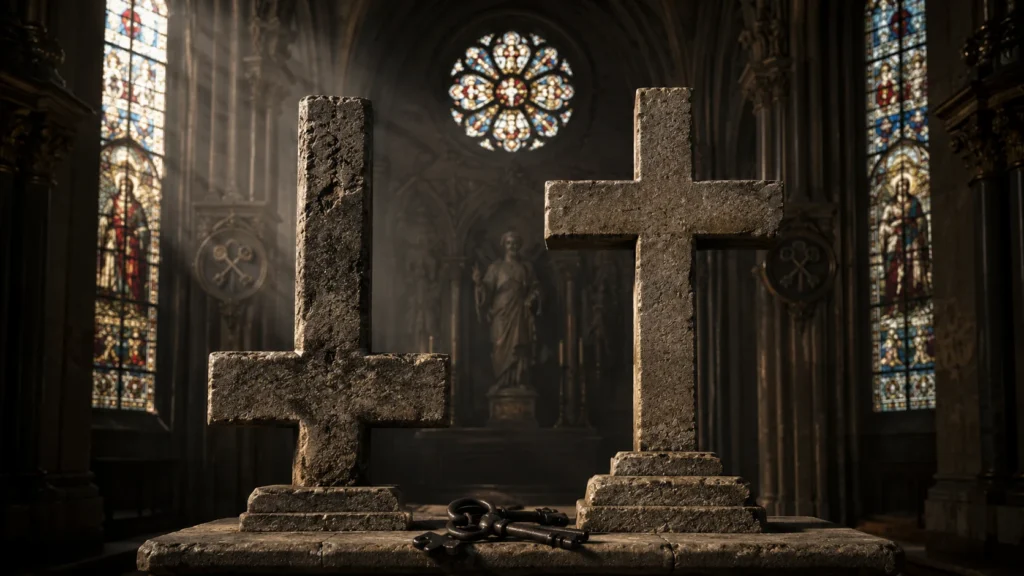
An upside down cross, also known as the Cross of Saint Peter or inverted cross, originally symbolizes humility, sacrifice, and the martyrdom of Saint Peter in Christianity. According to Christian tradition, Saint Peter requested to be crucified upside down because he felt unworthy to die in the same manner as Jesus Christ. While modern media, horror films, and some occult groups have used the upside down cross as an anti-Christian or rebellious symbol, its historical meaning remains deeply rooted in Christian faith and Catholic tradition. The symbol can represent either Christian devotion or anti-religious imagery depending on the context in which it appears.
Few religious symbols generate as much confusion as the upside down cross.
Some people immediately associate it with Satanism, horror movies, or anti-Christian movements. Others recognize it as the Cross of Saint Peter, a respected Christian symbol with roots that stretch back nearly two thousand years.
So what does an upside down cross mean?
The answer depends heavily on context.
Historically, the upside down cross began as a Christian symbol connected to the martyrdom of Saint Peter. Over time, popular culture transformed public perception. Movies, music, and alternative subcultures often presented the symbol in a very different light.
Understanding the true meaning of the upside down cross requires looking beyond modern assumptions and examining its historical origins, religious significance, and cultural evolution.
What Does an Upside Down Cross Mean?
Quick Answer
The upside down cross meaning varies depending on how it is used.
Historically and religiously, the symbol represents:
- Saint Peter’s crucifixion
- Humility before Jesus Christ
- Christian martyrdom
- Faith and devotion
- Self-sacrifice
In modern secular culture, the symbol may also represent:
- Rebellion against religion
- Anti-Christian sentiment
- Occult imagery
- Gothic aesthetics
- Horror symbolism
The original and oldest meaning is Christian rather than Satanic.
Understanding Context Matters
Symbols rarely have only one meaning.
A rose can symbolize love, remembrance, or secrecy depending on the situation. The same principle applies to the upside down cross symbol.
When displayed in a church, cathedral, or religious artwork, it often references Saint Peter. When displayed in horror films or anti-religious imagery, it may carry a completely different message.
Because of this, context is essential when interpreting an inverted cross.
The History of the Inverted Cross Meaning
The Origins of the Christian Cross
Before understanding the inverted cross, it helps to understand the traditional Christian cross.
The cross became Christianity’s most recognizable symbol because of the crucifixion of Jesus Christ. Early Christians viewed it as a symbol of redemption, salvation, sacrifice, and victory over death.
Over centuries, different variations of the cross emerged.
Some examples include:
| Cross Type | Meaning |
|---|---|
| Latin Cross | Traditional Christian cross |
| Greek Cross | Equal-length arms |
| Celtic Cross | Christianity combined with Celtic traditions |
| Jerusalem Cross | Symbol of Christian missions |
| Cross of Saint Peter | Inverted Christian cross |
Among these, the Cross of Saint Peter became one of the most misunderstood.
Who Was Saint Peter?
Saint Peter was one of Jesus Christ’s closest disciples.
Christian tradition identifies him as a leading figure among the apostles and the first bishop of Rome. Many Christian denominations regard him as one of the most influential individuals in early Christianity.
Peter played a central role in spreading Christian teachings throughout the Roman Empire.
His influence became so significant that generations of Christians honored him as a foundational figure of the Church.
The Martyrdom of Saint Peter
The story behind the upside down cross Christianity meaning begins with Peter’s death.
According to early Christian tradition, Roman authorities sentenced Peter to crucifixion during the persecution of Christians.
However, Peter reportedly made an unusual request.
He asked to be crucified upside down.
Why?
He believed he was not worthy to die in the same manner as Jesus Christ.
This act reflected profound humility.
Rather than placing himself on the same level as Christ, Peter chose a different form of execution.
As a result, the inverted cross symbolism became associated with:
- Humility
- Reverence for Jesus
- Self-sacrifice
- Martyrdom
- Christian devotion
This historical account forms the foundation of the Cross of Saint Peter.
The Rise of the Saint Peter Cross
Over time, artists and religious scholars incorporated the inverted cross into Christian iconography.
Churches displayed the symbol in artwork.
Religious texts referenced Peter’s martyrdom.
Christian communities came to recognize the symbol as a reminder of faith under persecution.
Far from being controversial, the symbol served as a respected representation of one of Christianity’s most important figures.
What Does an Inverted Cross Represent in Christianity?
A Symbol of Humility
Perhaps the most important Christian interpretation centers on humility.
Peter’s request demonstrated a belief that no human could equal Jesus Christ.
The upside down cross therefore became a visual expression of spiritual modesty.
Instead of glorifying personal achievement, the symbol encourages believers to recognize a higher authority.
A Symbol of Sacrifice
The persecution of early Christians often required extraordinary courage.
Many believers faced imprisonment, torture, or execution because of their faith.
The upside down cross reminds Christians of those sacrifices.
It symbolizes unwavering commitment even during hardship.
A Symbol of Martyrdom
Martyrdom remains one of the strongest themes associated with Saint Peter.
Throughout Christian history, martyrs have been honored for maintaining their faith despite extreme danger.
The inverted cross serves as a reminder of Peter’s ultimate sacrifice.
A Symbol of Faith Under Persecution
Early Christianity developed during periods of intense opposition.
Roman authorities frequently targeted Christian communities.
Because of this historical reality, the upside down cross also symbolizes perseverance.
It represents maintaining faith even when facing overwhelming challenges.
The Meaning of Upside Down Cross in Catholic Tradition
Catholic Symbolism and Saint Peter
The Catholic Church maintains a particularly strong connection to Saint Peter.
According to Catholic tradition, Peter became the first Pope.
Because of this relationship, the Cross of Saint Peter appears in various Catholic settings.
Examples include:
- Religious artwork
- Historical churches
- Sacred architecture
- Ecclesiastical symbolism
- Educational institutions
Its appearance in these contexts reflects Christian history rather than opposition to Christianity.
Why Some Churches Display an Inverted Cross
Many people feel surprised when they discover an upside down cross inside a church.
The reason is simple.
Within Christian tradition, the symbol honors Saint Peter.
Without knowledge of its history, observers sometimes misinterpret its presence.
However, church usage reflects centuries of Christian symbolism rather than modern popular culture.
Is the Upside Down Cross a Satanic Symbol?
The Short Answer
Not originally.
Historically, the upside down cross emerged as a Christian symbol.
Its association with Satanism developed much later.
How the Association Developed
During the twentieth century, various anti-religious movements adopted Christian imagery and reversed it.
The goal often involved challenging traditional religious authority.
Because the cross represented Christianity, turning it upside down became a visual method of expressing opposition.
This reinterpretation gradually entered popular culture.
As a result, many people began assuming that the inverted cross was inherently Satanic.
The Difference Between Historical Meaning and Modern Usage
Understanding the distinction is crucial.
| Historical Meaning | Modern Alternative Usage |
|---|---|
| Saint Peter | Anti-religious symbolism |
| Humility | Rebellion |
| Christian faith | Shock value |
| Martyrdom | Occult imagery |
| Devotion | Counterculture expression |
Both meanings exist today.
The intended message depends entirely on who is using the symbol and why.
Upside Down Cross Symbol vs Satanic Cross Symbol
Why Many People Confuse the Two
One of the biggest misconceptions surrounding the upside down cross symbol is the belief that it automatically represents Satanism.
This misunderstanding exists because many people first encounter the symbol through horror movies, television shows, video games, or controversial artwork rather than through Christian history.
When a symbol repeatedly appears in frightening or rebellious settings, people naturally begin to associate it with those themes.
However, historical evidence tells a different story.
The Cross of Saint Peter existed centuries before modern Satanic movements emerged. Its Christian roots are far older than its modern pop-culture reputation.
The Inverted Cross and the Satanic Pentagram Are Different Symbols
A common mistake involves treating all occult symbols as if they have identical meanings.
They do not.
Different symbols developed in different historical periods and carry distinct meanings.
| Symbol | Traditional Meaning | Modern Associations |
|---|---|---|
| Cross of Saint Peter | Humility and martyrdom | Christianity, Catholic symbolism |
| Inverted Cross in Anti-Religious Context | Rejection of Christianity | Rebellion, counterculture |
| Pentagram | Ancient spiritual symbol | Occultism, modern Satanism |
| Baphomet Imagery | Esoteric symbolism | Occult traditions |
| Inverted Pentagram | Modern Satanic usage | Satanic organizations |
This distinction matters because symbols often evolve over time.
The upside down cross and the inverted pentagram have different origins, different histories, and different meanings.
Does an Upside Down Cross Mean Evil?
Not necessarily.
A symbol cannot automatically communicate a single universal message.
Consider these examples:
- Inside a cathedral, an upside down cross may honor Saint Peter.
- In a religious history book, it may symbolize Christian martyrdom.
- In a horror movie, it may represent spiritual corruption.
- On an album cover, it may symbolize rebellion or shock value.
The meaning changes according to context.
That is why historians, theologians, and religious scholars emphasize examining how the symbol is being used rather than assuming one interpretation fits every situation.
Inverted Cross Symbolism Throughout History
Early Christian Symbolism
In the earliest centuries of Christianity, symbols served important purposes.
Many Christians lived under persecution. Open displays of faith could be dangerous.
As a result, symbols became powerful visual reminders of religious beliefs.
The Cross of Saint Peter represented:
- Loyalty to Christ
- Courage under persecution
- Spiritual humility
- Sacrifice for faith
- Apostolic authority
These meanings dominated Christian interpretations for centuries.
Medieval Interpretations
During the Middle Ages, Christian art flourished throughout Europe.
Artists frequently depicted biblical figures through symbolic imagery.
Saint Peter often appeared holding keys, representing authority in the Church. In some artworks, he appeared beside an inverted cross to reference his martyrdom.
These images reinforced Peter’s role within Christian history.
Importantly, medieval Christians generally did not view the symbol as evil.
Instead, they saw it as a tribute to one of Christianity’s most respected apostles.
Renaissance and Religious Art
As artistic techniques evolved, religious symbolism became even more sophisticated.
Painters, sculptors, and architects included references to saints throughout churches and cathedrals.
The upside down cross continued to function as an identifier for Saint Peter.
Just as a crown might identify a king or scales might represent justice, the inverted cross helped viewers recognize Peter’s story.
This artistic tradition persisted for hundreds of years.
Modern Reinterpretations
The twentieth century dramatically changed how many people viewed religious symbols.
Several cultural trends contributed to this shift:
- Growth of horror entertainment
- Rise of anti-establishment movements
- Expansion of alternative fashion
- Increased fascination with occult themes
- Commercial use of provocative imagery
These developments introduced new interpretations of the inverted cross.
As a result, many people today know the modern version of the symbol better than the original Christian one.
Why Is the Cross Upside Down in Movies?
Horror Films and Visual Storytelling
Filmmakers rely heavily on visual shortcuts.
A single image can communicate an idea instantly.
Because audiences already associate Christianity with the traditional upright cross, directors often invert the symbol to create tension or unease.
This technique functions as visual symbolism.
The message becomes:
- Something is wrong.
- Religious order has been disrupted.
- Spiritual danger may be present.
The effectiveness comes from audience expectations.
The Influence of Horror Cinema
Several horror genres helped popularize the upside down cross as a symbol of fear.
Common examples include:
- Possession stories
- Exorcism narratives
- Demonic horror films
- Occult thrillers
- Supernatural television series
In these settings, the inverted cross frequently appears as a dramatic visual device.
Over time, repeated exposure reinforced the public perception that the symbol was inherently sinister.
Why Movies Often Ignore Historical Meaning
Entertainment prioritizes emotional impact.
Historical accuracy often becomes secondary.
An upside down cross creates immediate visual tension. Explaining the martyrdom of Saint Peter requires more time and context.
As a result, many films choose the simpler option.
This decision shaped popular understanding of the symbol more than centuries of religious history ever did.
Upside Down Cross Meaning in Heavy Metal and Rock Culture
The Rise of Rebellious Imagery
During the 1960s, 1970s, and 1980s, many musicians sought imagery that challenged social norms.
Religious symbols frequently became part of this strategy.
The inverted cross appeared because it was instantly recognizable.
Its use often reflected:
- Rebellion against authority
- Criticism of organized religion
- Countercultural identity
- Shock value
- Artistic expression
Not every musician used the symbol for the same reason.
Some intended genuine criticism of religion. Others simply wanted provocative imagery.
Metal Music Symbolism and the Inverted Cross
Heavy metal culture frequently embraces dramatic symbolism.
Album covers, stage performances, and merchandise often feature powerful visual themes.
The upside down cross became popular because it communicates intensity and nonconformity.
However, its appearance does not automatically indicate Satanic beliefs.
Many artists use controversial imagery for aesthetic or theatrical purposes rather than spiritual reasons.
Alternative Culture and Gothic Symbolism
The inverted cross also appears in gothic fashion and alternative subcultures.
In these communities, symbols often function as artistic statements.
Common themes include:
- Mystery
- Mortality
- Individualism
- Historical aesthetics
- Dark romanticism
The symbol may serve a stylistic role rather than a religious one.
Context remains essential.
Occult Symbols and Meanings: Where Does the Inverted Cross Fit?
Understanding Occult Symbolism
The word “occult” refers to hidden or esoteric knowledge.
Over time, various traditions developed unique symbolic systems.
These traditions include:
- Hermeticism
- Ceremonial magic
- Alchemy
- Mysticism
- Esoteric philosophy
Many people mistakenly assume every unusual symbol belongs to the occult.
In reality, numerous symbols originated in mainstream religious traditions before acquiring alternative meanings.
The inverted cross is one example.
Modern Occult Usage
Some occult groups have adopted the upside down cross because of its cultural association with religious opposition.
When used in these contexts, the symbol may communicate:
- Rejection of traditional Christianity
- Spiritual independence
- Alternative belief systems
- Symbolic inversion of religious authority
This usage differs significantly from its historical Christian meaning.
Why Symbolism Evolves
Symbols change because cultures change.
Consider how meanings shift across generations.
A gesture, phrase, or image may acquire entirely new interpretations over time.
The upside down cross followed this pattern.
Its original meaning remains historically significant. New meanings emerged later through cultural adaptation.
The Difference Between an Inverted Cross and an Inverted Crucifix
Understanding the Distinction
Many people use these terms interchangeably.
Technically, they are not identical.
A cross is simply the cross itself.
A crucifix includes the figure of Jesus Christ attached to the cross.
| Symbol | Description |
|---|---|
| Cross | Plain cross without figure |
| Crucifix | Cross displaying Jesus Christ |
| Inverted Cross | Cross turned upside down |
| Inverted Crucifix | Crucifix displayed upside down |
Why the Difference Matters
An inverted crucifix often generates stronger reactions.
Because it includes the image of Christ, many viewers interpret it as more confrontational when displayed upside down.
As a result, horror films and controversial artwork frequently use inverted crucifixes rather than simple inverted crosses.
This distinction helps explain why some depictions create more controversy than others.
Cross Turned Upside Down Meaning Across Different Belief Systems
Christian Interpretation
Within Christianity, the upside down cross Christianity meaning remains closely tied to Saint Peter.
Key themes include:
- Humility
- Faith
- Martyrdom
- Sacrifice
- Devotion
Secular Interpretation
Among secular audiences, the symbol may simply represent nonconformity.
Some individuals use it without any religious intention at all.
For them, it functions as a visual statement rather than a spiritual one.
Anti-Religious Interpretation
Certain groups deliberately use the symbol to challenge Christianity.
In these situations, the upside down cross acts as a symbolic reversal of Christian authority.
Artistic Interpretation
Artists often prioritize symbolism over doctrine.
An inverted cross may represent:
- Conflict
- Transformation
- Rebellion
- Contradiction
- Psychological struggle
Artistic interpretations vary widely depending on the creator’s goals.
Common Myths About the Upside Down Cross
Myth: The Upside Down Cross Is Always Satanic
Reality: The symbol originated in Christianity and remains a recognized Christian symbol.
Myth: The Symbol Appears in Christianity as a Sign of Evil
Reality: Christian tradition associates the symbol with Saint Peter’s martyrdom and humility.
Myth: Every Person Wearing an Inverted Cross Rejects Religion
Reality: People wear the symbol for many reasons including fashion, history, art, faith, and personal expression.
Myth: The Symbol Was Created by Satanists
Reality: The Cross of Saint Peter predates modern Satanic movements by many centuries.
Myth: The Meaning Never Changes
Reality: Context determines meaning. Symbols often carry multiple interpretations simultaneously.
Quick Facts About the Upside Down Cross
The upside down cross is one of the most misunderstood symbols in modern culture.
Here are several important facts:
- The symbol is also called the Cross of Saint Peter.
- Its origins are rooted in Christian tradition.
- It represents Peter’s upside-down crucifixion.
- The Catholic Church recognizes its historical significance.
- Modern media helped popularize anti-Christian interpretations.
- Context determines how the symbol should be understood.
- The symbol existed long before modern Satanism.
- Religious art used the symbol for centuries.
What Does an Upside Down Cross Mean Today?
A Symbol With Multiple Interpretations
The modern world views symbols through many different lenses.
Unlike earlier periods of history, today’s culture blends religion, entertainment, social media, fashion, art, and personal expression. As a result, a single symbol can communicate several meanings at the same time.
The upside down cross is a perfect example.
Some people see the Cross of Saint Peter.
Others see horror movie imagery.
Some associate it with anti-Christian symbolism.
Others recognize it as a historical Christian emblem connected to martyrdom and humility.
This overlap explains why discussions about the symbol often create confusion.
The Importance of Historical Context
When historians analyze symbols, they typically begin with origins.
The oldest documented meaning of the inverted cross comes from Christian tradition and the story of Saint Peter’s crucifixion.
That historical foundation matters because it provides the original context for understanding the symbol.
While later generations introduced new interpretations, the symbol’s earliest significance remains tied to Christianity.
Ignoring that history would be like discussing a country’s flag without mentioning the nation that created it.
Why Context Is Everything
Imagine seeing an upside down cross in these different settings:
| Location | Likely Meaning |
|---|---|
| Catholic church | Saint Peter symbolism |
| Religious artwork | Christian martyrdom |
| Theology book | Church history |
| Horror movie | Spiritual corruption or fear |
| Metal concert | Rebellion or artistic expression |
| Fashion accessory | Style or personal identity |
| Anti-religious protest | Opposition to Christianity |
The symbol itself remains the same.
The surrounding context changes its message.
That reality explains why people often disagree about what the upside down cross represents.
Upside Down Cross Meaning vs Common Misconceptions
What People Think
Many internet users search phrases such as:
- Is upside down cross a satanic symbol?
- Does upside down cross mean evil?
- Why is the cross upside down in movies?
- What does an inverted cross represent?
These questions reveal how widespread the confusion has become.
Popular culture frequently presents the symbol in negative settings. Consequently, many people assume that interpretation is the only correct one.
What History Shows
Historical evidence points to a more nuanced answer.
The Cross of Saint Peter originated as a Christian symbol connected to:
- Humility
- Faith
- Sacrifice
- Martyrdom
- Respect for Jesus Christ
The anti-Christian interpretation emerged much later.
This does not mean modern interpretations are irrelevant. It simply means they are not the original meaning.
Why Understanding Symbolism Matters
Symbols influence culture.
They shape beliefs, emotions, and perceptions.
Misunderstanding a symbol can lead people to misunderstand history itself.
Learning the true history of the upside down cross helps separate historical facts from modern assumptions.
Inverted Cross Meaning Compared to Other Christian Symbols
How the Symbol Fits Within Christian Iconography
Christianity contains many powerful visual symbols.
Each serves a unique purpose.
Some emphasize hope. Others highlight sacrifice. Some focus on resurrection, redemption, or divine authority.
The inverted cross belongs to a larger tradition of symbolic storytelling.
Comparison of Major Christian Symbols
| Symbol | Primary Meaning | Connection to Christianity |
|---|---|---|
| Latin Cross | Crucifixion and salvation | Central Christian symbol |
| Crucifix | Christ’s sacrifice | Common in Catholic tradition |
| Fish Symbol (Ichthys) | Early Christian identity | Ancient Christian symbol |
| Dove | Holy Spirit and peace | Biblical symbolism |
| Crown of Thorns | Christ’s suffering | Passion narrative |
| Saint Peter’s Cross | Humility and martyrdom | Linked to Saint Peter |
| Empty Tomb | Resurrection | Easter symbolism |
This comparison highlights an important point.
The upside down cross developed within Christian symbolism rather than outside it.
Its historical role complements other Christian symbols instead of opposing them.
The Lasting Legacy of Saint Peter’s Cross
Why the Story Endures
Thousands of years have passed since the era of the apostles.
Yet the story of Saint Peter continues to resonate.
His decision to be crucified upside down symbolizes something timeless.
It reflects:
- Personal humility
- Commitment to faith
- Courage during persecution
- Respect for spiritual principles
- Willingness to sacrifice for belief
These themes remain relevant regardless of religious affiliation.
A Symbol That Transcends Time
Many historical symbols disappear.
Others survive because they continue to inspire discussion.
The upside down cross belongs to the second category.
Its meaning has evolved.
Its interpretation has expanded.
Its cultural impact continues to grow.
Few religious symbols have traveled such a remarkable journey from ancient Rome to modern popular culture.
Why It Remains Relevant
Today’s audiences encounter the inverted cross through:
- Religious studies
- Church history
- Films
- Television
- Music
- Literature
- Social media
- Fashion
- Art
Because the symbol appears in so many places, curiosity about its meaning remains high.
Understanding its origins helps people interpret those appearances more accurately.
Frequently Asked Questions
What Does an Upside Down Cross Mean?
The upside down cross originally symbolizes the martyrdom of Saint Peter. Christian tradition states that Peter requested to be crucified upside down because he felt unworthy to die in the same manner as Jesus Christ.
Is the Upside Down Cross a Satanic Symbol?
Not originally.
The symbol began as a Christian emblem associated with Saint Peter. Later cultural movements, occult groups, and entertainment media adopted the image for different purposes.
What Does an Inverted Cross Represent in Christianity?
In Christianity, the inverted cross represents:
- Humility
- Faith
- Martyrdom
- Sacrifice
- Devotion to Christ
Why Was Saint Peter Crucified Upside Down?
According to Christian tradition, Peter requested an upside-down crucifixion because he believed he was not worthy to die in the same way as Jesus Christ.
Does an Upside Down Cross Mean Evil?
No.
The symbol itself does not inherently represent evil.
Its meaning depends on context. Historically, it served as a Christian symbol. Modern usage varies significantly.
What Is the Difference Between a Cross of Saint Peter and an Inverted Cross?
In most cases, these terms refer to the same symbol.
The phrase “Cross of Saint Peter” emphasizes the Christian historical meaning. The term “inverted cross” is more general and may refer to any upside-down cross regardless of context.
Why Is the Upside Down Cross Used in Horror Movies?
Filmmakers often use the symbol because audiences associate it with religious inversion and spiritual conflict. This visual shorthand creates tension and suspense.
Is the Upside Down Cross Mentioned in the Bible?
The Bible does not explicitly describe Peter being crucified upside down.
The story comes from early Christian tradition and historical writings that developed after the New Testament period.
Can Christians Use the Upside Down Cross?
Many Christians do.
When used as the Cross of Saint Peter, the symbol reflects Christian history, humility, and martyrdom.
Why Do Some People Wear an Inverted Cross Necklace?
Reasons vary.
Some wear it for religious purposes connected to Saint Peter. Others wear it as a fashion accessory, artistic statement, or expression of personal identity.
Final Verdict
The answer is both simple and surprisingly complex.
Historically, the upside down cross meaning is rooted in Christianity. Known as the Cross of Saint Peter, it commemorates the martyrdom of Saint Peter, who according to Christian tradition requested to be crucified upside down out of humility and respect for Jesus Christ.
Over the centuries, the inverted cross meaning expanded beyond its original religious context. Popular culture, horror films, gothic fashion, heavy metal imagery, and some anti-religious movements adopted the symbol and gave it new interpretations.
That evolution explains why the symbol remains widely misunderstood today.
The most important fact to remember is this:
The original meaning of the upside down cross is Christian, not Satanic.
Whether it represents faith, humility, rebellion, artistic expression, or religious opposition depends entirely on how and where it is being used.
Understanding that distinction provides the clearest answer to the question, “What does an upside down cross mean?”
For some, it remains a powerful symbol of Saint Peter’s sacrifice.
For others, it represents modern cultural ideas.
Either way, the upside down cross continues to be one of the most fascinating and debated symbols in religious history.

Michael Anderson is a content writer specializing in word meanings, definitions and clear explanations of modern terms and phrases.