
Last Updated on June 15, 2026
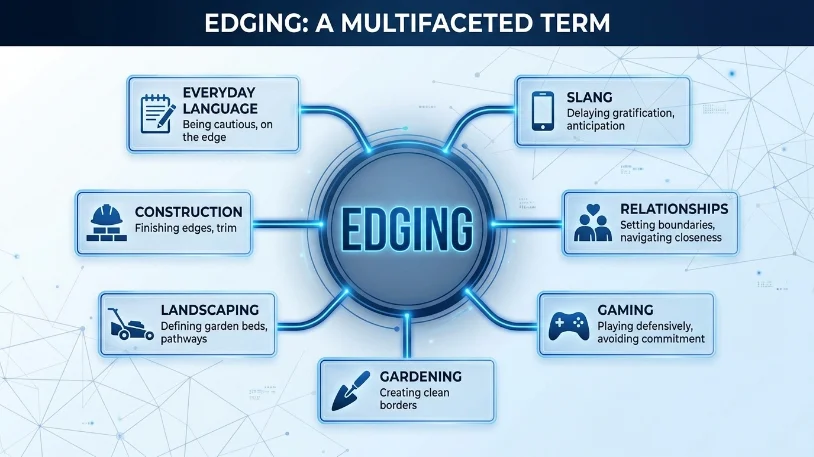
Edging is a term with several meanings depending on the context. In everyday language, it refers to moving something toward an edge or boundary. In gardening and landscaping, edging means creating a border around lawns, flower beds, or pathways. In gaming and sports, it can describe gaining a slight advantage or coming close to a desired result. In modern slang, edging commonly refers to intentionally delaying a climax to extend excitement or anticipation. Understanding the context is essential because the meaning changes across different situations.
What Does Edging Mean?
If you’ve recently seen the word edging online, in a conversation, on social media, or while reading about gardening or gaming, you may be wondering what it actually means.
The truth is that edging has multiple meanings. Its definition changes depending on the context in which people use it.
In the broadest sense, edging refers to approaching a boundary, limit, or edge. The term comes from the word edge, which describes the outer boundary of an object or area.
Over time, the word developed several specialized meanings across different industries, hobbies, and internet communities.
Today, edging may refer to:
- A slang expression
- A relationship-related practice
- A gardening technique
- A landscaping method
- A gaming situation
- A sports scenario
- A construction process
- A woodworking technique
Because of these different uses, context matters more than the word itself.
Edging Definition at a Glance
| Context | Meaning |
|---|---|
| General English | Moving toward an edge or boundary |
| Slang | A specific form of delayed gratification |
| Relationships | Extending anticipation or excitement |
| Gaming | Gaining a narrow advantage |
| Sports | Winning or succeeding by a small margin |
| Gardening | Creating borders around lawns or beds |
| Landscaping | Defining boundaries using materials or designs |
| Construction | Finishing or defining edges |
| Woodworking | Refining or shaping edges |
Although the meanings vary, they all share one central concept:
Approaching a limit, border, or threshold without fully crossing it.
That common theme connects nearly every use of the word.
Edging Meaning in Slang
In modern internet slang, edging most commonly refers to a practice involving delayed gratification.
The term gained popularity through online discussions, memes, social media platforms, and internet forums.
In slang usage, edging generally describes intentionally stopping just before reaching a desired outcome in order to prolong anticipation, excitement, or intensity.
Many people use the word casually in jokes or memes without discussing its original meaning directly.
For example:
- “He’s been edging toward the announcement for weeks.”
- “The trailer keeps edging viewers without revealing the ending.”
In these examples, the word is used metaphorically to describe building suspense.
As internet culture evolved, slang usage expanded beyond its original context and began appearing in everyday conversations.
What Does Edging Mean in Relationships?
Within relationships, edging often relates to anticipation and delayed satisfaction.
The broader concept revolves around extending excitement rather than rushing toward an immediate outcome.
Many relationship experts discuss anticipation as an important part of attraction and emotional connection.
Examples include:
- Planning surprises
- Building excitement before events
- Gradually revealing information
- Extending romantic anticipation
In this sense, edging becomes less about a specific action and more about creating a stronger emotional experience through patience and timing.
Humans naturally respond to anticipation.
Sometimes the wait becomes just as enjoyable as the reward itself.
Why Is It Called Edging?
The word comes directly from edge.
An edge represents a boundary, limit, border, or threshold.
The verb form “to edge” means moving closer to a boundary.
Examples include:
- Edging toward a finish line
- Edging closer to victory
- Edging along a wall
- Edging toward a decision
Over time, people began using the word figuratively.
Instead of describing physical boundaries, it started describing emotional, psychological, competitive, and situational limits.
That evolution led to the modern meanings people recognize today.
Edging Meaning in Psychology
From a psychological perspective, edging often relates to anticipation, delayed gratification, and reward systems.
Researchers have long studied how anticipation affects human behavior.
When people expect a reward, their attention often increases.
They become more engaged with the process.
This phenomenon appears in many areas of life:
- Entertainment
- Sports
- Relationships
- Marketing
- Goal setting
- Personal achievement
Think about waiting for the release of a highly anticipated movie.
The excitement before the premiere can sometimes feel almost as rewarding as watching the film itself.
That emotional buildup demonstrates the power of anticipation.
Edging often relies on this same psychological principle.
What Does Edging Mean in Gaming?
Gaming communities frequently use edging in a completely different way.
In competitive gaming, the term can describe:
- Slowly gaining an advantage
- Moving closer to victory
- Narrowly outperforming opponents
- Improving position incrementally
For example:
A commentator might say a team is “edging ahead” during a close match.
This means one team has gained a slight lead but the competition remains tight.
Examples include:
- Edging toward first place
- Edging out a competitor
- Edging ahead on points
- Edging closer to a win
Gamers often hear these phrases during tournaments and esports broadcasts.
Edging Meaning in Sports
Sports commentators have used the term for decades.
In sports, edging usually means defeating someone by a small margin.
Examples:
- A team edges its rival 2–1.
- A runner edges ahead in the final seconds.
- A golfer edges into first place.
The emphasis is on closeness.
The victory exists, but only by a narrow difference.
Sports headlines commonly use this wording because it quickly communicates a competitive result.
What Does Edging Mean in Gardening?
Gardening introduces another entirely different meaning.
Here, edging refers to creating a clear border between different areas of a landscape.
For example:
- Separating grass from flower beds
- Defining pathways
- Creating decorative boundaries
- Preventing lawn spread
Garden edging improves both appearance and maintenance.
A well-defined edge creates a cleaner and more organized landscape.
Common garden edging materials include:
- Stone
- Brick
- Wood
- Metal
- Plastic
- Concrete
Many homeowners use edging to increase curb appeal and simplify lawn care.
Types of Garden Edging
Stone Edging
Stone provides a natural appearance.
It blends well with traditional gardens and outdoor spaces.
Brick Edging
Brick offers durability and a classic aesthetic.
Many homeowners choose it for formal landscapes.
Metal Edging
Metal creates crisp, modern lines.
It works especially well in contemporary landscape designs.
Plastic Edging
Plastic remains one of the most affordable options.
It is lightweight and easy to install.
Concrete Edging
Concrete delivers long-term durability.
It can also be customized into various shapes and styles.
Edging Meaning in Landscaping
Landscaping professionals use edging as a design tool.
Its primary purpose is to separate different landscape elements.
Examples include:
- Lawn from mulch
- Lawn from gravel
- Garden from pathway
- Flower bed from driveway
Benefits of landscape edging include:
| Benefit | Explanation |
|---|---|
| Better appearance | Creates visual structure |
| Easier maintenance | Reduces overgrowth |
| Improved organization | Defines spaces clearly |
| Weed control | Helps limit spreading |
| Property value | Enhances curb appeal |
A simple border can dramatically improve the appearance of an outdoor space.
What Does Edging Mean in Construction?
Construction workers often use the term when discussing finishing processes.
Edging can involve:
- Defining boundaries
- Refining surfaces
- Creating smooth transitions
- Improving appearance and safety
Concrete projects frequently require edge finishing.
A properly finished edge reduces damage and creates a cleaner final result.
Common examples include:
- Sidewalk edges
- Driveway edges
- Patio borders
- Concrete slabs
Without proper edging, surfaces may appear unfinished or become more vulnerable to wear.
Edging in Woodworking
Woodworkers use edging to improve the appearance and durability of materials.
Typical edging tasks include:
- Smoothing rough edges
- Applying edge bands
- Creating decorative profiles
- Protecting exposed surfaces
Furniture manufacturers often add edge treatments to improve aesthetics.
These finishing touches can significantly enhance the final product.
A simple edge treatment can transform an ordinary board into a polished piece of furniture.
Common Phrases That Use the Word Edge
Many everyday expressions use the same root word.
Examples include:
Edge Ahead
To gain a slight advantage.
Edge Out
To defeat someone by a small margin.
Edge Closer
To gradually approach a goal.
On Edge
Feeling nervous or anxious.
Cutting Edge
Refers to the latest innovations or technology.
Although these phrases differ, they all relate to boundaries, limits, or advancement.
Why the Meaning of Edging Depends on Context
Language evolves constantly.
Words often develop multiple meanings over time.
Edging represents a perfect example.
The same word can mean:
- A landscaping technique
- A construction process
- A gaming situation
- A sports result
- A slang expression
- A psychological concept
Without context, misunderstanding becomes easy.
Always look at surrounding words and the topic being discussed.
Context reveals which definition applies.
Common Misconceptions About Edging
Many people assume edging only has one meaning.
That assumption is incorrect.
Here are several common misconceptions:
Misconception: Edging Is Only Slang
Reality: The word existed long before internet slang became popular.
Misconception: Edging Is Always Relationship Related
Reality: Gardening, sports, gaming, and construction all use the term.
Misconception: The Meaning Never Changes
Reality: Context completely changes the definition.
Misconception: It Is a New Word
Reality: Variations of the word have existed for centuries.
Understanding these distinctions prevents confusion.
Examples of Edging Used in Sentences
Here are examples from different contexts:
General Usage
- The cat kept edging closer to the doorway.
Sports Usage
- The home team edged ahead in the final minute.
Gaming Usage
- The player slowly edged toward the top ranking.
Gardening Usage
- We installed stone edging around the flower bed.
Landscaping Usage
- Landscape edging improved the yard’s appearance.
Each sentence uses the same word while conveying a different meaning.
Frequently Asked Questions
What does edging mean in slang?
In slang, edging generally refers to intentionally delaying a desired outcome to prolong anticipation, excitement, or intensity.
What does edging mean in gaming?
In gaming, edging often means gaining a small advantage or moving gradually toward victory.
What does edging mean in sports?
It usually means winning or leading by a narrow margin.
What does edging mean in gardening?
Gardening edging involves creating borders around lawns, flower beds, pathways, and landscape features.
Why is edging called edging?
The word comes from “edge,” meaning a boundary or limit. Most definitions involve approaching or defining a boundary in some way.
Is edging always a slang term?
No. The word has established meanings in landscaping, gardening, construction, woodworking, sports, and everyday English.
Conclusion
So, what does edging mean?
The answer depends entirely on context.
In its simplest form, edging refers to approaching, defining, or operating near a boundary, threshold, or limit. From gardening and landscaping to sports, gaming, psychology, and modern slang, the term has evolved into several specialized meanings.
Despite these differences, a common thread connects them all: the idea of moving toward an edge, limit, or desired outcome without immediately crossing it.
Understanding the surrounding context allows you to identify the correct definition quickly and avoid confusion when encountering the word online or in everyday conversation.

Sophia Bennett is a professional writer focused on explaining word meanings, expressions and everyday language in a simple and engaging way.