Last Updated on June 24, 2026
What does proficient mean? Proficient means having a high level of skill, knowledge, or competence in a particular activity, subject, or task. A proficient person can perform something effectively and independently because they have gained experience and understanding through practice. The word often describes language ability, job skills, computer knowledge, education levels, and professional expertise. Being proficient means you are skilled and capable, though not necessarily an expert.
You have probably seen the word proficient on resumes, job applications, school report cards, language tests, or online courses. It appears almost everywhere because it describes something that people constantly try to improve: their skills and abilities.
So, what does proficient mean?
In simple terms, proficient means being highly skilled, knowledgeable, and capable of performing something well. A proficient person understands a task thoroughly and can usually complete it correctly without constant guidance.
For example:
- A proficient writer can communicate ideas clearly.
- A proficient driver handles a vehicle confidently and safely.
- A proficient programmer writes code efficiently and solves technical problems.
- A proficient English speaker can communicate comfortably in most situations.
At its core, proficiency combines several qualities:
- Knowledge
- Practical experience
- Competence
- Efficiency
- Confidence
- Consistent performance
Think about learning to ride a bicycle.
At first, you wobble and struggle to balance. After enough practice, you can ride comfortably, steer smoothly, and react naturally to obstacles. At that point, you have become proficient.
The same principle applies to almost every skill in life.
Proficiency is not perfection. It is the ability to perform something competently, confidently, and independently.
Proficient Definition and Meaning in English
The proficient definition refers to someone who has developed a strong level of skill or competence through learning and practice.
The word generally describes a person who:
- Understands a subject well
- Possesses practical experience
- Performs tasks effectively
- Requires little supervision
- Demonstrates consistent results
A proficient person has moved beyond the beginner stage. They no longer rely heavily on instructions because they have developed confidence and competence.
Simple Definition
Proficient: Having a high degree of skill, competence, or knowledge in a particular area.
Meaning in Plain English
If someone is proficient at something, they are good at it because they have spent time learning and practicing.
Examples:
- She is proficient in accounting.
- He is proficient in graphic design.
- They are proficient in project management.
In each example, the individual has gained enough experience to perform effectively.
What Is the Meaning of Proficient in Everyday Life?
Many people assume proficiency only applies to careers or education. In reality, proficiency appears in everyday situations.
Consider these examples:
Cooking
A beginner follows recipes step by step.
A proficient cook understands ingredients, adjusts seasoning naturally, and prepares meals without needing detailed instructions.
Driving
A beginner concentrates on every movement.
A proficient driver handles traffic confidently and reacts smoothly to changing conditions.
Using Technology
A beginner struggles to locate features.
A proficient computer user quickly navigates programs and solves basic technical issues independently.
Communication
A beginner speaker searches for words constantly.
A proficient speaker communicates ideas naturally and responds confidently during conversations.
These examples reveal an important truth.
Proficiency develops through repeated practice and real-world application.
Nobody becomes proficient instantly.
It happens gradually.
Knowledge grows.
Experience increases.
Confidence builds.
Eventually, the skill feels natural.
Understanding the Core Elements of Proficiency
The meaning of proficient becomes clearer when you examine its building blocks.
Knowledge
Knowledge is understanding facts, concepts, and information.
For example, a proficient accountant understands financial principles and accounting standards.
Practical Experience
Knowledge alone is not enough.
A person becomes proficient by applying information repeatedly.
Someone may understand photography theory but still lack proficiency if they rarely use a camera.
Competence
Competence means performing tasks accurately and effectively.
A proficient employee consistently delivers reliable work.
Efficiency
Proficient individuals often complete tasks faster because they know what works.
They avoid common mistakes and use better techniques.
Confidence
Confidence comes from experience.
Proficient people usually trust their abilities because they have practiced enough to understand what they are doing.
Consistency
Anyone can perform well once.
Proficiency means producing good results repeatedly.
The Origin of the Word Proficient
Understanding a word’s history often helps clarify its meaning.
The word proficient comes from the Latin word proficere, which means:
- To advance
- To make progress
- To move forward
That origin perfectly describes proficiency.
A proficient person is someone who has progressed beyond basic understanding and developed meaningful competence.
The word itself suggests improvement and advancement.
Proficiency is not a fixed state.
It is the result of continuous learning and practical development.
How to Pronounce Proficient
Many people know the meaning of proficient but hesitate when saying it aloud.
Pronunciation
Proficient
Pronounced as:
pruh-FISH-uhnt
Phonetic spelling:
/prəˈfɪʃənt/
The emphasis falls on the second syllable:
pro-FISH-ent
Pronunciation Breakdown
| Part | Sound |
|---|---|
| Pro | pruh |
| Fi | fish |
| Cient | uhnt |
Helpful Memory Trick
Think of the phrase:
“Pro fish hunt.”
Although the phrase has no connection to the definition, it can help you remember the pronunciation pattern.
What Does Proficient Mean in Simple Terms?
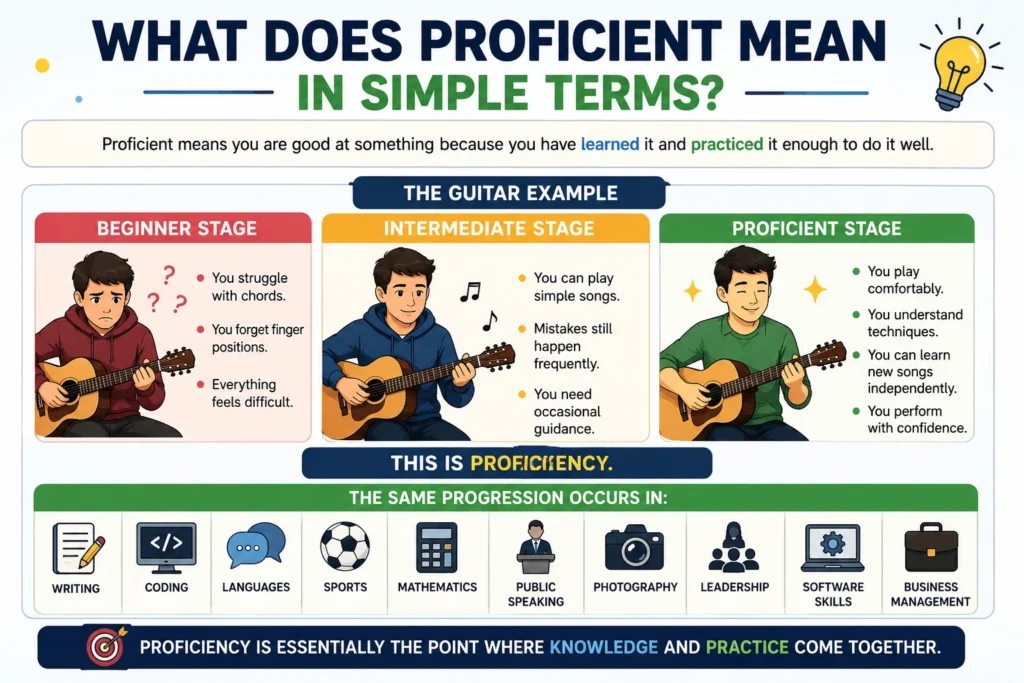
Sometimes dictionary definitions sound complicated.
Here is the simplest explanation:
Proficient means you are good at something because you have learned it and practiced it enough to do it well.
Imagine learning to play the guitar.
Beginner Stage
You struggle with chords.
You forget finger positions.
Everything feels difficult.
Intermediate Stage
You can play simple songs.
Mistakes still happen frequently.
You need occasional guidance.
Proficient Stage
You play comfortably.
You understand techniques.
You can learn new songs independently.
You perform with confidence.
This is proficiency.
The same progression occurs in:
- Writing
- Coding
- Languages
- Sports
- Mathematics
- Public speaking
- Photography
- Leadership
- Software skills
- Business management
Proficiency is essentially the point where knowledge and practice come together.
What Does Proficient Mean Compared With Simply Knowing Something?
Knowing something and being proficient are not the same.
Many people confuse these concepts.
Example: Swimming
Knowing how to swim:
- Understands basic techniques
- Can move through water
- May struggle in challenging situations
Being proficient at swimming:
- Swims confidently
- Uses proper techniques
- Maintains endurance
- Adapts to different environments
Example: Using Excel
Knowing Excel:
- Creates spreadsheets
- Enters information
- Performs simple calculations
Being proficient in Excel:
- Builds formulas
- Uses advanced functions
- Creates charts
- Analyzes data efficiently
- Solves problems independently
Comparison Table
| Aspect | Knowing Something | Being Proficient |
|---|---|---|
| Understanding | Basic | Advanced |
| Experience | Limited | Extensive |
| Independence | Low | High |
| Confidence | Moderate | Strong |
| Problem Solving | Limited | Effective |
| Performance | Inconsistent | Reliable |
This distinction matters because employers, teachers, and organizations often seek proficiency rather than simple familiarity.
Why the Word Proficient Matters
The word proficient carries significant meaning in modern life.
People use it to evaluate abilities and determine readiness.
Employers use proficiency to assess candidates.
Schools use proficiency to measure learning outcomes.
Language examinations use proficiency levels to classify communication abilities.
Professional certifications often require demonstrated proficiency.
Because of this, understanding the meaning of proficient helps you:
- Describe your skills accurately
- Understand job requirements
- Set realistic learning goals
- Evaluate your own abilities
- Communicate qualifications effectively
The term often acts as a bridge between learning and mastery.
You know enough to perform effectively, yet you still have room to grow.
Signs That Someone Is Proficient
How do you know when someone has reached proficiency?
Several indicators usually appear.
They Work Independently
Proficient individuals need minimal supervision.
They understand procedures and make informed decisions.
They Solve Problems
Problems no longer create panic.
They use knowledge and experience to find solutions.
They Perform Consistently
Good performance happens repeatedly rather than occasionally.
They Learn Faster
Because they possess a strong foundation, proficient people often acquire advanced skills more easily.
Adapt
They can handle unfamiliar situations because they understand underlying principles.
They Help Others
Many proficient individuals guide beginners because they understand both theory and practice.
Common Areas Where People Become Proficient
Proficiency can develop in almost every field.
Language Proficiency
- Speaking
- Reading
- Writing
- Listening
- Translation
Computer Proficiency
- Word processing
- Spreadsheet software
- Presentation tools
- Data analysis
- Programming
Professional Skills
- Leadership
- Project management
- Communication
- Negotiation
- Problem-solving
Academic Skills
- Reading comprehension
- Mathematics
- Research
- Writing
- Scientific reasoning
Creative Skills
- Photography
- Graphic design
- Music
- Video editing
- Drawing
Personal Development Skills
- Time management
- Decision-making
- Critical thinking
- Organization
- Public speaking
Every area follows the same pattern.
Learning leads to practice.
Practice leads to competence.
Competence leads to proficiency.
And proficiency opens the door to expertise.
A Simple Formula for Understanding Proficient Meaning
You can remember the meaning of proficient with this formula:
Knowledge + Practice + Experience + Consistency = Proficiency
Remove any one of these elements and proficiency weakens.
Someone may have knowledge without experience.
Another person may have experience but lack understanding.
True proficiency develops when all elements work together.
That is why becoming proficient takes time.
It is not a shortcut.
It is a process of continuous improvement and practical application.
Key Facts About Proficiency
| Fact | Explanation |
|---|---|
| Proficiency is learned | People develop proficiency through practice |
| Proficiency is measurable | Schools and employers often evaluate it |
| Proficiency is practical | It focuses on performing tasks effectively |
| Proficiency is not perfection | Mistakes still happen occasionally |
| Proficiency can improve | Skills continue developing over time |
| Proficiency applies everywhere | It exists in education, work, and daily life |
What Does Proficient Mean in Different Contexts?
The meaning of proficient changes slightly depending on the situation. The core idea remains the same. A proficient person possesses strong knowledge and practical ability. However, proficiency can look different in education, languages, technology, and professional environments.
Understanding these contexts helps you use the word correctly.
What Does Proficient Mean in Skills?
When people ask, “What does proficient mean in skills?”, they usually want to know whether being proficient means being good, advanced, or expert.
In skills, proficient means you can perform tasks effectively and independently.
For example, someone who is proficient in graphic design can:
- Use professional design software confidently
- Apply design principles correctly
- Create projects with minimal supervision
- Solve design problems independently
- Produce consistent results
A proficient skill level usually means:
| Characteristic | Description |
|---|---|
| Knowledge | Strong understanding of concepts |
| Experience | Significant practical exposure |
| Independence | Works without constant help |
| Performance | Produces reliable results |
| Problem Solving | Handles challenges effectively |
A proficient person does not simply know what to do.
They know how to do it and when to apply their knowledge.
What Does Proficient Mean in English?
The phrase proficient in English appears on resumes, university applications, and language tests.
It generally means a person can communicate comfortably and effectively in English.
An English-proficient individual can usually:
- Understand conversations
- Read books and articles
- Write clearly
- Participate in discussions
- Express ideas confidently
This does not mean the person knows every word in the language.
Even native speakers continuously learn new vocabulary.
Language proficiency means functional and effective communication.
For example:
A person who can:
- Understand instructions
- Write emails
- Participate in meetings
- Explain ideas clearly
is generally considered proficient in English.
What Does Proficient Mean in Reading?
Reading proficiency involves more than simply recognizing words.
A proficient reader can:
- Understand main ideas
- Interpret information
- Identify details
- Draw conclusions
- Analyze meaning
- Read efficiently
Imagine two students reading the same article.
The first student reads every sentence but struggles to explain the message.
The second student understands the topic, identifies key arguments, and summarizes the information.
The second student demonstrates reading proficiency.
What Does Proficient Mean in Writing?
Writing proficiency means communicating ideas clearly, accurately, and effectively.
A proficient writer can:
- Organize thoughts logically
- Use appropriate vocabulary
- Write clearly
- Adjust writing style for different audiences
- Explain ideas effectively
Writing proficiency does not require perfect grammar.
Instead, it requires communication that is understandable and purposeful.
A proficient writer can produce:
- Essays
- Reports
- Emails
- Articles
- Professional documents
without needing extensive assistance.
What Does Proficient Mean in Speaking?
Speaking proficiency refers to verbal communication ability.
A proficient speaker can:
- Express ideas clearly
- Participate in conversations naturally
- Explain concepts effectively
- Understand questions quickly
- Adapt language to different situations
For example, a proficient public speaker can:
- Organize thoughts quickly
- Speak confidently
- Engage an audience
- Respond to unexpected questions
Speaking proficiency combines knowledge, confidence, and practical communication skills.
What Does Proficient Mean in Education?
Educational systems frequently use the word proficient.
Students often see it on assessments and report cards.
In education, proficient usually means:
Meeting or exceeding expected academic standards.
A proficient student demonstrates:
- Strong understanding
- Appropriate skills
- Effective application of knowledge
- Consistent performance
Schools may use categories such as:
| Performance Level | General Meaning |
|---|---|
| Beginning | Limited understanding |
| Developing | Partial understanding |
| Proficient | Meets expectations |
| Advanced | Exceeds expectations |
Being proficient in school usually indicates that students understand material at the expected grade level.
What Does Proficient Mean at Work?
The workplace uses the word proficient frequently.
Job descriptions often require:
- Proficient communication skills
- Proficient computer skills
- Proficient analytical skills
- Proficient leadership abilities
At work, proficiency means:
- Completing tasks accurately
- Working independently
- Solving problems efficiently
- Producing reliable outcomes
Employers value proficiency because proficient employees require less supervision and adapt more quickly.
A proficient project manager, for example, can:
- Organize tasks
- Lead teams
- Manage deadlines
- Communicate effectively
- Handle challenges calmly
What Does Proficient Mean in Computer Skills?
Computer proficiency has become increasingly important.
Being proficient in computer skills means more than knowing how to turn on a computer.
Computer proficiency may include:
- Word processing
- Spreadsheet management
- Presentation software
- Email communication
- Data organization
- Internet research
- File management
- Problem-solving
Someone proficient in spreadsheet software can:
- Build formulas
- Create charts
- Analyze information
- Organize large amounts of data
Computer proficiency combines knowledge and practical application.
What Does Proficient Mean in Professional Development?
Professional proficiency refers to the ability to perform occupational responsibilities competently.
Professionals become proficient through:
- Education
- Training
- Experience
- Continuous improvement
Examples include:
Proficient Teacher
- Explains concepts clearly
- Manages classrooms effectively
- Adapts teaching methods
Proficient Engineer
- Applies technical principles accurately
- Solves complex problems
- Follows industry standards
Proficient Manager
- Leads teams effectively
- Makes informed decisions
- Communicates strategically
Professional proficiency often leads to:
- Promotions
- Greater responsibilities
- Increased trust
- Career advancement opportunities
What Does “Proficient in Something” Actually Mean?
People frequently use phrases like:
- Proficient in marketing
- Proficient in coding
- Proficient in accounting
- Proficient in Spanish
But what does “proficient in something” truly mean?
It means the person:
- Understands the subject well
- Applies knowledge effectively
- Works independently
- Performs consistently
- Solves relevant problems
Consider someone who is proficient in photography.
That person likely understands:
- Camera settings
- Lighting techniques
- Composition principles
- Editing software
- Different photography styles
More importantly, they can apply this knowledge practically.
They do not simply memorize information.
They know how to use it.
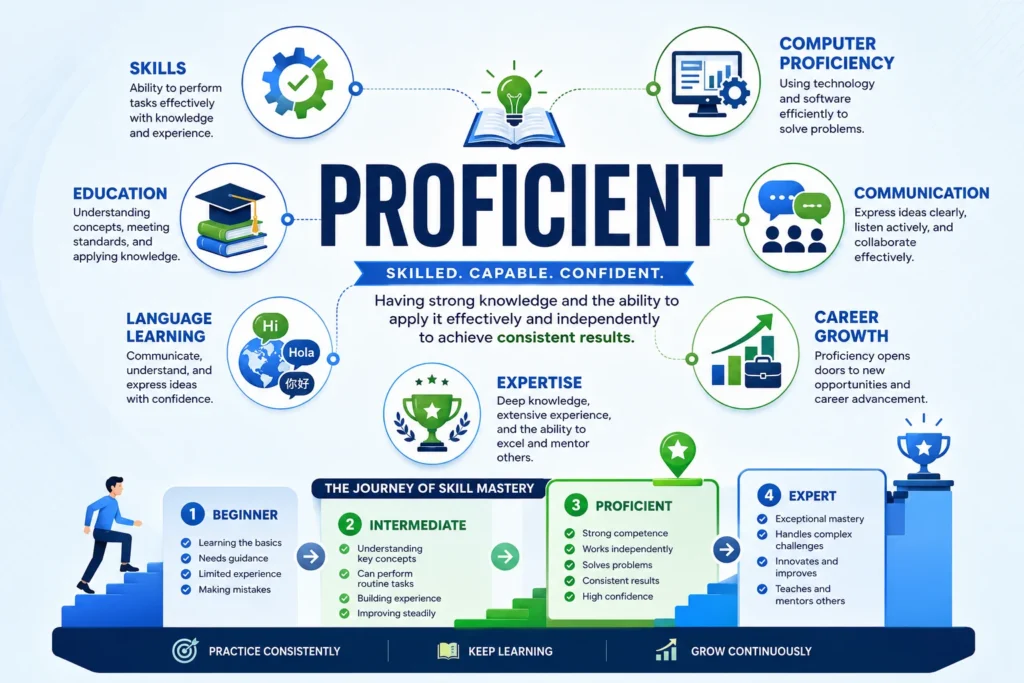
Proficient vs Beginner vs Intermediate vs Advanced
Skill development often follows stages.
Understanding these levels makes the meaning of proficient much clearer.
Beginner
Beginners possess limited experience.
They often:
- Need instructions
- Make frequent mistakes
- Require supervision
- Focus on fundamentals
Examples:
- First-time drivers
- New language learners
- People learning software
Intermediate
Intermediate individuals understand basic concepts.
They can:
- Complete routine tasks
- Work independently in simple situations
- Apply fundamental knowledge
However, challenges still create difficulties.
They continue learning.
Proficient
Proficient individuals demonstrate:
- Strong competence
- Significant experience
- Confidence
- Independence
- Consistency
They can:
- Solve problems
- Apply knowledge effectively
- Adapt to new situations
- Produce reliable work
Advanced or Expert
Experts possess:
- Deep knowledge
- Extensive experience
- Specialized understanding
- Exceptional performance
They often:
- Teach others
- Develop strategies
- Handle highly complex situations
- Innovate within their fields
Skill Level Comparison Table
| Level | Knowledge | Independence | Performance |
|---|---|---|---|
| Beginner | Basic | Low | Inconsistent |
| Intermediate | Moderate | Moderate | Fairly reliable |
| Proficient | Strong | High | Consistent |
| Expert | Exceptional | Very High | Outstanding |
This comparison shows that proficiency represents a high level of capability.
However, it does not necessarily indicate complete mastery.
Is Proficient the Same as Expert?
This question causes confusion because people often use these words interchangeably.
They are related but different.
Proficient Means Highly Capable
A proficient person:
- Performs effectively
- Understands principles
- Solves problems independently
- Demonstrates strong competence
Expert Means Exceptional Mastery
An expert:
- Possesses deep specialization
- Has extensive experience
- Handles highly complex challenges
- Often teaches or mentors others
Comparison Table
| Aspect | Proficient | Expert |
|---|---|---|
| Skill Level | High | Exceptional |
| Experience | Considerable | Extensive |
| Knowledge | Strong | Deep and specialized |
| Independence | High | Complete |
| Complexity Handling | Strong | Outstanding |
| Teaching Ability | Possible | Usually expected |
Think about driving.
A proficient driver can:
- Drive confidently
- Follow traffic laws
- Handle common situations
An expert driver may:
- Teach driving techniques
- Manage emergency conditions
- Possess professional racing experience
Expertise often builds upon proficiency.
Most experts were once proficient learners who continued improving.
Proficient vs Skilled
People frequently ask whether proficient and skilled mean the same thing.
They are similar.
However, they are not identical.
Skilled
Skilled means having an ability developed through training or experience.
Proficient
Proficient means being skilled and consistently capable of applying that skill effectively.
A person may possess some skill while still developing proficiency.
For example:
Someone may be skilled at creating presentations.
A proficient presenter:
- Organizes information strategically
- Speaks confidently
- Answers questions effectively
- Delivers presentations consistently
Proficiency often suggests a higher degree of capability and independence.
Proficient vs Competent
These terms also overlap.
Competent
Competent generally means capable of performing adequately.
Proficient
Proficient usually suggests:
- Stronger ability
- Greater experience
- Better performance
- Increased confidence
Comparison Table
| Aspect | Competent | Proficient |
|---|---|---|
| Ability | Sufficient | Strong |
| Experience | Moderate | Significant |
| Confidence | Good | High |
| Performance | Adequate | Consistently effective |
A competent employee performs assigned tasks correctly.
A proficient employee often exceeds expectations and requires minimal supervision.
Synonyms of Proficient
Several words share similar meanings with proficient.
Each carries slightly different shades of meaning.
| Synonym | Meaning |
|---|---|
| Skilled | Trained and capable |
| Competent | Adequately capable |
| Adept | Highly skilled |
| Accomplished | Very capable and experienced |
| Experienced | Having practical knowledge |
| Capable | Able to perform effectively |
| Knowledgeable | Well-informed |
| Efficient | Producing good results quickly |
| Talented | Naturally gifted |
Example Sentences
She is a skilled designer.
He is an adept negotiator.
They are accomplished researchers.
The manager is highly capable.
Each sentence communicates competence, though proficient often emphasizes practical performance and reliability.
Antonyms of Proficient
Antonyms describe the opposite of proficiency.
| Antonym | Meaning |
|---|---|
| Unskilled | Lacking developed abilities |
| Inexperienced | Having little practical exposure |
| Inept | Performing poorly |
| Incapable | Unable to perform effectively |
| Amateur | Limited experience |
| Novice | Beginner |
| Incompetent | Lacking necessary ability |
| Unqualified | Not possessing required skills |
These words represent various stages before proficiency develops.
Most proficient individuals once started as novices.
Skill growth is a journey rather than an instant achievement.
How to Use Proficient in a Sentence
Understanding sentence usage makes the meaning easier to remember.
Everyday Examples
- She became proficient at cooking after years of practice.
- He is proficient in photography.
- They are proficient at solving puzzles.
Educational Examples
- The student is proficient in mathematics.
- She became proficient in academic writing.
- Most students achieved proficient reading levels.
Professional Examples
- The candidate is proficient in data analysis.
- He is proficient in project management software.
- The designer is proficient in digital illustration tools.
Language Examples
- She is proficient in English and French.
- He became proficient in Spanish after living abroad.
- They are proficient speakers of multiple languages.
The word usually appears with the prepositions:
- Proficient in
- Proficient at
Both forms are correct depending on context.
Examples:
- Proficient in accounting
- Proficient in English
- Proficient at problem-solving
- Proficient at negotiation
Common Phrases That Use the Word Proficient
You will frequently encounter phrases such as:
- Proficient in English
- Proficient in computer skills
- Proficient in Microsoft Office
- Highly proficient
- Technically proficient
- Professionally proficient
- Financially proficient
- Proficient at communication
- Proficient at leadership
- Become proficient at something
These phrases appear regularly in:
- Job applications
- Resumes
- School assessments
- Training programs
- Professional certifications
- Language examinations
Understanding these expressions helps you recognize the practical meaning of proficiency in everyday life.
The next section explores how people become proficient, how long proficiency takes to develop, and the most common mistakes people make when describing their abilities.
How to Become Proficient at Something
Many people ask, “How do you become proficient?”
The answer is surprisingly simple.
You become proficient by combining learning, practice, experience, and continuous improvement over time.
There is no magic formula.
There is no overnight transformation.
Proficiency develops gradually. Every expert, professional, and high performer started as a beginner.
Think about learning a language.
On your first day, even simple conversations may feel difficult. After months of practice, you begin understanding grammar, vocabulary, and pronunciation. Eventually, you can communicate naturally and confidently.
That progression is proficiency in action.
Learn the Fundamentals First
Strong foundations create strong skills.
Many people try to skip the basics because they want quick results. Unfortunately, weak foundations usually create long-term problems.
For example, becoming proficient in mathematics requires understanding:
- Addition
- Subtraction
- Multiplication
- Division
- Number relationships
Similarly, becoming proficient in coding requires understanding:
- Variables
- Data types
- Functions
- Logic
- Problem-solving concepts
The fundamentals may seem simple.
However, they form the building blocks of proficiency.
The more solid your foundation becomes, the easier advanced learning gets.
Practice Consistently
Practice transforms knowledge into ability.
Reading about swimming does not make someone a swimmer.
Reading about public speaking does not make someone a speaker.
Reading about leadership does not automatically create leadership skills.
Practical application matters.
Consistency matters even more.
Small efforts repeated over time often produce remarkable results.
For example:
Practicing a language:
- Twenty minutes daily for one year often produces greater improvement than several hours once per month.
Practicing writing:
- Writing one page every day develops stronger communication abilities than writing occasionally.
Proficiency grows through repetition.
Skills become smoother.
Tasks become easier.
Confidence increases naturally.
Apply Skills in Real Situations
Many people understand concepts but struggle to use them.
That gap separates knowledge from proficiency.
Real-world application forces people to:
- Make decisions
- Solve problems
- Adapt to challenges
- Learn from mistakes
Imagine someone learning photography.
They may understand:
- Camera settings
- Lighting principles
- Composition techniques
Yet they may still struggle to produce great photographs.
Why?
Because knowledge without application remains incomplete.
Real situations create practical experience.
Practical experience develops proficiency.
Seek Feedback and Improve
Nobody becomes proficient entirely alone.
Feedback accelerates learning.
Constructive advice helps people:
- Identify weaknesses
- Correct mistakes
- Improve techniques
- Discover better approaches
Athletes use coaches.
Writers use editors.
Musicians work with instructors.
Business professionals seek mentors.
Feedback acts like a mirror.
It reveals areas that need improvement.
The willingness to learn often separates highly proficient individuals from average performers.
Continue Learning
Proficiency is not a destination.
It is an ongoing process.
Technology changes.
Industries evolve.
Methods improve.
New information constantly appears.
A proficient software developer, for example, continuously learns:
- New programming languages
- Updated frameworks
- Better development practices
- Security improvements
The same principle applies to every profession and skill.
Continuous learning protects proficiency from becoming outdated.
How Long Does It Take to Become Proficient?
There is no universal timeline.
Several factors influence the process.
Complexity of the Skill
Some skills require relatively little time.
Others require years of dedicated practice.
Learning basic spreadsheet functions may take weeks.
Becoming proficient in medicine may require years of education and practical experience.
Frequency of Practice
People who practice consistently usually improve faster.
Skill development often follows this pattern:
| Practice Frequency | Typical Progress |
|---|---|
| Rare practice | Slow improvement |
| Weekly practice | Moderate improvement |
| Daily practice | Faster improvement |
| Deliberate practice | Significant improvement |
Quality of Learning
Simply repeating mistakes does not create proficiency.
Effective learning includes:
- Purposeful practice
- Reflection
- Feedback
- Correction
- Continuous improvement
Quality matters as much as quantity.
Characteristics of a Proficient Person
A proficient person usually demonstrates several recognizable traits.
Confidence
Confidence comes from experience.
Proficient individuals trust their abilities because they have practiced extensively.
Adaptability
Unexpected situations do not easily overwhelm them.
They understand principles deeply enough to adjust and respond effectively.
Efficiency
They complete tasks with less effort and fewer mistakes.
Experience often helps them work smarter.
Problem-Solving Ability
Challenges become opportunities rather than obstacles.
Proficient people rely on experience and knowledge to find solutions.
Reliability
Others trust proficient individuals because they consistently produce quality results.
Reliability often becomes one of the most valuable aspects of proficiency.
Areas of Proficiency in Modern Life
Almost every aspect of life includes opportunities for developing proficiency.
Communication Proficiency
Communication proficiency includes:
- Writing clearly
- Speaking effectively
- Listening carefully
- Presenting ideas confidently
Technical Proficiency
Technical proficiency may involve:
- Programming
- Software use
- Data analysis
- System management
Professional Proficiency
Professional proficiency often includes:
- Leadership
- Decision-making
- Project management
- Strategic thinking
Academic Proficiency
Academic proficiency includes:
- Reading comprehension
- Research skills
- Writing ability
- Mathematical understanding
Personal Development Proficiency
Personal growth also requires proficiency.
Examples include:
- Time management
- Critical thinking
- Organization
- Emotional intelligence
- Problem-solving
Common Mistakes People Make With the Word Proficient
Many people misunderstand the meaning of proficient.
These misunderstandings often lead to inaccurate self-assessments.
Assuming Proficient Means Perfect
This is perhaps the biggest misconception.
No one performs perfectly all the time.
Even highly skilled professionals occasionally make mistakes.
Proficiency means strong performance and competence.
It does not mean perfection.
Confusing Proficient With Expert
Another common mistake involves treating proficiency and expertise as identical.
Experts generally possess:
- Greater specialization
- More extensive experience
- Deeper knowledge
- Exceptional performance abilities
A proficient person performs very well.
An expert often operates at an elite level.
Overestimating Skill Levels
People sometimes claim proficiency after limited exposure.
For example:
Watching several videos about coding does not automatically create programming proficiency.
Reading about photography does not instantly create photographic proficiency.
Proficiency requires:
- Experience
- Repetition
- Application
- Demonstrated performance
Ignoring Continuous Improvement
Some people believe proficiency represents the end of learning.
In reality, proficiency should encourage further development.
Highly proficient individuals usually remain curious.
They keep learning.
They continue refining their abilities.
What Does Proficient Mean on a Resume?
The word proficient appears frequently on resumes.
Employers often see statements such as:
- Proficient in Microsoft Excel
- Proficient in Python programming
- Proficient in project management
- Proficient in customer relationship management software
When you claim proficiency on a resume, you are telling employers:
- You understand the subject thoroughly.
- You can work independently.
- You can solve related problems.
- You can apply the skill effectively.
Because of this, honesty matters.
Recruiters often verify skill claims during interviews.
For example:
If someone states they are proficient in Excel, employers may expect them to:
- Build formulas
- Create charts
- Analyze information
- Organize data efficiently
Exaggerated claims can create problems during interviews and employment.
Example Resume Statements Using Proficient
Technical Skills
- Proficient in Microsoft Excel and PowerPoint.
- Proficient in SQL database management.
- Proficient in data visualization tools.
Communication Skills
- Proficient in written and verbal communication.
- Proficient in business presentations.
- Proficient in professional correspondence.
Language Skills
- Proficient in English and Spanish.
- Professionally proficient in French.
- Proficient in translation and interpretation.
Specific statements often sound stronger because they clearly communicate capabilities.
Proficiency Levels Explained
Many educational institutions and organizations classify skills using proficiency levels.
Although terminology differs slightly, the framework often looks similar.
| Level | Description |
|---|---|
| Beginner | Limited knowledge and experience |
| Elementary | Basic understanding |
| Intermediate | Functional capability |
| Proficient | Strong competence and independence |
| Advanced | Highly developed abilities |
| Expert | Exceptional mastery and specialization |
This framework demonstrates that proficiency represents a significant achievement.
A proficient individual has moved well beyond the beginner stage.
Real-Life Examples of Proficiency
Examples often make definitions easier to understand.
Example One: Language Learning
Beginner:
Can say simple phrases.
Proficient:
Can participate in conversations, understand written information, and communicate effectively.
Example Two: Driving
Beginner:
Requires constant concentration.
Proficient:
Drives confidently and responds naturally to traffic situations.
Example Three: Public Speaking
Beginner:
Feels nervous and forgets points.
Proficient:
Presents ideas clearly and responds comfortably to questions.
Example Four: Computer Skills
Beginner:
Uses basic functions.
Proficient:
Works independently and solves technical challenges effectively.
These examples reveal a common pattern.
Proficiency always combines:
- Knowledge
- Experience
- Confidence
- Practical application
Frequently Asked Questions
What does proficient mean in simple words?
Proficient means being skilled and capable of doing something well because of knowledge and practice.
Is proficient higher than intermediate?
Yes.
Proficiency generally indicates stronger knowledge, greater experience, and more independence than intermediate ability.
Is proficient the same as fluent?
Not necessarily.
Fluency often refers specifically to smooth communication, especially in languages.
Proficiency refers more broadly to competence and practical ability.
Is proficient considered advanced?
In many frameworks, proficient represents a high level of ability.
However, some systems place advanced or expert levels above proficiency.
Does proficient mean professional?
Not automatically.
Someone may be proficient at a skill without working professionally in that field.
A hobby photographer, for example, can still be highly proficient.
What does proficient mean in computer skills?
It means you can use software and technology confidently, independently, and effectively to accomplish tasks.
What does proficient mean in education?
In education, proficient generally means meeting expected academic standards and demonstrating strong understanding and application of knowledge.
Can someone be proficient without being an expert?
Absolutely.
Many people are highly proficient without reaching expert-level mastery.
Proficiency represents strong competence rather than complete specialization.
Final Thoughts
So, what does proficient mean?
Proficient means possessing a strong level of skill, knowledge, and competence in a particular area. A proficient person can perform tasks effectively, solve problems independently, and produce reliable results because they have developed their abilities through learning and practice.
Whether the subject involves:
- Language proficiency
- Professional skills
- Computer knowledge
- Education
- Communication
- Personal development
the core meaning remains remarkably consistent.
A proficient individual demonstrates:
- Capability
- Confidence
- Experience
- Efficiency
- Reliability
Most importantly, proficiency is not perfection.
It is not genius.
It is not effortless talent.
It is the result of continuous learning, deliberate practice, and practical experience.
Proficiency begins when knowledge turns into confident action.
Every expert was once a beginner.
Every proficient person was once inexperienced.
With time, practice, and persistence, proficiency becomes achievable in almost any skill you choose to develop.

Michael Anderson is a content writer specializing in word meanings, definitions and clear explanations of modern terms and phrases.